Here is the most expensive assumption in print-on-demand: that the way to stand out is to let the buyer put their own name, photo, or monogram on the product. It feels safe. It is what most new shops build their first ten listings around. And across almost every product I studied, it is the single worst-converting thing you can make.
I know because I checked. Over the last few months, my team and I pulled the top listings for the biggest searches behind 22 different print-on-demand products, from t-shirts to candles. We deduplicated them down to nearly 17,000 unique designs and re-ranked every one by whether real people actually save it, not by where Etsy happens to place it. Then we hand-coded all of them by theme, medium, and mockup.
This is the pillar for that whole study. Each product got its own deep teardown (linked throughout and gathered at the bottom). This page is the map that sits on top of them: the one law that repeats across all 22, the handful of design moves that travel from product to product, and a ranked view of where the open lanes actually are. If you sell print-on-demand on Etsy and you want to stop guessing what to make, start here.
What this guide covers
- The one number that separates what sells from what just fills a search page
- The single pattern that holds across all 22 products (and the two exceptions that prove it)
- What wins by product family: apparel, home decor, drinkware, and small goods
- Which products reward a great design the most, and which are closed shops
- Five design levers that carry across every product
- The presentation finding: how to shoot the hero image so it sells
- The two Etsy rules a design has to survive first
- A week-one plan, plus links to all 22 product teardowns
The one number every teardown is built on
A listing’s view count tells you almost nothing on its own. Ads and age both inflate it. Favorites are the honest signal of wanting, because a favorite costs the shopper a tiny bit of effort and earns them nothing. The problem is that Etsy hides both numbers on the search cards.
The free Listadum browser extension prints the views and favorites right onto every card as you scroll a search, so you can read genuine demand at a glance instead of guessing from grid position. That one addition is what made this entire study possible.
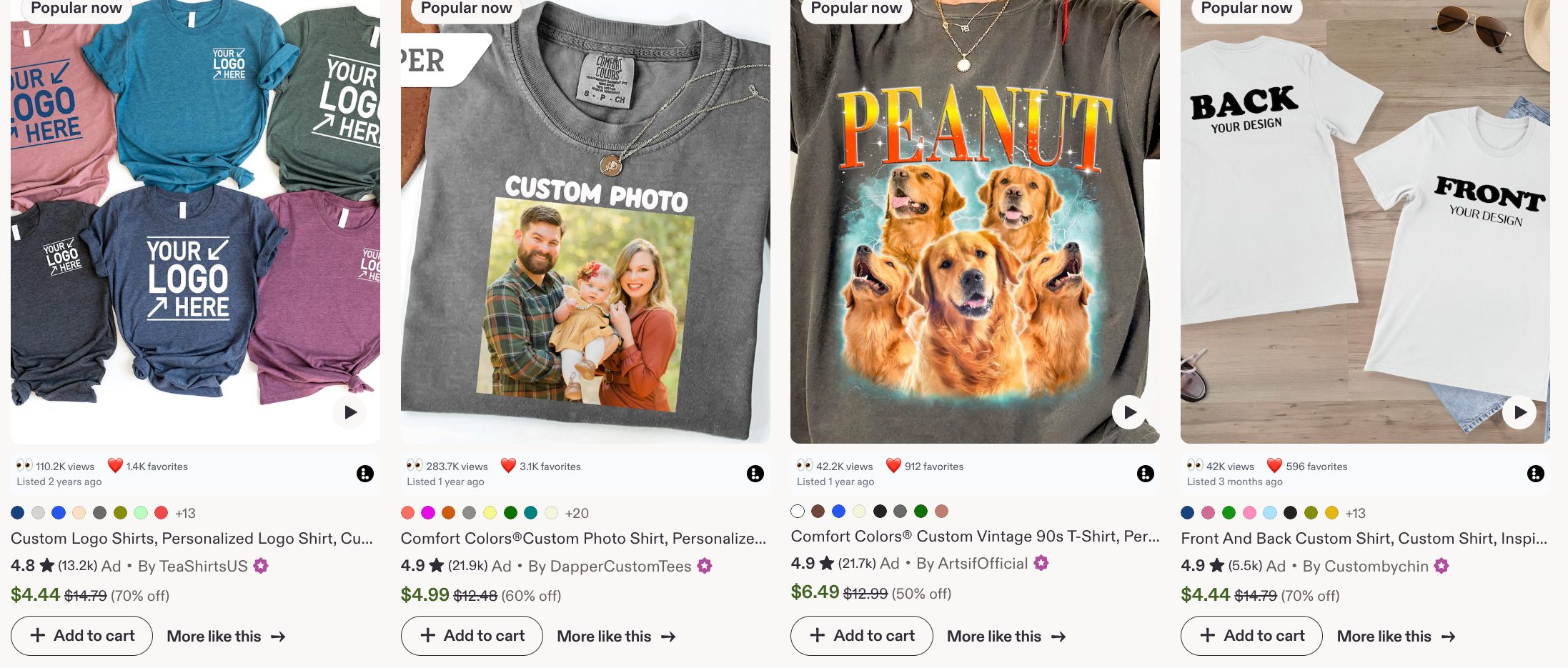
What the Listadum extension adds to a normal Etsy search: the views and favorites on every card. Those two numbers are the raw material for this whole study.
Divide one by the other and you get a number you can actually use:
Favorite ratio = favorites ÷ views.
Of the people who saw this design, what share liked it enough to save it? That single ratio cancels out ad spend, listing age, and shop size, so a brand-new design from a tiny shop and a three-year-old listing from a 20,000-sale store can finally be compared fairly. It measures the design’s pulling power and nothing else, which is the part you control when you sit down to make something.
Two more ideas show up in every teardown, and neither needs a calculator:
- The ceiling: the favorite ratio the best designs actually reach on a given product. Hit it and you have a real winner.
- Fair share: whether a design lane wins as many of the top designs as its size on the shelf would suggest. A lane that fills a fifth of the shelf should win about a fifth of the top designs. When it wins far fewer, it is crowded and losing. Far more, and it is an open lane worth chasing.
That is the whole toolkit: one ratio, one benchmark, and a fair-share gut check.
The one law: a design beats a name, almost everywhere
When I lined up all 22 products, one finding repeated so cleanly it became the spine of the whole study. On every single product, the crowded personalization lane (the custom-name, monogram, or photo design) is one of the biggest slices of the shelf and one of the smallest slices of the winners. It never wins its fair share.
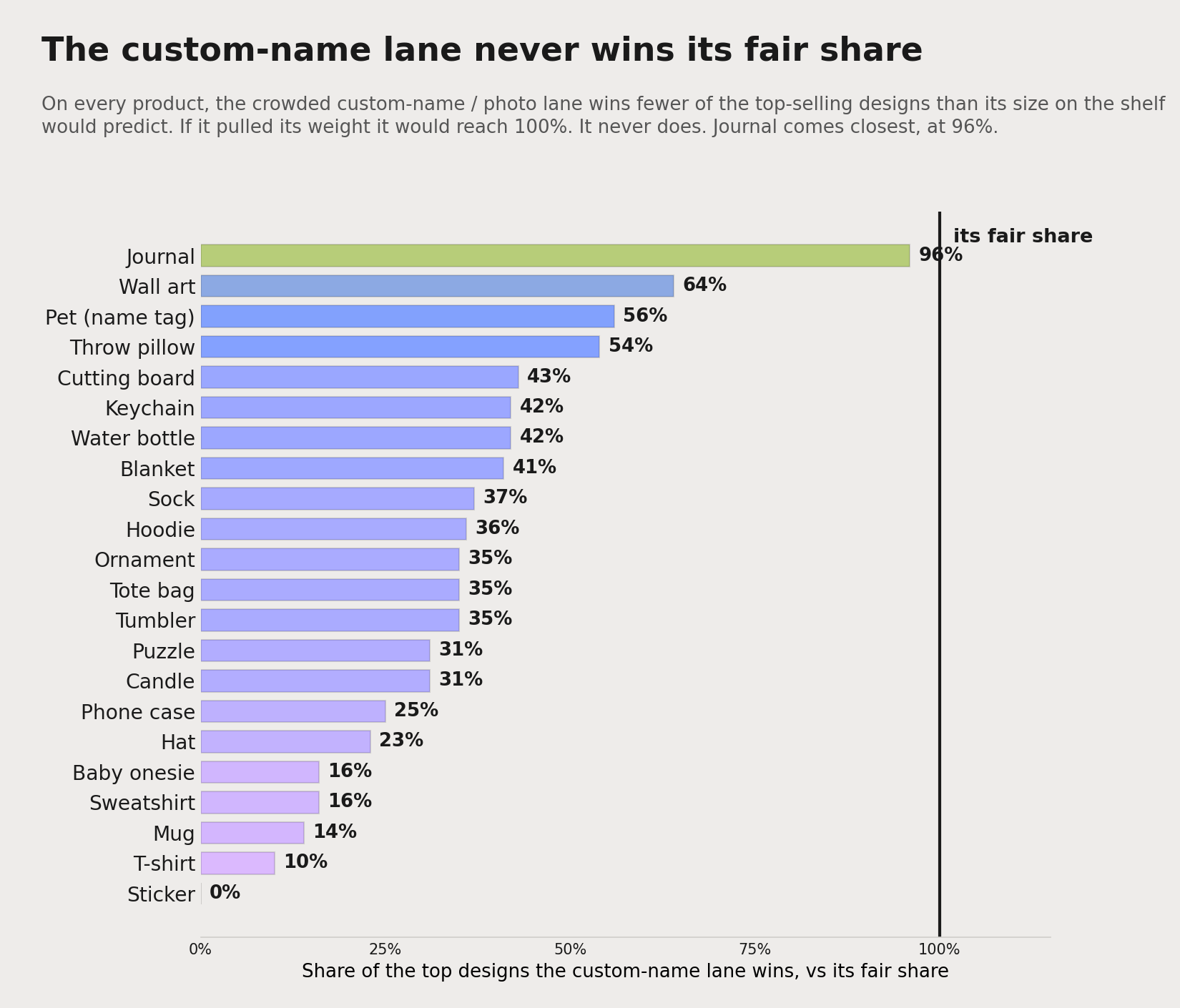
Read that chart slowly, because it is the whole point of the study. On t-shirts the custom lane is a fifth of the shelf but only about 1 in 50 of the top designs. On sweatshirts it is nearly half the shelf and a small fraction of the winners. Mugs, socks, phone cases, hats, blankets: same story, over and over.
The reason is the same everywhere. When the design is the buyer’s own name or photo, you are not competing on creativity at all. You are competing on turnaround time, review count, and ad budget, and that is a fight a new shop almost never wins.
The flip side is the opportunity. In almost every product, the winning lanes are under-supplied and high-pull: the designs a stranger would want, not a gift for one specific person. Make something a stranger would put on their own couch, wear on their own chest, or stick on their own laptop, and the numbers move.
The two exceptions that prove the rule
Two products look like they break the law. Read closely and they confirm it.
Pet products. Roughly 80% of the pet shelf is personalized, and personalized designs take about 70% of the winners, so at a glance personalization looks like the winner here. But split it apart and the pattern holds: the illustrated custom portrait is a designed product and wins well above its share, while the name-on-a-tag lane (collars, engraved tags) wins only about half of what its size would predict. The winning personalization is still a design. The lazy one still loses. Read the pet teardown for the full split.
Journals. The custom-name journal is the one lane in the study that roughly pulls its weight. A name on a journal cover is acceptable, because a journal is a gift and a keepsake. But the real wins still go to designed covers (funny and cute-character lead by a wide margin), and a bare initial or blank cover pulls the worst of any journal lane. A name is tolerated; a design still wins. The journal teardown has the numbers.
Neither product overturns the law. They just show its edges: personalization can work when it is executed as a genuine design, and it stops working the moment it becomes a blank field for the buyer to fill in.
What wins, by product family
“A design beats a name” is the law. What kind of design wins depends on the product family. Four patterns cover almost everything.
Apparel and wearables: say something
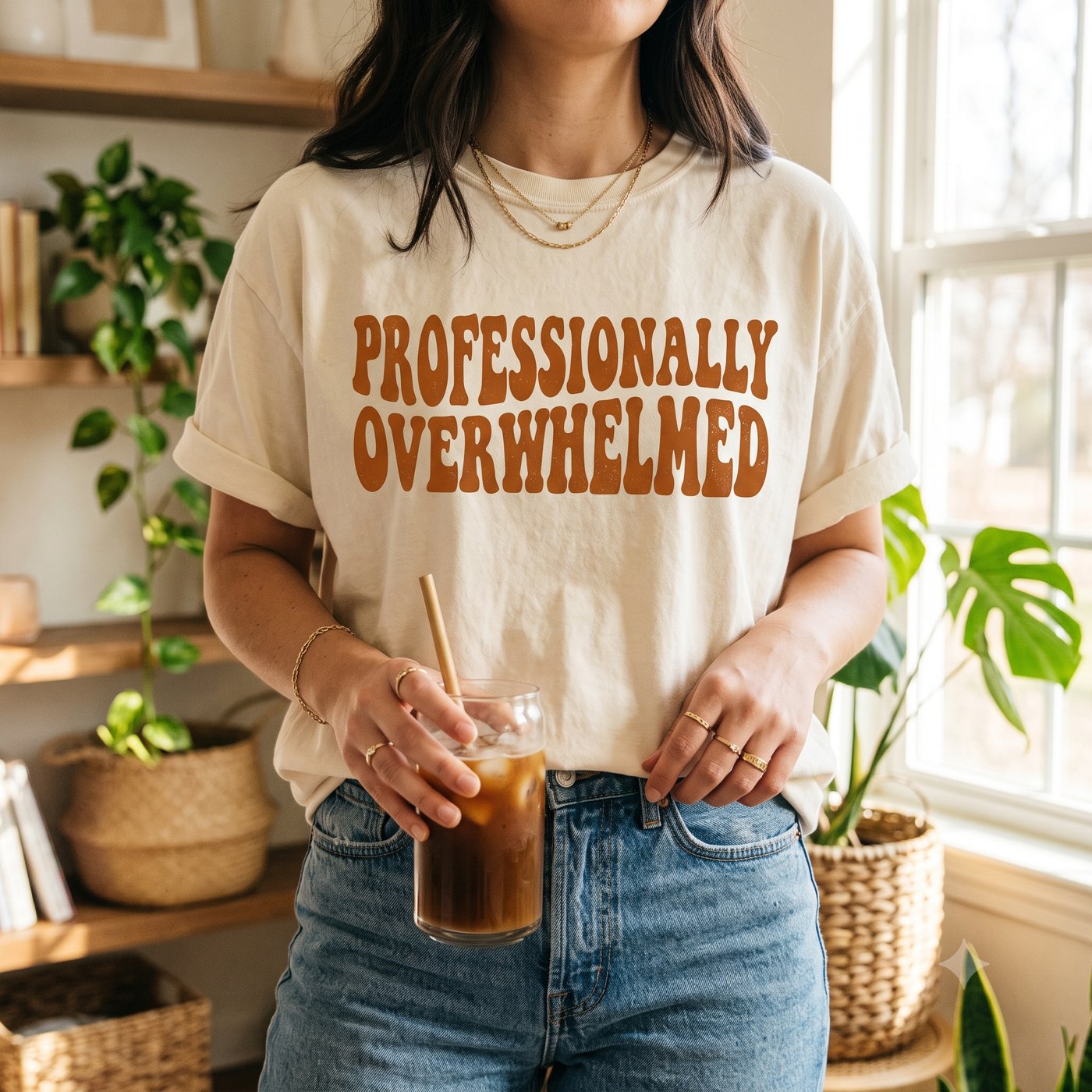
On t-shirts, sweatshirts, hoodies, hats, baby onesies, tote bags, and socks, a message beats a picture. Statements, puns, funny lines, and fandom references pull the saves. On the tee, text-driven designs out-pull pretty artwork almost every time; puns are a sliver of the sweatshirt shelf yet produce a wildly outsized share of its winners.
There is a medium twist on knitwear: embroidery is the winning execution. On sweatshirts, small tonal embroidery is 63% of designs and the majority of winners. On hats, embroidered graphics and words lead while embroidered names lose. Say something worth stitching, then stitch it.
Start with the t-shirt, sweatshirt, and hat teardowns.
Home decor: show art a stranger would hang
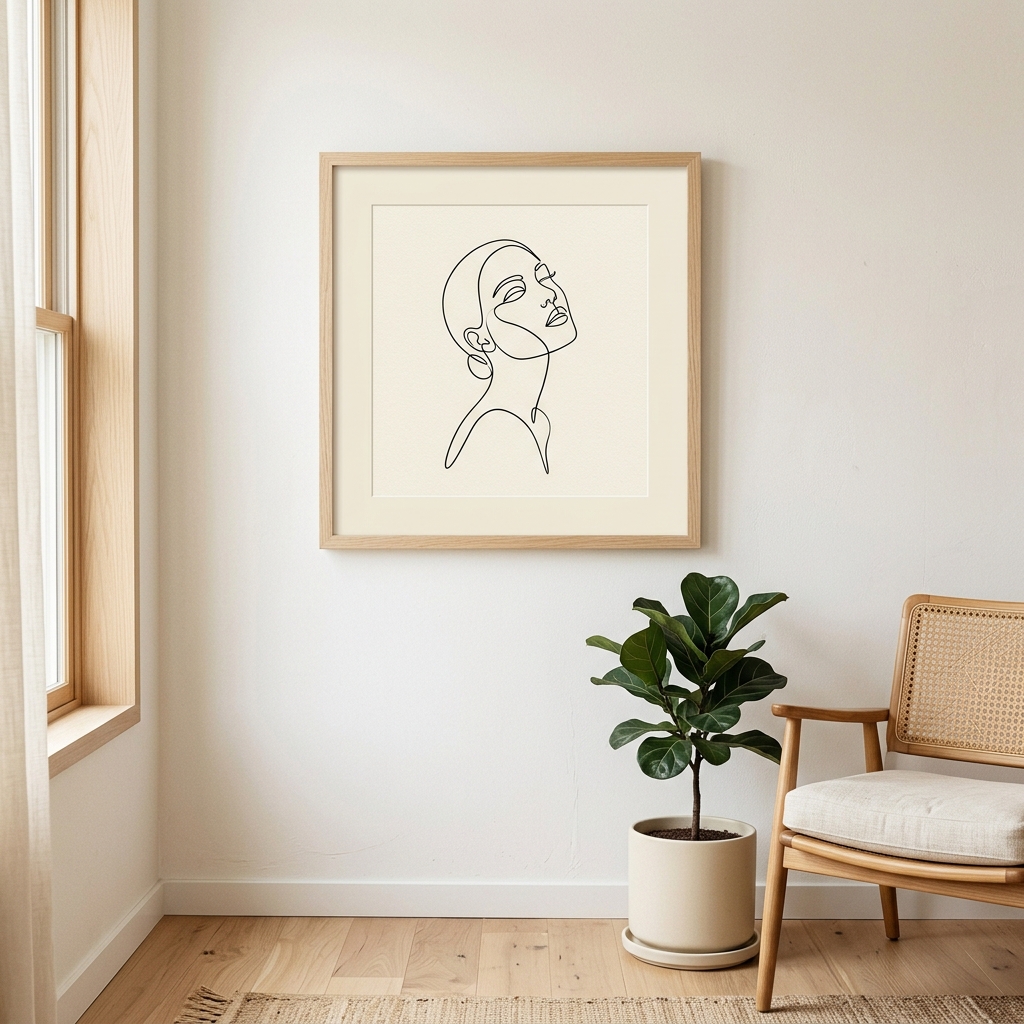
On wall art, throw pillows, blankets, ornaments, and cutting boards, illustrated and decorative art wins. Floral, nature, animal, and line-art designs are the under-supplied, high-pull half of every one of these shelves. On wall art, figure and line art wins several times more often than its shelf space would predict; on blankets, woven nature scenes are the single biggest over-performer in the whole study.
The medium matters here too. Woven throws beat printed fleece on blankets. Dimensional, handmade-looking ornaments take 77% of ornament winners while the flat printed disc (60% of the shelf) pulls the weakest. If you run print-on-demand, you can still win by making printed artwork that reads as designed decor, not as a commodity blank.
See the wall art, throw pillow, and blanket teardowns.
Drinkware: a full-color design, not a name

On mugs, tumblers, and water bottles, fandom, animal, and funny designs win, and the winning medium is the full-color wrap or print. On tumblers the sublimation wrap is a third of the shelf but 57% of the winners. On mugs, fandom designs win well above their share while photo mugs win nothing at all. The engraved or vinyl name is the loser across all three.
Read the mug, tumbler, and water bottle teardowns.
Small goods: illustration is the lever
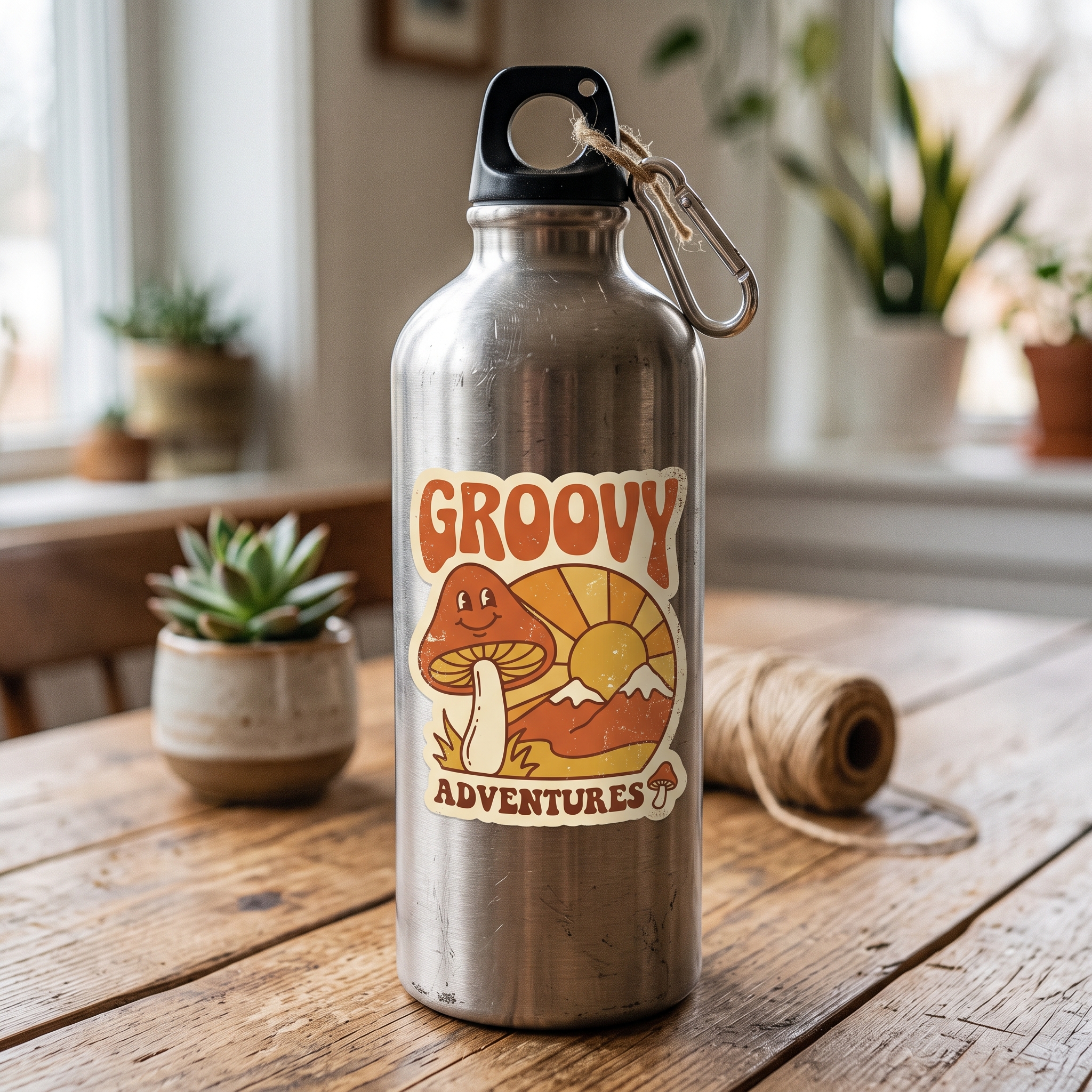
On stickers, keychains, phone cases, puzzles, candles, and journals, original illustration wins and the medium is often the hidden lever. Illustrated stickers are 54% of the shelf but 70% of the winners; the photographic sticker is the single worst-performing look in the whole study. On keychains, a crafted resin charm clearly out-pulls an engraved metal name tag. On candles, a colorful retro label beats a photo printed on the glass.
Dig into the sticker, keychain, phone case, and candle teardowns.
Which products reward a great design most
Not every product pays out equally for a strong design. Two things decide it: how high the ceiling is (how strong the best designs get) and the ad load (how much pay-to-play stands between you and views). A high ceiling with light ads is an open lane. A low ceiling with heavy ads is a grind.
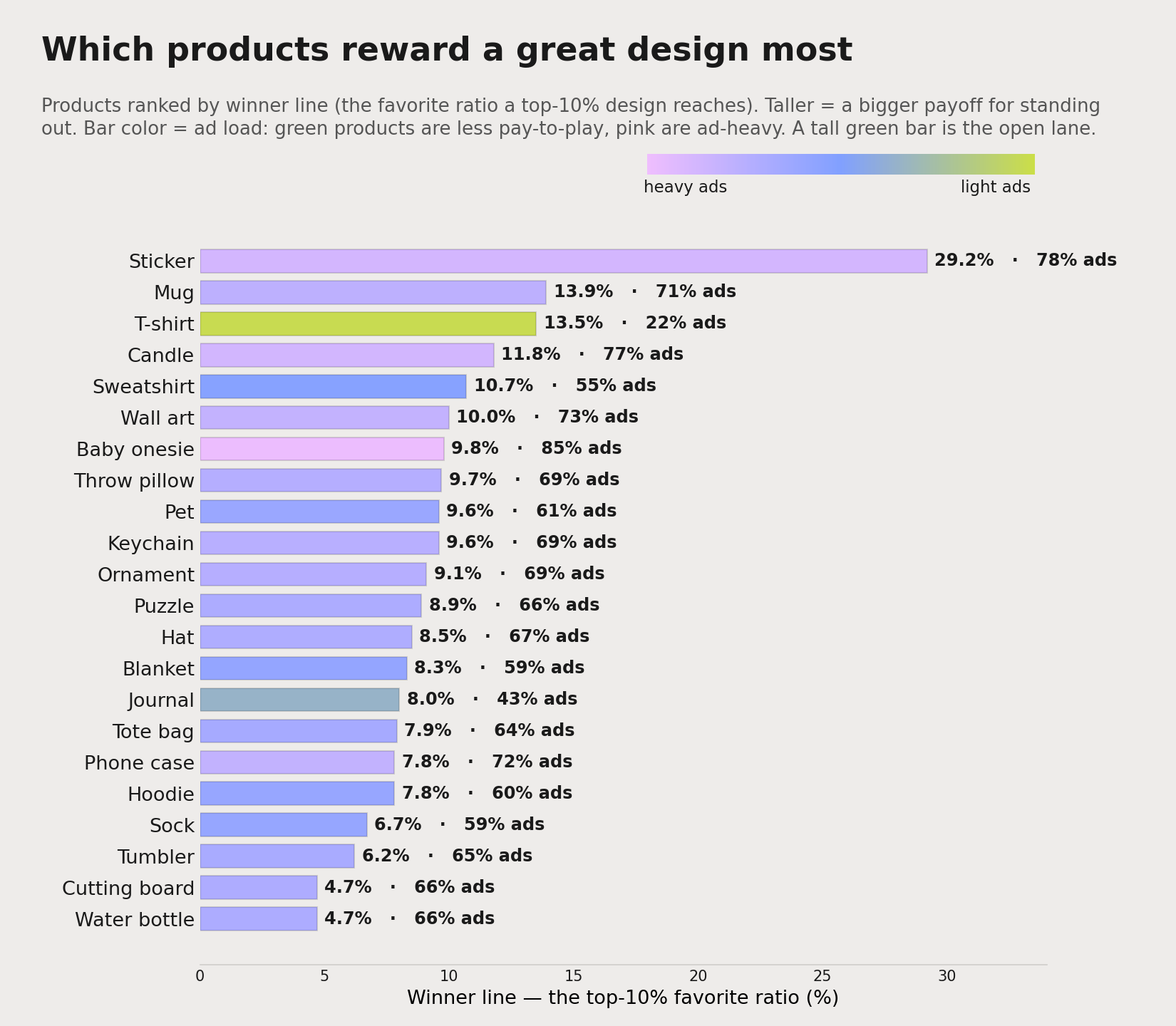
A few reads from that ranking:
- Stickers have the highest ceiling by far (a 29.2% ceiling) and the most rising new shops (14%), though the shelf is ad-heavy. A great illustrated sticker can pull like nothing else in the study.
- T-shirts are the standout: a high ceiling (13.5%) with the lightest ad load of any product (22%). The retro and funny lanes in particular are wide open.
- Mugs and candles reward a great design with double-digit ceilings, even though both run heavy ads.
- Water bottles and cutting boards are the closed shops: the lowest ceilings, almost no rising new shops (water bottle had 0%), and mature established-seller fields. Enter with your eyes open.
The pattern to hold onto: the ceiling is high enough on most products that a genuinely good design is worth making. What kills new shops is not a low ceiling, it is spending that design effort in the crowded name-and-photo lane where the ceiling does not apply to you.
The five levers that carry across all 22 products
Whatever product you pick, these five moves showed up as winners again and again.
- Say something, or show art a stranger would want. Not a name, not a photo field. A message on wearables, designed art on decor, an original illustration on small goods.
- Pass the thumbnail test. A design lives or dies at about 200 pixels wide in the search grid. Shrink yours and check that it still reads as a deliberate design. If it turns to mush, simplify: bolder shapes, higher contrast, more breathing room.
- Use the medium as a lever. Embroidery on knitwear, full-color wraps on drinkware, woven or dimensional makes on decor, resin over engraved metal on charms. The execution is often worth more than the motif.
- Style the mockup, do not ship the stock one. The default Printify or Printful mockup loses on every product. How you shoot the hero image is its own finding, below.
- Score every listing on favorite ratio. After it goes live, divide its favorites by its views and hold it against that product’s ceiling. Keep what pulls, retire what does not, and the guessing quietly stops.
Thumbnails that win: how to shoot the hero image
The design decides whether a listing can win. The thumbnail — that first search-grid image — decides whether anyone stops to look. So I coded the hero-image style on all 22 products and measured each style against that product’s typical listing. Presentation moves the favorite ratio almost as much as the artwork does, and pooling every product gives a clean ranking of what to shoot.
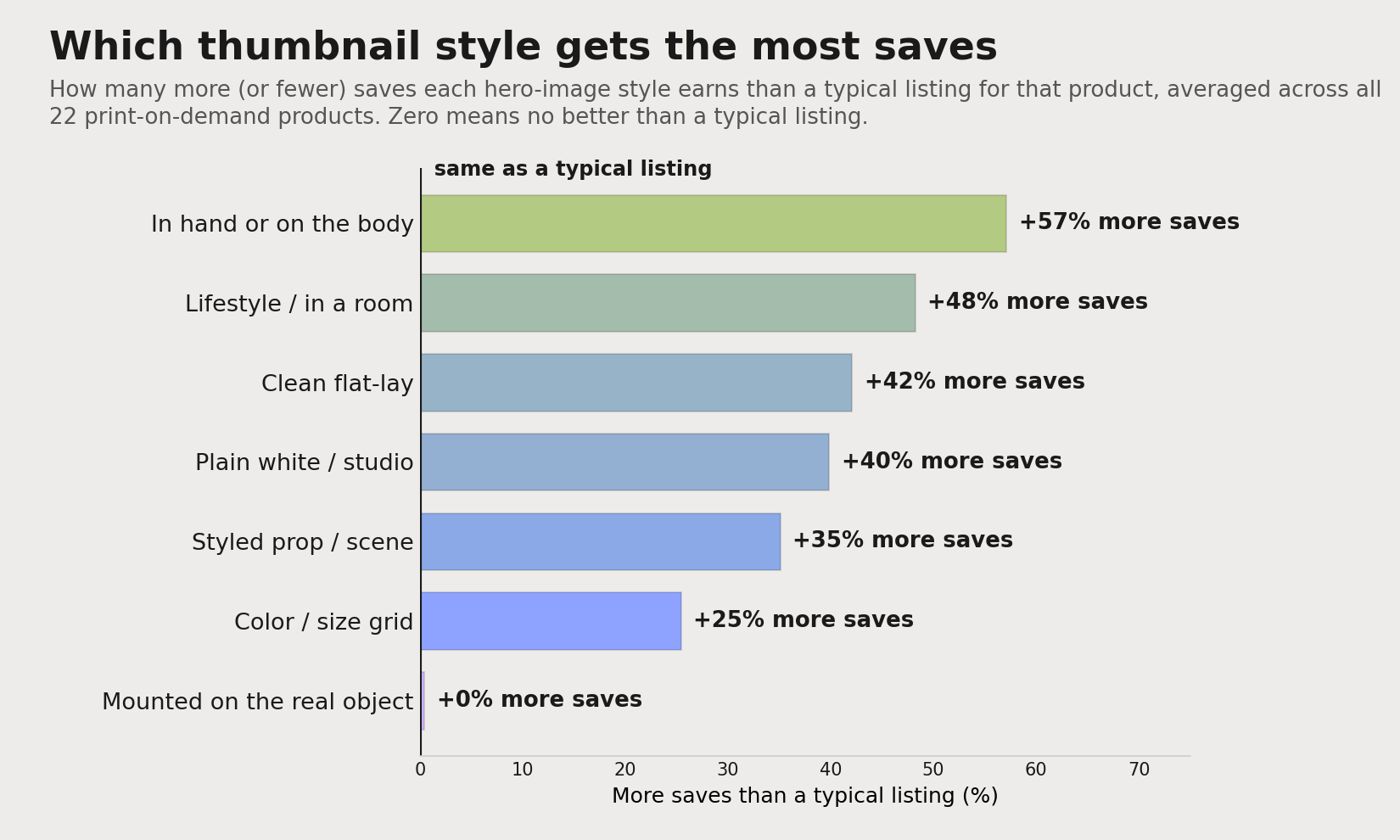
A person in the frame wins on every product. A shot with the item held in a hand or worn on the body earned about 57% more saves than a typical listing, and it helped on all 22 products. It is the only style that never lost. A hand-held candle nearly tripled its usual saves; a held water bottle pulled roughly 140% more. A human gives the product scale and life, and buyers save it.
For things people live with, put them in a room. On home decor, a lifestyle or in-room scene is the next best: about 48% more saves, and it helped on nearly every one. Wall art in a styled room out-pulled a bare frame by two-thirds, and a mug in a kitchen scene nearly doubled its saves. Buyers are picturing the thing in their own space, so show it there.
For small goods, shoot a clean flat-lay. When the design is the product (stickers, keychains, socks, journals, cutting boards), a crisp overhead flat-lay wins: about 42% more saves. A sock flat-lay out-pulled every other sock shot, and a cutting-board flat-lay more than doubled its saves. Clarity beats atmosphere when the buyer is really shopping the artwork. The lone exception is wall art, which belongs on a wall, not the floor.
The safe middle: a styled prop shot. The single most common hero across all 22 products, and a reliable, modest lift of about 35% more saves — it beats a bare product shot but rarely tops the category. Fine as a fallback, not a standout.
Three styles are where sellers quietly lose saves:
- Plain white is a coin flip. On average it adds about 40% more saves, but it only helps on roughly 4 in 5 products. It soars where the product is the graphic (baby onesies, sweatshirts, phone cases) and sinks where texture and context sell: a plain-white hat pulled 56% fewer saves than a typical listing, a white-background blanket 53% fewer.
- A color or size grid is a weak hero. It adds only about 25% on average, the softest of the styles that help, and it loses outright on products like water bottles and pet goods. Use it as a second or third image for variant-heavy products, not as the main one.
- Mounting on the real object is the trap. Across products it adds nothing on average, and it helps only about half the time. A phone case shown on a busy real phone pulled 29% fewer saves; a pet portrait shown on the actual pet lost too. When the setting fights the design, the save disappears. (Stickers are the exception, because on a laptop or water bottle is how they are used.)
So the rule that falls out of all 22: if people live with it, put a person or a room in the shot; if the design is the product, shoot it clean and sharp. Add a human hand wherever you can, never ship the default Printify or Printful mockup, and keep the color grid and the busy real-object shots out of the hero slot and into your other nine images. Each product teardown has its own mockup ranking if you want the exact numbers for yours.
Two rules a design has to survive first
Before a design can sell, it has to stay up. Two Etsy rules quietly end more print-on-demand shops than any trend miss.
It has to be your own. Etsy’s Creativity Standards require that items made with production partners, which is all print-on-demand, are based on your own original design. Buying a trending design pack and printing it unchanged fails that test and is a common reason listings get deactivated. Our guide to Etsy’s rules for print-on-demand sellers walks through what “original” actually means.
It cannot borrow someone else’s work. Copying a hot design, using a famous artwork, or lifting a band, team, or cartoon into a fandom product is the fastest route to a takedown. Fandom pulls well across several products, which makes it tempting, but most fandom designs are quietly infringing, and that is a shop-ending gamble. The safe move is your own take on a theme, not someone else’s asset.
Neither rule blocks you from selling a floral, a funny line, or a boho pattern. They block you from selling the exact one someone else already made. Original beats borrowed, and it is the only version that lasts.
Where to start this week
You do not need to guess what is hot. You need to pick one open lane and test it honestly. Here is the whole study as five steps.
- Pick a product with a ceiling worth chasing. Use the ranking above. If you want the lightest competition, t-shirts; the highest ceiling, stickers; a dependable middle, mugs or wall art.
- Pick the winning lane for that product, not the name lane. Open its teardown below and take the top theme plus the winning medium.
- Make it original and run the thumbnail test. If it does not read at 200 pixels, simplify before you list.
- Style the main image. Show the design in use, in soft light, on a real subject. Skip the stock mockup.
- List it, then read its favorite ratio. A couple of weeks later, divide favorites by views. Under that product’s median, buyers are scrolling past. Above the ceiling, you have a design worth scaling.
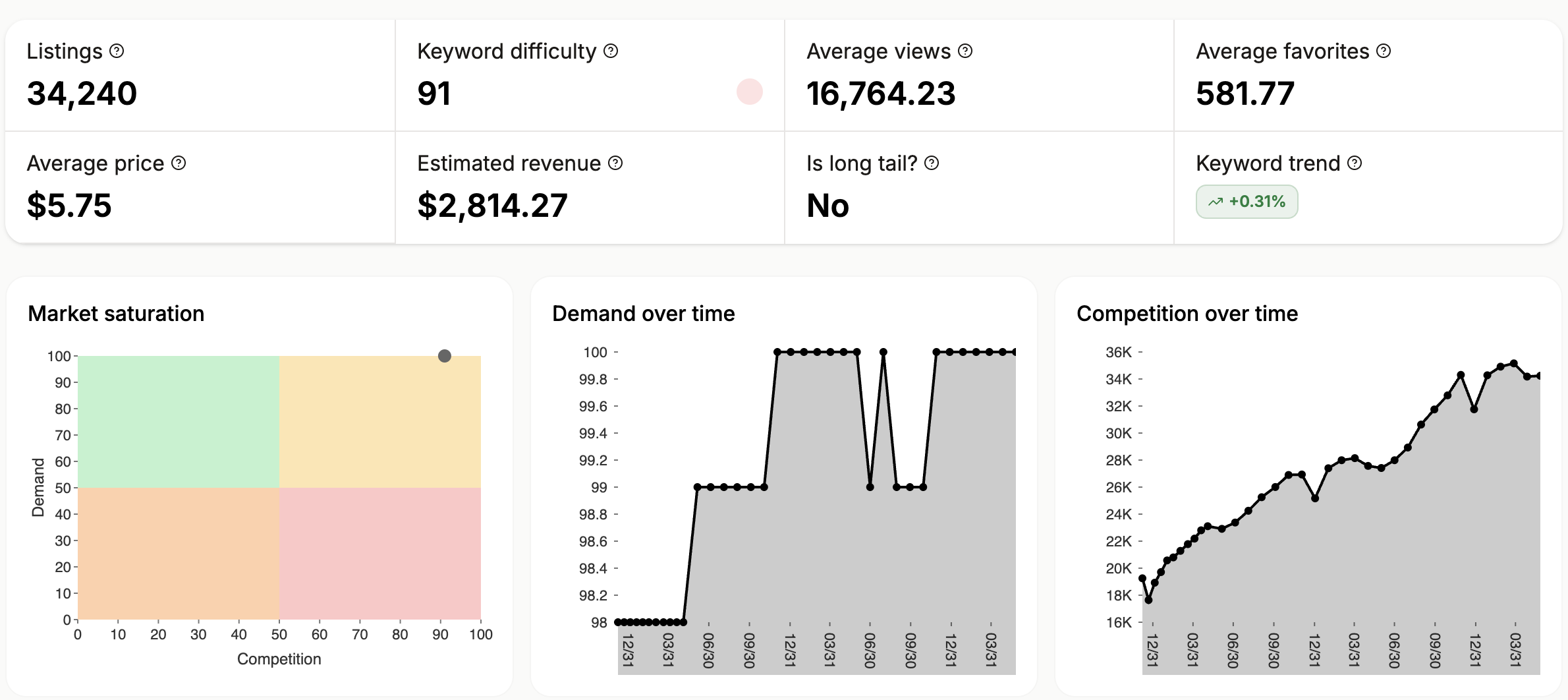
Want to see how crowded a lane is before you commit? The free Keyword Explorer shows demand against competition for any phrase, so you can aim at a pocket that is not already a red ocean.
The full teardown series: all 22 products ranked
Each product below has its own deep teardown: the full theme ranking, a design prompt for every winning lane, the traps to skip, the benchmark to grade your own listing, and the mockup finding. The table is sorted by ceiling, so the biggest design payoffs are at the top.
| Product | Winner line | Median | Ads | The winning lane | The crowded trap | Teardown |
|---|---|---|---|---|---|---|
| Sticker | 29.2% | 8.8% | 78% | Illustrated message (cause, quote, funny) | Custom-name + photographic | Read |
| Mug | 13.9% | 4.0% | 71% | Fandom, funny, animal message | Custom text + photo | Read |
| T-shirt | 13.5% | 6.1% | 22% | A message (statement, pun, retro) | Custom / personalized | Read |
| Candle | 11.8% | 4.2% | 77% | Nostalgia, fandom, funny labels | Custom name + photo | Read |
| Sweatshirt | 10.7% | 3.6% | 55% | Puns, nature, retro (embroidered) | Custom / personalized | Read |
| Wall art | 10.0% | 3.6% | 73% | Figure/line art, floral, animal | Custom portrait + map prints | Read |
| Baby onesie | 9.8% | 3.7% | 85% | Funny, fandom, cute (printed) | Custom name (embroidered) | Read |
| Throw pillow | 9.7% | 3.8% | 69% | Nature, floral, animal art | Custom name + photo | Read |
| Keychain | 9.6% | 3.7% | 69% | Resin, beaded, illustrated charms | Engraved-metal name tags | Read |
| Pet | 9.6% | 4.2% | 61% | Illustrated custom portrait | Name-on-a-tag (collars, tags) | Read |
| Ornament | 9.1% | 4.2% | 69% | Embroidered, 3D, stamped-clay makes | Flat printed disc | Read |
| Puzzle | 8.9% | 2.9% | 66% | Original illustrated art | Custom photo + wooden name | Read |
| Hat | 8.5% | 2.7% | 67% | Animal, funny, outdoor (stitched) | Embroidered names + monograms | Read |
| Blanket | 8.3% | 2.8% | 59% | Woven decorative throws | Custom name + photo | Read |
| Journal | 8.0% | 3.6% | 43% | Funny, cute-character covers | Bare monogram + blank covers | Read |
| Tote bag | 7.9% | 3.1% | 64% | Funny, animal, book, pattern | Custom name + monogram | Read |
| Hoodie | 7.8% | 2.6% | 60% | Nature back-prints, puns | Custom / personalized | Read |
| Phone case | 7.8% | 3.3% | 72% | Cute character, trendy, textured | Custom name + photo | Read |
| Sock | 6.7% | 1.8% | 59% | Animal, food, floral prints | Custom name + face-photo | Read |
| Tumbler | 6.2% | 2.1% | 65% | Animal, fandom, pattern wraps | Engraved name + photo | Read |
| Water bottle | 4.7% | 1.9% | 66% | Wellness/copper, animal wraps | Personalized-name bottle | Read |
| Cutting board | 4.7% | 2.1% | 67% | Plain quality wood + printed art | Engraved personalized-name boards | Read |
New to print-on-demand entirely? Start with selling on Etsy without inventory, then come back and pick a product.
Frequently asked questions
What print-on-demand designs sell best on Etsy?
Designs, not personalization. Across a 22-product study of nearly 17,000 top listings, the crowded custom-name and photo lane won less than its fair share in every single product: it is one of the biggest slices of the shelf and one of the smallest slices of the winners. The designs that won were the ones a stranger would want: a message on wearables, illustrated or decorative art on home goods, original illustration on small goods like stickers and phone cases.
Why don’t custom-name and photo products sell as well?
Because they are crowded and undifferentiated. When the design is the buyer’s own name or photo, you compete on turnaround, review count, and ad spend rather than creativity, and a new shop rarely wins that fight. In the study, personalization was usually the single biggest slice of the shelf yet took a small share of the winners.
What is a favorite ratio and why does it matter?
Favorite ratio is favorites divided by views: of the people who saw a design, what share saved it. It strips out ad spend, listing age, and shop size, so it measures a design’s real pulling power. It is the metric every teardown in this series ranks by. The free Listadum browser extension shows the views and favorites Etsy hides.
Which print-on-demand product is easiest to break into?
By the data, t-shirts: a high design ceiling (a 13.5% ceiling) with the lightest ad load measured (22%), and the retro and funny lanes are especially open. Stickers have the highest ceiling of all (29.2%) and the most rising new shops, though the shelf runs more ads.
Which print-on-demand products are hardest?
Water bottles and cutting boards had the lowest ceilings and almost no rising new shops (water bottles had 0% rising), meaning they are mature, established-seller fields. Baby onesies had the heaviest ad load in the study at 85%. They can still work, but the design has to be excellent and you should expect a grind.
Can I use AI to make print-on-demand designs for Etsy?
You can, but the design must be your own original work, and you must not feed in a copyrighted image, a famous artwork, a sports team, or someone else’s photo. Etsy’s Creativity Standards require print-on-demand art to be based on your own design, and many sellers disclose AI assistance for buyer trust. Use AI to generate an original design you direct, not to copy an existing one.
How do I know if my design is good before I scale it?
List it, then read its favorite ratio a couple of weeks later. Compare it to that product’s typical listing and its ceiling (both are in each teardown). Below the median, buyers are scrolling past and the design is the likely reason. At or above the ceiling, you have something worth making more of.
Stop guessing which of your designs is pulling and which is dead weight.
Listadum reads every listing in your shop and flags the ones losing you sales: weak images, no video, thin titles, low engagement. You get a clear, prioritized list of what to fix first, in plain English.
Free plan · no credit card · connect your real Etsy shop in minutes
About the author
Neha Chandelier, co-founder of Listadum, selling on Etsy since 2020. She writes about Etsy tips and tricks, how to sell on Etsy, and growing a handmade shop.
Last updated August 20, 2026.