
By Neha Chandelier, Co-founder of Listadum · Last updated: June 2026 · 11 min read
Print-on-demand is one of the most popular ways to start an Etsy shop, and also one of the most misunderstood. Every few months a wave of posts claims Etsy is “banning POD,” a seller’s listings get pulled, and the panic spreads. The reality is calmer and more useful than the rumors: POD is allowed, it has clear rules, and the sellers who follow them have a real, scalable business.
This guide covers both halves you need. First the rules, so you stay in good standing. Then the strategy, so the shop actually sells.
Quick answer: Etsy allows print-on-demand in 2026. You must be the original designer, disclose your POD company as a production partner, and represent your listings accurately. Within those rules, POD is a legitimate, scalable Etsy business. The sellers who get burned are almost always the ones using reused designs or skipping the production-partner disclosure.
Part of: the Niche Playbooks Guide
Across to: How to sell custom t-shirts on Etsy
Across to: How to list personalized items on Etsy
Is print-on-demand allowed on Etsy in 2026?
Yes. If you sell prints, posters, canvas, apparel, mugs, or other POD products, the most important thing to know is that Etsy has not banned print-on-demand, and there is no sign it plans to.
What Etsy has done, gradually across 2024 and 2025 and continuing into 2026, is clarify and more actively enforce how POD fits its marketplace rules. The risk is almost never “I used a POD partner.” The risk comes from how listings are categorized, how originality is represented, and whether the required disclosures are set up. Get those three right and you are operating exactly as Etsy intends.
The recent wave of removals and visibility drops that sellers describe across forums and Reddit is real, but it tracks closely to those three failure points, not to POD as a model.
Why POD gets blamed when listings disappear
Three things happening in the background explain why POD sellers feel singled out, even though POD itself is allowed.
Etsy is leaning harder into handmade and original work. Etsy’s brand, and its recent enforcement, both push toward genuinely human, original creativity. That is good for real designers, but it raises the bar on proving your work is your own, and it makes anything that looks mass-produced or generic more likely to get a closer look.
Dropshipping muddies the water. Dropshipping, reselling mass-produced items you did not design and shipping them straight from a supplier, is against Etsy’s rules. POD, where you create the design and a partner prints and ships it, is allowed. From the outside the two can look alike, because both involve a third party shipping something you never physically handled. So when Etsy tightens the screws on dropshippers, compliant POD sellers can get swept up in the same enforcement if their originality and disclosures are not crystal clear.
Design theft triggers false flags. Sites like Temu and AliExpress scrape and copy Etsy designs at scale. When your original design then shows up on one of those mass-market sites, Etsy’s systems can flag or even deactivate your listing, reading the match as a sign the item is mass-produced or unoriginal. The seller sees the deactivation, knows they use POD, and assumes POD caused it, when the real trigger was someone stealing their work.
The throughline is originality and proof of it. Keep your source files and design dates, report copycats when you find them, and keep your production-partner disclosures clean. When a flag does happen, that evidence is what lets you appeal and win.
Etsy’s Creativity Standards and how they apply to POD
The most important policy for POD sellers is Etsy’s Creativity Standards, which define what belongs on Etsy and why. Every product has to fall into a clear category, and for POD that category is Designed by a seller. It means:
- The seller creates the original artwork or design.
- A third party may assist with manufacturing or fulfillment.
That matches how most POD shops work: you create the design, send it to a POD provider to print and ship, and sell the finished product on Etsy. Etsy allows this as long as the creative authorship clearly belongs to you.
Where Etsy has tightened is in how it judges originality. Designs that lean heavily on purchased templates, reused graphics, AI output with minimal human input, or tiny modifications of existing work may no longer clear the bar. You can read the full policy in the Etsy Seller Handbook. The practical takeaway: the more genuinely original your design work, the safer and more defensible your shop.
Production partner disclosure is required
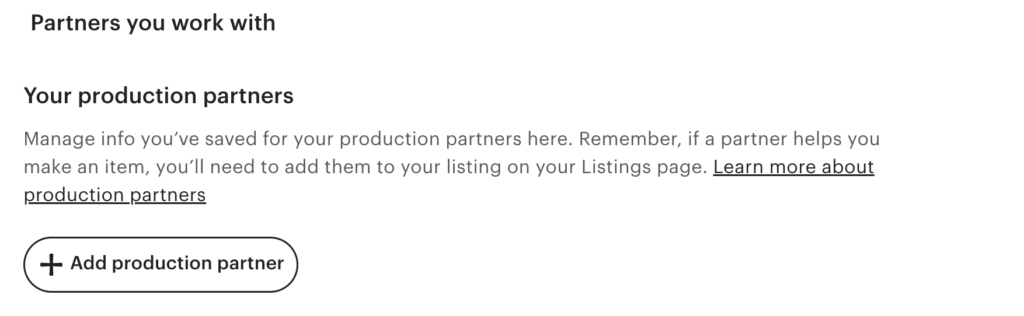
Etsy requires you to disclose any third party that helps produce your physical products, and that includes every print-on-demand company, no matter its size or location.
This is not new, but it is still one of the most common compliance gaps. Etsy’s position is straightforward:
- Production partners must be listed in your shop settings.
- The production partner cannot be listed as the creator of the item.
In POD terms: the company prints and ships, but you are the designer. Disclose that relationship accurately and you are fine. Skip it, or imply your items are handmade by you when they are fulfilled by a partner, and you are exposed.
The Policy Violations page and listing appeals
Etsy added a Policy Violations page inside Shop Manager that shows when a listing is removed or restricted for a policy issue, and it has started rolling out the ability to appeal certain removals.
For POD sellers this is a real improvement. Instead of guessing why a listing vanished, you can see which policy was involved, whether an appeal is available, and whether editing the listing could resolve it. Check this page whenever traffic or sales drop unexpectedly; the answer is often sitting there.
Staying compliant: the short checklist
If you remember nothing else from the rules half, remember this:
- Create your own original designs, not lightly-edited templates.
- List every POD provider as a production partner in shop settings.
- Never imply handmade-by-you production when a partner fulfills the order.
- Watch the Policy Violations page for notifications.
- Keep listing details accurate to what the buyer actually receives.
Keep your POD listings in good standing. Run a free Shop Critique. It flags missing policies, production-partner gaps, and incomplete listings across your shop, with no signup required.
Now the strategy: choosing POD products that sell
Compliance keeps you alive; strategy makes you money. The first strategic decision is what to make. POD on Etsy rewards specificity over breadth.
A generic “funny cat t-shirt” competes with a million others. A shirt aimed at a narrow, identifiable buyer, a particular hobby, profession, breed, or in-joke, has far less competition and a buyer who feels seen. Pick niches you can keep designing into, and use real demand data to confirm people are actually searching for them rather than guessing. Our keyword research workflow shows how to find those low-competition pockets.
The best POD niches share a pattern: a passionate audience, an occasion or identity to design around, and gifting potential. Apparel, wall art, mugs, and tote bags all work when the design is specific enough to stop the scroll.
Designing for originality and for the algorithm
Original design is now both a compliance requirement and a competitive edge. The same instinct that keeps you safe under the Creativity Standards, making genuinely your own work, is what helps you stand out in a crowded category.
Treat every design as a real creative decision: your own concept, your own composition, your own twist on a trend rather than a reused graphic. Then make the listing match: a title that leads with the phrase a buyer would search, all 13 tags filled with specific long-tail phrases, and a description that opens with what the product is and who it is for. POD listings live or die on search visibility, so the listing optimization basics matter as much here as anywhere. See the complete guide to Etsy listing optimization for the full system.
Pricing print-on-demand for profit
POD margins are thinner than handmade, because your base cost is set by the provider. That makes pricing a discipline, not an afterthought.
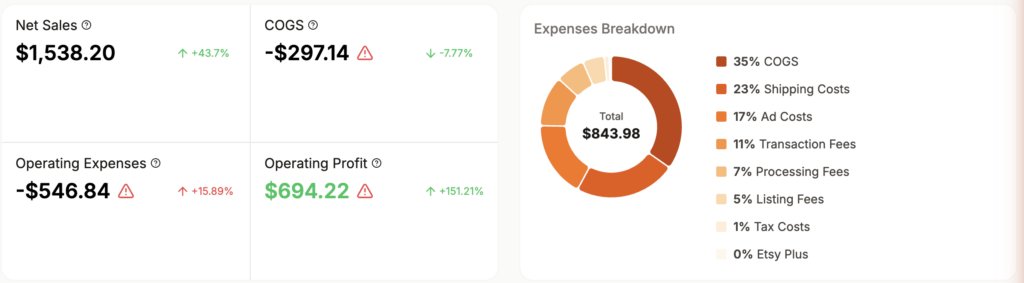
Start from your true cost: the POD base price, plus the Etsy listing and transaction fees, plus payment processing, plus any shipping you absorb. Price so there is real margin left after all of it, not just above the base cost. Many new POD sellers price to beat competitors, win the sale, and quietly lose money on fees. Know your break-even on every product before you list it, and treat free shipping as a cost you have built into the price, not a giveaway.
This is where Listadum’s Profit Tracking earns its keep for POD. It connects to Printful, Printify, and Gelato to pull your product costs automatically, so you see true profit on every order instead of guessing at your margin.
Scaling without breaking the rules
The appeal of POD is volume: once a design sells, you can spin up variations and related designs quickly. The bottleneck is listing creation, and that is where most POD shops stall.
This is where Listadum helps you scale without cutting compliance corners. Bulk create lets you build many listings at once from your design files instead of one slow listing at a time, and templates keep your titles, tags, and production-partner details consistent across every new product, so disclosures never get dropped as you grow. The faster you can launch a tested design across products, the more of your winners you actually capture.
Frequently asked questions
Is print-on-demand banned on Etsy?
No. Etsy allows print-on-demand in 2026. You must be the original designer and disclose your POD company as a production partner. The recent enforcement is aimed at unoriginal designs and missing disclosures, not at POD as a model.
Is dropshipping the same as print-on-demand on Etsy?
No. Dropshipping means reselling mass-produced items you did not design, shipped directly from a supplier, which is against Etsy’s rules. Print-on-demand means you create the original design and a partner prints and ships it, which Etsy allows. The two can look similar from the outside, so keep your original authorship and production-partner disclosures clear to avoid being mistaken for a dropshipper.
Do I have to disclose my POD provider on Etsy?
Yes. Etsy requires you to list every production partner that helps make your physical products, including all POD companies, in your shop settings. The partner prints and ships; you remain the listed designer.
Can I use AI-generated designs for Etsy POD?
Only with genuine, substantial human creative input. Etsy’s Creativity Standards have tightened on designs that rely on AI output with minimal human contribution. Use AI as a starting point if you like, but the original creative decisions need to be yours.
Why did my POD listing get removed?
The most common reasons are designs that are not clearly original, a missing production-partner disclosure, or listing details that imply handmade-by-you production. Check the Policy Violations page in Shop Manager to see the specific policy and whether an appeal or edit can resolve it.
Is print-on-demand profitable on Etsy?
It can be, but margins are thinner than handmade because the provider sets your base cost. Profitability comes from pricing above your true all-in cost (base, Etsy fees, processing, shipping) and from picking specific niches with real demand and low competition.
How do I scale a POD shop on Etsy?
Win with a specific design, then expand it across products and related niches. Use bulk listing creation and templates to launch quickly while keeping titles, tags, and production-partner disclosures consistent, so growth does not create compliance gaps.
Build a POD shop that lasts
Print-on-demand on Etsy is not a loophole to exploit, it is a real business with clear rules. Stay original, disclose your partners, price for profit, and keep your listings optimized, and POD remains one of the most scalable ways to sell on Etsy.
Listadum helps on both sides: it flags compliance gaps before they cost you a listing, and it speeds up the listing work so you can scale your winners.
Free plan · no credit card · connect your real Etsy shop in minutes
Neha Chandelier, Co-founder of Listadum, selling on Etsy since 2020. She writes about Etsy tips and tricks, how to sell on Etsy, and growing a handmade shop.
Related guides: How to sell custom t-shirts on Etsy · How to list personalized items on Etsy · The Complete Guide to Etsy Listing Optimization