


By Neha Chandelier, co-founder of Listadum · Last updated August 13, 2026
The water bottle aisle on Etsy fooled me for months.
Every time I searched it, the same thing filled the screen: a name in cursive on a matte bottle, then the same name in a different color, then a grid of twenty color options of that same name. It looked like the whole market. It looked like that was the thing that sold. So the one time I tried a water bottle listing, I did what everyone else did. I set up a “personalize your name” field, made a tidy color grid, and waited.
Nothing happened. And I could not figure out why, because I was doing exactly what the top of the search seemed to be doing.
If you have ever looked at that wall of personalized-name bottles and thought “okay, so I guess I make a name bottle too,” I want to save you the months I lost. Because when I finally stopped trusting how the shelf looked and measured what people actually save, the answer flipped completely.
So I stopped guessing and looked at the data instead.
I pulled the top listings across the three biggest water bottle searches on Etsy, about 1,700 of them, and ranked every one by a single number that shows whether people actually want a design. Not by Etsy’s default order. By real demand. Then I hand-coded all 532 unique designs by theme, aesthetic, mockup, and lettering so I could see the pattern underneath the noise.
This is the long version: the full ranking, the design types that win with a prompt to make each one, the traps, the benchmark to grade your own work, and why this is the most closed drinkware category I have measured. Grab a coffee.
The one number that tells you if a design sells
Every Etsy listing carries two stats that, together, tell you almost everything: how many people viewed it, and how many favorited it. On their own, neither means much. Views can be bought with ads or piled up over years. Favorites depend on how many people ever saw the thing.
Divide one by the other and you get something useful:
Favorite ratio = favorites / views.
Here is the catch: Etsy does not show you those two numbers on the listing card by default. You would have to open each listing and dig.
That is where the free Listadum browser extension comes in — it puts views and favorites right on every listing card as you browse the search results, so you can eyeball the favorite ratio of the whole page at a glance. The entire method in this post depends on being able to see those two numbers, and the extension is what surfaces them.
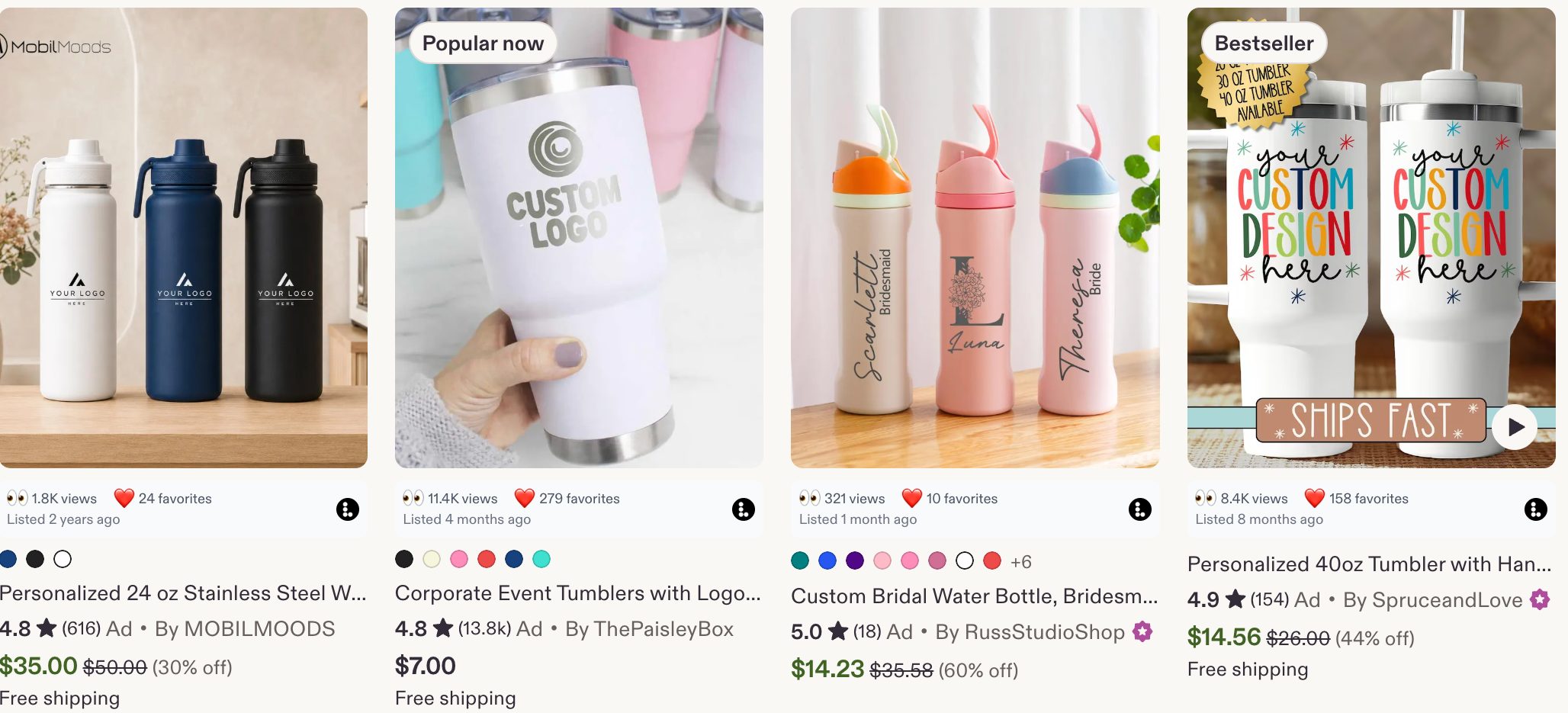
What the Listadum extension adds to a normal Etsy search — the views and favorites count on every card. Those two numbers are what this whole method runs on.
Inside Listadum we call this your favorite ratio, and it is the number I trust most when I judge a design. Of the people who saw this design, what share liked it enough to keep it. That single ratio strips out the noise. A brand-new bottle from a tiny shop and a three-year-old listing from a shop with 24,000 sales can finally be compared fairly, because the favorite ratio cancels out ad spend, age, and shop size.
It measures the design’s pulling power, and nothing else. And pulling power is the part you actually control when you sit down to make a new bottle.
When I re-ranked every listing by favorite ratio, the order scrambled hard. Bottles Etsy had buried far down the results out-pulled the personalized-name listings sitting in the top row. Etsy’s default sort tells you what Etsy is promoting. The favorite ratio tells you what buyers love. On the water bottle shelf, those are very much not the same list.
Designed content wins, not a name field
Here is the headline finding, and it is not subtle.
The personalized name bottle — a name engraved or vinyl-cut onto a blank bottle, shown as a grid of color options — is 48% of everything listed and only a fifth of the winners. It punches at 0.42x its weight. It is the single most oversupplied lane in the entire twenty-product study I am running, and it barely converts.
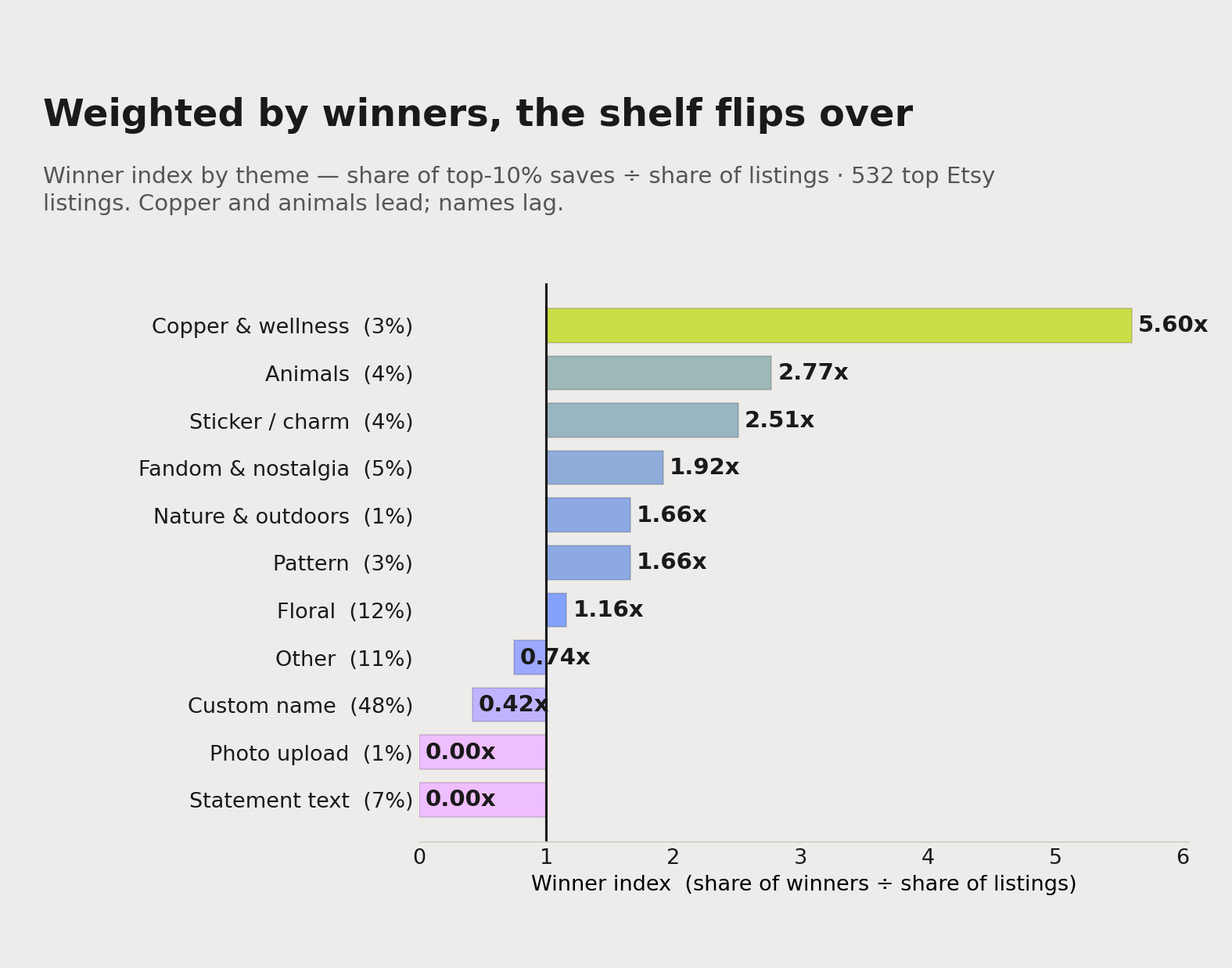
What earns saves instead is designed content: a real graphic wrap, a wellness aesthetic, an animal, a nostalgia hook, a pattern. Copper wellness bottles alone pull 5.6x above their share of the shelf. Animals index 2.77x. Fandom and nostalgia 1.92x. Pattern, nature, and floral all hold at or above par. The two personalization mediums — engraving and vinyl names — do the opposite.
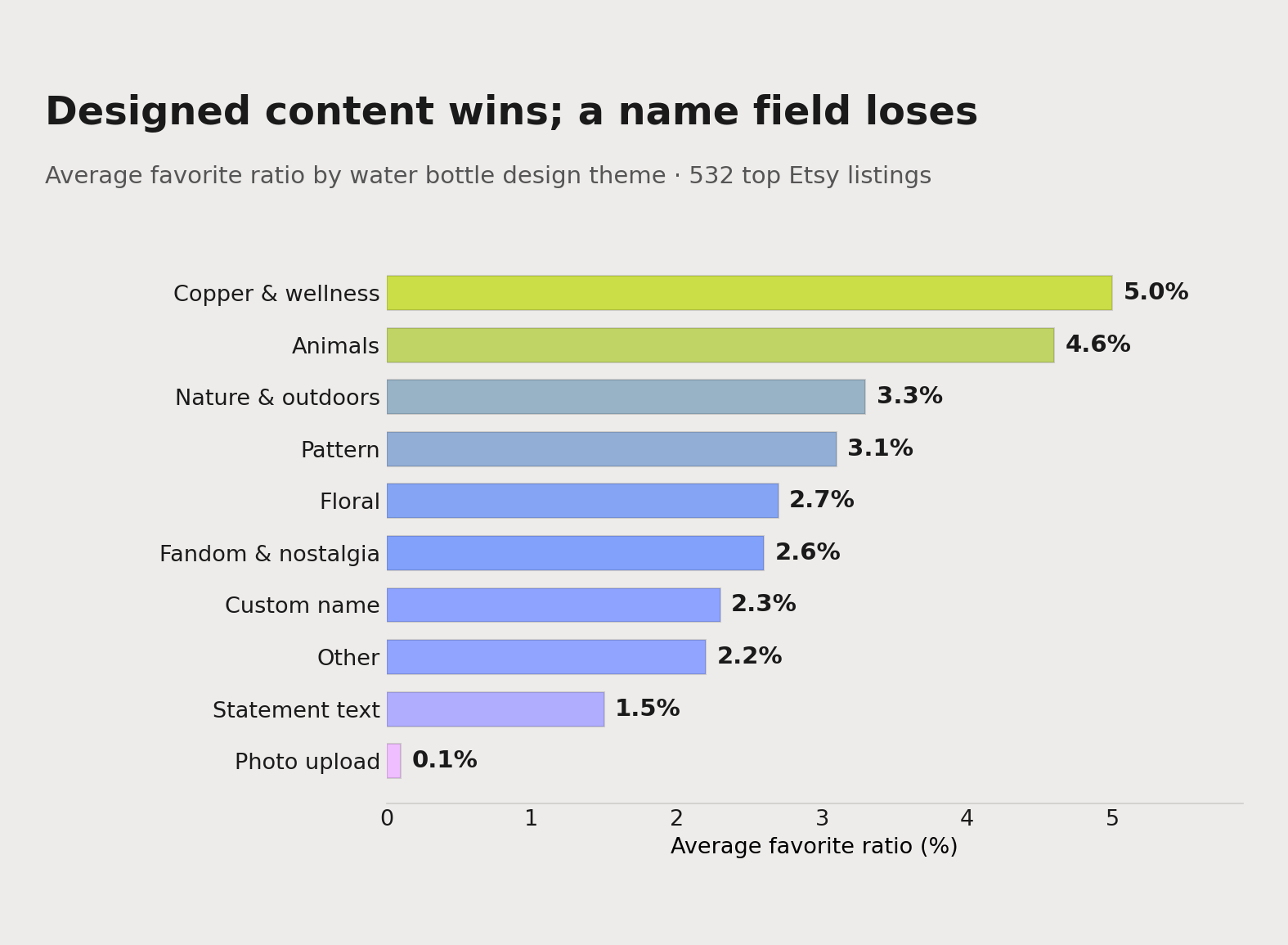
The plain-English version: a name is not a design. When the “design” is the buyer’s own name added to a blank bottle, you are not competing on creativity, you are competing on price and reviews against sellers who have thousands of both. Bring a designed surface — something to look at, belong to, or feel — and you are playing a completely different, far less crowded game.
That is the big picture. Now let me show you the whole board, not just the top of it.
The full ranking: winners, runners-up, and what to skip
Every theme is not a simple win or lose. There are tiers, and the runners-up matter as much as the champions, because they are less crowded and still pull well. Here is where each design theme landed, by average favorite ratio across all 532 designs. The overall median is 1.9%.
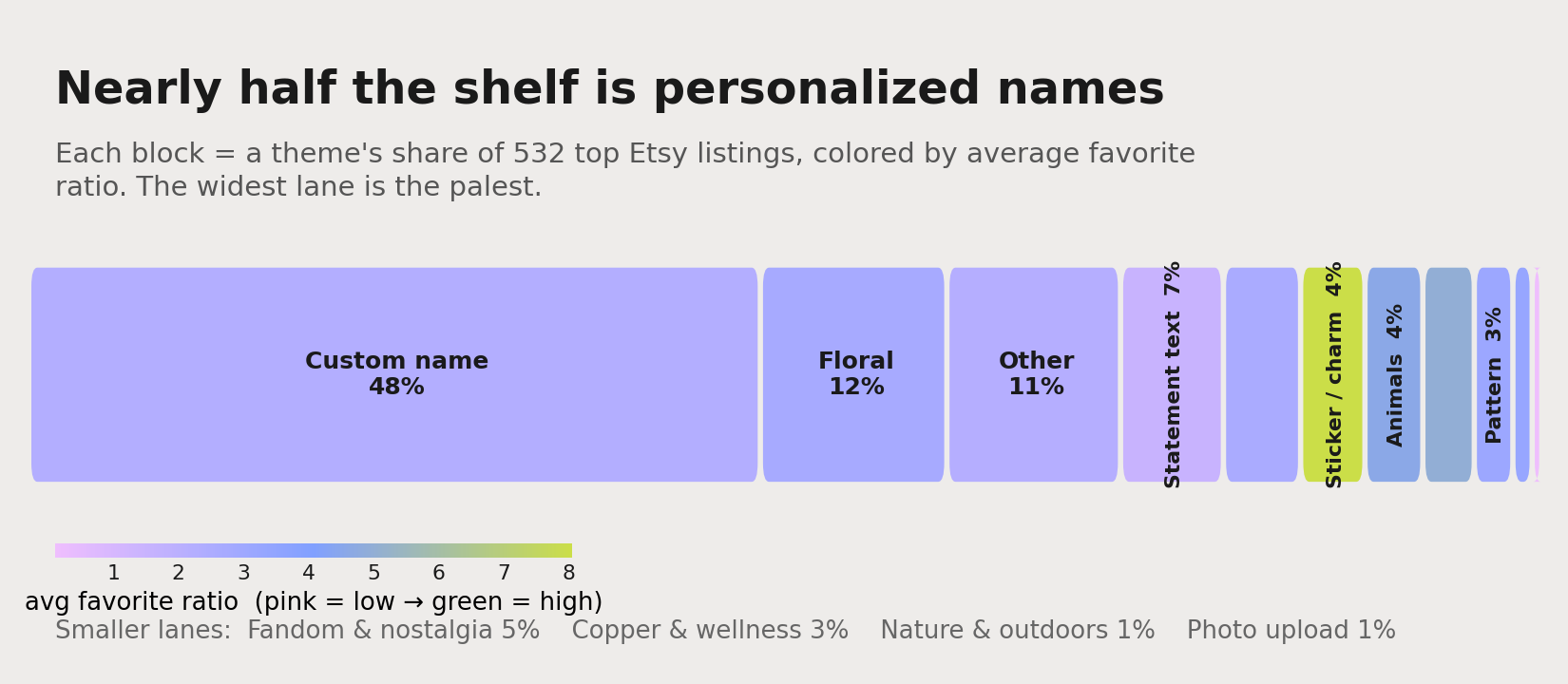
Sized purely by shelf space, custom-name looks unbeatable. But weigh each theme by how many winners it actually produces and the board flips over completely:
The top pullers. Copper and wellness (5.0% average, and the runaway winner by index) and animals (4.6%) are the two highest-pulling design lanes in the study. Both are small slices of the shelf, which is exactly why they win: high demand, low supply.
The strong runners-up. Nature and outdoors (3.3%) and pattern (3.1%). Small categories, clear buyers, quietly dependable, and well under-supplied. This is the tier people overlook. A runner-up theme with less competition can be a better bet than fighting for scraps in the crowded custom lane.
The middle of the pack. Floral (2.7%), fandom and nostalgia (2.6%), and custom-name (2.3%) all cluster just above the 1.9% median. Floral and fandom over-index at the winner line even though their averages are middling — meaning the best examples pull hard, the mediocre ones drag the average. Custom-name sits here only because there are so many of them; the average is propped up by volume, not by any single strong listing.
The weak tiers. Statement text (1.5%) and photo uploads (0.1%) pull below the median and produced zero top-10% winners between them. A plain quote in vinyl and a printed photo are the two surest ways to get scrolled past.
Two things jump out when you read it this way. First, the gap between the top puller and the bottom is enormous — copper pulls fifty times what a photo upload does. Second, the winners are not names. They are designed: a wellness look, a creature, a landscape, a repeating pattern.
Here is the cleaner way to see it — how much each theme over- or under-delivers relative to how much shelf space it takes up, its share of winners divided by its share of listings: copper and wellness punches 5.6x, animals 2.77x, fandom 1.92x, pattern and nature 1.66x, floral 1.16x. Custom-name delivers 0.42x, and statement and photo deliver zero. That ratio is the real map of where the open lanes are.
There is one more split worth knowing, because it decides your whole approach: the medium. Laser-engraved names (0.24x) and applied vinyl names (0.32x) are together 59% of the shelf and badly under-win. Full printed graphic wraps over-index (1.27x), and the sculptural copper wellness bottle runs away with it (5.6x). A great designed surface beats a name added to a blank bottle, every time.
The winning design types (with a prompt to make each)
This is the part I wish someone had handed me the day I made that useless name bottle. For each winning type: what the data says, why it works, and a Gemini prompt you can use to generate your own original version.
Two rules before you generate anything, because they decide whether your shop survives. Keep it original, since Etsy requires print-on-demand art to be your own. And never prompt for a real brand, character, logo, team, park name, or lyric. Every prompt below is written to stay clear of that.
Swap the CAPS placeholder for your niche so the output is yours, not a generic AI design a hundred other sellers can also make. Each prompt makes the artwork only — a transparent, isolated design with no bottle and no mockup — so you can drop it onto your own product wrap.
1. Copper and wellness bottles (5.0% average, the runaway winner)
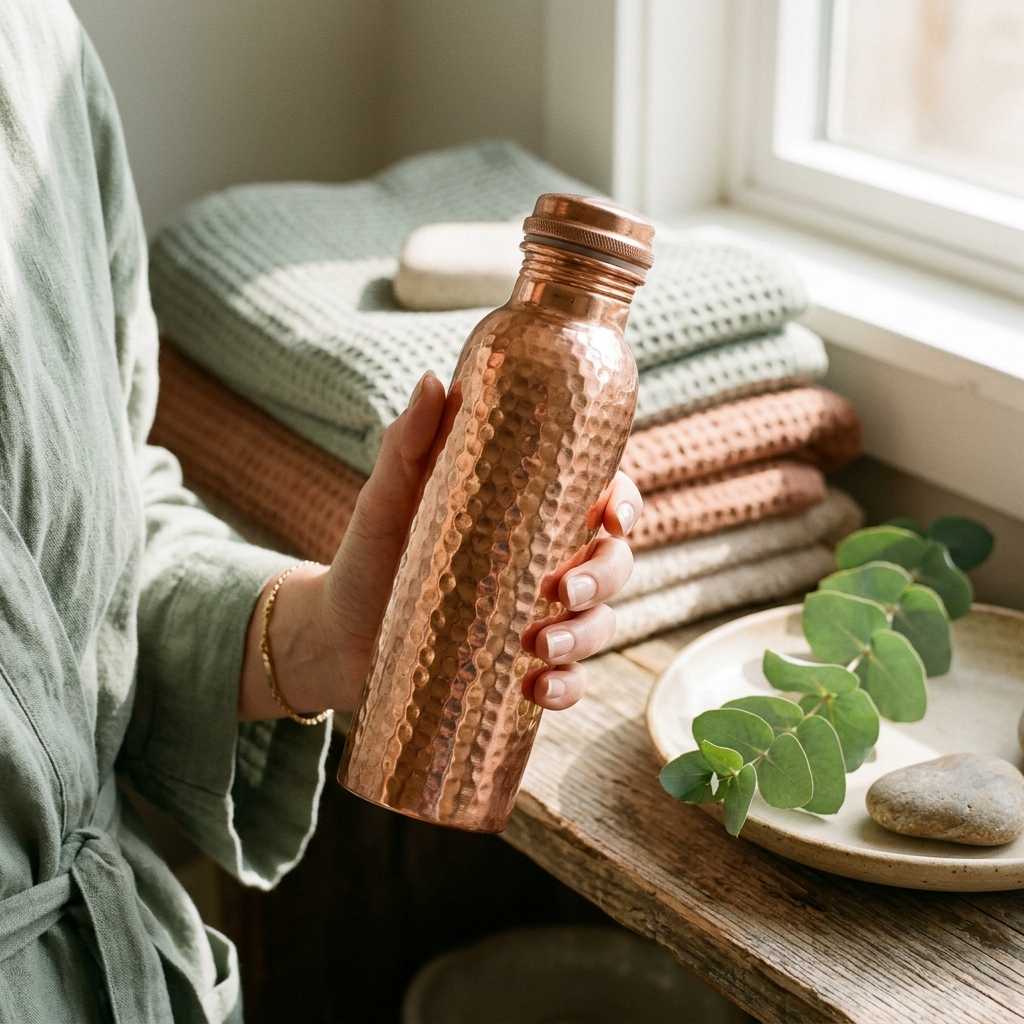
The single biggest per-listing winner in the study, at 5.6x its share of the shelf. Part of this is the material itself — hammered copper and matte earth-tone bottles read as “wellness” before a single word is on them.
If you print rather than source copper, you can capture the same buyer with a wellness aesthetic: minimalist hydration motifs, gentle affirmations, botanical line art, a daily water tracker, in a calm sage-and-terracotta palette.
A minimalist wellness-aesthetic water bottle wrap design. A calm, spa-like composition around a short affirming word or a simple hourly hydration tracker “YOUR WELLNESS WORD OR TRACKER HERE” (for example a mindful word, a self-care phrase, or a drink-water time scale), with delicate botanical line art and a soft sun or wave motif. Muted sage, terracotta, cream and clay palette, thin elegant linework, lots of calm negative space, transparent background, print-ready, reads clearly at thumbnail size. Just the artwork, no bottle, no mockup.
2. Animal bottle wraps (4.6% average, broad and reliable)
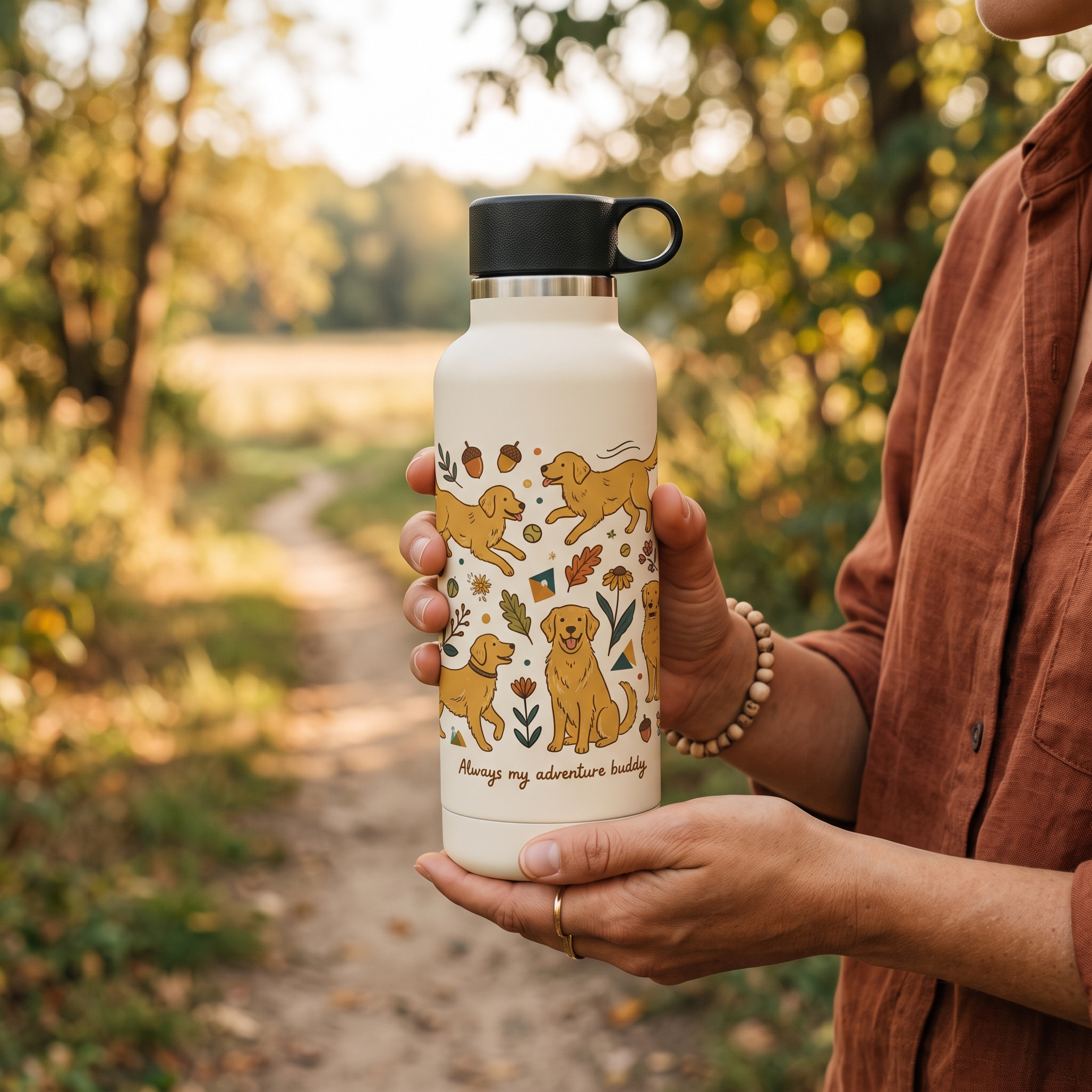
The most dependable design lane with the widest buyer base, indexing 2.77x. A cute, slightly retro creature — with or without a warm caption — beats a plain bottle every time, and it is a natural gift. Great for kids’ bottles and animal-lover niches alike.
A charming flat-illustration water bottle wrap of A SINGLE ANIMAL (a chubby cat, a golden retriever, a sea otter, a frog) drawn in a cute, slightly retro storybook style, optionally paired with a short warm or funny caption “YOUR LINE HERE” underneath. Limited earthy palette, clean outlines, centered, transparent background, print-ready, high contrast, thumbnail-readable. Artwork only, no bottle, no mockup.
3. Fandom and nostalgia, made original (2.6% average, over-indexes at the top)
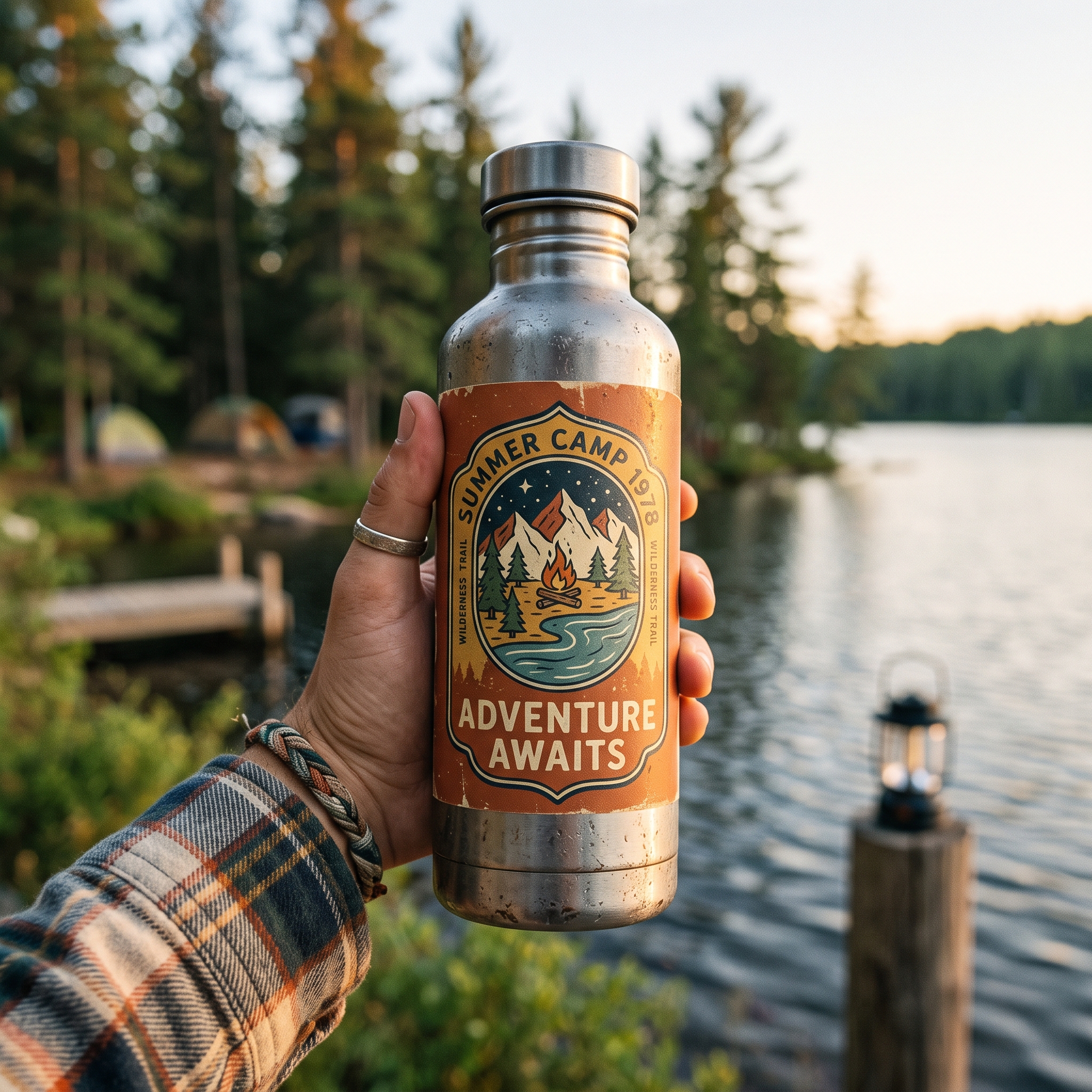
Punches 1.92x at the winner line, and it is the most legally dangerous type if you do it wrong. You cannot use a real show, band, game, or character. You can own the feeling of a hobby or an era: retro camp, 90s arcade, cottagecore, road-trip nostalgia. The move is an original graphic that gives superfans of that vibe the hit of recognition without borrowing anyone’s asset.
A bold nostalgic water bottle wrap that captures the feeling of A HOBBY OR ERA, not a brand (for example retro summer camp, 90s arcade, road-trip nostalgia, cottagecore). An original graphic with a short in-group phrase “YOUR INSIDER LINE HERE” and a simple related motif, in a warm vintage palette with slight distressed texture. Centered, high contrast, transparent background, print-ready, thumbnail-readable. No real franchise, character, logo, or trademark. Artwork only, no bottle, no mockup.
4. Pattern and abstract wraps (3.1% average, wide-open lane)
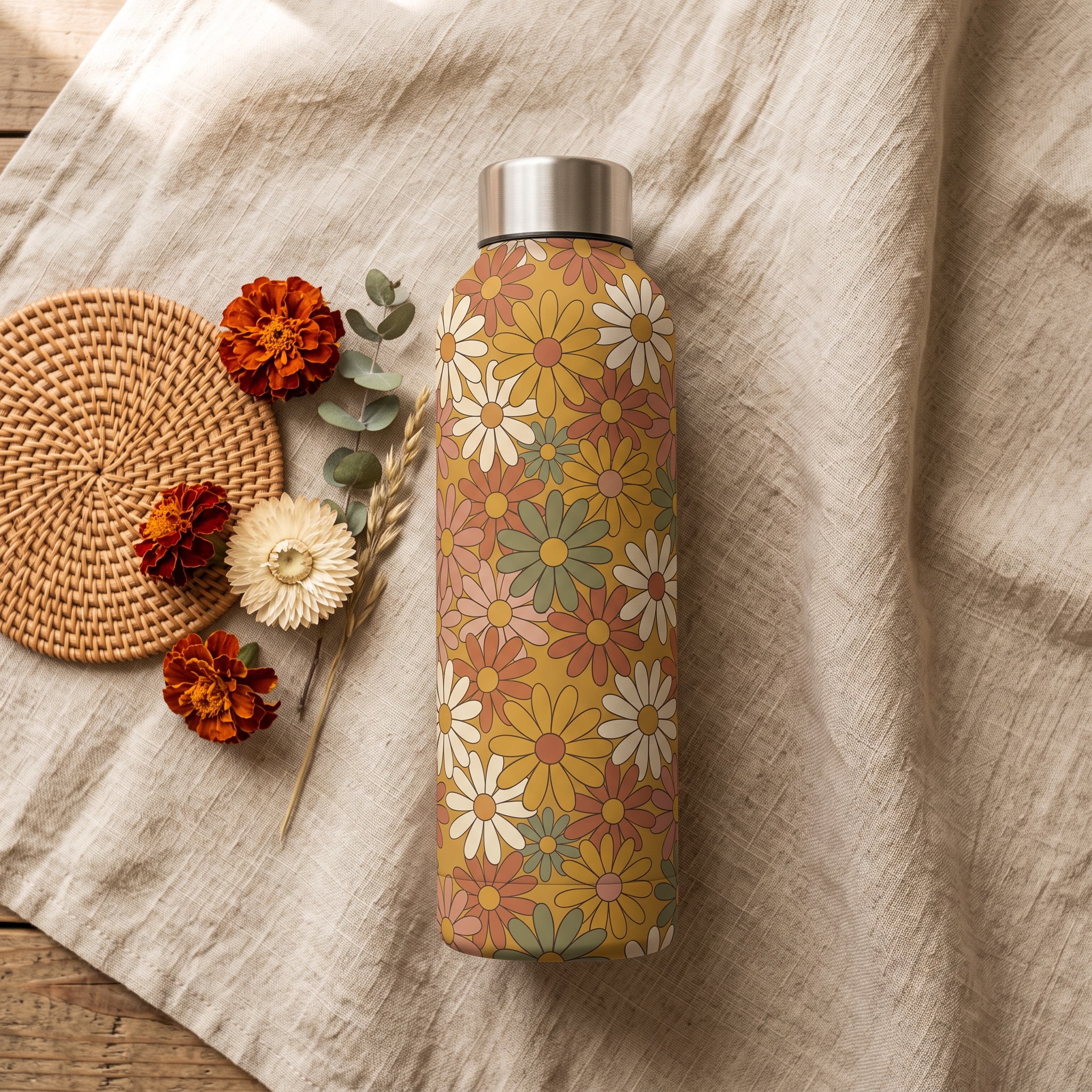
Indexes 1.66x from a tiny base, so the lane is genuinely open. A water bottle is one of the few products where a full seamless wrap looks fantastic, and almost nobody in the personalized-name crowd is making them. Repeating florals, checkerboards, groovy retro waves, terrazzo, boho shapes.
A seamless repeating pattern water bottle wrap built around A SIMPLE MOTIF (retro daisies, wavy checkerboard, terrazzo speckles, groovy 70s swirls). Balanced tileable repeat that wraps continuously with no seam, a cohesive limited palette of three or four warm modern colors, flat vector look, transparent background, print-ready, still reads at thumbnail size. Just the artwork, full-wrap pattern only, no bottle, no mockup.
5. Nature and outdoors wraps (3.3% average, the overlooked runner-up)
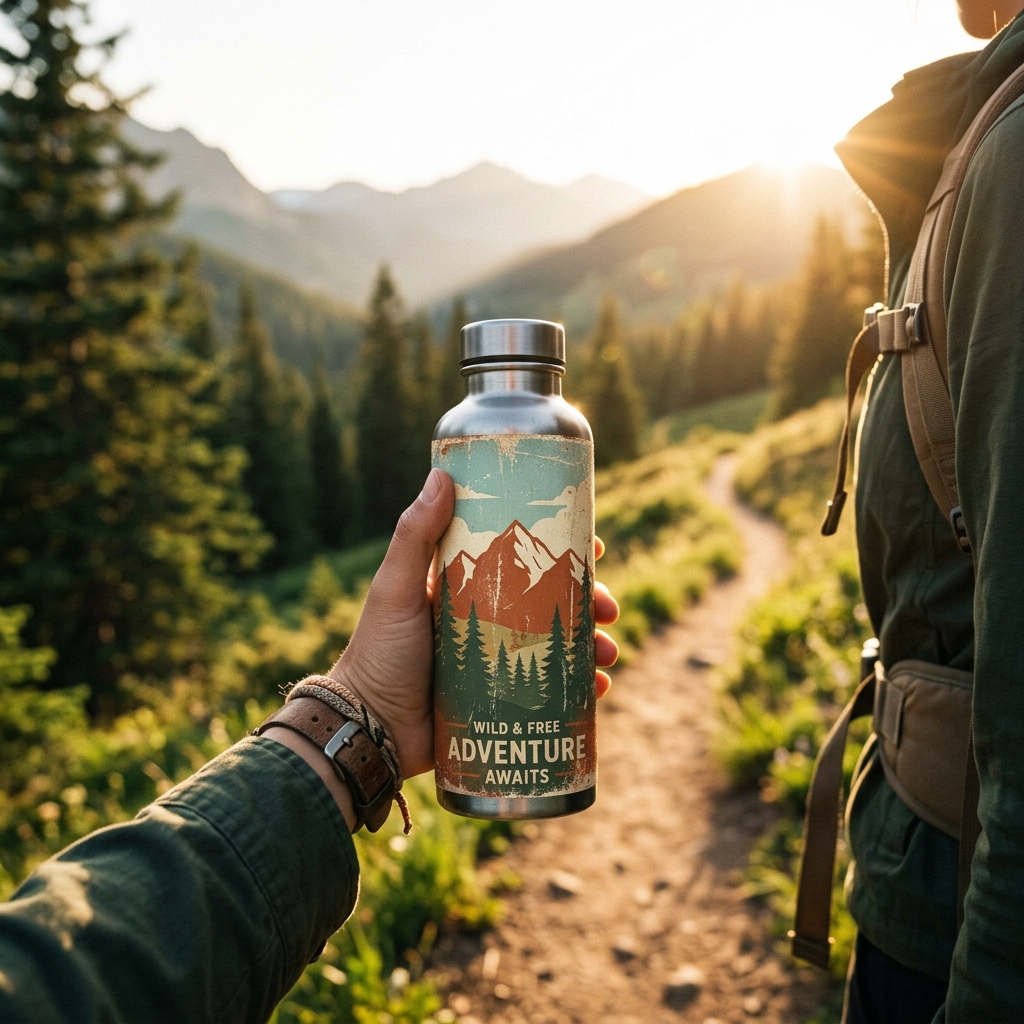
The runner-up worth a real look, indexing 1.66x. Bottles live outdoors — on trails, at the gym, in the car — so an outdoorsy illustrated scene fits the product’s own story. Mountains, pine forests, waves, a rising sun. Keep place names invented, never a real park or trademark.
A retro-illustration water bottle wrap of AN OUTDOOR SCENE (mountains, a pine forest, ocean waves, a desert at sunrise) with an optional made-up place or a short outdoorsy phrase “YOUR PHRASE HERE”. Faded adventure palette of rust, forest green, cream and sky blue, simple layered shapes, slight grain, transparent background, print-ready, readable at small size. Original artwork only, no real park or brand names, no bottle, no mockup.
6. Designed floral wraps, not name florals (2.7% average, the strong ones win)
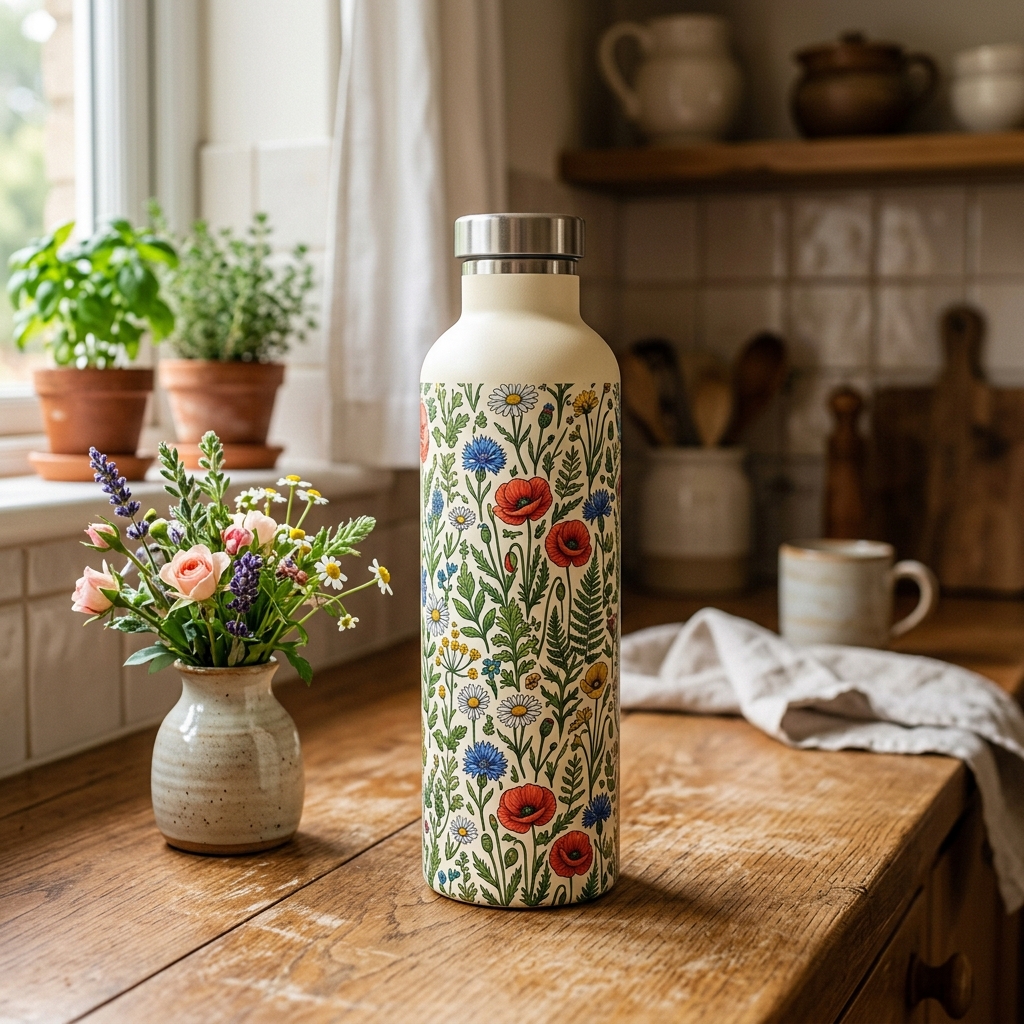
Floral holds at 1.16x — but only when the flowers are the design, not decoration around someone’s name. A confident, full botanical wrap behaves like a pattern and does fine. A few wildflowers tucked next to a cursive name behaves like a name bottle and gets scrolled past. Design the whole surface.
A designed botanical water bottle wrap with flowers as the whole composition, not an accent. A rich full-coverage arrangement of A FLORAL THEME (wildflowers, pressed blooms, line-art botanicals, vintage roses) that wraps the bottle edge to edge, in a cohesive modern palette. No name, no monogram, no blank space for personalization. Flat or gently textured illustration, transparent background, print-ready, thumbnail-readable. Artwork only, no bottle, no mockup.
After you generate any of these, shrink it to about 200 pixels wide and see if you can still tell what it is. If you cannot, simplify: fewer elements, higher contrast, a cleaner focal point. That thumbnail test is the difference between a design that pulls and one buyers scroll past.
💡 Pro tip — you do not need real copper. The runaway winner lane sells a feeling, not a metal. A printed sage-and-terracotta wrap with botanical line art and a little hydration tracker reads “wellness” just as fast, and it drops straight onto the POD bottle you already sell. Chase the aesthetic, not the material.
The two traps that look busy but rarely sell
Two kinds of listing flood the water bottle searches. Because there are so many of them, they look like proof of demand. The favorite ratio says otherwise.
The personalized name bottle. This is the big one, and it is the whole reason the shelf misleads you. Engraved and vinyl name bottles are 48% of everything listed and just a fifth of the winners, at a 0.42x index — the biggest single-lane oversupply I have measured across any product. The problem is baked in: when the design is the buyer’s own name, you compete on price and reviews, not creativity, and that is a fight a new shop almost never wins. The color-swatch grid photo those listings use is itself a tell — it pulled a 0.0% winner rate. This is the “your name here” red ocean.
Plain statement text and photo uploads. A quote in vinyl (1.5% average) and an uploaded photo (0.1% average) produced zero winners between them. Text alone and a personal snapshot both read as generic on a bottle. Note the exception that proves the rule: a statement baked into a real designed wrap behaves like a graphic, not a statement, and does fine. The words can be there — they just cannot be the whole idea.
None of this means these designs are bad. They are crowded, or they are lazy. Supply of name bottles is enormous and they blur together, so the next new one gets ignored. Enter these lanes only with a genuinely different angle, and spend most of your energy in the under-supplied, high-pull design lanes instead.
💡 Pro tip — a name is not a design. The moment your “design” is the buyer’s own name on a blank bottle, you are competing on price and reviews against shops with thousands of both, and that is a fight a new shop rarely wins. If a name has to appear, bake it into a full graphic wrap so it reads as art, not as a fill-in-the-blank field.
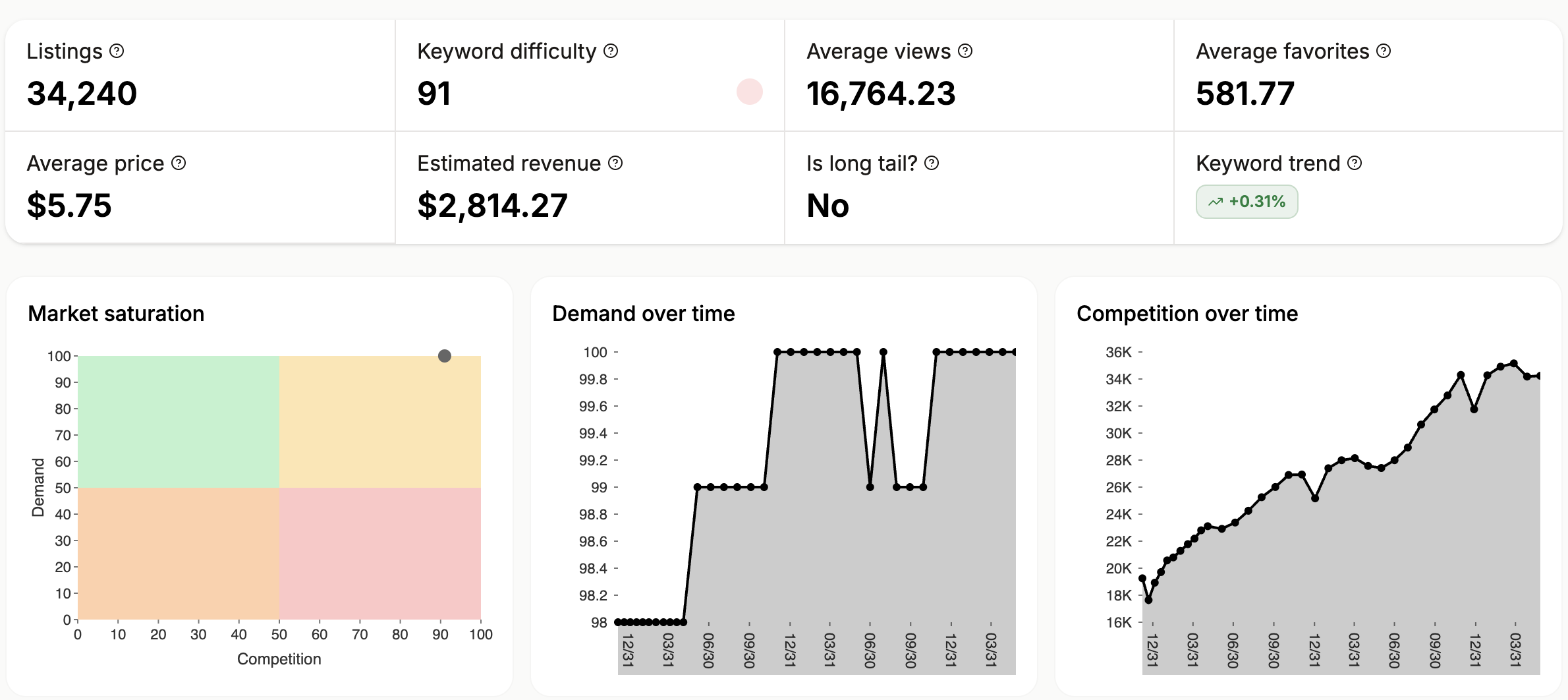
Want to see how crowded a design angle is before you commit to it? That is what the free Keyword Explorer shows you: demand against competition for any phrase, so you can aim at a pocket that is not already a red ocean.
Your yardstick: is your design a winner?
Numbers are only useful if you can hold your own work up against them. So here is the scale for a water bottle that already ranks on Etsy.
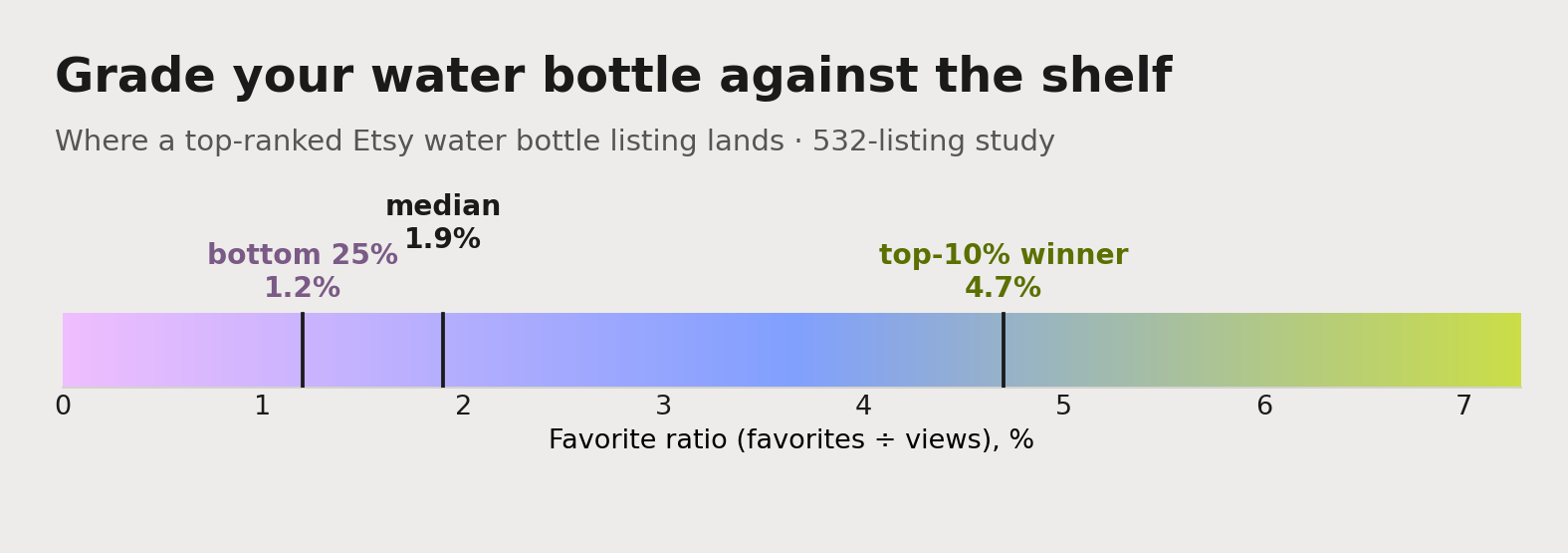
- Under 1%: the bottom quarter. People are seeing it and scrolling past. Rethink the design.
- Around 1.9%: dead average. Fine, not a winner.
- 3 to 4%: the top third. A strong design.
- 4.7% and up: the top 10%. A genuine winner.
These bars sit lower than any other drinkware I have measured — mugs cross the winner line at 13.9%, tumblers at 6.2%, water bottles at just 4.7%. That is not because bottles are easy; it is because the shelf is so flooded with low-pulling name listings that the whole distribution is dragged down.
If you sell on Etsy, run this check on your own listings tonight: open a listing’s stats, divide favorites by views, and see where it lands. A bottle sitting under 1.9% is telling you something, and on this shelf it is almost always the design, not the traffic.
💡 Pro tip — grade a bottle tonight. Open one of your live water bottles, divide its favorites by its views, and drop the number on the scale above. Under 1.9% and buyers are scrolling past; 4.7% and up and you have a genuine top-10% winner. On this flooded shelf a low number is almost always the design, not the traffic.
Two rules a design has to survive first
Before a design can sell, it has to stay up. Two Etsy rules quietly end more POD shops than any trend miss.
It has to be your own. Etsy’s Creativity Standards require that items made with production tools, which is all print-on-demand, are based on your own original design. Buying a trending graphic and dropping it on a bottle unchanged fails that test, and it is a common reason listings get deactivated. Our guide to Etsy’s rules for print-on-demand sellers walks through what “original” actually means in practice.
It cannot borrow someone else’s brand. Copying a hot design or using a protected phrase, logo, character, or park name is the fastest route to a trademark strike and a shop at risk. The safe move is your own take on a theme, not someone else’s asset. If copycats are a worry the other direction too, there is a hidden setting that helps protect your shop from copycats.
Neither rule blocks you from selling a mountain bottle or a cat pun. Plenty of shops do. They block you from selling the exact one someone else already made. Original beats borrowed, and it is also the only version that lasts.
The mockup finding: show it held, not as a color grid
Here is the part that will save you hours of second-guessing — but for water bottles it is a real finding, not a shrug.
On t-shirts, mockup style barely moves the needle. On water bottles it clearly does. I checked the average favorite ratio for each mockup style across the whole sample.
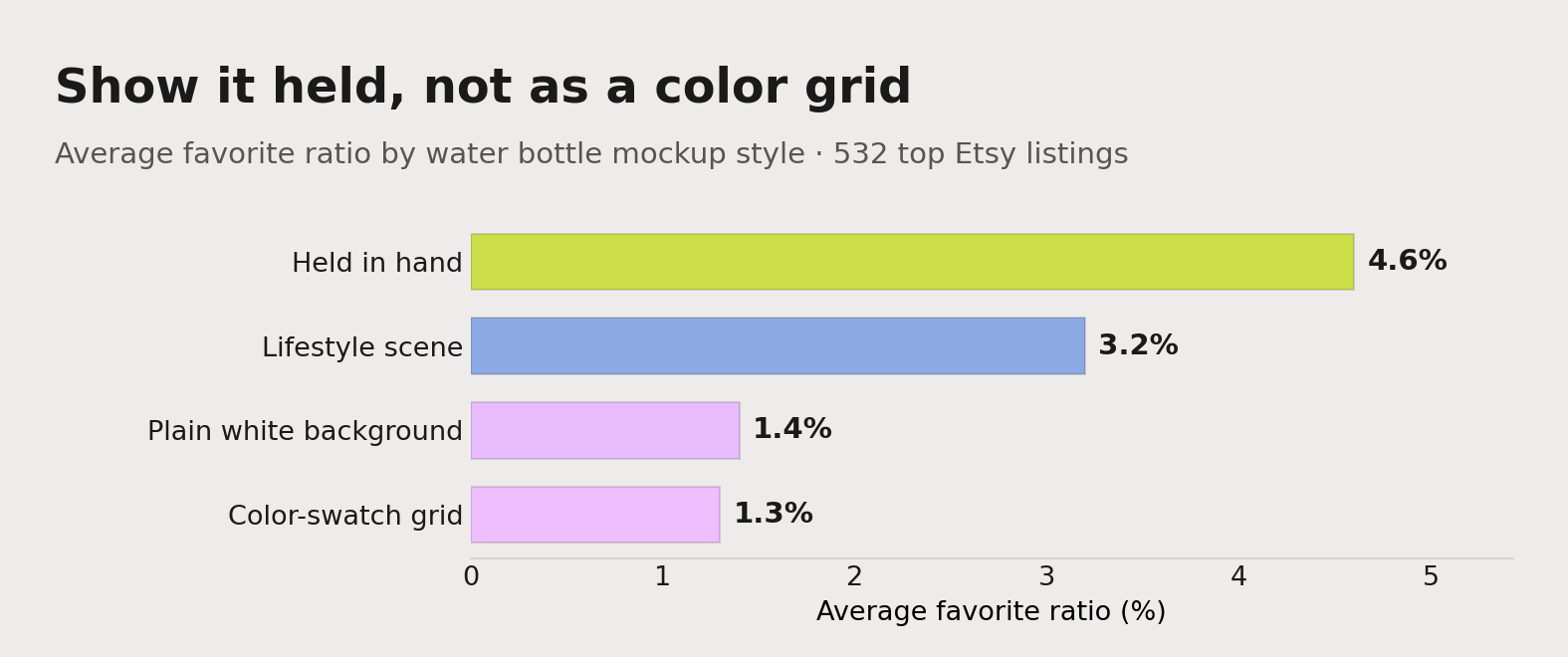
Held-in-hand shots averaged 4.6% and lifestyle scenes 3.2% — both well above the 1.9% median. A plain white-background product shot (1.4%) and the color-swatch grid (1.3%) both sat below it and produced zero winners. The grid shot is doubly damning: it is the signature of the personalized-name lane, so it signals “generic name bottle” before a buyer even reads the title.
💡 Pro tip — shoot the human moment. Held-in-hand pulled 4.6% and lifestyle 3.2%, more than triple the color-swatch grid. Show the bottle on a trail, on a gym bench, propped in a sunlit kitchen — a real hand in a real setting does the buyer’s imagining for them, and it instantly separates you from the wall of bare bottles on white.
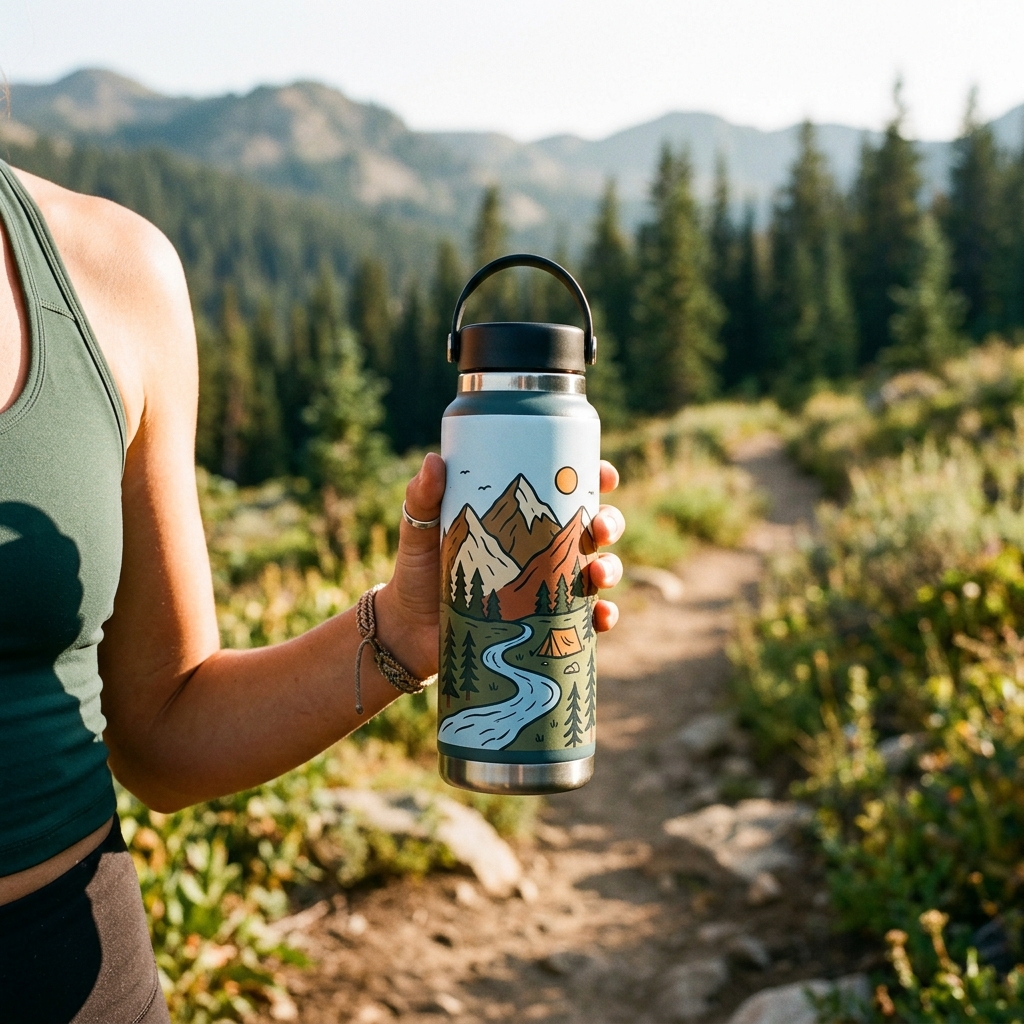
So the guidance here is specific: show the bottle in a human moment — held on a trail, sitting on a gym bench, propped in a sunlit kitchen — and never lead with a bare bottle on white or a wall of color swatches. A few more things that move mockups, none of which is worth agonizing over:
- Do not ship the default POD stock mockup. Everyone uses them, so your listing blends into a wall of identical bottles. A realistic smart-object template or a bulk-mockup tool is worth the small effort. Here is what we learned about better listing images with mockups.
- Use most of your ten image slots, in an order. A lifestyle hero shot for the thumbnail, then a design close-up, a scale or size reference, capacity and lid detail, a “what you get” graphic, then mood shots. The full sequence is in our guide to listing image types that drive sales.
- Match the exact bottle. If you print on a 32oz matte bottle, mock it up on that bottle, not a glossy 20oz. Etsy requires the thumbnail to represent the real product, and mismatches drive returns and unhappy reviews.
- Add a simple video. A ten-second turn of the bottle showing the full wrap gets impression priority and shows the design all the way around.
- Disclose it. When an image is a mockup or AI-assisted, say so, both for Etsy’s standards and for buyer trust. Here is how and why to disclose mockups and AI images.
Free download: the Etsy SEO Checklist
A winning design still has to be found. This one-page checklist walks the titles, tags, and attributes that get a bottle ranking, so the design you just made actually gets seen.
Grab the free Etsy SEO Checklist →
New shops are barely breaking in here
On most products I study, this is the encouraging section: new shops break in every week. On water bottles, I have to be honest with you — this is the one category where they mostly do not.
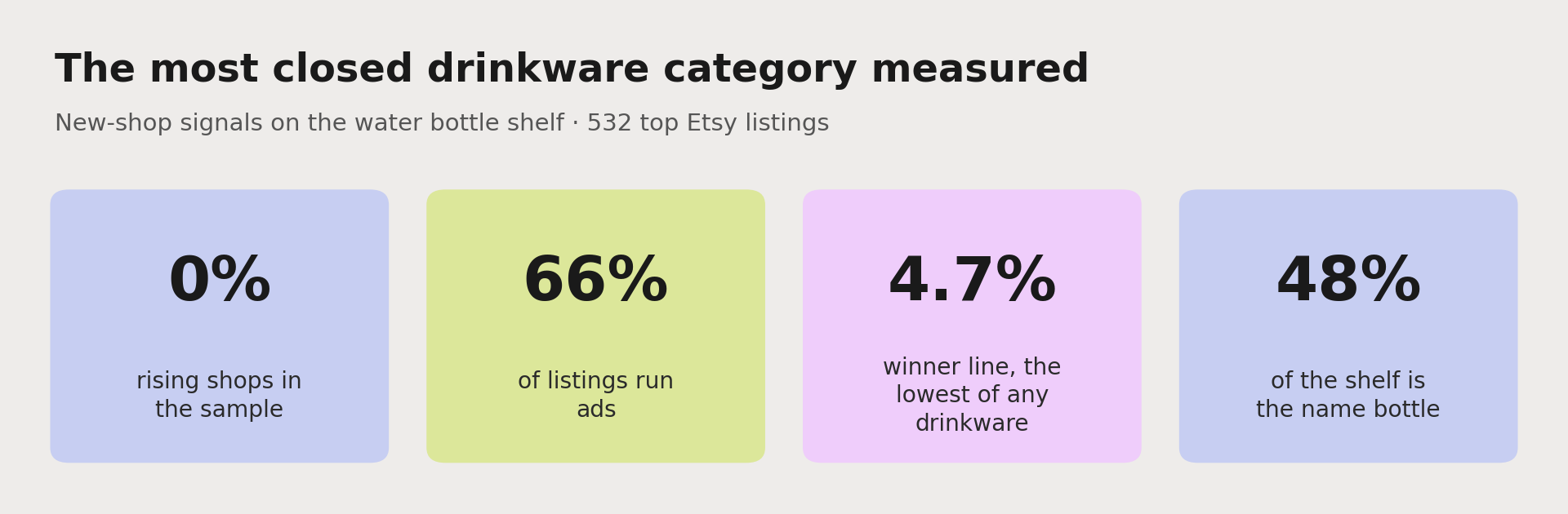
I flag a listing as “rising” when it is under about three months old, pulling a high favorite ratio, from a small or mid-size shop. Across the whole water bottle sample, that number was zero. Not a single new shop broke into the top with a genuinely fresh, high-pulling design in the window I measured. Two-thirds of listings run ads. The winner line is the lowest of any drinkware. This is a mature, established-seller field.
That sounds bleak, but read it the right way and it is a map. A closed category is closed for the people making the same name bottle as everyone else. Zero rising shops in the crowded lane is exactly why the under-supplied design lanes — copper and wellness, animals, patterns, nature, real designed wraps — are where a new shop actually has room. The door is not locked. It is just not on the wall of name bottles everyone is pushing on.
If you are going to enter water bottles, enter with a design, not a name field, and know going in that you are playing a patient, differentiated game, not a quick-win one.
Where to start this week
If you came in thinking the water bottle shelf was all personalized names, I hope this traded that impression for a map. You do not need to add your listing to the wall of name bottles. You need to make something designed for a specific buyer, then check whether people actually save it.
Here is the whole post as five steps:
- Pick an open lane: copper and wellness, an animal, a pattern, a nature scene, a real designed floral. Skip the personalized-name and photo-upload red oceans.
- Design the whole surface, not a name field. If words appear, make them part of the artwork.
- Keep it readable at thumbnail size: clear focal point, high contrast, cohesive palette.
- Shoot it held in a hand or in a real-life scene. Never lead with a bare bottle on white or a color-swatch grid.
- List it, then read its favorite ratio. Under 1.9% and buyers are scrolling past. Above 4.7% and you have a winner.
Most sellers never get to that last step. They copy the name-bottle format, cross their fingers, and wonder why it goes nowhere. But that number is the whole game. Make something designed, check its favorite ratio a couple of weeks later, keep the ones that pull, and let the rest go. Do that a few times in the open lanes and you stop guessing. One day you might even be the shop that finally breaks the zero.
Keep reading on Listadum. New to print-on-demand? Start with selling on Etsy without inventory. Ready to run a POD product niche properly? See our guide for print-on-demand sellers and how to find a profitable Etsy niche.
Frequently asked questions
What kind of water bottle designs sell best on Etsy?
Designed graphics, not personalized names. In my study of 532 top listings, the personalized name bottle was 48% of everything listed but only a fifth of the winners. What pulled well above the 1.9% median were copper and wellness bottles (5.0% average favorite ratio), animals (4.6%), nature and outdoors (3.3%), and patterns (3.1%). Plain statement text and uploaded photos produced zero winners.
Why don’t personalized name water bottles sell as well as they look like they should?
Because you are competing on price and reviews, not design. When the “design” is the buyer’s own name on a blank bottle, there is nothing creative to prefer you for, so the sale goes to the cheapest established shop. Name bottles are 48% of the shelf and pull at just 0.42x their share of the winners — the most oversupplied lane in the whole study.
What is the favorite ratio, and how do I see it?
Favorite ratio is a listing’s favorites divided by its views — the share of people who saw a design and liked it enough to keep it. Etsy does not show both numbers on the listing card by default; the free Listadum browser extension puts views and favorites on every card as you browse, which is what makes the method possible.
Do lifestyle mockups really sell better for water bottles?
Yes, and clearly so — unlike t-shirts, where it is a tie. Held-in-hand shots averaged a 4.6% favorite ratio and lifestyle scenes 3.2%, both well above the median, while a bare bottle on white (1.4%) and a color-swatch grid (1.3%) produced zero winners. Show the bottle in a human moment.
How do I know if my water bottle design is any good before I lean into it?
Once it is live, check its favorite ratio: favorites divided by views. Under about 1.9% means buyers are scrolling past. Above 4.7% puts you in the top 10% of listings that already rank on the water bottle searches.
Can I sell a design that is trending right now?
You can sell your own take on a trending theme. You cannot copy someone else’s specific design, or use a protected brand, phrase, character, or park name. Etsy’s Creativity Standards require print-on-demand items to be based on your original work, and trademark strikes are a real account risk.
Stop guessing which of your designs is pulling and which is dead weight.
Listadum reads every listing in your shop and flags the ones losing you sales: weak images, no video, thin titles, low engagement. You get a clear, prioritized list of what to fix first, in plain English.
Free plan · no credit card · connect your real Etsy shop in minutes
About the author
Neha Chandelier, Co-founder of Listadum, selling on Etsy since 2020. She writes about Etsy tips and tricks, how to sell on Etsy, and growing a handmade shop.
Last updated August 13, 2026.
Sources: Listadum Keyword Explorer (demand data, pulled July 2026); Listadum study of 532 unique top-ranked Etsy water bottle listings across three search terms, ranked by favorite ratio; Etsy Creativity Standards.