


Part of our Niche Playbooks guide. Pairs with the print-on-demand playbook and the digital downloads playbook.
Vintage on Etsy plays by a completely different set of rules than handmade or print-on-demand. There is no restocking a bestseller, no scaling a winning design. Every item is one of one, and there is a hard age rule that decides whether you can even list it.
But that age rule is not just a constraint. It is your moat. It keeps the entire print-on-demand crowd out of your category, because they physically cannot make what you sell. Your job is to lean into that, be more honest, more findable, and more organized than the shop next to you.
This is the playbook: what qualifies as vintage, why the rule protects you, how to photograph and describe condition so buyers trust you, how vintage buyers actually search, and how to build a shop rather than a single hero listing.
Quick answer: how do you sell vintage on Etsy?
To sell as vintage on Etsy, an item must be at least 20 years old, so in 2026 that means made in 2006 or earlier (Etsy’s vintage policy). After that, four moves win the category:
- Prove the age and be honest about condition. Show every flaw and give exact measurements. It wins the sale and kills the return.
- Do era-and-style SEO. Put the decade, material, and style at the front of the title, because vintage buyers search “1970s brass” and “mid century teak,” not “nice lamp.”
- Build the shop, not the listing. With one-of-a-kind stock, traffic comes to the shop, so consistency and volume of well-tagged listings matter more than any single item.
- Price for rarity and condition, not cost. Buyers routinely pay 3 to 5 times thrift-store prices for a curated, well-photographed piece.
In this guide:
- What counts as vintage on Etsy (the 20-year rule)
- Why the 20-year rule is a moat, not a limit
- What the data says about vintage competition on Etsy
- Photographing and describing condition honestly
- How vintage buyers actually search (era, style, maker, material)
- Build the shop, not the listing
- Pricing vintage
- What is selling in vintage right now (2026)
- A thin listing, rebuilt
- Common mistakes to avoid
- FAQ
What counts as vintage on Etsy (the 20-year rule)
Etsy has one hard line for the Vintage category: the item must be at least 20 years old. The rule rolls forward every year, so as of 2026 an item must have been made in 2006 or earlier to qualify (Etsy vintage policy).
A few things sellers get wrong here:
- The 20-year rule has no exceptions. “Vintage style,” “retro,” and “made to look old” do not count. Reproductions are not vintage, and listing them as vintage risks removal.
- Age alone is not enough. The item also has to be something you genuinely sourced or curated, not mass-bought new-old-stock passed off as a collection.
- Etsy can ask you to prove it. Etsy may request where an item came from, how you source it, the designer or maker, and photo documentation of vintage indicators (labels, maker’s marks, construction). Keep that information handy per listing.
So before anything else, confirm the piece clears 2006-or-earlier and that you can back it up. That single check is what separates a real vintage shop from one that gets flagged.
Why the 20-year rule is a moat, not a limit
Most sellers treat the age rule as a ceiling. Flip it: it is a wall around your category that your biggest competitors cannot climb.
The flood of near-identical listings that makes handmade and print-on-demand so brutal simply cannot happen in vintage. Nobody can spin up 40 copies of a 1968 Danish teak sideboard. The supply is finite and the makers are gone. That means:
- No price race to zero. When an item is genuinely one of one, “cheaper down the street” is not a real threat.
- Curation is the product. Buyers are paying for your eye, that you found the good piece and vetted it, as much as the object itself.
- Trust compounds. In a category built on condition and authenticity, a shop with a reputation for honest listings wins repeat buyers in a way a commodity shop never does.
Your competition is not other sellers with the same item. It is vague titles, one dark photo, and no measurements. Beat those and you are ahead of most of the category.
What the data says about vintage competition on Etsy
The moat argument holds up in the numbers. These come from Listadum’s Keyword Explorer, pulled from live Etsy data in mid-2026.
The broad terms are a wall. Type the obvious keyword and you are one listing in millions:
| Search term | Live listings competing | Listadum competition score |
|---|---|---|
| vintage | 26.9 million | maxed out (100th percentile) |
| vintage home decor | 7.2 million | 100th percentile |
| vintage jewelry | 5.1 million | 100th percentile |
| vintage kitchen | 4.4 million | 100th percentile |
| antique | 3.9 million | 100th percentile |
| art deco | 3.3 million | 100th percentile |
No new shop ranks against 26.9 million listings. If your title just says “vintage,” it is found for nothing.
The demand underneath is very real, and it rewards specificity. Go one level narrower and the picture flips. “Mid century modern” pulls an average of about 15,000 views per listing, carries a $165 average price, and its top listing is estimated at roughly $49,000 a month. “1970s decor” averages about 7,700 views per listing. Buyers are there, they are just searching the specific phrase, not the generic one.
The winnable zone is the narrow collector phrase. These terms have strong demand but a tiny fraction of the competition:
| Narrow search | Live listings | Demand (views percentile) | Avg sale price |
|---|---|---|---|
| vintage pyrex | ~39,000 | 97th (very high) | $31 |
| vintage typewriter | ~18,500 | 64th | $53 |
| art deco lamp | ~56,000 | 69th | $260 |
“Vintage” makes you fight 26.9 million listings. “Vintage pyrex” makes you fight about 39,000, with demand in the 97th percentile. That is a roughly 600-times-smaller pool of competitors for a search real buyers actually type. That gap is the entire game.
One caution the data makes clear: narrow is not automatically good. “1960s barware” (about 36,000 listings) and “1970s ceramic vase” (about 13,000) are specific, but their demand sits near the bottom, few people search them. Specific only wins when there is demand behind it, which is exactly why you check both scores before you commit a tag.
Photograph and describe condition honestly
Vintage buyers cannot touch the item and they know it is old, so their single biggest fear is “what is wrong with it that the photos are hiding.” Answer that fear completely and you win the sale. Hide it and you earn a return and a bad review.
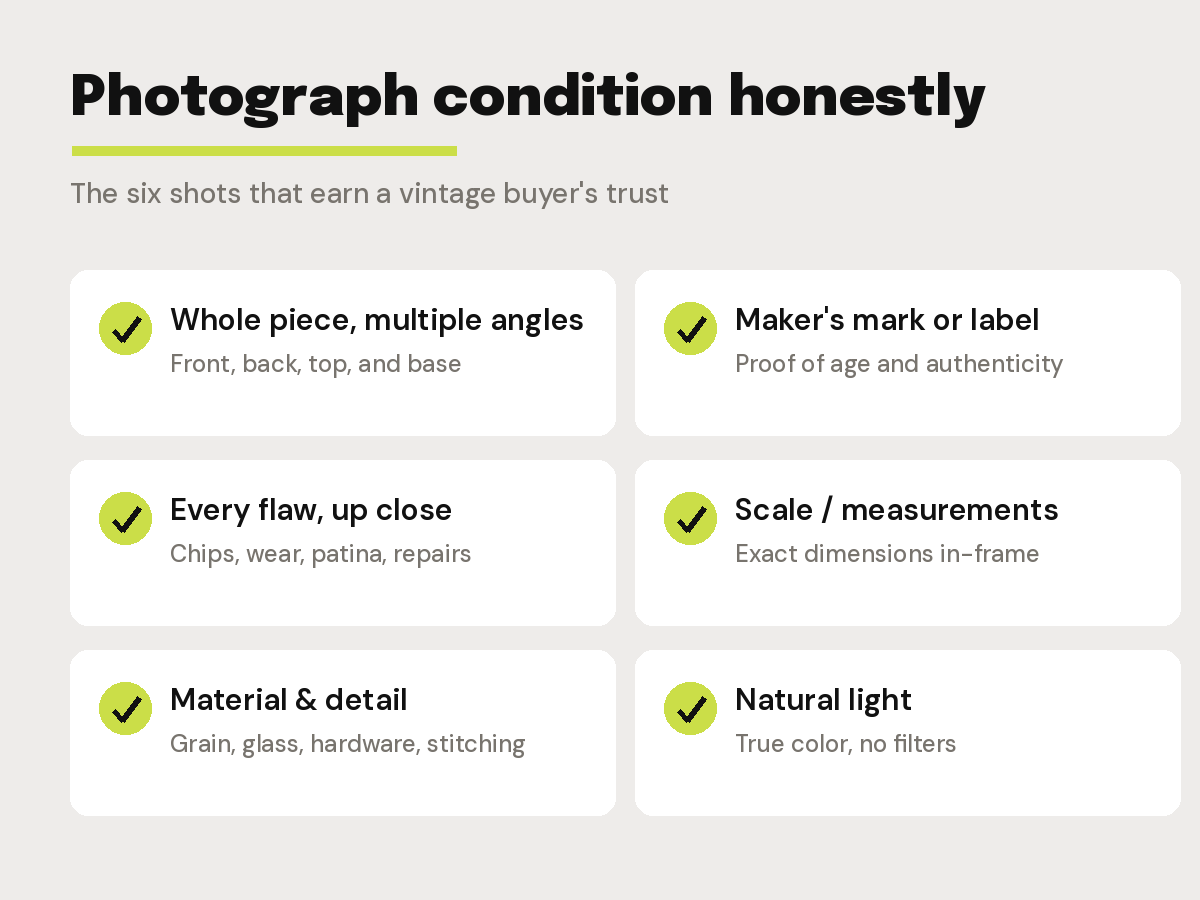
Shoot in natural light and give buyers the full picture:
- The whole piece, multiple angles. Front, back, top, base, and any maker’s mark or label.
- Every flaw, up close. The chip, the scuff, the missing button, the patina. Photograph the damage clearly rather than burying it. Honesty here is what makes the rest of your listing believable.
- Scale and measurements. Exact dimensions in the photos and the description. “Smaller than expected” is the number one complaint for anything sold online, and one measurement shot prevents it.
- The details that justify the price. Grain, glass, hardware, stitching, the marks of real age that a reproduction cannot fake.
Then say it in words too. Describe the material, color, dimensions, and condition plainly, and note every imperfection. Our free Etsy Listing Image Playbook walks through the full photo sequence shot by shot.
Free Etsy SEO Guide. Vintage lives or dies on being found and trusted. Get the whole picture, titles, tags, descriptions, and photos, in one free guide you can work through listing by listing. Get the free Etsy SEO Guide →
How vintage buyers actually search: era, style, maker, material
Vintage shoppers search differently from handmade shoppers. They rarely type “lamp.” They type a decade, a style, a maker, or a material, often combined: “mid century brass table lamp,” “1970s smoked glass,” “art deco vanity.”
So build your titles and tags from four ingredients:
- Era or decade: 1960s, 1970s, mid century, art deco, Victorian.
- Style or aesthetic: boho, cottagecore, brutalist, Hollywood regency, farmhouse.
- Maker or brand: Pyrex, Ercol, Wedgwood, a known designer or pottery mark (when you can verify it).
- Material and color: brass, teak, smoked glass, burgundy, patina.
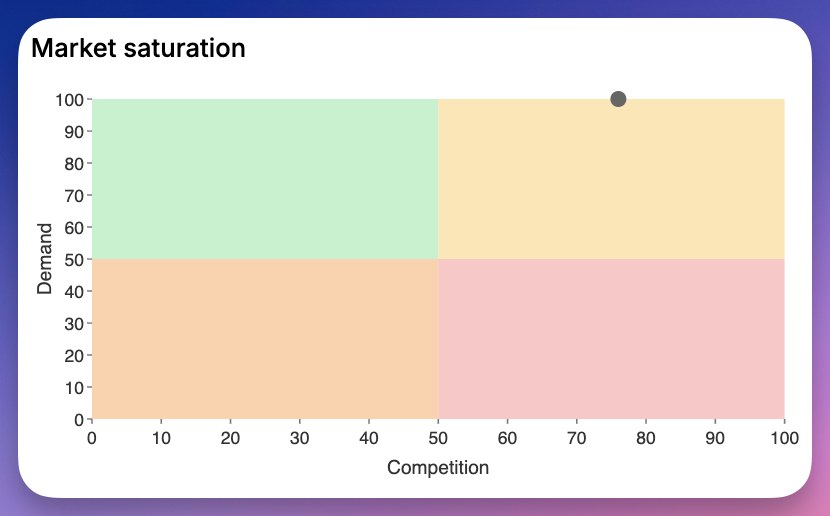
Two rules make this work. First, put your most specific keywords at the front of the title, because the first characters carry the most weight and are what buyers scan. Second, use all 13 tags and mix broad category tags (“vintage decor”) with narrow collector tags (“mid century brass”), since niche buyers search the narrow ones and they are far less competitive.
The hard part is knowing which era and style phrases actually get searched. Listadum’s Keyword Explorer scores each phrase by demand and competition, so you spend your 13 tags on terms real buyers use and that you can rank for, instead of guessing. (The full method is in our guide to writing Etsy tags that get found.)
Find the vintage searches you can win. Listadum’s Keyword Explorer scores every era and style phrase by demand and competition, so you tag for terms you can actually rank for. Try the free Keyword Explorer →
Build the shop, not the listing
This is the mindset shift that separates hobby vintage sellers from real ones. In handmade, you can pour everything into one hero listing and restock it forever. In vintage, every item sells once and is gone. So the unit that grows is the shop, not the listing.
What that changes in practice:
- Volume of distinct listings is your traffic. More well-tagged, genuinely different items means more search surface. Forty listings each catching their own era-and-style searches beats obsessing over one.
- Consistency builds the brand. A recognizable style (mid century only, or all cottage kitchenware) makes browsers into followers who check back, because they trust your eye.
- Shop-level signals matter. Complete listings, good photos, filled-in attributes, and healthy reviews lift how Etsy reads your whole shop, so a few sloppy listings quietly drag the good ones down. A completion score that flags the weak listings keeps the whole shop tidy as your inventory grows.
Think like a curator running a shelf, not a maker perfecting one product.
Pricing vintage: rarity and condition, not a cost-up formula
Handmade pricing is cost-plus: materials, labor, fees, margin. Vintage does not work that way, because your “cost” is whatever you paid at an estate sale, which has nothing to do with what the piece is worth.
Price on rarity, condition, and demand instead:
- Anchor to comparables. Search sold listings for the same era, maker, and condition to see what buyers actually paid, not what hopeful sellers are asking.
- Condition moves the number a lot. Mint with the original label commands far more than the same piece with a chip. Your honest condition photos justify the higher end.
- Expect a real multiple over sourcing. Curated, well-photographed vintage routinely sells for 3 to 5 times thrift-store prices, because buyers pay for the finding and the vetting, not the object alone.
- Then account for Etsy’s cut. Build in the standard fees before you set the price: a $0.20 listing fee, 6.5% transaction fee, and about 3% + $0.25 US payment processing (Etsy fee policy).
The sourcing is the moat. Your ability to find good pieces cheaply and price them for what they are worth is the whole business.
What is selling in vintage right now (2026)
Trends matter in vintage because they decide which of your finds move fast. Heading through 2026, buyers are leaning into warm, lived-in, history-rich interiors:
- Organic, tactile materials: rich wood, caned furniture, hand-blown glass.
- Deeper, moodier colors: burgundy, forest green, and patina blue over the cool greys of a few years ago.
- Sculptural vintage jewelry and bold, characterful pieces.
- Floral motifs and collectible items with an ethical origin and a story to tell.
You do not chase trends by faking them, you cannot, the item is the age it is. You use them to decide what to source and which pieces to photograph and promote first.
A thin vintage listing, rebuilt
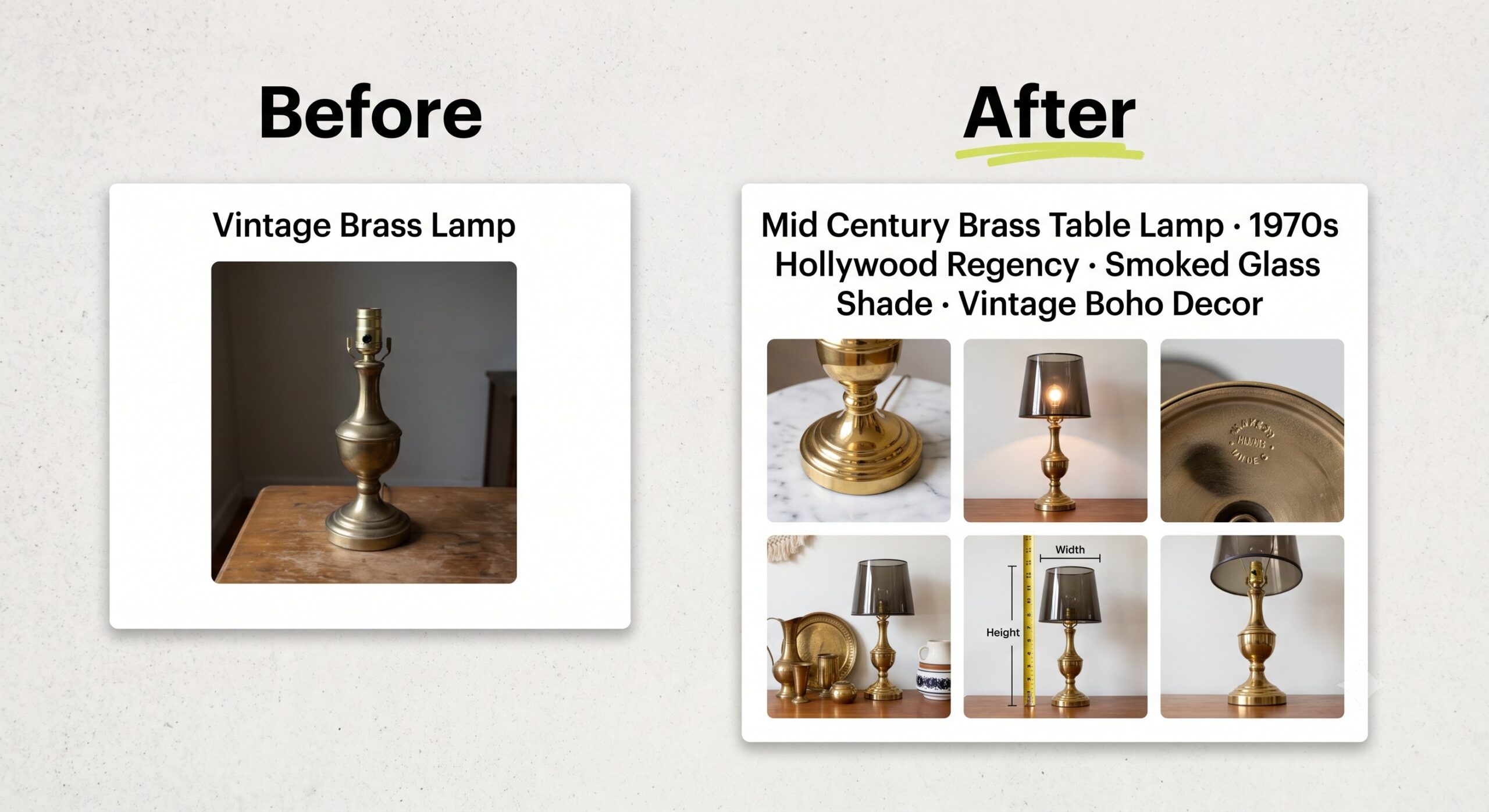
Here is a typical weak vintage listing:
Title: Vintage Brass Lamp
It names almost nothing a buyer searches: no era, no style, no size, no material detail beyond “brass.”
Now the rebuilt version, using the four moves:
Title: Mid Century Brass Table Lamp, 1970s Hollywood Regency Lighting, Smoked Glass Shade, Vintage Boho Decor
Tags (all 13, each 20 characters or fewer, no repeated words):
- mid century lamp
- brass table lamp
- 1970s lighting
- hollywood regency
- smoked glass shade
- vintage boho decor
- retro home accent
- moody living room
- gold metal light
- collector gift
- warm ambient light
- statement piece
- eclectic interior
Same lamp, but now it names the era, the style, the material, and the aesthetic, so it surfaces for the specific searches vintage buyers type, and the honest condition photos close the sale.
Common mistakes to avoid
- Listing “vintage style” as vintage. If it is not 2006 or earlier, it does not belong in the category, and mislabeling risks removal.
- Hiding flaws. The chip you cropped out becomes a return and a one-star review. Photograph every flaw and you build trust instead.
- No measurements. The most common online complaint is “smaller than expected.” One scale shot and exact dimensions prevent it.
- Generic titles. “Vintage lamp” competes with everything and gets found for nothing. Lead with era, style, and material.
- Obsessing over one listing. With one-of-one stock, your growth is the volume of distinct, well-tagged items, not a single hero.
- Cost-up pricing. What you paid at the estate sale is irrelevant. Price to comparable sold listings and condition.
- Skipping documentation. If Etsy asks about sourcing and you cannot answer, the listing is at risk. Note provenance per item.
FAQ
How old does something have to be to sell as vintage on Etsy?
At least 20 years old. The rule rolls forward each year, so in 2026 an item must have been made in 2006 or earlier to qualify. “Vintage style,” retro, and reproductions do not count, and Etsy can ask you to document an item’s age and origin.
How do I price vintage items on Etsy?
Price on rarity, condition, and demand, not on what you paid. Check sold listings for the same era, maker, and condition to see real prices, let condition move the number, and expect curated vintage to sell for roughly 3 to 5 times thrift-store cost. Factor in Etsy’s fees before setting the final price.
What keywords work best for vintage listings?
Combine an era or decade (1970s, mid century), a style (boho, art deco), a maker or brand when verifiable, and a material or color (brass, teak, burgundy). Put the most specific terms at the front of the title and use all 13 tags, mixing broad category tags with narrow collector phrases.
How should I photograph vintage items?
Shoot in natural light and show the whole piece from multiple angles, any maker’s mark, every flaw up close, and a scale or measurement shot. Honest condition photos are what earn a vintage buyer’s trust and prevent returns.
Do I need to disclose flaws in vintage listings?
Yes. Show and describe every imperfection, chips, wear, repairs, missing parts, in both photos and text. Vintage buyers expect age, but they will return an item and leave a poor review if a flaw is hidden. Disclosure builds the trust that lets you charge more.
How do I get found when every item is one of a kind?
Build the shop, not the listing. Because each item sells once, your search surface is the volume of distinct, well-tagged listings, each targeting its own era-and-style searches. A consistent aesthetic turns browsers into repeat buyers, and complete, healthy listings lift how Etsy ranks your whole shop.
Your vintage finds deserve better than page 37.
Connect your shop to Listadum free and see which listings are missing keywords or tags, with a fix suggested for each, so your one-of-a-kind pieces actually get found.
Free plan · no credit card · connect your real Etsy shop in minutes
Explore more
Etsy vintage policy · Etsy Seller Handbook: selling vintage · Etsy fee policy
Related: Niche Playbooks guide · Print-on-demand playbook · Selling digital products on Etsy