
The Niche Playbooks Guide
By Neha Chandelier, Co-founder of Listadum · Last updated: June 2026 · 16 min read
Quick answer: The Etsy advice that works for everyone works fully for no one. Each category, print-on-demand, digital downloads, jewelry, vintage, art, has its own buyers, search behavior, margins, and rules. This guide gives you the one framework that adapts to every niche, then a focused playbook for each, so you can stop applying generic tips and start running the plays that fit what you actually sell.
Most Etsy advice is written for “the average seller,” who does not exist.
I have watched sellers follow every generic tip to the letter and still stall. The tactics that grow a digital-download shop will quietly hold back a vintage shop. The photography that sells jewelry would look out of place on a print-on-demand mug.
This is the hub for niche-specific strategy. First the framework every successful shop runs on, then a mini-playbook for each of the five biggest Etsy niches, with a link to the full guide where one exists. Read the framework, then jump to your niche.
Why generic Etsy advice underperforms
Generic advice fails in the details, and the details are where Etsy shops win or lose:
- “Use all 13 tags” is true everywhere. But the tags that convert differ wildly: “custom name necklace gold” for jewelry versus “printable budget planner pdf” for a digital planner.
- “Take great photos” is true everywhere. But a vintage seller photographs genuine wear and patina honestly, while a POD seller shows a mockup.
- “Price for profit” is true everywhere. But a digital download has near-zero marginal cost, and a jewelry maker buys silver by the gram.
The framework below is the part that genuinely is universal. Everything after it is where your niche changes the play. Start there, then run your plays, not someone else’s.
The framework every niche runs on
Five moves show up in every Etsy shop I have seen work, whatever it sells. The moves are universal. How you run each one is where your niche takes over, and that is exactly the part most advice skips.
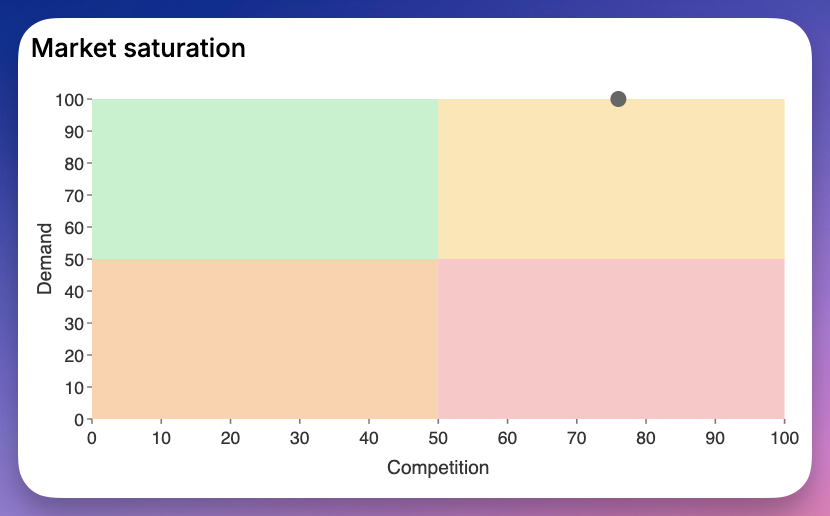
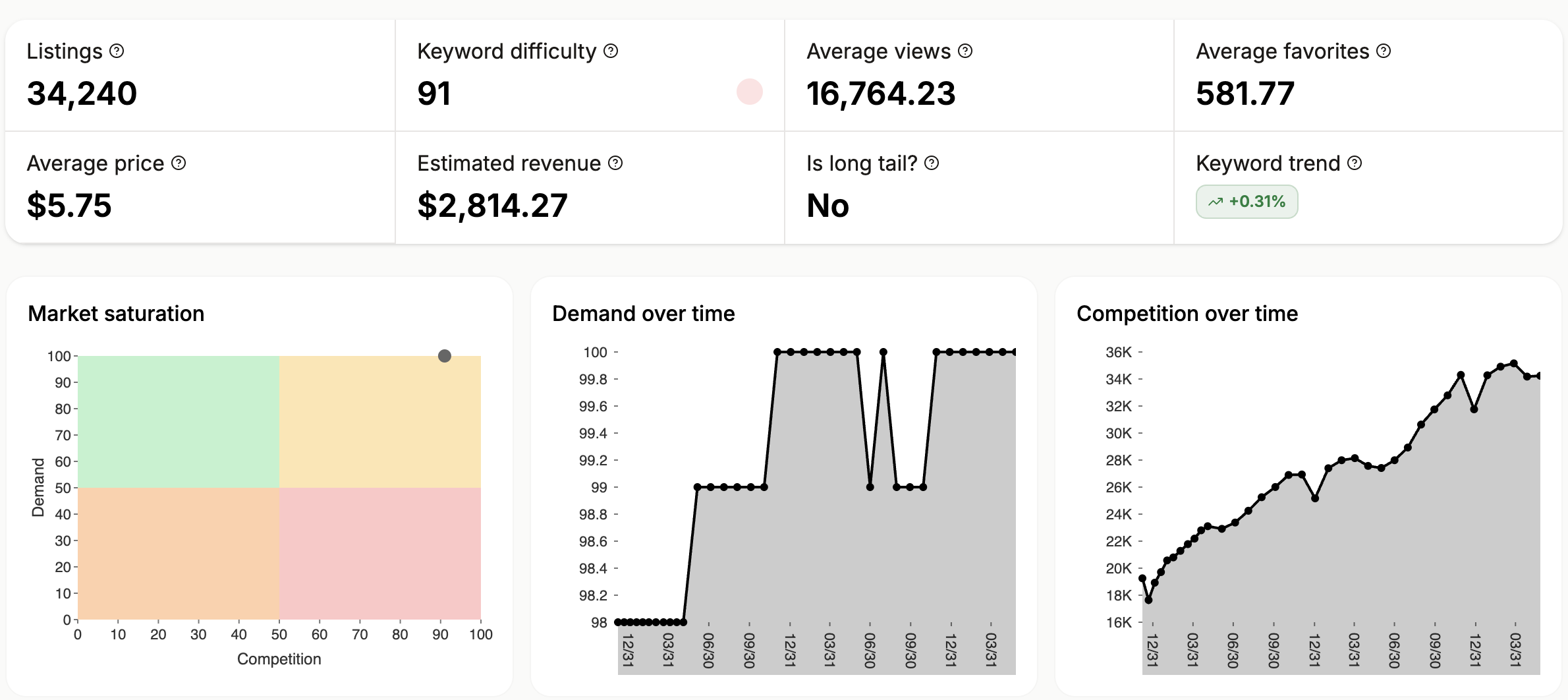
- Research demand before you make anything. Confirm there is real demand and a beatable gap before you design, source, or list. Making things nobody searches for is the most expensive mistake on Etsy (I made it early). A keyword tool that scores demand against competition turns the guess into a decision. Our keyword research workflow finds the low-competition pockets in any category.
- Differentiation a buyer sees in three seconds. Every niche is crowded. Picture the results page: a wall of thumbnails that mostly blur together. The click goes to the one whose difference is obvious at a glance, in the thumbnail and the first line of the title, before a buyer reads a word. Winners are the clearest, not the cheapest.
- Niche-tuned SEO. The mechanics of Etsy search are the same for everyone (see the Etsy SEO guide), but your buyers’ vocabulary is specific. Optimize for the words buyers actually type, not maker language. The full listing system is in the listing optimization guide.
- Pricing that survives your real costs. Margin is where niches diverge hardest. Know your true all-in cost (materials or base price, Etsy fees, processing, shipping) before you set a price, and price for profit rather than to be cheapest.
- Photography that answers buyer doubt. Every niche has a different “will this be what I expect” worry, and your photos exist to answer it: scale and material for jewelry, honest condition for vintage, the finished printed result for digital and POD.
Now the niches. Each section is a working mini-playbook; where a full guide exists, it is linked at the end.
Print-on-demand playbook
POD is the most scalable Etsy niche and the most misunderstood. The model: you create an original design, a partner like Printful, Printify, or Gelato prints and ships it, and you sell the finished product on Etsy. It is allowed, with clear rules.
Here is the playbook:
- Win on specificity. A generic “funny cat shirt” competes with a million others. A shirt for a narrow, identifiable audience (a hobby, profession, breed, or in-joke) has far less competition and a buyer who feels seen.
- Scale your winners. Land one specific design, then expand it across products and related niches.
- Price with discipline. Margins are thinner than handmade because the provider sets your base cost. Price above your true all-in cost, not just above the base, or you are quietly working for free. Listadum’s Profit Tracking syncs costs from Printful, Printify, and Gelato so you see real profit per order.
- Stay compliant. Be the original designer, disclose your production partner, and never imply handmade-by-you production.
Read the full playbook: Print-on-Demand on Etsy: the rules and the strategy, and the focused guide to selling custom t-shirts.
Digital downloads playbook
Digital downloads (printables, planners, templates, SVGs, digital art) have the best margin structure on Etsy: make once, sell infinitely, near-zero marginal cost.
Sounds like the dream, right? Here is the catch. If it is that cheap and easy for you to make, it is just as cheap and easy for everyone else, so the results fill up with near-identical files and price slides toward the floor.
So the strategy is to win on specificity and usability, not price:
- Get specific. A “budget planner” is a crowded term. A “zero-based budgeting planner for irregular income” is a buyer with a real problem and few good options.
- Make your photos do the work. There is no physical product to show, so use clean mockups of the printed or in-use result and show every page or variation.
- Spell out what they get. Set the file type, dimensions, and instant-download details so buyers know exactly what they receive. That heads off the messages and refunds that come from confusion.
- Treat traffic as your real constraint. Marginal cost is near zero, so SEO and a volume of well-differentiated listings are your main growth levers.
Read the full guide: Selling digital products on Etsy: tips and tricks.
Jewelry playbook
Jewelry is one of Etsy’s largest and most competitive categories, and also one where buyers expect to pay for craftsmanship. That combination rewards sellers who signal quality and trade on personalization.
Three moves carry a jewelry shop:
- Materials clarity. Buyers filter and decide on material (sterling silver, 14k gold fill, hypoallergenic), so set those attributes precisely and say it plainly in the title.
- Personalization, the highest-converting angle. Custom names, initials, birthstones, and dates turn a generic piece into a gift with intent, and gift buyers convert well and price-shop less.
- Scale and detail photography. A buyer cannot try it on, so give them a wrist or neck shot for scale, a macro shot for craftsmanship, and a lifestyle shot for the feeling.
- Pricing that respects real costs. Metal and stone add up, so know your per-piece cost before you set a price.
A full jewelry playbook is coming as part of this hub; the moves above are its core.
Vintage playbook
Vintage is the niche where Etsy’s rules are strictest and the strategy is most different. To be listed as vintage, an item must be at least 20 years old, and misrepresenting age is the fastest way to lose a listing. That constraint is also the moat: vintage cannot be mass-produced, so genuine sourcing is a durable advantage.
The vintage playbook is built on trust and discovery:
- Condition honesty. Photograph real wear, patina, flaws, and measurements. A vintage buyer expects imperfection but punishes surprises.
- Era-based SEO. Lean on era, style, and maker keywords (mid-century, art deco, a brand or designer name) far more than generic product terms, because that is how vintage buyers search.
- Build the shop, not the listing. Each piece is often one-of-one, so strong shop branding and consistent sourcing are what turn one-time finds into a repeat following.
A full vintage playbook is coming as part of this hub; lead with condition honesty and era-based SEO.
Art and prints playbook
Selling art on Etsy, original work or reproductions, is a balance between standing out as an artist and being findable as a product. I see so many talented artists get this half right: gorgeous work that never gets found, or findable listings that feel generic. The buyer is shopping for a feeling and a fit (a wall, a room, a gift), so your listing has to bridge emotion and specifics.
The art playbook rewards three moves, plus one rule:
- Show the art in context. A framed mockup on a real wall sells a print better than the flat file, because it answers the buyer’s “how will this look in my space” question.
- Sell every size and format clearly. Print buyers decide on dimensions and framing, and ambiguity kills the sale.
- SEO by style and subject. Use “botanical line art,” “abstract neutral wall art,” or a specific subject, not just “art print,” because that is how buyers browse.
- POD rules apply if you reproduce your own original work via print-on-demand.
A full art and prints playbook is coming as part of this hub; lead with in-context mockups and size clarity.
How to pick, or validate, your niche
Not sure which niche to pick, or whether yours still has room? Run the same simple test on each one you are weighing:
- Is there real search demand?
- Is the competition beatable?
- Can you make or source something genuinely different, and profitable, in it?
Use demand data rather than instinct. Look at what is selling, where the gaps are, and whether you can produce for a price that leaves real margin.
The best niche for you sits where genuine demand, beatable competition, and your own capability overlap. A niche with huge demand and brutal competition is a grind; a niche you love with no demand is a hobby. Aim for the middle.
And do not let anyone tell you your niche is “too saturated” without checking the data first. Crowded and unbeatable are not the same thing, and I see sellers talk themselves out of good niches all the time.
See where your shop stands in your niche. Run a free Shop Critique. It scores your listings and shows the specific gaps to close, with no signup required.
Worked example: one product, two niches
Say you make minimalist line-art prints of pets. The same core product plays very differently depending on the niche you frame it in.
Framed as art and prints, you lead with in-context wall mockups, sell multiple sizes and frame options, and use style-based SEO (“minimalist pet line art, neutral wall art”).
Framed as personalized print-on-demand gifts, you lead with the custom angle (upload your pet’s photo), emphasize gifting and occasions, sell it across products (print, mug, tote), and use gift-intent SEO (“custom pet portrait gift”).
Same art, two playbooks, two different buyers. Choosing the framing deliberately, instead of trying to be both at once, is most of the battle.
Frequently asked questions
What is the best niche to sell in on Etsy?
There is no single best niche; the best one for you is where real search demand, beatable competition, and your own ability to make or source something differentiated and profitable overlap. Print-on-demand and digital downloads scale easily but are crowded; jewelry and vintage reward craftsmanship and sourcing. Use demand data to validate before committing.
Do different Etsy niches need different SEO?
The mechanics of Etsy search are the same for everyone, but the keywords your buyers use are niche-specific. A vintage buyer searches by era and style, a digital buyer by file type and use case, a jewelry buyer by material and personalization. Optimize for the words your particular buyers actually type.
Is print-on-demand or digital downloads better for beginners?
Both have low startup costs. Digital downloads have the best margins (make once, sell infinitely) but heavy competition, so differentiation is everything. Print-on-demand is highly scalable but has thinner margins and strict originality and disclosure rules. Pick based on whether your strength is design volume (digital) or product range (POD).
How do I know if my Etsy niche is too competitive?
Use a keyword tool to compare demand against competition for your main terms. High demand with high competition means you need sharp differentiation to break in; moderate demand with low competition is the sweet spot. Also look at whether established shops have obvious gaps you can fill.
Can I sell in more than one niche in the same Etsy shop?
You can, but a focused shop usually ranks and converts better, because Etsy and buyers both reward a clear identity. If you span niches, keep each one coherent within its own sections and listings rather than blending them. Many sellers who scale eventually run separate shops per niche, managed in one place.
Does Etsy favor handmade over print-on-demand and digital?
Etsy increasingly emphasizes original, human creativity, but that is about originality and accurate representation, not banning POD or digital. As long as you are the original designer, disclose production partners, and represent your items honestly, POD and digital products remain fully allowed alongside handmade.
Find your niche’s next move, free
Whatever you sell, the fastest way to see your specific gaps is to let Listadum show you. Connect your Etsy shop on the free plan and get a completion score for every listing, demand-vs-competition data for your keywords, and the exact fixes ranked by impact, all tuned to what you actually sell.
Free plan · no credit card · connect your real Etsy shop in minutes
Neha Chandelier, Co-founder of Listadum, selling on Etsy since 2020. She writes about Etsy tips and tricks, how to sell on Etsy, and growing a handmade shop.
Related guides: Print-on-Demand on Etsy: rules and strategy · Selling digital products on Etsy · The Complete Guide to Etsy Listing Optimization