
Part of the Listing Optimization Guide
By Neha Chandelier, Co-founder of Listadum · Last updated: June 2026 · 14 min read
Quick answer: Optimizing an Etsy listing means tuning all six of its parts (title, tags, description, photos, attributes, and category) so the listing both matches what buyers search for and gives Etsy the quality signals it rewards. Do it in this order: attributes and category first, then tags, then title, then description, then photos. Get the foundation right once, and every future listing gets faster.
When I started selling on Etsy in 2020, I was sure the title and tags were the whole game. I rewrote my titles constantly, stuffed my tags with every keyword I could think of, and kept refreshing my stats waiting for the views to roll in. They didn’t.
It took me far too long to see why. Title and tags are only two of the six parts of a listing, and Etsy reads all six. I was polishing two corners and leaving the other four blank.
That is the exact mistake I now see in almost every shop I look at. Not bad titles, incomplete listings. The sellers who win are not the ones with the cleverest words. They are the ones whose listings are complete: every field filled, every signal pointing the same way.
So this is the whole system, the one I wish someone had handed me back then: what each part does, the order to work through them, and how to take a weak listing to a strong one in an afternoon. All of it is free to act on.
What “optimized” actually means on Etsy in 2026
Etsy search works in two steps, and you have to satisfy both.
- Step one: query matching. When a buyer types “personalized leather dog collar,” Etsy gathers every listing that could match those words, pulling from your title, tags, attributes, and categories. If the buyer’s phrase is not in those fields, you are not even in the running. This is the part most people call “SEO.” It is only the door.
- Step two: ranking by quality and conversion. Once Etsy has the matching pool, it decides the order using signals that predict clicks and sales: recent sales and views, conversion rate, your shop’s customer-experience score, photos, price, shipping, and how complete the listing is. A keyword-perfect listing with one dark photo loses to a slightly-less-perfect one that looks trustworthy.
So optimization is two jobs at once: be findable, then be the listing a buyer chooses. Every section below feeds one or both.
That is why “complete” beats “clever.” A fully filled-out listing sends more matching signals and more quality signals than a half-finished one, no tricks required.
For the deeper mechanics of how the algorithm weighs these factors, see our Etsy SEO guide. This guide stays focused on the listing itself.
Titles: front-load the phrase a buyer would type
Your title is the single strongest query-match field you control, and the first 40 or so characters carry the most weight. Treat the opening as prime real estate.
The mistake is writing for yourself instead of the buyer. “Handmade Artisan Keepsake, Crafted with Love” describes how you feel. Nobody searches that. “Personalized Leather Dog Collar, Custom Name Tag” describes what a buyer types.
A reliable structure:
- Lead with the core product phrase. The exact thing a buyer would search.
- Add two or three close variations. Different ways people look for the same item.
- Use the rest for attributes. Material, color, occasion, recipient.
- Separate ideas with commas so each phrase reads cleanly, and do not repeat the same word. Etsy does not reward stuffing, and shoppers find it hard to read.
One rule that trips people up: the words in your title should also appear in your tags. Etsy treats a phrase as a stronger signal when it shows up in more than one field. A title and tag set that agree beat ones that each go their own way.
Read the full guide: The Etsy Title Formula That Actually Ranks in 2026 walks through the formula with worked examples.
Tags: use all 13, and make every one count
Etsy gives you 13 tags. Using fewer leaves free relevance on the table, yet plenty of shops run with five or six. Fill all 13, every time.
The rules that matter:
- Use phrases, not single words. Each tag holds up to 20 characters, so “leather dog collar” beats a wasted “dog collar.” Long-tail phrases match how buyers actually search and face less competition, which is where a smaller shop wins.
- Do not repeat the same root (“dog collar,” “dog collars,” “dog collar tag”). It buys you nothing.
- Do not split a phrase across tags hoping Etsy reassembles it. It does not. Each tag is read as one complete phrase.
- Cover different angles with 13 distinct phrases: material, use, recipient, occasion, style.
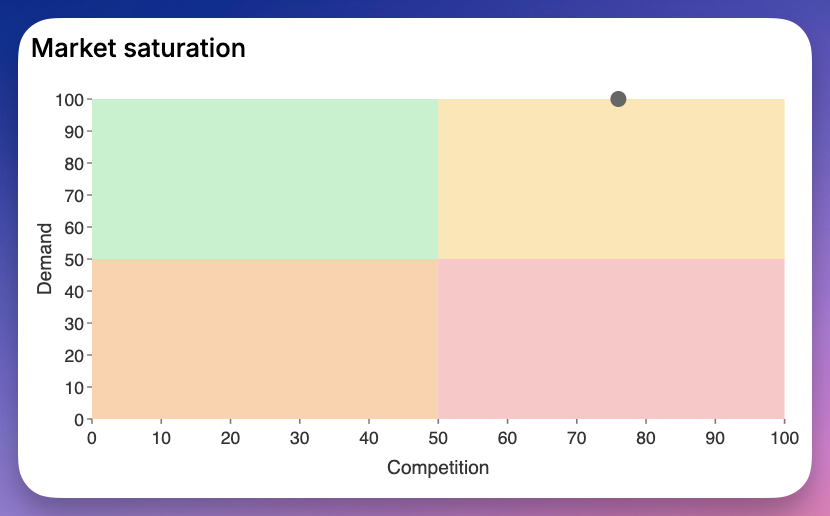
Where do the phrases come from? Real demand data, not guesses. Listadum’s Keyword Explorer color-codes phrases by demand and competition, so you can see at a glance which long-tail tags are worth a slot and which are too crowded to bother with.
Read the full guide: How to Write Etsy Tags That Get Found in 2026 covers the full 13-tag workflow.
Descriptions: the first two lines rank, the rest sells
For years sellers were told descriptions did not affect search. That is no longer safe to assume. Etsy now uses the opening of your description as a relevance signal, and AI shopping assistants and Google both read it to understand your product. The description is doing more work than it used to, not less.
Two jobs, in order:
- First two sentences: rank. Write them as if they have to stand alone, because they often do. Lead with what the product is and who it is for, in the same buyer language as your title.
- The rest: sell. The details a photo cannot show: sizing, materials, customization, the answer to the question that makes people message you before buying.
Break it into short paragraphs or a few labeled lines. A wall of text gets skipped on a phone, and most of your buyers are on a phone.
Write for a human, and let the keywords sit where they naturally fall. That always beats copy written to please a robot.
Read the full guide: How to Write Etsy Product Descriptions That Rank and Sell covers structuring the description for skimmers, search, and AI, with examples.
Photos: the 10-shot rule
Photos are where step two is won or lost. They drive whether a buyer clicks in search and whether they buy once they land.
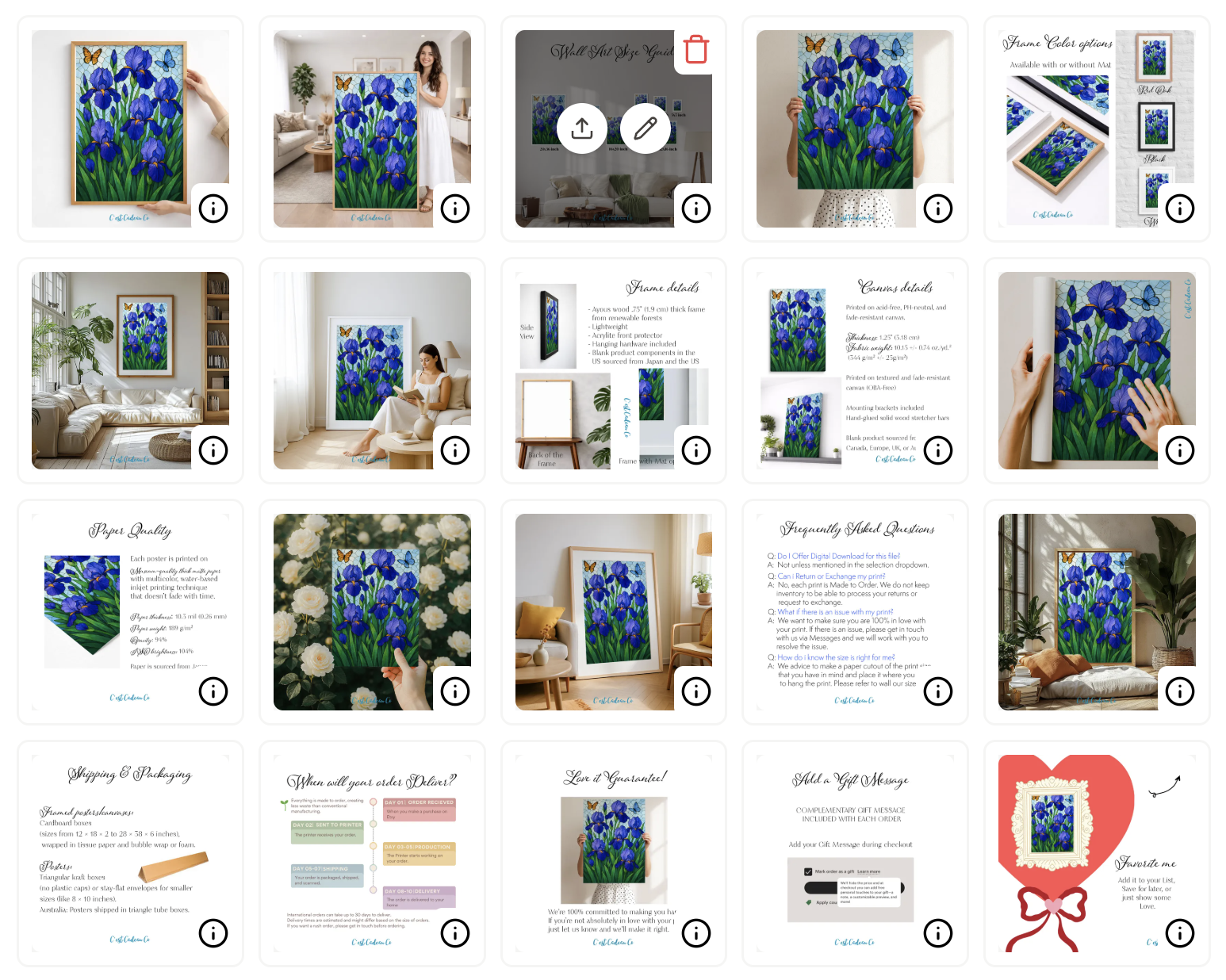
Etsy now gives you up to 20 photo slots and 2 video slots (the photo limit doubled from 10 to 20 in 2025), but more is only better when each one earns its place. Start with the core 10:
- Hero shot (your thumbnail; it has to win the click against a whole page of shops).
- In context or in use.
- A scale reference so buyers know the real size.
- Close-ups of detail and material.
- Variations, if you offer them.
- The doubt-killer: how it arrives, how it is packaged, how a customization looks.
When those answer a real question, the buyer has no reason to bounce to a competitor to check something you left out. Use the extra slots for more variations, seasonal styling, or process shots, and add a short video of the product in motion.
Quality matters as much as quantity. Bright, in-focus, well-lit images on a clean background read as professional. Test more than one hero image over time and keep the one that earns more clicks.
Read the full guide: The 10-Shot Etsy Photo Rule breaks down the core 10 shots, plus how to use the extra slots and video.
Attributes and category: the free relevance signal sellers skip
This is the most skipped, highest-return five minutes in Etsy optimization.
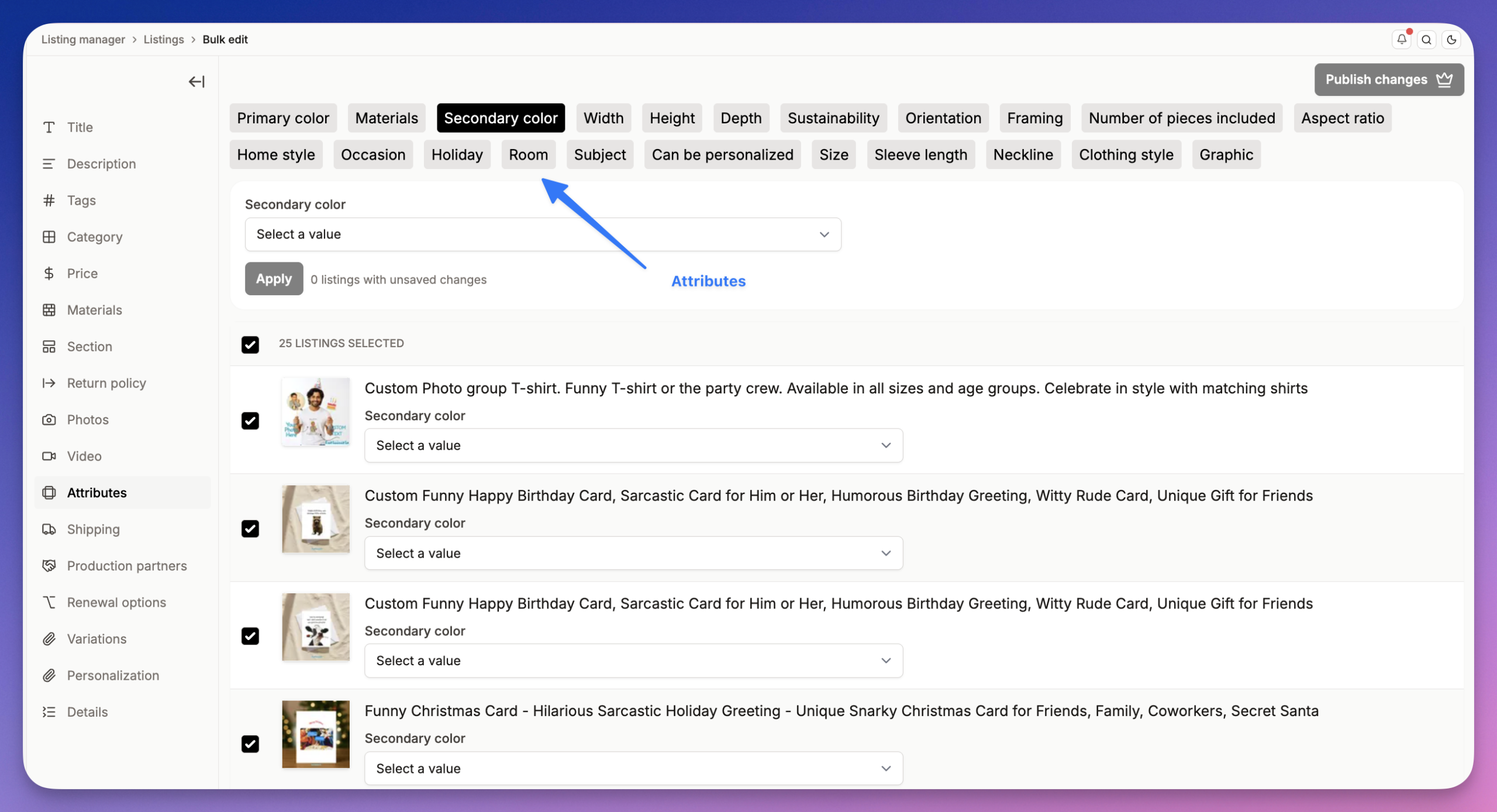
Attributes are the structured fields for color, material, size, occasion, recipient, holiday, and more. Most sellers fill a couple and move on. Filling all the relevant ones does two things:
- Feeds query matching, the same engine your tags feed.
- Places you in filtered search, where a buyer narrowing by “silver” or “for him” only sees shops that set that attribute. Leave it blank and you vanish from that result.
Your category works the same way. Choose the most specific category that fits, not the closest broad one. A bracelet filed under “Jewelry” competes with everything; filed under “Bracelets > Beaded Bracelets” it competes in its actual lane, in front of buyers who chose that path on purpose.
Attributes and category cost nothing but a few minutes, carry no stuffing risk, and have no downside to completeness. This is the clearest case on Etsy of “complete beats clever.”
The order to optimize in
One listing? Do all six parts now. 200 listings? You need a sequence so you start where the return is highest and nothing gets half-done.
- Attributes and category first. Fastest, zero risk, pure relevance and filter placement. Knock these out across the whole shop first.
- Tags next. Fill all 13 with researched long-tail phrases. Your biggest query-match lever after the title.
- Title third. Front-load the buyer phrase and make it agree with your tags.
- Description fourth. Rewrite the first two lines for relevance, the rest for conversion.
- Photos fifth. Most time-consuming, so it comes last, but highest-impact on conversion. Prioritize your best-selling and highest-traffic listings.
Work in this order and even if you run out of time, the cheap high-return work is already done everywhere, and the expensive work is concentrated where it pays back fastest.
Your listing optimization toolkit
The spoke guides under this hub, each going deep on one part of the listing:
- The Etsy Title Formula That Actually Ranks in 2026: the exact title structure, with examples.
- How to Write Etsy Tags That Get Found in 2026: the full 13-tag, long-tail workflow.
- The 10-Shot Etsy Photo Rule: the core 10 shots, plus the new 20 slots and video.
- How to Write Etsy Product Descriptions That Rank and Sell: structuring for skimmers, search, and AI.
- Etsy attributes and categories, in depth (coming as part of this hub): every attribute field and how to use it.
Worked example: one listing, weak to strong
Take a handmade beaded bracelet, currently titled “Pretty Bracelet, Handmade with Love.” Six tags, three photos, a one-line description, and only the color attribute set. In Listadum it scores low, and the gaps are easy to see.
The optimization pass, in order:
- Attributes and category: set material (glass beads), color, bracelet style, occasion, and recipient. Move it from “Jewelry” to “Bracelets > Beaded Bracelets.”
- Tags: replace the six single words with 13 long-tail phrases from demand data: “beaded bracelet for women,” “handmade gift for her,” “colorful stacking bracelet,” and so on.
- Title: rewrite to “Beaded Bracelet for Women, Handmade Gift for Her, Colorful Stacking Bracelet,” leading with the phrase a buyer searches.
- Description: open with “A handmade beaded bracelet for women, made to stack and gift.” Then sizing, materials, and customization in short labeled lines.
- Photos: add seven images: on the wrist for scale, a stack of variations, a close-up of the beads, the gift packaging, and a styled lifestyle shot.
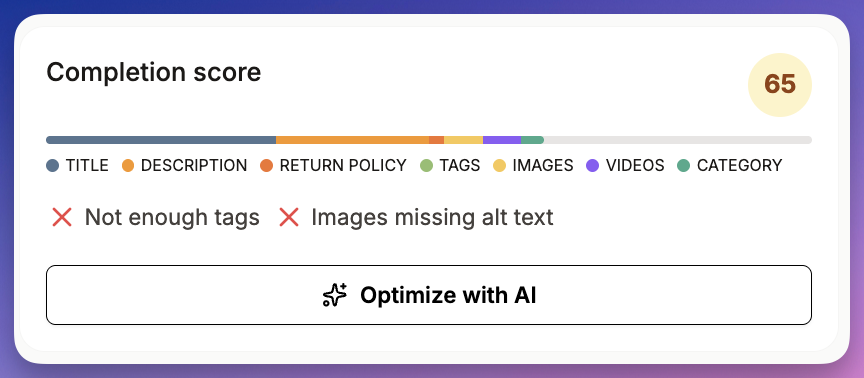
Same product. It is now both findable and clickable, and its completion score climbs as you fill the parts the score tracks (tags, description, photos, alt text). That score is the fastest way to see what a listing is missing without auditing it by hand.
See where your listings stand right now. Run a free Shop Critique. It scores your shop and lists the specific fixes that will move the needle, no signup required.
The Etsy listing optimization checklist
Run every listing through this, top to bottom. It is the whole guide on one screen.
Attributes and category
- Picked the most specific category that fits (clicked all the way down the path)
- Set every attribute that applies: color (primary and secondary), material, size, occasion, recipient, holiday, style or room
- Set the personalization or customization attribute if it applies
Tags
- All 13 tags filled
- Every tag a multi-word phrase, no single words
- No repeated roots, no phrases split across tags
- Phrases pulled from demand data, leaning to green (low-competition) where you can
Title
- Core buyer phrase in the first 40 or so characters
- Two or three close variations after it
- Title and tags share the strongest phrases
- Reads cleanly, no keyword stuffing
Description
- First two sentences say what it is and who it is for, in buyer language
- Body covers sizing, materials, customization, and the question people always ask
- Short paragraphs or labeled lines, easy to skim on a phone
Photos
- At least the core 10 shots (hero, in-use, scale, detail, variations, packaging or doubt-killer)
- A strong hero that reads at thumbnail size
- Bright, in focus, clean background
- Extra slots and a short video used where they add something new
Frequently asked questions
How long does it take to optimize an Etsy listing?
A single listing takes 15 to 30 minutes for a full pass once you know the order: a couple of minutes for attributes and category, about ten for tags and title, five for the description, and the rest on photos. Across a large shop, bulk-editing tags and attributes together is far faster than going listing by listing.
Does Etsy SEO still matter in 2026?
Yes, and the listing fields are where it lives. Etsy still matches buyer searches against your title, tags, attributes, and categories, then ranks the matches by quality and conversion. The mechanics evolve, but a complete, well-targeted listing remains the foundation of getting found.
How often should I re-optimize my listings?
Review them when traffic or sales drop, when you find new keyword opportunities, and at least once a quarter for your best sellers. Etsy rewards fresh, active shops, so periodic updates to tags, photos, and descriptions are worth the time, especially on listings that already earn traffic.
Do I really need to use all 13 tags and a full set of photos?
Use all 13 tags, always. For photos, Etsy now gives you up to 20 slots, so cover at least the core 10 shots and add more when they answer a real question. Every filled tag is another phrase you can match; every photo that earns its place is another buyer doubt you remove. Skip slots that would just be filler.
What is a listing completion score?
It is a 0-to-100 measure of how complete a listing is, with a breakdown of exactly what is missing: thin descriptions, unused tags, too few photos, no alt text. Listadum generates one per listing so you can work a checklist instead of guessing at “good SEO.”
Should I optimize old listings or focus on new ones?
Start with old listings that already get traffic or sales, because small improvements there compound on an audience you already have. Then bring the same standard to every new listing so you are not creating future cleanup work.
Will changing my listings hurt my current rankings?
Thoughtful updates help far more often than they hurt. Etsy does not penalize editing; it rewards active, improving shops. Avoid churning a listing constantly or deleting and recreating it, which resets its history. Edit in place, and give changes a few weeks to settle.
What is the single highest-impact change I can make today?
Fill in every attribute and choose the most specific category on your best-selling listings. It takes minutes, carries no risk, and immediately improves both your keyword match and your placement in Etsy’s filtered search.
Optimize your whole shop, free
You do not need to take a guide’s word for where your listings stand. Connect your Etsy shop to Listadum’s free plan and see a completion score for every listing, with the exact issues to fix, ranked by impact. Fix the easy wins first and watch the scores climb.
Free plan · no credit card · connect your real Etsy shop in minutes
Neha Chandelier, Co-founder of Listadum, selling on Etsy since 2020. She writes about Etsy tips and tricks, how to sell on Etsy, and growing a handmade shop.
Related guides: The Complete Guide to Etsy SEO · The Complete Guide to Running a Profitable Etsy Shop · The Etsy Title Formula That Actually Ranks in 2026