
—
By Neha Chandelier, Co-founder of Listadum · Last updated: June 2026 · 12 min read
The hub for the money side of your Etsy shop. Each lever below has its own focused guide. Sits alongside our Etsy SEO guide, Listing Optimization guide, and Niche Playbooks guide.
Quick answer: A profitable Etsy shop comes down to one equation: Profit = Revenue − Etsy fees − cost of goods − shipping − taxes. Etsy takes about 12 to 13% of every sale in base fees (before ads). Aim for net margins of 70 to 95% on digital, 25 to 50% on handmade, and 20 to 35% on print-on-demand. Price from your costs up to a target margin, never to undercut, and track real profit per order so you back the products that actually pay you.
I still remember my first “good” month on Etsy. Orders were rolling in, my stats looked incredible, and I was up past midnight packing every night. Then I added up what was actually left after fees, materials, and shipping, and it was almost nothing. I had been busy, not profitable.
That was the month I learned the thing nobody tells you in month one: traffic gets you the sale, but profit is decided after the sale, by your pricing, fees, shipping, and taxes. You can be the busiest shop on Etsy and still take home pocket change if those four levers are off.
This guide is the money side, with the real numbers, so you do not have to learn it the way I did.
In this guide
- Why “more sales” is not the same as “more profit”
- The profit equation every Etsy shop runs on
- What Etsy actually charges in 2026
- What profit margin should you aim for?
- Worked examples: what sellers actually keep
- How to price for margin (the formula)
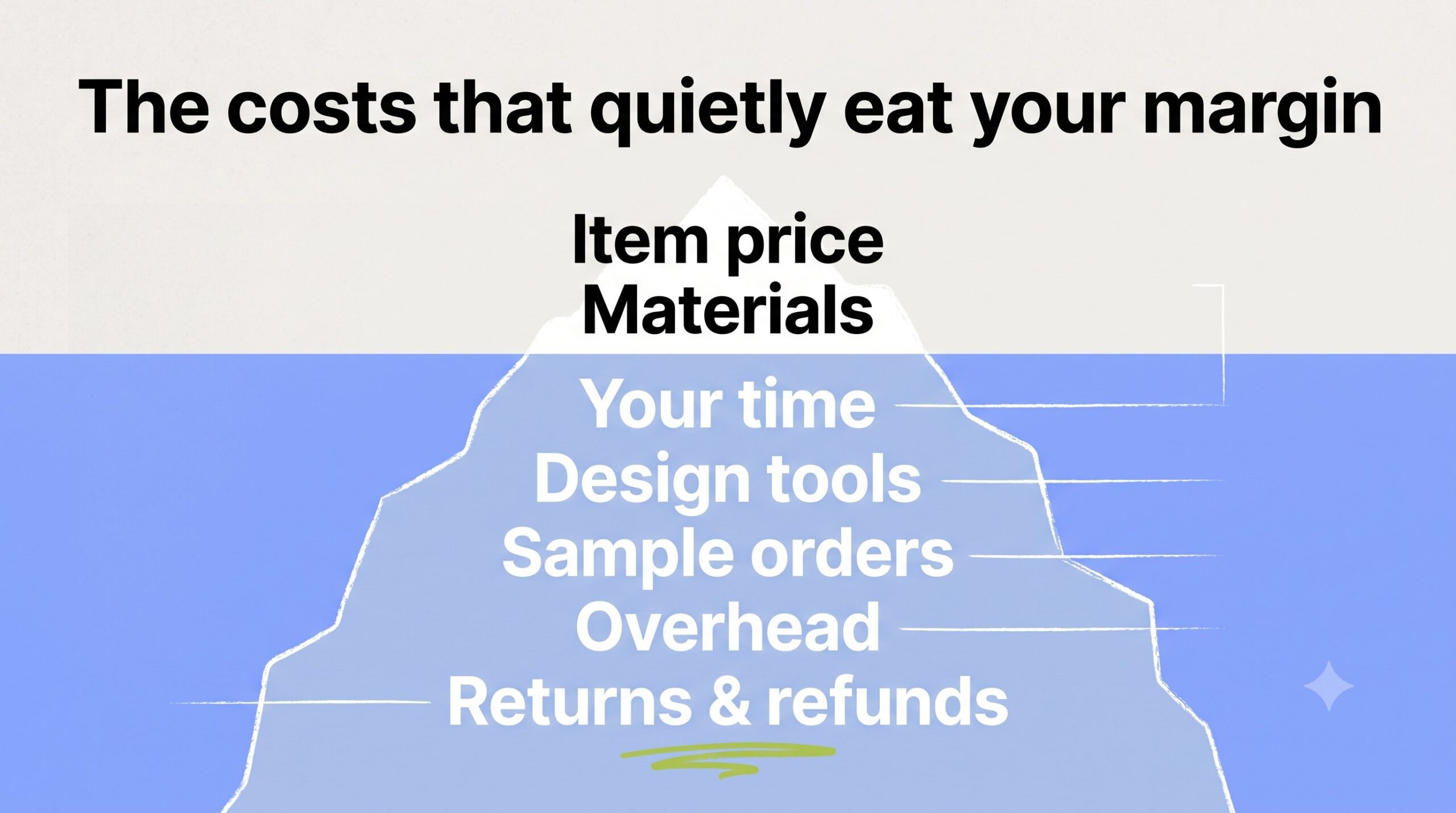
- The hidden costs that quietly eat your margin
- Shipping, sales tax, and tracking profit
- The biggest profit-killing mistakes
- Your monthly profit routine
- FAQ
Why “more sales” is not the same as “more profit”
More orders does not always mean more money.
Picture two listings. One sells 100 units a month at 80 cents profit each. The other sells 30 units at $6 each. The “bestseller” makes you $80. The quiet one makes you $180.
The bestseller can even lose money: if your costs creep above your price, every extra sale digs the hole deeper.
And here is the part nobody warns you about: thin margins do not just cost money, they cost motivation. When a sale nets you a dollar, launching a new product feels like a lot of work for almost nothing, so you stop. When a sale nets you fifteen, the next design feels worth making. Margin is what keeps you building.
The profit equation every Etsy shop runs on
The whole thing on one line:
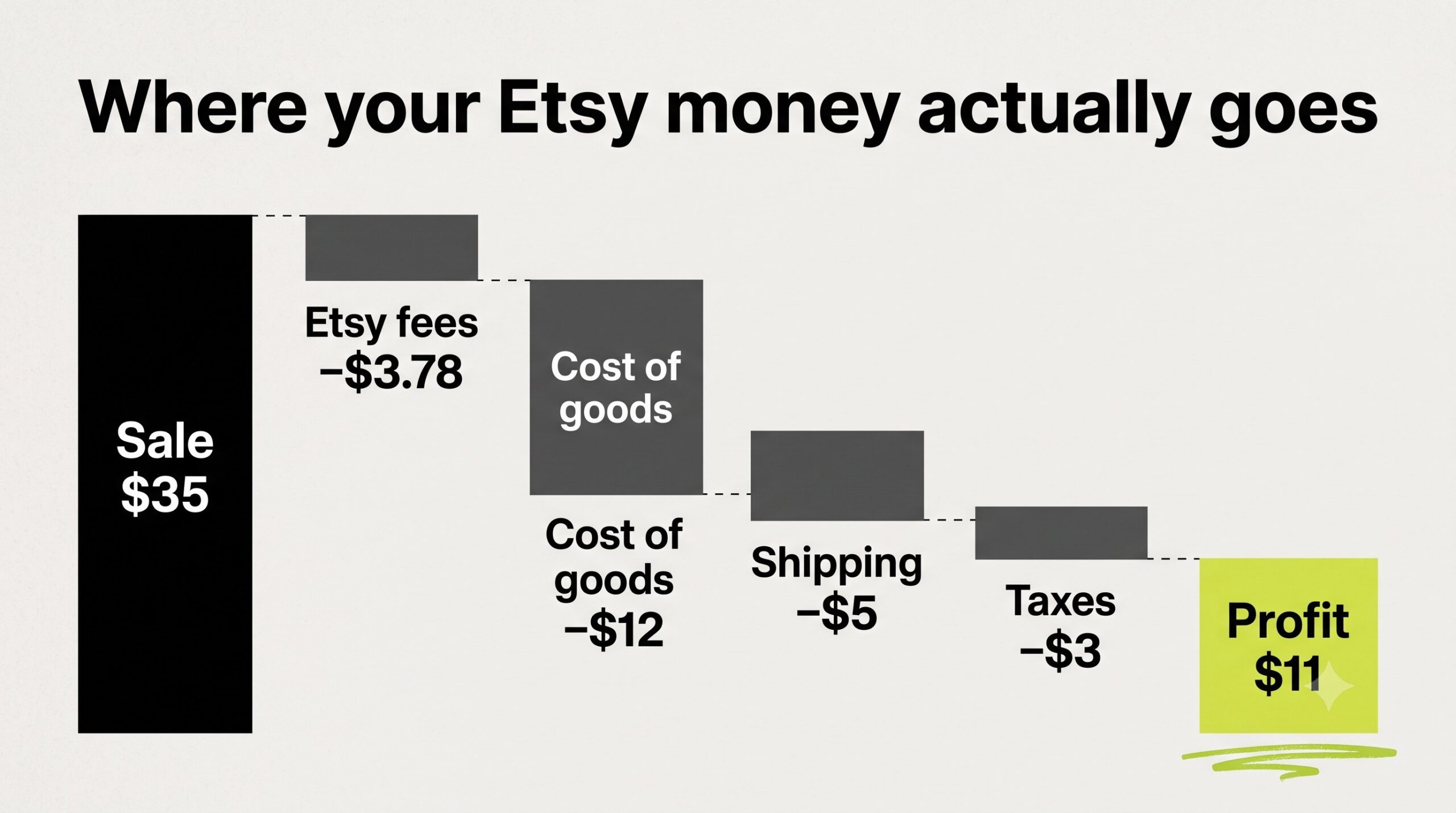
Profit = Revenue − Etsy fees − cost of goods − shipping − taxes
- Revenue: item price plus anything you charge for shipping.
- Etsy fees: listing, transaction, and payment processing (real numbers next).
- Cost of goods: materials or product base cost, plus your own time to make and pack. Your time is a real cost.
- Shipping: what it actually costs to ship, even when you advertise “free shipping” (you are paying it).
- Taxes: sales tax where it applies, and income tax on your profit.
Most sellers know their price and material cost, and stop there. The other three lines are where the money quietly leaks.
What Etsy actually charges in 2026
You cannot price for margin without knowing what Etsy takes. Current fees, straight from Etsy’s fee policy:
- Listing fee: $0.20 per listing. Charged whether it sells or not; the listing stays active for four months or until it sells.
- Transaction fee: 6.5% of the total order (item price + shipping + gift wrap + any personalization). Note: it applies to shipping too.
- Payment processing: 3% + $0.25 in the US. Varies by country, so check your local rate.
- Offsite Ads fee: 12 to 15%, but only on orders that come through an Etsy offsite ad. Shops under $10,000 in the last year pay 15% and can opt out; shops over $10,000 pay 12% and cannot. Capped at $100 per order.
Added up, the mandatory base fees (listing + transaction + processing) come to about 12 to 13% of each sale.
Worked example, a $30 item with $5 shipping ($35 total):
- Transaction fee (6.5% of $35): $2.28
- Payment processing (3% of $35 + $0.25): $1.30
- Listing fee: $0.20
- Total mandatory fees: about $3.78 (≈ 11% of the order)
- If that order came through an offsite ad (15%), add $5.25, for about $9.03 in total fees.
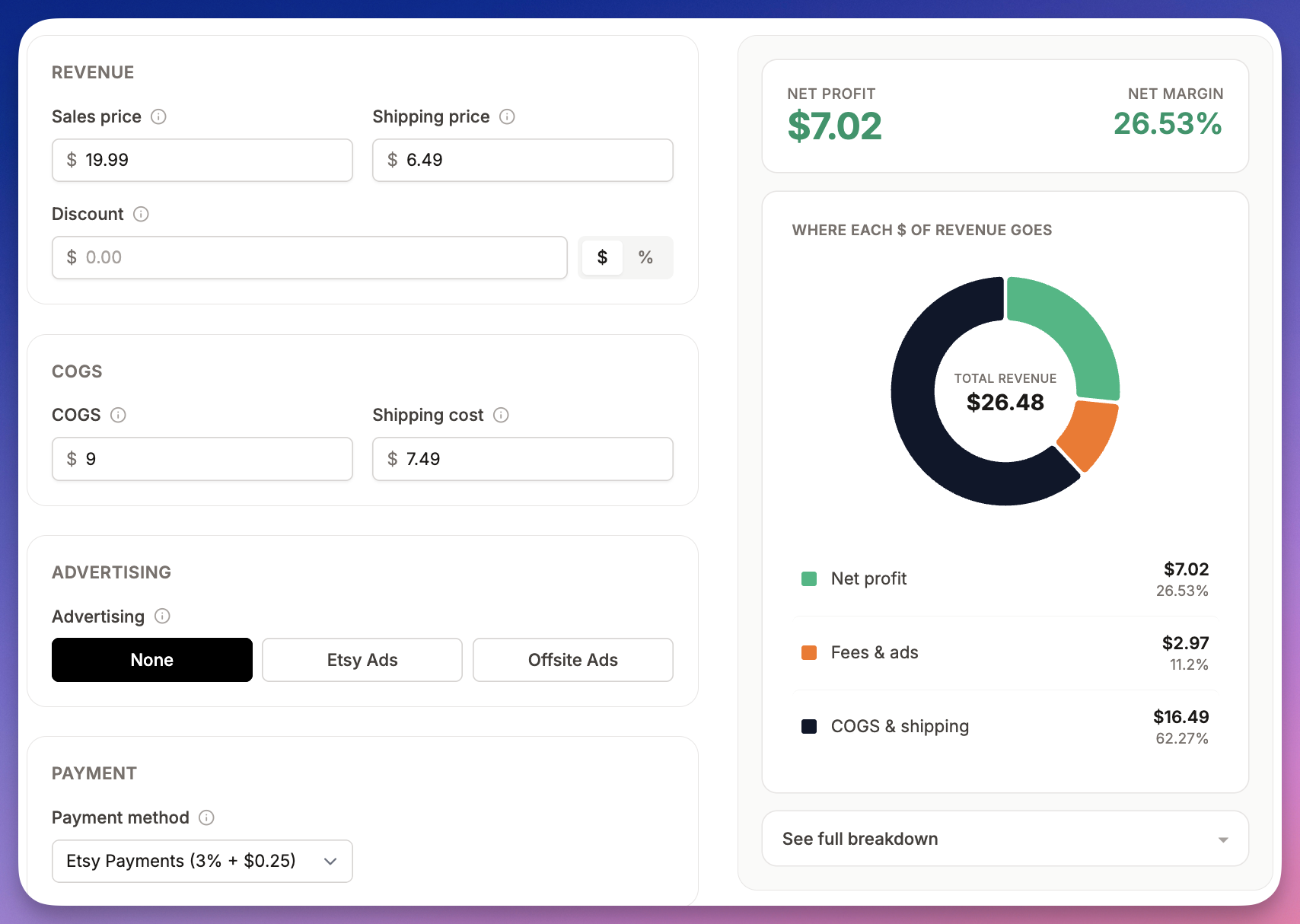
Free Etsy Fee Calculator. Type in any price and see your real take-home after every fee, in a few seconds.
For a deeper walkthrough of every fee and when it applies, see our Etsy fee calculator walkthrough (coming as part of this hub).
What profit margin should you actually aim for?
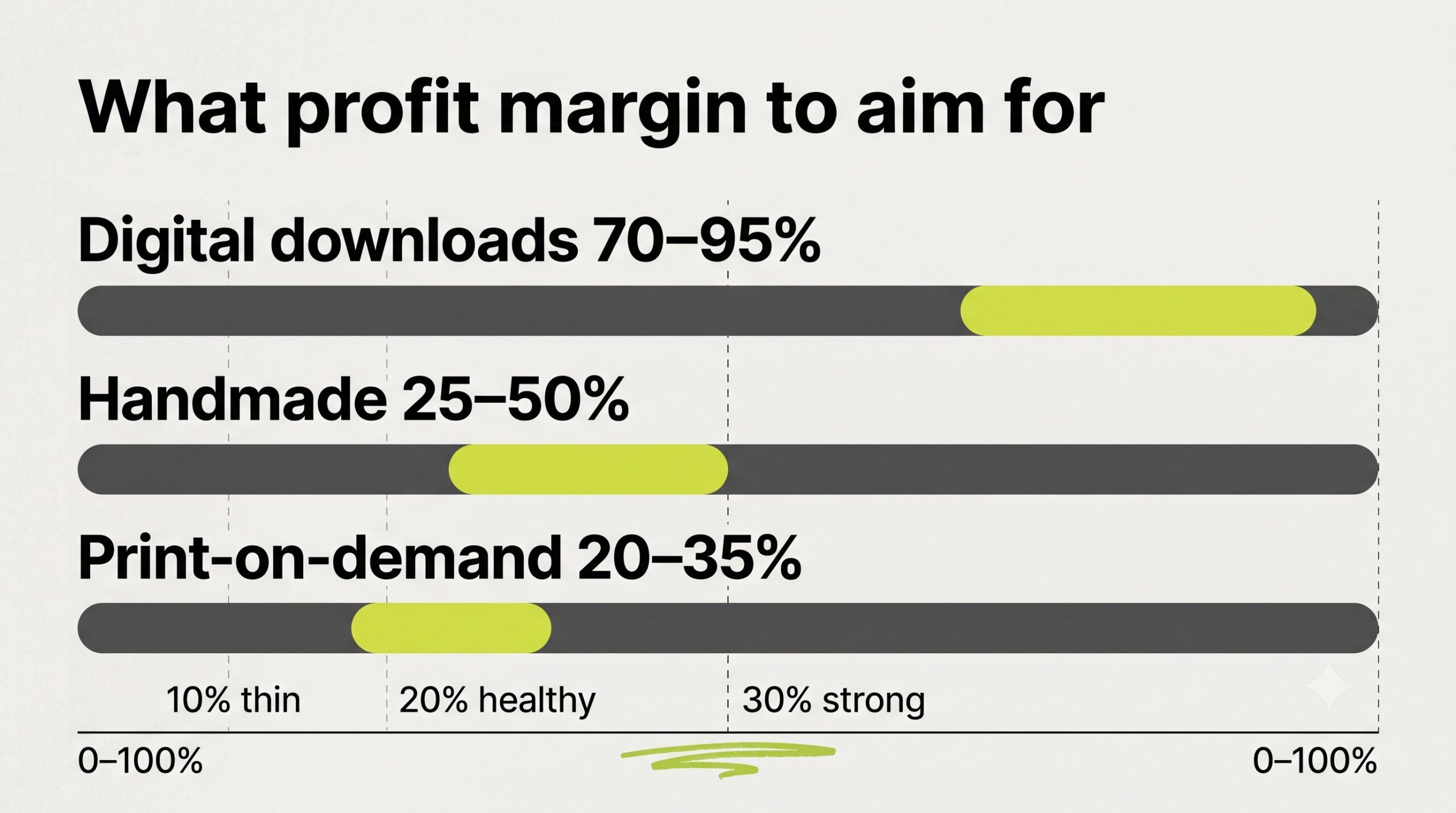
Margin is profit as a percentage of price. The right target depends on what you sell, because the cost structures are completely different. Rough 2026 benchmarks:
| Category | Typical net margin | Why |
|---|---|---|
| Digital downloads | 70 to 95% | Make once, sell infinitely. No materials, shipping, or inventory. |
| Handmade | 25 to 50% | Materials plus your time; quality and personalization let you charge more. |
| Print-on-demand | 20 to 35% | The provider’s base cost eats most of the price; branding lifts it. |
A simple rule of thumb across any category: under 10% is thin, 20% is healthy, 30%+ is strong.
Print-on-demand by seller maturity, because it is the niche where margins surprise people:
- New / competing on price: 15 to 25%.
- Optimized mid-tier (good designs and pricing): 30 to 45%.
- Premium, strong branding and unique designs: 50 to 65%.
The base cost from Printful, Printify, or Gelato is fixed, so your margin is made on price and design, not on volume. Price a POD shirt at “just above base” and Etsy’s fees can wipe the rest out.
Worked examples: what sellers actually keep
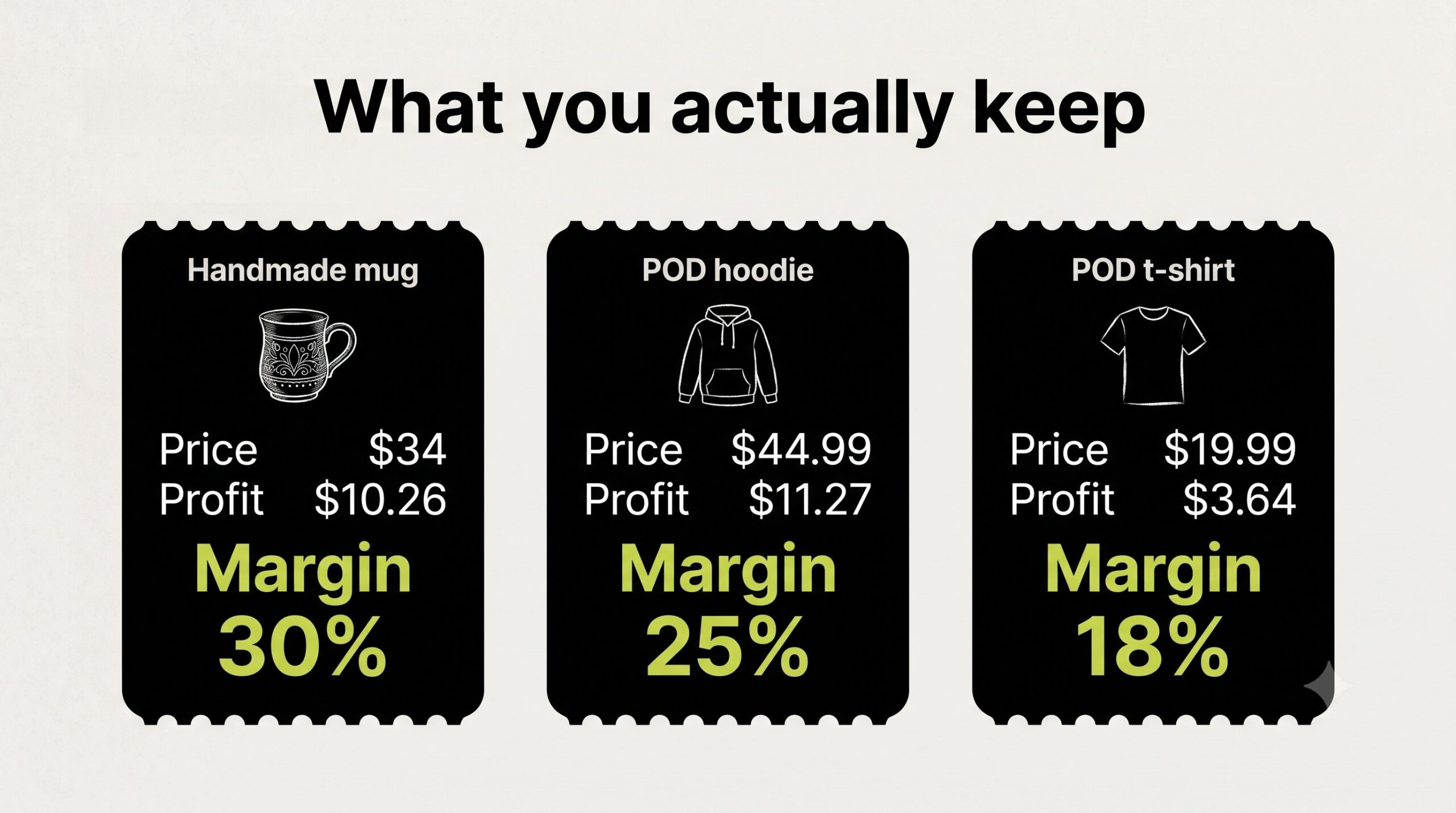
Here is the math on real products, with every line shown. (POD examples use “free shipping,” which on Etsy means you absorb the shipping cost.)
Handmade ceramic mug, priced with the formula:
- Materials (clay, glaze, packaging): $5.00
- Labor (0.5 hr at $25/hr): $12.50
- Overhead allocation (kiln, studio, supplies): $2.50
- True cost: $20.00
- Priced at $34 for a 30% target margin: Etsy fees ≈ $3.74, leaving $10.26 profit (30% margin).
Low-margin POD t-shirt:
- Sale price: $19.99 (free shipping)
- Production cost: $9.00
- Shipping you absorb: $5.00
- Etsy fees (6.5% + 3% + $0.25 + $0.20 listing): about $2.35
- Total cost: $16.35 → profit $3.64 (18% margin)
Higher-margin POD hoodie:
- Sale price: $44.99 (free shipping)
- Production cost: $22.00
- Shipping you absorb: $7.00
- Etsy fees: about $4.72
- Total cost: $33.72 → profit $11.27 (25% margin)
Notice the pattern: the higher-priced item carries the fixed costs (that $0.20 listing and $0.25 processing) far better, and clears more actual dollars. This is why premium products and unique designs out-earn a pile of cheap ones.
How to price for margin (the formula)
Price from your costs up, not from the market down. The handmade pricing formula:
Price = (Materials + Labor + Overhead) ÷ (1 − target margin % − Etsy fee %)
Worked: true cost $20, target margin 30%, Etsy fees 11%. Price = $20 ÷ (1 − 0.30 − 0.11) = $20 ÷ 0.59 = $33.90. Round to $34.
The steps:
- Add the true cost of one item: materials or product base cost, your time at a real hourly rate ($15 to $30+), an overhead allocation (monthly overhead ÷ items sold), and the Etsy fees (about 11 to 13%).
- Pick a target margin from the benchmarks above and plug it into the formula.
- Then sanity-check against the market. If you cannot be profitable at a competitive price, the answer is usually a better product or clearer niche, not a lower price.
Gut check: would you happily make this item a hundred more times at this price? If not, the price is too low, not the customer too cheap.
The full fill-in-the-blank version is in our guide to the Etsy pricing formula that protects your margin (coming as part of this hub).
The hidden costs that quietly eat your margin
These never show up in a single order, but they lower your real margin. Most sellers forget them:
- Your time to design, list, photograph, and handle customer messages. At $20 to $30/hr, two hours per design is $40 to $60 spread across its sales.
- Design tools and assets: Canva Pro (~$13/month), Adobe Creative Cloud (~$53/month), fonts and stock images.
- Sample orders for quality control, especially in POD, before you trust a product.
- Overhead: studio or storage, packaging, shipping supplies, software. Allocate it per item.
- Returns, replacements, and the occasional refund. Build a small buffer in.
You do not need to itemize these on every order. You do need to know they exist, so your “profit” is real and not just price minus materials.
Shipping, sales tax, and tracking profit
Three levers that quietly decide your take-home:
- Shipping. Build reusable shipping profiles (by weight, size, region) and make sure the true cost is covered, whether you charge for it or bake it into a “free shipping” price. Remember the 6.5% transaction fee applies to shipping too. Set honest processing times; bad reviews cost more than postage. (Full guide: Etsy shipping profiles, done once and properly, coming as part of this hub.)
- Sales tax. In many places Etsy collects and remits it automatically, but not everywhere or in every case, so know what applies where you sell. You also owe income tax on profit, so keep clean records from day one. We are not accountants, so talk to a tax pro for your situation. (Full guide: sales tax for Etsy sellers, coming as part of this hub.)
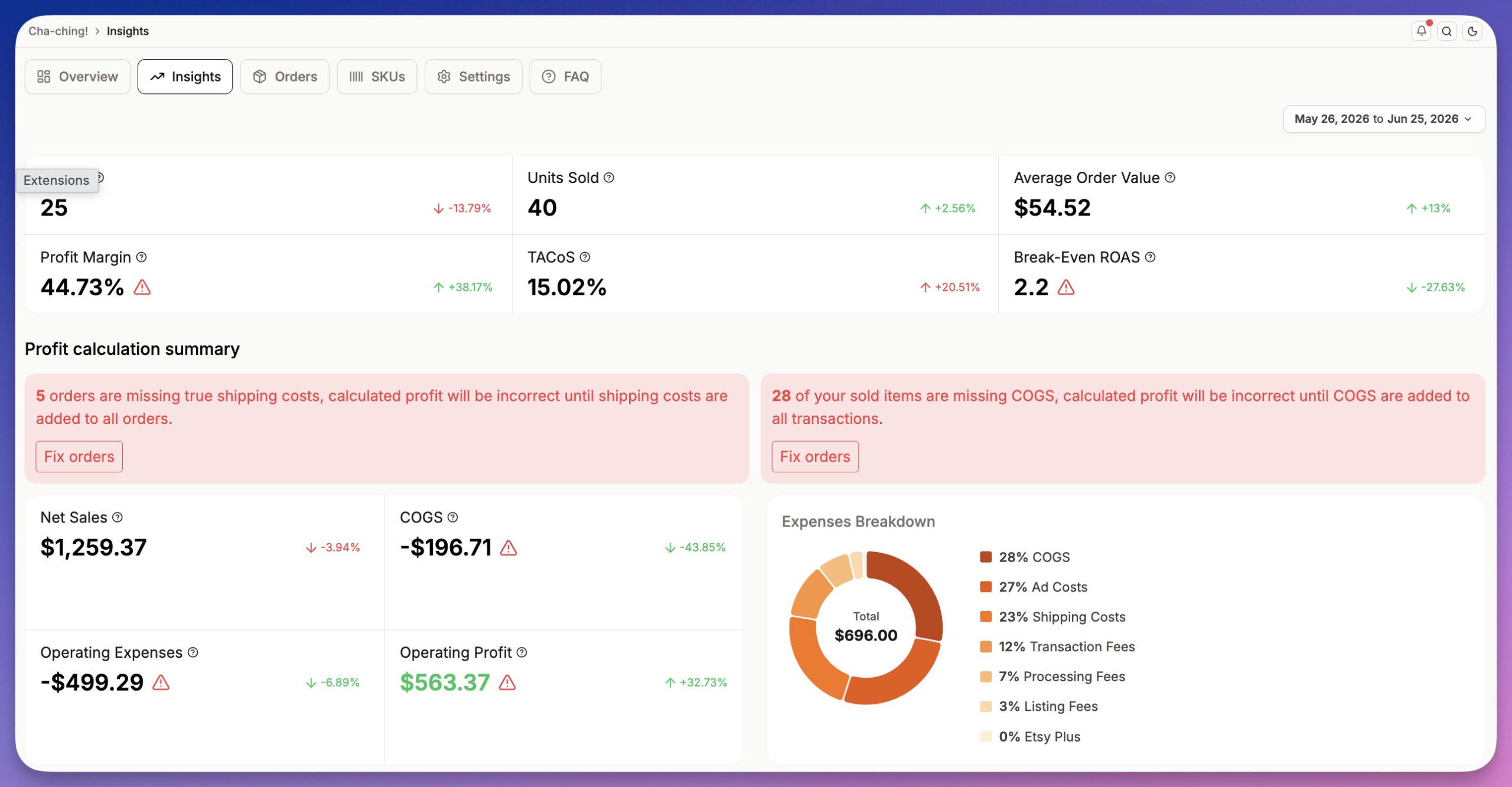
- Tracking profit per order. Doing the per-order math by hand is miserable, so most sellers never do it. Listadum’s Profit Tracking pulls your real costs together, syncs item costs from your POD provider where you use one, and shows actual profit per order and per listing, so you back the products that genuinely pay.
The biggest profit-killing mistakes
- Pricing your time at zero. Labor is the most-skipped cost and the biggest reason sellers undercharge.
- Racing competitors to the bottom. Competing on price alone is unsustainable; compete on design, quality, and niche.
- Ignoring the small fees. The $0.20 listing and $0.25 processing barely register on a $50 sale but gut a $6 one.
- Forgetting Etsy’s 6.5% applies to shipping. A “free shipping” price you did not adjust for is margin gone.
- Not tracking true cost per order, so you keep promoting busy products that quietly lose money.
- Chasing revenue instead of profit. Orders and revenue are vanity numbers; profit per order is the one that pays you.
Your monthly profit routine
No finance degree needed, just a short routine. Once a month:
- Pull your real profit per listing (Profit Tracking does this for you).
- Find your quiet winners and busy losers. Promote what pays; fix or retire what does not.
- Re-check pricing on anything under ~20% margin, costs up, with your time included.
- Confirm shipping still covers cost, since carrier rates drift.
- Set aside your tax money so it is never a surprise.
Ten minutes a month here will do more for your take-home than another dozen listings.
FAQ
How much does Etsy take per sale?
About 12 to 13% in mandatory fees: a $0.20 listing fee, a 6.5% transaction fee on the total (item + shipping), and payment processing (3% + $0.25 in the US, varies by country). On a $35 order that is roughly $3.78. If the sale comes through an offsite ad, add 12 to 15% more, capped at $100 per order.
What is a good profit margin on Etsy?
It depends on the category. Digital downloads run 70 to 95%, handmade 25 to 50%, and print-on-demand 20 to 35% net. As a rule of thumb, under 10% is thin, 20% is healthy, and 30% or higher is strong. Price to hit a target margin rather than to undercut competitors.
How do I price my handmade products on Etsy?
Use Price = (Materials + Labor + Overhead) ÷ (1 − target margin % − Etsy fee %). Add up materials, your time at a real hourly rate, an overhead allocation, then divide by one minus your target margin and Etsy’s ~11% fees. A $20 true cost at a 30% margin prices to about $34. Pricing your labor at zero is the most common undercharging mistake.
Why are my print-on-demand margins so low?
Because the provider’s base cost is fixed and Etsy’s fees come off the top, so pricing “just above base” leaves almost nothing. New POD sellers see 15 to 25% margins; optimized shops hit 30 to 45%, and premium branded ones reach 50 to 65%. Price for a target margin and track real profit per order.
Is more sales always better on Etsy?
No. A product can sell constantly and still make little or lose money once costs are in. Thirty orders netting six dollars each beat a hundred netting eighty cents. Watch profit per order, not just revenue or order count.
Do I have to charge sales tax on Etsy?
In many places Etsy collects and remits sales tax for you automatically, but it varies by location and situation, so check what applies where you sell. You also owe income tax on your profit, so keep clean records. Consult a tax professional for your specifics.
How do I track real profit on Etsy?
Subtract every cost from each sale: Etsy fees, materials, shipping, your time, and taxes. Listadum’s Profit Tracking does this automatically and can sync item costs from your print-on-demand provider, so you see actual profit per order and per listing instead of guessing.
—
Running the shop should pay you, not just keep you busy.
Listadum gives you the money side in one place: real profit per order, true take-home on every price, and the tools to fix what is leaking.
Free plan · no credit card · connect your real Etsy shop in minutes
Related: Etsy SEO guide · Listing Optimization guide
—