
Part of our Niche Playbooks guide. Pairs with the print-on-demand playbook, the digital downloads playbook, and the vintage playbook.
I opened my Etsy shop in 2020 to sell my own art prints, so let me be honest with you from the start, artist to artist. This is the category everyone thinks they can walk into, and it is the one that quietly broke my heart a little before it started to work.
The dream is real, and it is why we all start here. You make a piece once, list it, and it can sell while you sleep, no restock, no packing. Then you list your first print, search your own keyword to see where it landed, and find it buried under nearly 21 million other “wall art” listings. I remember that exact gut-drop. If you have felt it, you are not doing anything wrong. You just listed into the single most crowded search on Etsy, the same mistake I made.
Here is what took me too long to learn: the crowding is only at the top. The second you look one level down, past the generic terms, the picture changes completely. There are searches with real buyers and a fraction of the competition sitting right next to the saturated ones. That gap is the whole game, and most of us never look for it because we are too busy making the next piece.
I am not going to hand you the passive-income fairy tale here. Selling your own art is hard in ways that have nothing to do with the art, and I have felt all of them. But it is doable, and the sellers who make it are not the best artists, they are the ones who learned to be found. So let me save you the years it took me.
This is the playbook: which format to sell in, where the winnable demand actually is (with live Etsy numbers, not vibes), what is selling in 2026, how art buyers really search, the 2026 rules you cannot ignore, and how to price so a $6 print is still worth listing.
Quick answer: how do you sell art on Etsy in 2026?
Pick a format (digital download, print-on-demand physical, or original), then niche down hard, because every broad art term on Etsy is maxed out on competition. Four moves win the category:
- Choose your format for the margin you want. Printable digital art is instant and near-pure profit but sells for about $6. Canvas and framed prints sell for $50 or more but you fulfill them. Decide before you design.
- Compete on the specific search, never the generic one. “Wall art” has 21 million listings. “Gallery wall set” has 180,000 with almost the same demand. You win in the gap.
- Sell what is provably rising. Personalized art (pet portraits especially) and gallery-wall sets are pulling the highest demand right now. Some old favorites are cooling.
- Follow the 2026 rules. AI art must be disclosed and marked “Designed by,” print-on-demand needs a listed production partner, and purely AI-generated art cannot be copyrighted, so anyone can copy it.
In this guide:
- From artist to shop owner (and the original-vs-demand dilemma)
- The starting-out mistakes that cost artists months
- Pick your format first (digital, print-on-demand, or original)
- Find your lane by what you already make
- What the data says about art competition on Etsy
- Where the winnable demand actually is
- What is selling in art and prints right now (2026)
- How art buyers actually search (style, room, mood)
- The 2026 rules honest art sellers follow
- Pricing art and prints
- A thin art listing, rebuilt
- Listing mistakes to avoid
- FAQ
From artist to shop owner (and the original-vs-demand dilemma)
The moment you list your art for money, you quietly take a second job you never trained for: running a shop. Nobody warns you about that. You trained to make things, and now half the work is pricing, keywords, photos, packaging, and reading data, none of which is why you picked up a brush. That gap is where a lot of talented artists stall out, not from bad art, but from never making the shift.
And the shift comes with a dilemma that every artist I know has wrestled with: your original vision versus what the market is actually buying. You want to make the work in your head. The data says buyers want neutral botanical sets and custom pet portraits. Making “what sells” can feel like selling out the exact thing that made you want to do this.
Here is how I made peace with it, and it is the most important sentence in this whole guide: demand is information, not instruction. It does not get to tell you what you are allowed to create. It only tells you what people are already looking for, so you can decide what to make more of and how to frame what you already make. The balance that works is “one for them, one for me”: anchor your shop with a few demand-aligned pieces that pay the bills and pull in traffic, and let that traffic fund and surface the work that is purely yours. The buyer who came for a neutral print stays to discover your actual voice. You are not bending your art to the market, you are making it findable next to what the market is already reaching for.
The starting-out mistakes that cost artists months
Before the tactics, the pitfalls, because I made most of these myself and they cost me a year I did not need to lose.
- Making a huge inventory before a single sale. This is the big one. You design 40 pieces, list them all in a burst, and wait for the market to reward the effort. It usually does not. Make a small, tight collection first, list it, watch which pieces actually pull views and favorites, then make more of what is working. Validate, then produce. Painting into the void is not momentum, it just feels like it.
- Not deciding fulfillment before you list. Prints feel simple until you are hand-rolling one into a tube at 11pm, eating the cost of a corner that bent in transit, or realizing your home printer’s color is nothing like the screen. Decide up front: digital download (you never ship), a print-on-demand partner (they print and ship), or self-fulfilled (you control quality, but you also own the packing, the tubes, the post office runs, and every reprint). All three are fine. Not choosing is the mistake.
- Treating it like a hobby that happens to have a checkout. Sporadic listing, a different style every week, no reinvestment. A shop compounds only if you show up to it like a business, even a tiny one.
- Trying to be for everyone. A shop that is a little bit of everything reads as no one’s favorite. The clear lane you are tempted to avoid, because it feels limiting, is exactly what turns a browser into a follower.
- Quitting at three sales. Almost everyone does. The artists who make it are rarely the most talented ones in the category, they are the ones who treated the slow start as data instead of a verdict.
Pick your format first (digital, print-on-demand, or original)
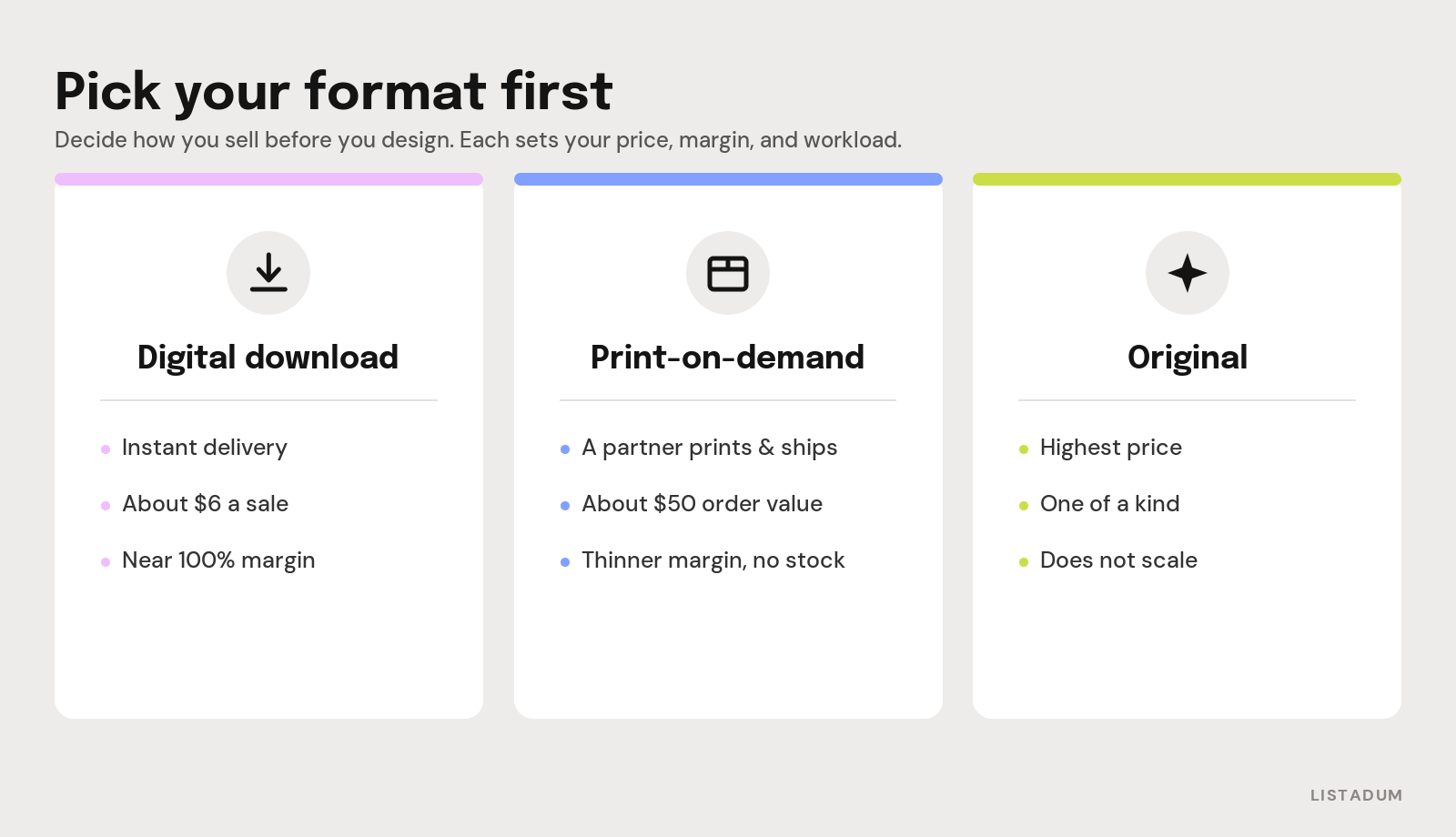
Before you design a single thing, decide how you are going to sell it, because the format sets your price, your margin, and your workload. There are three, and most sellers should pick one to start.
- Digital download (printable art). You upload the file once, the buyer prints it themselves, and you never touch fulfillment. Margins are near 100% and delivery is instant. The catch is price: printable wall art averages about $5.94, so this is a volume game.
- Print-on-demand physical. A print partner makes and ships a poster, canvas, or framed print when it sells. You carry no inventory, but you pay a base cost per item, so your margin is thinner and your price has to cover it. Canvas prints average about $49.84 and framed prints about $46.73, so the ceiling is much higher.
- Original art. One-of-a-kind pieces or hand-signed limited runs. Highest price and least competition, but it does not scale, and you are back to packing and shipping fragile things.
There is no wrong answer, only a wrong mismatch. If you want passive and high-volume, go digital. If you want higher order values without holding stock, go print-on-demand. Our print-on-demand playbook covers the fulfillment side in depth, and the digital downloads playbook covers the printable side.
Find your lane by what you already make
Format is half the decision. The other half is playing to the skill you already have, because the fastest start is the one that does not ask you to become a different artist first. Here is the quick map I would give you based on your background.
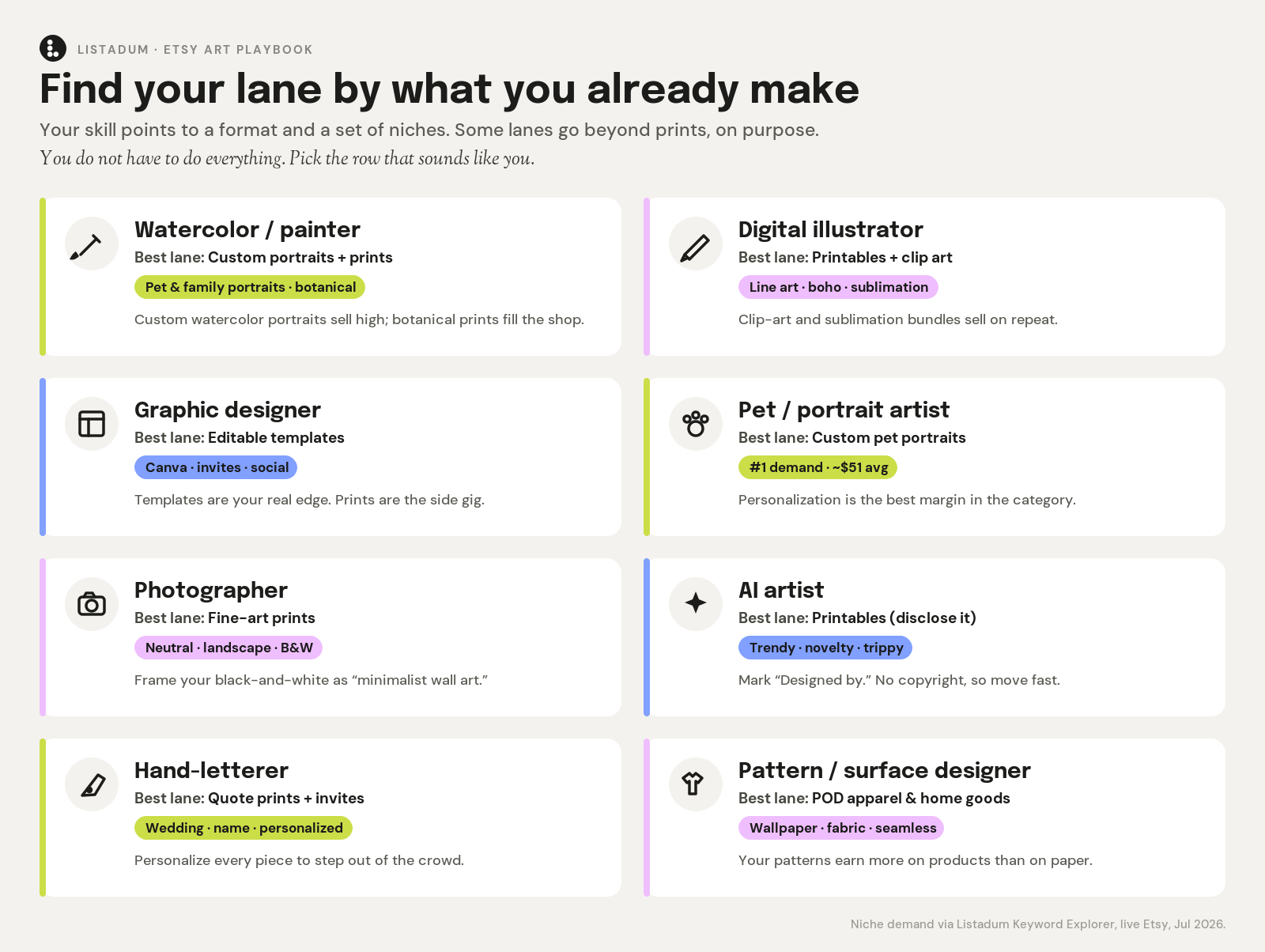
Find the row that sounds like you and start there. A couple of these lanes point past prints on purpose, because it would be dishonest to pretend wall art is every artist’s best move. If you are a graphic designer, editable Canva and invitation templates usually out-earn prints. If you are a surface designer, your patterns make more money on print-on-demand apparel and home goods than on paper. Start in the lane that fits your skill, and remember that a shop doing one thing well beats one doing eight things thinly.
What the data says about art competition on Etsy
Let me show you the wall before I show you the door. These figures come from Listadum’s Keyword Explorer, pulled from live Etsy data in early July 2026.
Every broad art term is pinned at the maximum competition score. Type the obvious keyword and you are one listing in millions:
| Search term | Live listings competing | Listadum competition score |
|---|---|---|
| wall art | 20.8 million | maxed out (100th percentile) |
| art print | 14.4 million | 100th percentile |
| digital download art | 7.1 million | 100th percentile |
| poster | 5.3 million | 100th percentile |
| printable wall art | 3.1 million | 100th percentile |
| canvas print | 2.5 million | 100th percentile |
No new shop ranks against 20.8 million listings. If your title just says “wall art,” you are found for nothing. That is not a reason to quit the category. It is a reason to stop competing where everyone else is.
Where the winnable demand actually is
Now the door. Go one level narrower and competition drops while demand stays high. These are real searches with real buyers and far fewer sellers:
| Narrow search | Live listings | Competition | Demand (views percentile) | Avg price |
|---|---|---|---|---|
| custom pet portrait | ~242,000 | 98 | 100th (max) | $51.02 |
| gallery wall set | ~180,000 | 97 | 99th | $27.40 |
| abstract print set | ~162,000 | 97 | 91st | $32.62 |
| trippy wall art | ~35,000 | 91 | 91st | $20.24 |
| mid century wall art | ~440,000 | 99 | 71st | $18.90 |
| line art print | ~245,000 | 98 | 56th | $10.89 |
Look at “gallery wall set”: near-max demand (99th percentile), one of the lowest supply counts in the whole category, and a healthy $27 price. Or “trippy wall art,” with the lowest competition score here (91) and only about 35,000 listings against 91st-percentile demand. These are the openings. They exist because most sellers stop at “wall art” and never niche down.
One caution the data makes just as clear: narrow is not automatically good. You still have to check demand, because a specific phrase with no buyers is just a quiet listing. That is exactly the demand-versus-competition read a keyword tool gives you, and why it matters more here than in almost any other category.
Find the art searches you can actually win. Listadum’s Keyword Explorer scores every style, room, and subject phrase by demand and competition, so you list into the gaps instead of the wall. Try the free Keyword Explorer →
What is selling in art and prints right now (2026)
Trends decide which of your designs move. Here is what the live demand and the 2026 market are both pointing at. One picture makes the whole point: size each art product by the money in it, shade it by buyer demand, and the winners are impossible to miss.
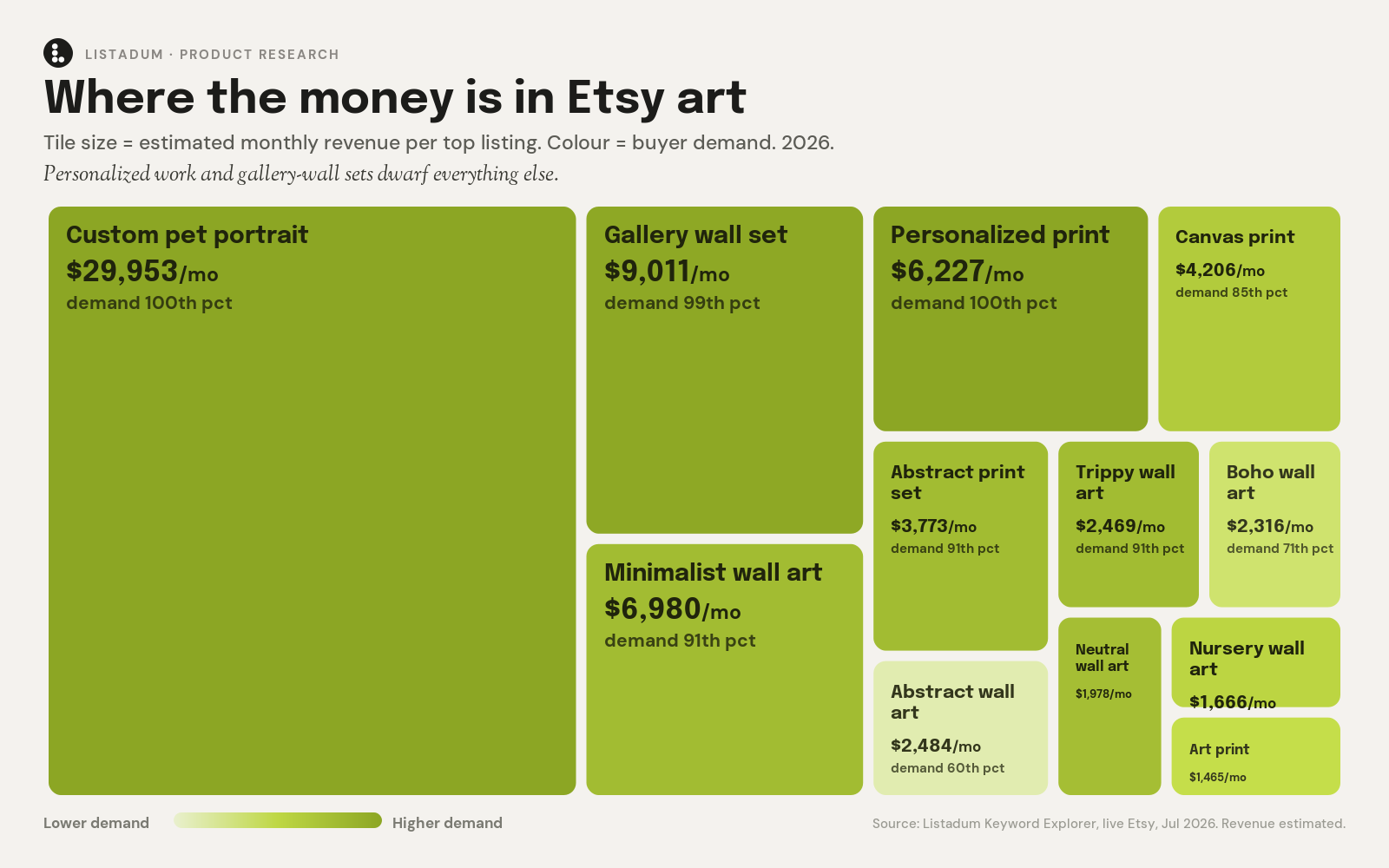
- Personalized art is the demand monster. “Custom pet portrait” sits at the maximum demand percentile with momentum climbing fast, at a $51 average price. Personalization is why the margins here are the best in the category: nobody else can make this buyer’s dog.
- Gallery-wall sets and bundles. Selling art in sets of three or six lifts your order value and rides near-top demand at a fraction of the competition. “Abstract print set” alone pulls 91st-percentile demand against only ~162,000 listings.
- Neutral, botanical, and nature-inspired. Searches for “neutral wall art” are up more than 40% year over year. Muted, earthy, calming palettes and botanical illustrations are the dominant 2026 aesthetic.
- Minimalist line art. Clean single-line faces, figures, and bodies keep selling because they fit almost any room.
And one honest warning the data gives us: cottagecore is cooling. Its demand is still high on paper, but views on the top listings dropped sharply over the last 30 days. If a trend is on the way down, list into it carefully. A keyword’s 30-day momentum tells you whether you are catching a wave or its tail.
How art buyers actually search: style, room, and mood
This is the part most of us avoid. Keywords feel like the opposite of art, and after a day of making, the last thing you want is to think like a search engine. I get it, I dodged it for a long time. But being found is not a betrayal of the work, it is what lets the work reach the wall it was made for. Fifteen minutes of tags is the price of a piece not dying in a folder.
Art buyers rarely type “print.” They describe a feeling and a place: “neutral botanical living room art,” “boho nursery print set,” “moody kitchen wall art.” So build your titles and tags from four ingredients:
- Style or aesthetic: boho, mid century, minimalist, abstract, cottagecore, vintage.
- Room: nursery, kitchen, living room, office, bathroom.
- Subject: botanical, line art, landscape, pet, figure.
- Color or mood: neutral, beige, moody, jewel tone, black and white.
Two rules make this work. First, put your most specific keyword at the front of the title, because the first characters carry the most weight and are what buyers scan. Second, use all 13 tags and mix a broad tag (“wall art”) with narrow ones (“neutral nursery set”), because niche buyers search the narrow ones and they are far less competitive.
Here is a lesson the data taught me that you will not find in most guides: word order is a ranking decision. “Custom pet portrait” is surging right now, while “pet portrait custom,” the same three words reordered, is actually cooling. Etsy treats them as different phrases. Listadum’s Keyword Explorer scores each phrasing so you tag the one that is winning, and our guide to writing Etsy tags that get found walks through the full method.
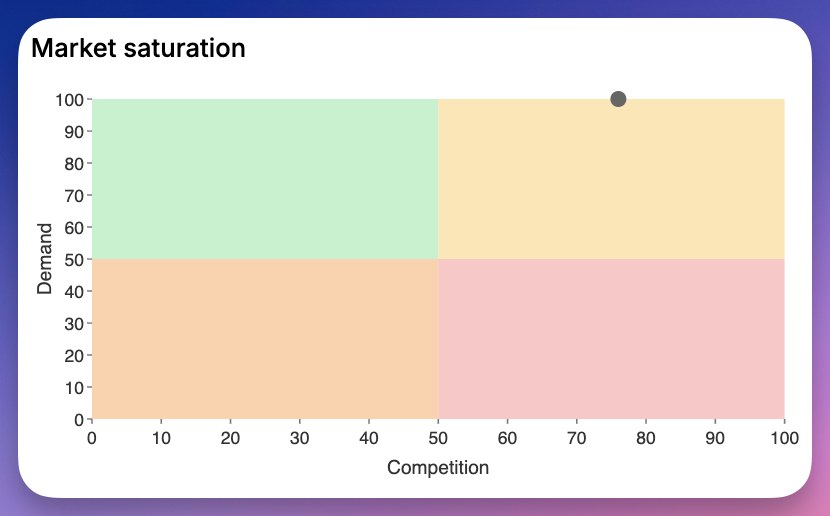
Free Etsy SEO Guide. Art lives or dies on being found. Get titles, tags, descriptions, and photos in one free guide you can work through listing by listing. Get the free Etsy SEO Guide →
The 2026 rules honest art sellers follow
I will be honest about how this one feels, because if you make your work by hand it stings. Watching the category flood with AI-generated art, listed faster than any of us can paint, is demoralizing. The small comfort is that Etsy is watching this category more closely than any other right now, and the 2026 rules are starting to protect the people who actually make things. Getting them wrong can cost you a listing or the whole shop, so learn them whichever side of the line you sell on.
- Disclose AI, and mark it “Designed by.” If AI played a real role in making the art, Etsy requires you to select “Designed by” (not “I made it”) in the item details and add a clear AI disclosure in your description. Hiding it risks removal.
- List your production partner for print-on-demand. Print-on-demand is allowed, but the design must be yours and you must name your production partner in the listing. Reselling someone else’s design (dropshipping) is not allowed.
- Know that purely AI art has no copyright. After the 2026 Thaler v. Perlmutter decision, work made entirely by AI has no copyright protection, which means anyone can legally copy and resell it. Your own hand in the design is what gives you something to protect.
- Skip fan art and movie posters. Characters, logos, and film artwork are protected. They sell until a takedown arrives, and then the shop is at risk. Build on your own work instead.
None of this is meant to scare you off. It is the opposite: sellers who follow these rules openly are the ones who last, because Etsy’s enforcement keeps clearing out the ones who do not.
Pricing art and prints: format sets the floor
I have to name the hard part first, because I lived it: pricing your own art feels strange in a way pricing a mug never would. It is yours, so it feels arrogant to charge more and safer to charge less, and almost every artist I know starts out underpriced. Please do not. Underpricing does not win the sale, it just trains buyers to see your work as cheap and leaves you resentful of a shop you built to love. Let the format, not your nerves, set the floor.
- Digital prints are a volume play. At roughly $6 for a printable, you make money on quantity and bundles, not on any single sale. Sell sets, sell collections, and cross-sell matching pieces.
- Print-on-demand has to clear the base cost. Your print partner charges you per item, so start from that cost, add Etsy’s fees, then add your margin. This is exactly where thin-margin sellers lose money without noticing.
- Sets raise the order value. A gallery-wall set of three at $27 beats three singles nobody bundles, and it matches how buyers actually decorate.
- Account for Etsy’s cut. Build in the standard fees before you set the price: a $0.20 listing fee, 6.5% transaction fee, and about 3% + $0.25 US payment processing (Etsy fee policy).
For print-on-demand especially, knowing your real profit per order is the difference between scaling a winner and scaling a loss. Listadum’s Profit Tracking syncs your print-partner costs and Etsy fees to show actual profit per order, not a guess.
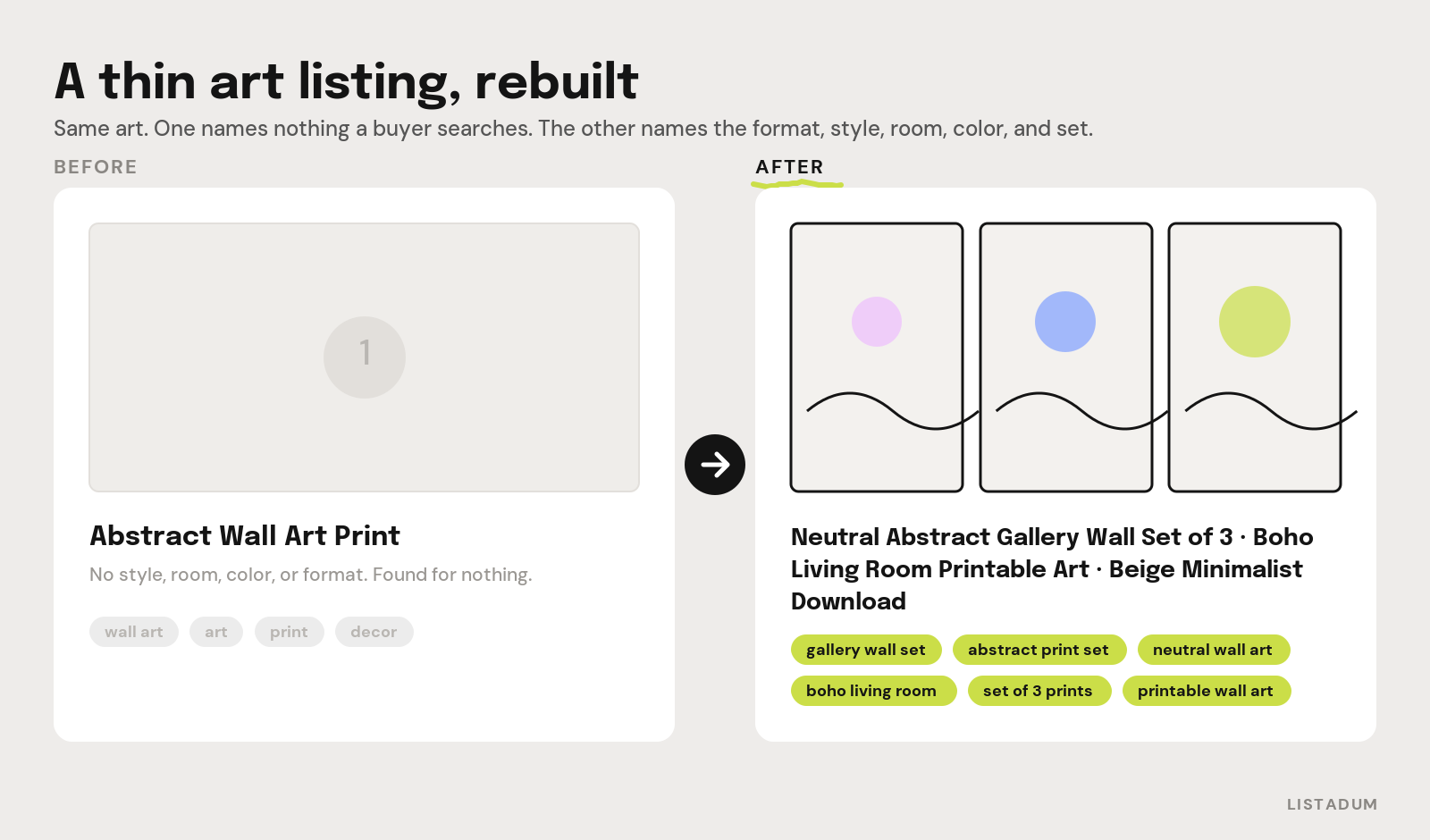
A thin art listing, rebuilt
Here is a typical weak art listing:
Title: Abstract Wall Art Print
It names nothing a buyer searches: no style, no room, no color, no set, no format. It competes with millions and gets found for none of them.
Now the rebuilt version, using the four ingredients and the set angle:
Title: Neutral Abstract Gallery Wall Set of 3, Boho Living Room Printable Art, Beige Minimalist Digital Download
Tags (all 13, each 20 characters or fewer, no repeated words):
- gallery wall set
- abstract print set
- neutral wall art
- boho living room
- beige wall art
- minimalist print
- printable wall art
- digital download
- set of 3 prints
- living room decor
- modern abstract
- earthy wall art
- housewarming gift
Same art, but now it names the format, the style, the room, the color, and the fact that it is a set, so it surfaces for the specific, winnable searches instead of the saturated one.
Listing mistakes to avoid
These are the execution-level ones, the mistakes that live inside a single listing once you are past the starting-out phase above.
- Competing for the broad term. “Wall art” and “art print” are unwinnable for a new shop. Lead with style, room, and subject instead.
- Ignoring format economics. Listing a $6 printable and hoping for a full-time income off single sales. Bundle, or move up to print-on-demand.
- Hiding AI. Not disclosing AI or marking it “Designed by” is a fast route to a removed listing.
- Selling fan art. Characters and movie posters sell until the takedown. Build your own designs.
- One print, one listing, no sets. Sets raise order value and ride high-demand, low-competition searches.
- Chasing a cooling trend. Cottagecore looks strong until you see the 30-day momentum. Check whether a trend is rising or falling before you commit a collection to it.
- Guessing tags. With competition this high, guessing wastes all 13. Score phrases by demand and competition first.
FAQ
How do I start selling art on Etsy?
Pick a format first: digital download (you upload a file, the buyer prints it, near-100% margin but about $6 a sale), print-on-demand (a partner prints and ships physical art, higher price, thinner margin), or original art. Then niche down, because broad terms like “wall art” have up to 21 million listings. Compete on specific style, room, and subject searches instead.
Is selling art on Etsy still worth it in 2026?
Yes, but only if you niche down. The broad searches are saturated, but narrow ones like “gallery wall set” (about 180,000 listings, 99th-percentile demand) and “trippy wall art” (about 35,000 listings) have strong demand and a fraction of the competition. The category is crowded at the top and wide open one level down.
Should I make the art I love or the art that sells on Etsy?
Both, and you do not have to choose one. Treat market demand as information, not instruction: it tells you what buyers are already searching for, not what you are allowed to create. A balance that works is “one for them, one for me,” anchoring your shop with a few demand-aligned pieces (neutral sets, pet portraits) that pay the bills and pull in traffic, then letting that traffic surface the work that is purely your own voice.
How much art should I make before I open my Etsy shop?
Less than you think. The most common starting mistake is designing dozens of pieces before a single sale. Start with a small, focused collection, list it, and watch which pieces pull views and favorites, then make more of what is working. Validate real demand before you mass-produce, so your effort follows the data instead of a guess. Deciding your fulfillment method (digital, print-on-demand, or self-shipped) before you list saves the other classic starting headache.
Can I sell AI-generated art on Etsy?
Yes, with disclosure. Etsy requires you to select “Designed by” rather than “I made it” and to state clearly in the listing that AI was used. Note that after the 2026 Thaler v. Perlmutter decision, purely AI-generated art has no copyright protection, so anyone can legally copy it. Your own creative input is what gives you something to protect.
What art sells best on Etsy right now?
By live Etsy data in mid-2026, personalized art leads, especially custom pet portraits, which sit at maximum demand with a $51 average price. Gallery-wall sets, abstract print sets, and neutral or botanical styles are also strong. Neutral wall art searches are up over 40% year over year, while cottagecore is cooling.
Should I sell digital prints or physical prints?
It depends on the margin and workload you want. Digital printables are instant and near-pure profit but average about $6, so they are a volume and bundle game. Physical print-on-demand (canvas around $50, framed around $47) carries higher order values but a per-item base cost and thinner margins. Many sellers start digital and add print-on-demand once a design proves itself.
How do I price art prints on Etsy?
Price to your format. For digital, sell sets and collections since single prints are low-ticket. For print-on-demand, start from your print partner’s base cost, add Etsy’s fees ($0.20 listing, 6.5% transaction, about 3% + $0.25 processing), then your margin. Tracking real profit per order matters most for print-on-demand, where thin margins hide losses.
One last thing, from someone who has been exactly where you are. The reason I ended up building tools for Etsy sellers is that I was an artist who could make the work but could not get it seen, and I refused to believe those were the same skill. They are not. You can learn the being-found part without becoming less of an artist. Make the thing only you can make, then give it the fifteen minutes of findability it needs to reach someone’s wall. That is the whole job.
Your art deserves better than page 40.
Connect your shop to Listadum free and see which listings are missing keywords or tags, with a fix suggested for each, so your prints actually get found and every order’s real profit is clear.
Free plan · no credit card · connect your real Etsy shop in minutes
Explore more
Etsy’s Creativity Standards · Etsy on AI creations · Etsy fee policy
Related: Niche Playbooks guide · Print-on-demand playbook · Digital downloads playbook · Vintage playbook