
By Neha Chandelier, co-founder of Listadum. Last updated June 7, 2026.
Part of our Etsy SEO guide. Pairs with Etsy titles and product descriptions.
You make beautiful things. So why are they sitting on page 37 of search?
Nine times out of ten, it is the tags.
Tags are the 13 little phrases that tell Etsy what your item is and who it is for. Get them right and Etsy shows your listing to the exact buyers typing those words. Get them lazy and your work just quietly disappears.
Here is the good news: tags are one of the few ranking factors you fully control. No ad budget, no waiting on reviews, no algorithm magic. Just 13 boxes and a bit of research.
Let me walk you through how to fill all 13 the right way.
TL;DR
- Use all 13 tags, every time. They are really a 260-character budget (13 tags, about 20 characters each). Fill it.
- Lead with hyper-relevant long-tail phrases. The exact phrases a buyer types, like “custom dog collar” (tags max out at 20 characters). These are your strongest matches.
- Then cast a wider net with unique words. Etsy breaks your tags into individual words and builds its own combinations, so every new relevant word opens up more searches.
- Never repeat a word. Etsy already recombines what you give it, so a repeat is wasted characters. Spend them on a new word instead.
- Pick phrases with real demand and beatable competition, which a keyword tool shows you in color.
- Verify your main keywords in Etsy’s Marketplace Insights (real search volume), then use Listadum for the multi-year trend and seasonality.
Why your tags decide whether you get found
Etsy search works by matching the words a buyer types against the words in your listing: your title, your tags, your attributes, your categories.
Tags are where you get to cast the widest net. You have 13 of them, and each one is another phrase you can show up for.
So think about it. If you fill 6 tags and leave 7 empty, you have cut your chances of being matched roughly in half. Same product, same photos, half the search surface.
That is the most common mistake I see, and it is the easiest one to fix.
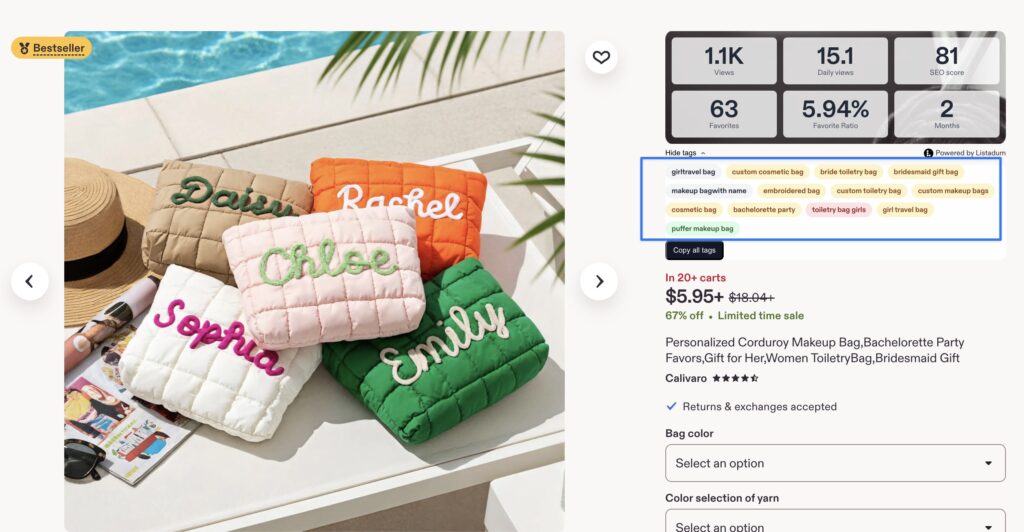
Use all 13, every single time
This one is non-negotiable. Fill all 13 tags on every listing.
An empty tag slot does nothing for you. It is not “saving” relevance for a stronger word. It is just a phrase you will never be found for.
If you are stuck finding 13, that usually means you are thinking too narrowly about your own product. Widen out by answering a few questions:
- What is it? The plain description: “linen apron,” “gold hoop earrings.”
- What is special about it? Material, style, color, technique: “hand-forged,” “minimalist,” “sage green.”
- Who is it for? “gift for new mom,” “gardener gift,” “teacher present.”
- When is it for? “housewarming gift,” “bridesmaid proposal,” “Mother’s Day gift.”
- What occasion or room? “kitchen decor,” “wedding favor,” “nursery wall art.”
Run your product through those five and you will have far more than 13 candidates. The job then becomes picking the best ones.
Free Etsy SEO Guide. Tags are one piece of it. Get the whole search picture, titles, tags, descriptions, and photos, in one free guide you can work through listing by listing.
Lead with long-tail phrases, then widen the net
Two things are true about how Etsy reads your tags, and using both is the whole game.
First, Etsy does not just match your tags as-is. It breaks each tag into individual words and builds its own combinations to match what buyers search. So your real budget is not “13 tags,” it is the roughly 260 characters across them (13 tags, up to 20 characters each). Every unique, relevant word you fit into that space gives Etsy another piece to combine, and another search you can show up for.
Second, your most important tags are the hyper-relevant long-tail phrases: the exact, specific phrases a buyer would actually type, like “custom dog collar” or “gold hoop earrings” (each tag maxes out at 20 characters, so phrases stay tight). These come first. They match how people really search, and they are specific enough that you are not buried under millions of broad listings.
So the order of operations is simple:
- First, your hyper-relevant long-tail phrases. The exact phrases that describe this specific item. These earn your strongest matches.
- Then, tags that cast a wider net. Relevant words that, combined with everything else, let Etsy match you on more searches.
A single broad word like “mug” or “art” is the weakest possible tag: hugely competitive, and Etsy can already build it from the words in your other tags. Spend the slot on a phrase instead.
The mistakes that quietly waste tags
Even sellers who fill all 13 often leak relevance through a few habits. Watch for these:
- Repeating a word. This is the big one. Etsy already recombines the words you give it, so once “ceramic” is in one tag, repeating it anywhere else buys you nothing and burns characters you could have spent on a new, relevant word. Listadum flags this as a repeated-tags issue for exactly this reason.
- Splitting a phrase into single words. Keep “dog collar” as one tag. It gives you the exact-phrase match and still feeds both words into Etsy’s combinations. Breaking it into “dog” and “collar” loses the phrase strength and burns an extra slot.
- Single-word tags. Covered above, and worth repeating: Listadum calls these out as a single-word tags issue because they are such a common drain.
- Leaving slots empty. The not-enough-tags issue again. All 13, always.
- Tags that do not match your item. Stuffing a popular but unrelated phrase (“Taylor Swift”) onto a candle gets you clicks that bounce, and bounce hurts your ranking. Stay relevant.
Where the good phrases come from
So how do you know which phrases are worth chasing? You stop guessing and look at the data.
Two things matter for every phrase:
- Demand: are people actually searching for it?
- Competition: how many other listings are you up against?
The sweet spot is high demand and low competition. Lots of buyers, not many sellers. That is where a small shop can land on page one.
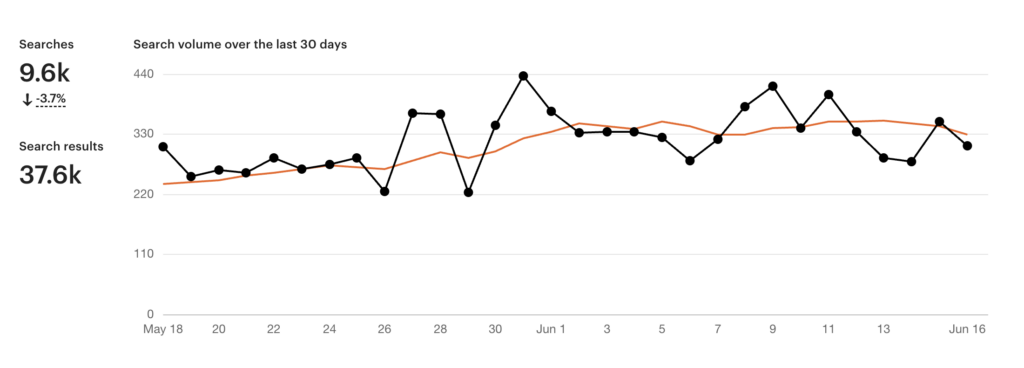
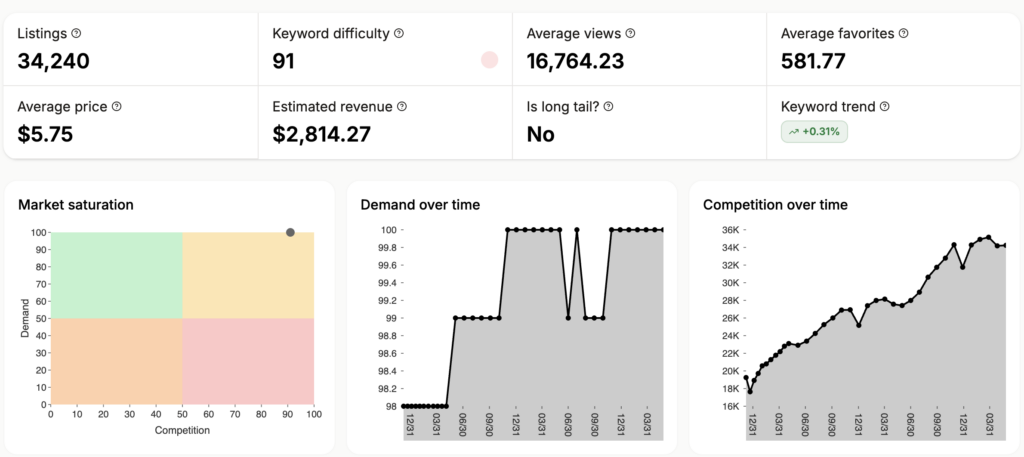
Listadum’s Keyword Explorer scores every phrase on exactly those two axes and color-codes them so you can read it at a glance:
- Green: high demand, low competition. Your best primary tags.
- Yellow: high demand, high competition. Worth chasing, but only if your listing is fully optimized to stand out.
- Orange: low demand, low competition. Great as secondary long-tail tags.
- Red: low demand, high competition. Skip these as primaries; fine only as the occasional hyper-specific secondary.
A quick note on honesty here: Listadum does not invent a fake “search volume” number. Etsy does not hand search volume to outside tools, so any third-party tool showing you an exact figure is guessing. (Etsy does show it to you directly, in Marketplace Insights, which is worth using for your main keywords. More on that next.) Listadum instead scores demand and competition relative to millions of other tags, and tracks them over years, which is the trustworthy way to read the market.
There is also a small number next to each tag: the keyword difficulty, from 0 to 100. Closer to 0 means easier to rank. Closer to 100 means you need real momentum already. Use it as a tiebreaker between two similar phrases.
Verify your main keywords with Etsy’s own data
There is one source that beats every tool for raw search volume: Etsy itself.
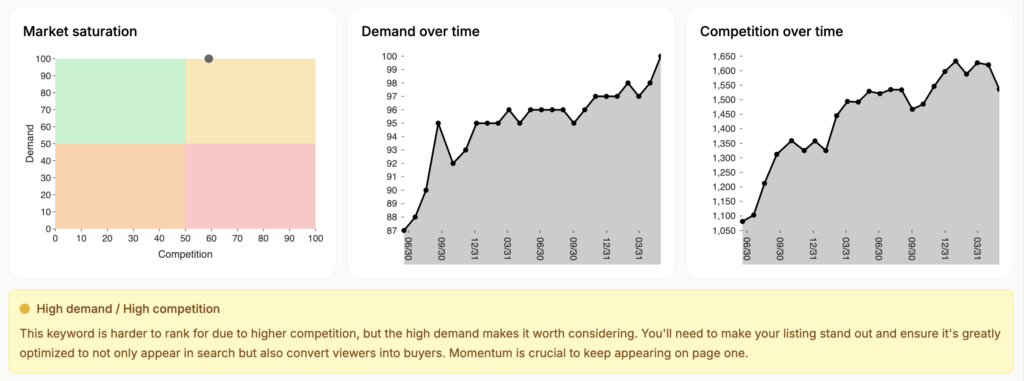
Etsy’s Marketplace Insights, inside your shop’s search analytics, shows the actual search volume for a term, straight from the marketplace. For the handful of primary keywords you are building a whole listing around, it is worth checking there to confirm real people are searching them.
Two things to know:
- Right now it shows about 30 days of data. Etsy is slowly rolling out a 12-month window, so some shops already see a full year. Check what your account shows.
- It is the best place to verify volume for your main keywords, because it is Etsy’s own first-party number, not an outside estimate.
So why still use Listadum? Because 30 days is a snapshot, and a snapshot hides the things that quietly sink a listing:
- Long-range demand and competition. Listadum tracks both over years, so you can tell whether a keyword is genuinely growing or just had one good month.
- Seasonality. A term that looks flat in July can triple in November. Listadum’s demand-over-time chart shows the pattern, so you tag for the season that is coming, not the one you are in.
Use them together: Etsy Marketplace Insights to confirm your primary keywords have real volume right now, and Listadum’s Keyword Explorer for the multi-year trend, the competition, and the seasonal swing before you commit.
Your tag workflow, step by step
Here is the routine I would run for any listing. It takes about ten minutes once you have done it twice.
- Step 1: Name your primary phrase. What is the most obvious thing a buyer would type to find this exact item? For a poster of pasta shapes, it is some version of “pasta poster.” Do not overthink it. Make that one of your tags.
- Step 2: Check your primary in the Keyword Explorer. Is it green or yellow? Good. Deep red? Your product may be in a low-demand niche, and no tag will fix that. Consider whether a nearby phrase has more pull.
- Step 3: Pull related and linked keywords. The Explorer shows phrases that commonly appear near yours. This is your candidate list for the other tags.
- Step 4: Build a spread. Aim for a mix that leans toward the top half of the demand/competition chart. A few green primaries, some yellow and orange long-tail, the odd red only if it is perfectly relevant.
- Step 5: Run your five questions. What is it, what is special, who is it for, when, what occasion. Fill any remaining slots with phrases that answer these.
- Step 6: Clean up. No repeated words, no split phrases, no single words, no empty slots. All 13 working.
- Step 7: Match your title. Your strongest tags should also appear in your title. Title and tags agreeing is a real ranking signal.
That last step matters more than people think. Tags and titles are a team, not two separate chores.
Worked example: weak tags to 13 strong ones
Say you sell a hand-poured lavender soy candle. Here is a typical weak setup:
- soy candle
- lavender candle
- scented candle
- aromatherapy candle
- candle gift
- handmade candle
- home decor
Seven tags, six slots left empty, and the word “candle” stuffed into six of them. Every term is broad and saturated, and because Etsy already recombines your words, repeating “candle” everywhere buys you nothing. Let’s rebuild it.
Strong version, all 13, phrases throughout, and no word repeated anywhere (every tag is 20 characters or fewer):
- lavender soy candle
- hand poured wax
- aromatherapy jar
- relaxation gift
- calming home decor
- stress relief
- floral fragrance
- cozy bedroom accent
- housewarming present
- self care idea
- vegan eco friendly
- spa night treat
- bridesmaid favor
Notice what changed:
- Every slot is full. 13, not 7, with no empty slots.
- Every tag is a phrase. No lonely single words.
- No word repeats. “candle,” “soy,” “wax,” “gift” each appear exactly once. Because Etsy recombines the words you give it, these 13 unique-word tags stretch across far more searches than six broad words ever could.
- The buyer’s language is there. “housewarming present,” “self care idea,” and “bridesmaid favor” are how people actually search for a candle to give.
Same candle. Same photos. Many times the search surface.
FAQ
How many tags should I use on an Etsy listing?
All 13. Etsy gives you 13 tag slots and every one you leave empty is a search phrase you will never appear for. Filling all 13 is the single easiest tag win there is.
Should Etsy tags be single words or phrases?
Phrases. Etsy allows up to 20 characters per tag specifically so you can use multi-word phrases like “custom coffee mug.” Single words are the most competitive terms on the platform, so phrases both match real searches better and face less competition.
Do my tags need to match my title?
Yes, and it helps you rank. When your strongest tags also appear in your title, Etsy reads that as a consistent, confident relevance signal. Treat your title and tags as one coordinated set of phrases.
Can I repeat words across different tags?
No, and it is one of the most common ways sellers waste tags. Etsy breaks your tags into words and recombines them itself, so once a word is in one tag, repeating it adds nothing. You have about 260 characters across your 13 tags, so spend every one on a new, relevant word.
What are long-tail keywords and why do they matter?
Long-tail keywords are longer, more specific phrases like “gold hoop earrings” instead of “earrings” (kept within Etsy’s 20-character tag limit). They have less competition and attract buyers who know exactly what they want, so they often convert better even though fewer people search them.
How do I find low-competition tags for my niche?
Use a keyword research tool that scores demand against competition. Listadum’s Keyword Explorer color-codes every phrase, green for high-demand and low-competition, so you can spot the tags you can realistically rank for instead of guessing.
Where can I see real Etsy search volume?
In Etsy’s own Marketplace Insights, inside your shop’s search analytics. It shows the actual search volume for a term, currently about 30 days of data, with a 12-month window rolling out. It is the most reliable way to confirm your main keywords have real demand. For the longer trend and seasonality a 30-day window hides, pair it with Listadum’s demand-over-time chart.
Stop guessing which tags are worth chasing.
Listadum’s Keyword Explorer scores every search by demand and competition, so you can fill all 13 tags with phrases you can actually rank for.
Free plan · no credit card · connect your real Etsy shop in minutes
Related: Etsy title secrets · How to write good product descriptions