


You’ve got great products, but if buyers can’t remember your shop or feel confused after they order, you’re losing repeat customers. This guide walks you through building a brand that sticks and a customer experience that turns first-time buyers into regulars.
I’ve been selling on Etsy since 2020, and I’ve learned that the shops that grow aren’t always the ones with the most unique products. They’re the ones that feel like a real business, the ones buyers trust enough to come back to.
Branding and customer service aren’t separate projects. They’re two sides of the same promise: this is who we are, and this is how we treat you. When you get both right, you build something bigger than a transaction. You build a relationship.
This guide is practical. You’ll walk away with templates, systems, and a 48-hour action plan you can start using today.
Table of Contents
- Why Branding and Customer Service Work Together
- Building Your Etsy Brand Identity
- Writing Your Brand Voice and Messaging
- Setting Up Your Customer Service System
- Creating a Consistent Post-Purchase Experience
- Measuring What’s Working (and What Isn’t)
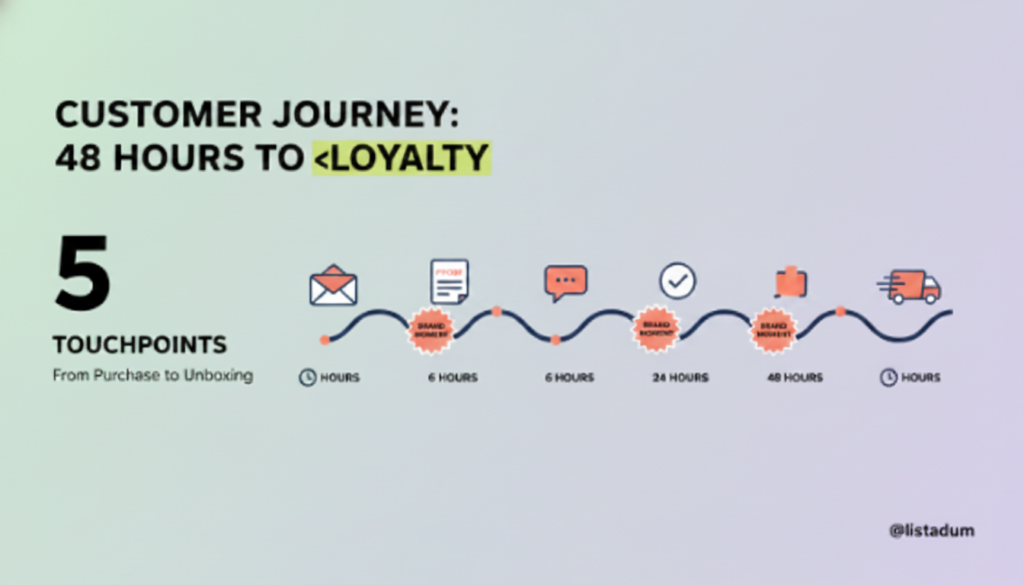
- Step-by-Step: Your First 48 Hours After a Sale
- Frequently Asked Questions
Why Branding and Customer Service Work Together
Branding isn’t just your logo. It’s every single place a buyer encounters your shop: your listing photos, the way you answer questions, the note you tuck into the package, the follow-up message two weeks later.
Customer service is where your brand promise gets tested. You can have the most beautiful shop banner and the most heartfelt About section, but if you take three days to answer a simple question or ship an item in a torn envelope, none of that matters. Buyers will remember the disconnect.
When branding and service align, you get remembered and recommended. When they don’t, you get five-star products with three-star reviews and comments like “beautiful item, but communication was frustrating.”
What Etsy Branding Actually Means
Your brand has three layers, and they all need to tell the same story.
Visual identity is what buyers see first: your shop banner, your logo or shop name treatment, your listing photos. If you sell minimalist ceramic mugs, your photos should be clean and uncluttered. If you sell maximalist floral prints, your visuals should be bold and colorful. The style should be consistent across every listing so buyers recognize your work in search results.
Your story lives in your About section, your shop policies, and the way you describe your process. This is where you explain who you are, why you make what you make, and what buyers can expect. It’s not a bio. It’s context that helps someone decide whether your shop is the right fit for them.
How you communicate shows up in messages, packaging inserts, thank-you notes, and responses to reviews. If your brand is warm and chatty, your messages should be too. If your brand is elegant and understated, your tone should match. Inconsistency here makes buyers feel like they’re dealing with a different business every time.
All three layers should feel like they come from the same place. When they do, buyers trust you faster.
Why Customer Service Is Part of Your Brand
Every message, every package insert, every response to a problem is a brand moment. Buyers don’t separate “the shopping experience” from “the product.” It’s all one thing.
If your brand promises handmade care and attention, but your response to a shipping question is a two-word answer sent three days late, the promise breaks. If your packaging is gorgeous but you don’t respond when someone reports a damaged item, the brand falls apart.
Buyers remember how you made them feel more than they remember your return policy. They’ll forget the exact wording of your shop announcement, but they’ll remember that you helped them track down a lost package or sent a replacement without making them feel like a burden.
Great customer service isn’t a separate skill. It’s your brand in action. It’s proof that you mean what you say.
The Trust Equation for Handmade Sellers
Here’s how trust gets built on Etsy: recognition plus reliability.
Recognition comes from consistent branding. When someone sees your listing photo style, your color palette, your shop name in the same visual treatment over and over, your shop starts to feel familiar. Familiar feels safer. Safer makes someone more likely to click, more likely to buy, and more likely to remember you when they need a gift three months from now.
Reliability comes from consistent service. You answer questions within 24 hours. You ship on time. You handle problems quickly and fairly. You do what you say you’ll do. This builds trust that goes deeper than “I like this product.” It builds trust that says “I know what to expect from this seller.”
Together, recognition and reliability reduce perceived risk. Buying from a small handmade shop always feels riskier than buying from a big brand. You reduce that risk every time you show up the same way, every time you follow through.
The result: higher repeat customer rates, better reviews, fewer disputes, and word-of-mouth referrals. That’s the trust equation in action.
Building Your Etsy Brand Identity
Defining your brand doesn’t require a marketing degree. It requires clarity about what makes your shop different and the discipline to show that difference consistently.
You don’t need to appeal to everyone. In fact, trying to appeal to everyone makes you forgettable. You need to be the right fit for your people.
Choose Your Brand Pillars (Not Everything to Everyone)
Pick two to three things your shop stands for. Not things you want to stand for someday. Things that are already true about how you work and what you make.
Here are examples from real Etsy niches:
A jewelry shop might stand for: bold color, vintage-inspired design, and sustainable materials. Everything they do, from product photography to packaging, should reinforce those three pillars.
A candle shop might stand for: small-batch quality, cozy minimalism, and toxic-free ingredients. Their listings, their messaging, their visual style should all say the same thing.
A print shop might stand for: quirky humor, accessible art, and fast shipping. If those are the pillars, the shop voice should be playful, the designs should feel approachable (not precious), and the policies should emphasize quick turnaround.
Your pillars should be specific enough that they guide decisions. “High quality” isn’t a pillar because everyone claims it. “Made-to-order so nothing goes to waste” is a pillar. “Beautiful designs” is too vague. “Art inspired by mid-century travel posters” is specific.
If you’re not sure what your pillars are, look at your best reviews. What do repeat customers mention? What do people say when they refer a friend? Those are clues.
Visual Consistency Across Your Shop
Which one would you choose?
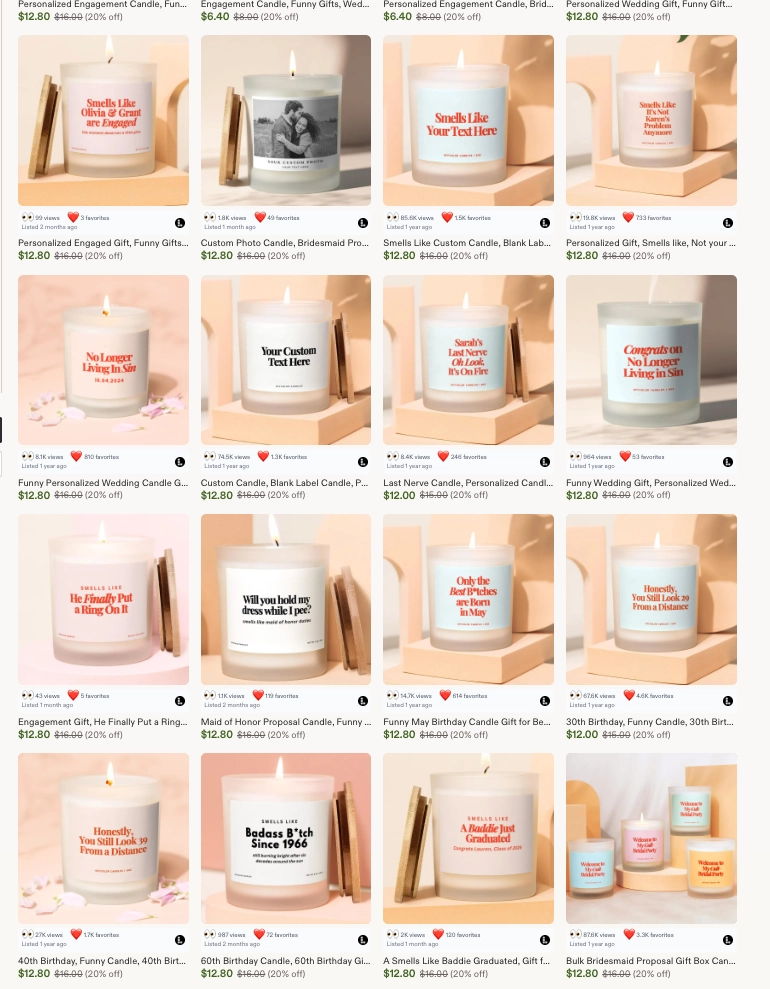
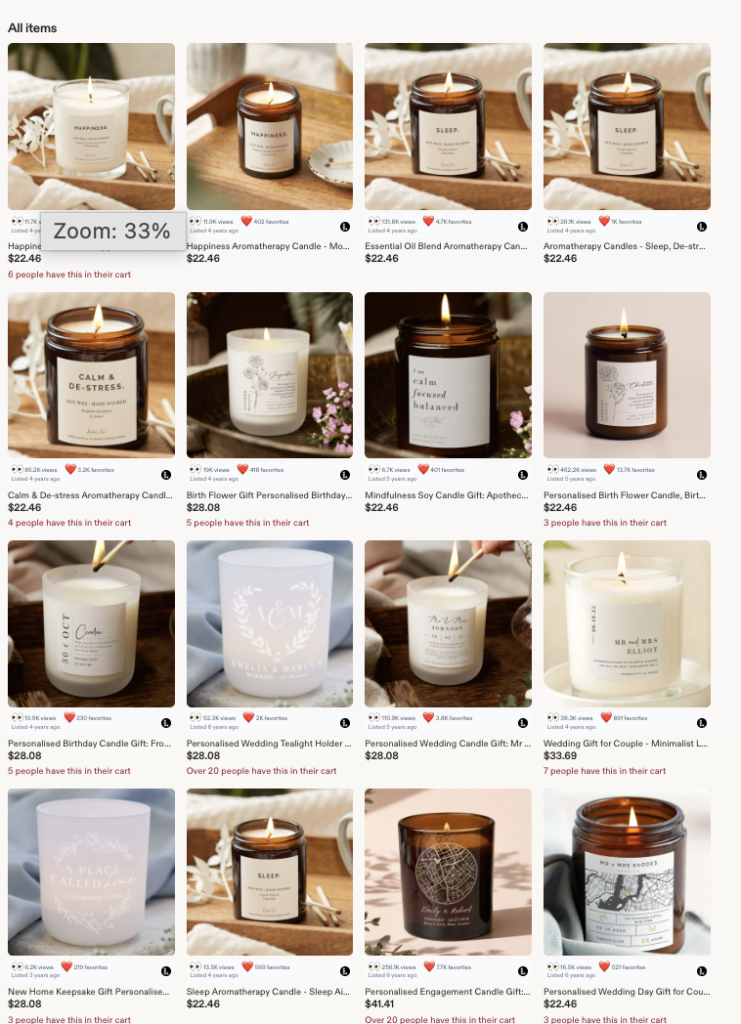
Visual consistency means that if someone scrolled through your listings without reading a single word, they’d know all the photos came from the same shop.
Start with your shop banner and logo (or wordmark). Your banner doesn’t need to be designed by a professional. It needs to be clean, on-brand, and updated. If you sell bright, playful kids’ items, your banner should reflect that. If you sell moody landscape photography, the banner should match the tone.
Your logo can be as simple as your shop name in a readable font with consistent spacing. If you don’t have a logo, just make sure your shop name is easy to read and appears the same way everywhere (Etsy shop, social media, packaging, business cards).
Listing photo style is where most sellers lose consistency. Pick a setup and stick with it: same background color or texture, same lighting (natural window light is free and works), same props if you use them.
You don’t need expensive equipment. A phone camera, a white poster board, and a window can create a clean, professional look. The key is repetition. If your first five listings have white backgrounds and your next five have wood backgrounds and your next five have lifestyle shots, it looks like three different shops.
Pick one primary style and use it for your first photo in every listing. You can add variety in the second and third photos (detail shots, scale shots, lifestyle shots), but the first image should be instantly recognizable as yours.
Color palette doesn’t mean every product has to be the same color. It means the colors in your photos, your banner, your packaging, and your marketing materials should feel related. If your brand is soft and earthy, don’t use hot pink in your banner. If your brand is vibrant and maximalist, don’t shoot everything on a grey background.
Choose two to three colors that represent your brand and use them consistently in non-product elements (banners, packaging, social graphics).
Your About Section and Shop Policies as Brand Tools
Your About section isn’t a biography. It’s a brand story. It should answer three questions: Who makes this? Why do you make it? What can I expect if I order?
Don’t write: “I’ve always loved creating things, and I’m so excited to share my work with you.” That could describe 500,000 Etsy shops.
Do write: “I’m a former architect who started making geometric plant hangers during the pandemic. Every piece is knotted by hand in my Portland studio using cotton cord I source from a family mill in North Carolina. If you love clean lines and want something that’ll last, you’re in the right place.”
See the difference? The second version is specific. It gives context, it explains the process, and it tells you what kind of buyer will love this shop.
Your shop policies should sound like you, not like a legal document. If your brand is warm and personal, your processing time language should be too.
Don’t write: “Processing time is 3-5 business days. Orders are shipped via USPS First Class Mail. Seller is not responsible for delays caused by the postal service.”
Do write: “I’ll have your order ready to ship within 3 to 5 business days. I use USPS First Class Mail, which usually takes 2 to 5 days after I drop it off. If you need it faster, just message me and I’ll do my best to help.”
Same information. One version sounds like a corporation. The other sounds like a person you’d want to buy from.
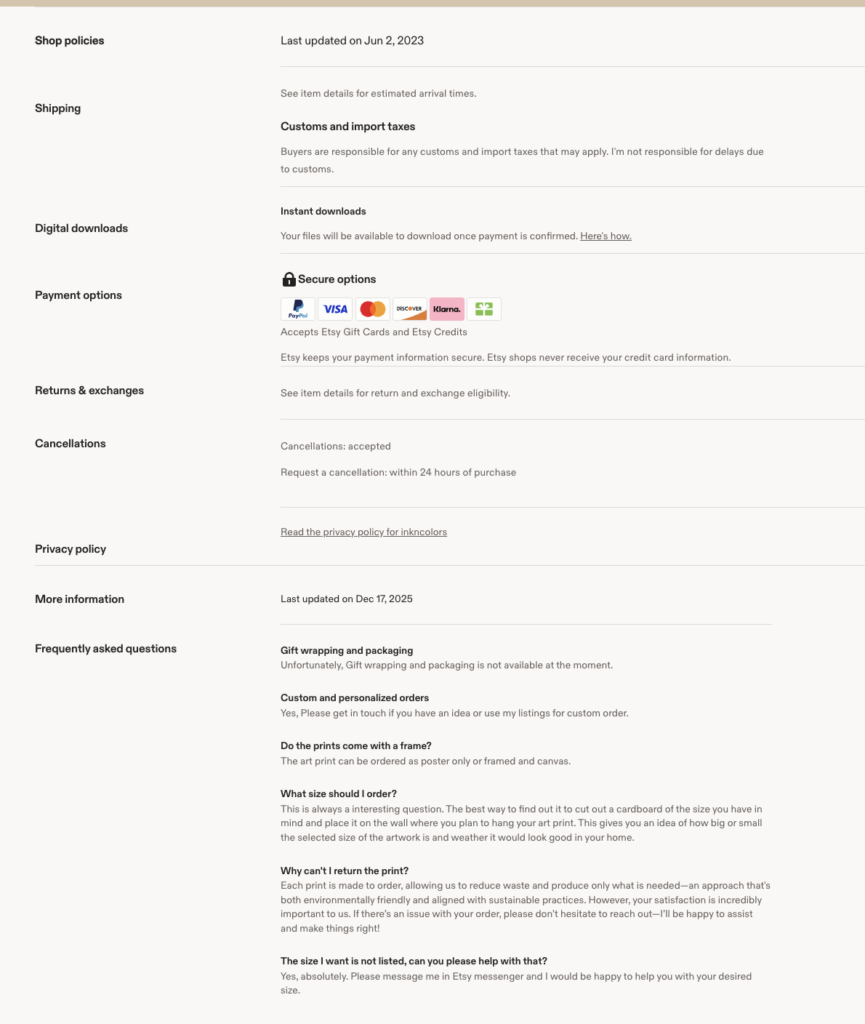
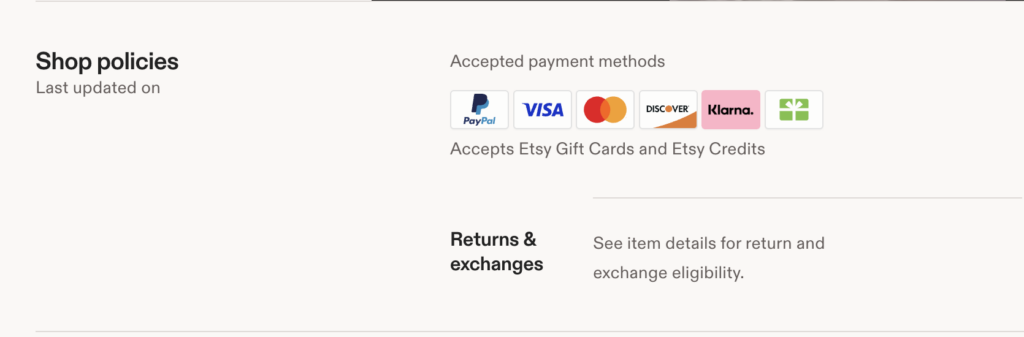
[Check if you have all your policies in place — Shop Critique]
Writing Your Brand Voice and Messaging
Your brand voice is how you sound in writing. It’s the difference between “Your order has shipped” and “Your earrings are on the way!”
A consistent voice builds trust because it proves there’s a real person behind the shop, and that person shows up the same way every time.
Define How You Sound (in Three Words)
Pick three words that describe how you want to come across in every piece of writing: listings, messages, policies, social posts, package inserts.
Here are some examples:
- Friendly, straightforward, helpful: You’re approachable and clear. You don’t use jargon. You explain things simply. You’re happy to answer questions.
- Calm, detailed, thoughtful: You take your time. You provide lots of information. You anticipate questions. Your tone is reassuring.
- Playful, bold, irreverent: You’re fun. You use humor. You don’t take yourself too seriously. You’re not afraid to have personality.
Once you have your three words, use them as a filter. Before you send a message or publish a listing, ask: Does this sound [word 1], [word 2], and [word 3]? If not, rewrite it.
Let’s say your three words are warm, clear, and professional. Here’s how that changes a product description:
Without voice: “Handmade ceramic mug. Dishwasher safe. Holds 12 oz.”
With voice: “This mug is wheel-thrown in my Vermont studio and glazed in a soft matte white. It holds 12 ounces (a generous cup of coffee), and it’s totally dishwasher safe. I use it every morning, and I think you’ll love it too.”
Same facts. One version is a list. The other version sounds like a person talking to you.
Writing Listings That Match Your Brand
Your listing copy should sound like the same person who wrote your About section and will later send the thank-you note.
Let’s compare two jewelry shops selling similar products (delicate gold necklaces), but with different brand voices:
Shop A (minimal, elegant, understated): “A single freshwater pearl on a 14k gold-filled chain. Simple, classic, and meant to be worn every day. Available in 16″ or 18″ length.”
Shop B (bold, quirky, playful): “One perfect little pearl. She’s sweet, she’s timeless, and she goes with literally everything. We hand-wire each one onto gold-filled chain, so she’s sturdy enough for your real life (yes, even the shower). Pick your length and go.”
Both are well-written. Both describe the product. But they’re clearly from different brands, and they’ll attract different buyers. Shop A appeals to someone who wants quiet luxury. Shop B appeals to someone who wants personality.
Your voice isn’t about being the “best” writer. It’s about being consistent so the right people recognize you.
Message Templates That Still Sound Like You
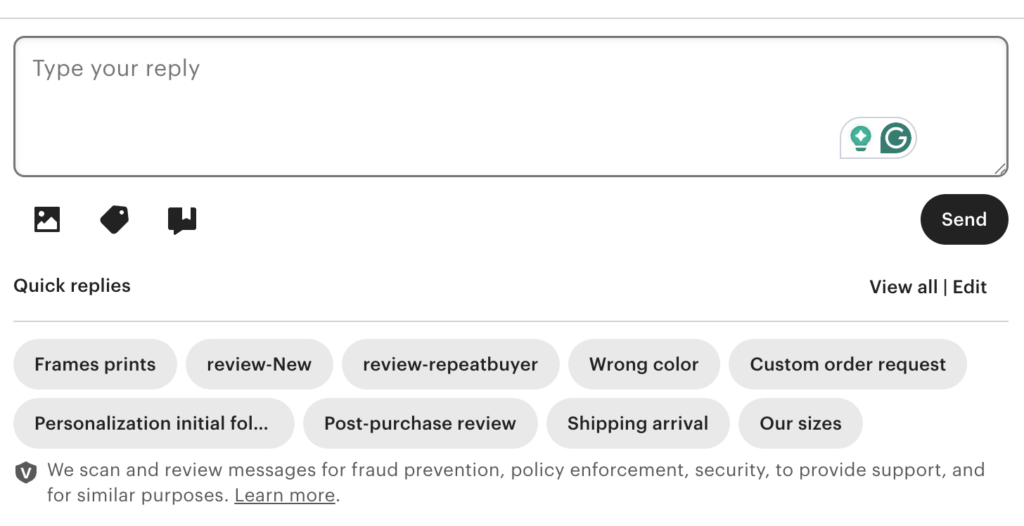
Templates save time, but they shouldn’t sound robotic. The trick is to write them in your voice and leave room for personalization.
Here are four essential templates every seller should have saved:
1. Order confirmation thank-you
“Hi [Name], thank you so much for your order! I’m working on your [item name] and will have it ready to ship by [date]. If you have any questions in the meantime, just reply to this message. I’m here to help.”
Personalize: Use their name, item name, and ship date.
2. Shipping notification
“Good news, [Name]! Your [item name] is on its way. Here’s your tracking link: [link]. It should arrive by [estimated date]. I included care instructions in the package. Enjoy!”
Personalize: Name, item, tracking, estimated arrival.
3. Delayed order apology
“Hi [Name], I wanted to reach out personally. Your [item name] is taking a bit longer than expected because [specific reason: supply delay, custom detail, etc.]. It’ll ship by [new date]. I’m really sorry for the wait. If that doesn’t work for you, I’m happy to cancel and refund right away. Just let me know.”
Personalize: Name, item, specific reason, new date. Keep the tone apologetic but not defensive.
4. Problem resolution
“Hi [Name], I’m so sorry your [item name] arrived [damaged/wrong/etc.]. That’s completely my fault. I’d like to send you a replacement right away at no charge, and you can keep or toss the original. I’ll have it out tomorrow. Does that work for you?”
Personalize: Name, item, specific problem, solution. Offer a fix before they have to ask.
These templates should be 70% written and 30% filled in. That balance keeps them fast to send but still personal.
Setting Up Your Customer Service System
Customer service isn’t just being nice. It’s having systems that let you be consistent, fast, and helpful without burning out.
A good system means you’re not reinventing the wheel every time someone asks “where’s my order?” It means you can take a day off without messages piling up into anxiety. It means problems get solved before they become bad reviews.
Response Time Standards (and How to Actually Hit Them)
Etsy expects sellers to respond to messages within 24 hours. It’s not a suggestion. Your response rate affects your search ranking and your eligibility for the Star Seller badge.
Fast responses also lower buyer anxiety. When someone sends a message, they’re usually worried about something: Will this arrive in time? Will it fit? Is this seller legit? Every hour you wait, that anxiety grows.
Here’s how to hit 24 hours consistently:
Check messages twice a day at set times. Morning and evening works for most sellers. Put it on your calendar like any other business task.
Use the Etsy app so you can answer simple questions from your phone. You don’t need to be at your desk to say “Yes, I can ship this by Friday” or “That item is 3 inches wide.”
Set an auto-reply if you’re away. If you’re on vacation, at a show, or taking a mental health day, turn on Etsy’s vacation mode or set a shop announcement explaining the delay. Buyers are fine with a 48-hour wait if they know it’s coming. They’re not fine with silence.
Batch your responses if you’re answering the same question multiple times. If three people ask about shipping times in one day, that’s a sign your policies need to be clearer. Update your listing or FAQ, then answer all three with a saved reply.
You don’t have to be available 24/7. You just have to be reliable.
The Four Messages Every Seller Should Pre-Write
Save these as templates in a document, in Etsy’s saved replies, or in a tool like Listadum. Customize them to match your voice.
1. Order thank-you
Sent right after purchase (or within a few hours). Sets expectations and invites questions.
“Hi [Name], thank you so much for ordering the [item]! I’ll have it ready to ship by [date]. If you have any questions or special requests, just reply here. I’m happy to help.”
2. Shipping update
Sent when you mark the order as shipped. Etsy auto-sends tracking, but a personal note is a nice touch.
“Your [item] is on its way! Tracking: [link]. It should arrive by [date]. I included [care instructions/thank-you note/business card] in the package. Hope you love it!”
3. Delayed order apology
Sent as soon as you know something will be late. Proactive honesty prevents frustration.
“Hi [Name], I wanted to give you a heads-up. Your [item] is running a day behind because [reason]. It’ll ship by [new date] instead of [original date]. I’m really sorry for the delay. If you need it by a specific date and this won’t work, let me know and I’ll cancel and refund right away.”
4. Problem resolution
Sent in response to a damaged item, wrong item, or any issue that’s your fault.
“I’m so sorry about [problem]. That’s on me. I’d like to [offer replacement/refund/discount] right away. [Explain what you’ll do and when.] Does that work for you? And again, I really apologize.”
These templates should feel like you. If you’re formal, they can be polite and professional. If you’re casual, they can be friendly and conversational. The content matters more than the tone, but both should be consistent.
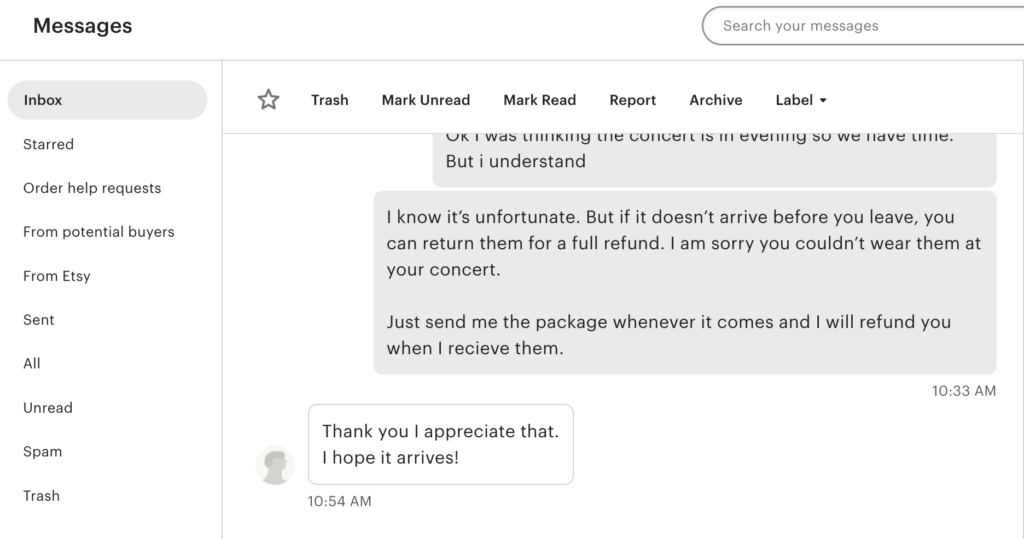
When (and How) to Offer Refunds, Replacements, or Discounts
You need a decision tree for problems so you’re not figuring it out under pressure every time.
Lost in mail: Offer a full refund or free replacement (buyer picks). File an insurance claim if you have coverage. Most buyers will choose replacement if you offer it quickly.
Damaged item: Apologize, offer a replacement at no charge, and let them keep or toss the damaged one. If it’s a pattern (multiple items arriving broken), revisit your packaging.
Wrong item sent (your mistake): Send the correct item immediately at your expense. Let them keep the wrong one if it’s low-value. Refund shipping if they had to wait longer than expected.
Buyer’s remorse (they just changed their mind): Check your shop policies. If you accept returns, honor it. If you don’t, you can still offer store credit to keep goodwill. Explain your policy kindly: “I don’t usually accept returns on custom items, but I’d be happy to offer you a $20 credit toward a future order.”
Incorrect personalization (they gave you the wrong name/date): This is tricky. If you confirmed details before making it, you’re not obligated to redo it. But offering a discount on a corrected version builds loyalty. Use your judgment.
The general rule: be generous early. A $15 replacement costs less than a case, a bad review, or the time you’ll spend arguing. It also turns a frustrated buyer into someone who tells their friends “I had an issue, but they fixed it immediately.”
Creating a Consistent Post-Purchase Experience
The sale isn’t the finish line. It’s the starting line for a relationship.
What happens after someone clicks “buy” determines whether they come back, leave a review, tell their friends, or forget you exist.
Every touchpoint after purchase is a chance to reinforce your brand and set up the next sale.
Branded Packaging on Any Budget
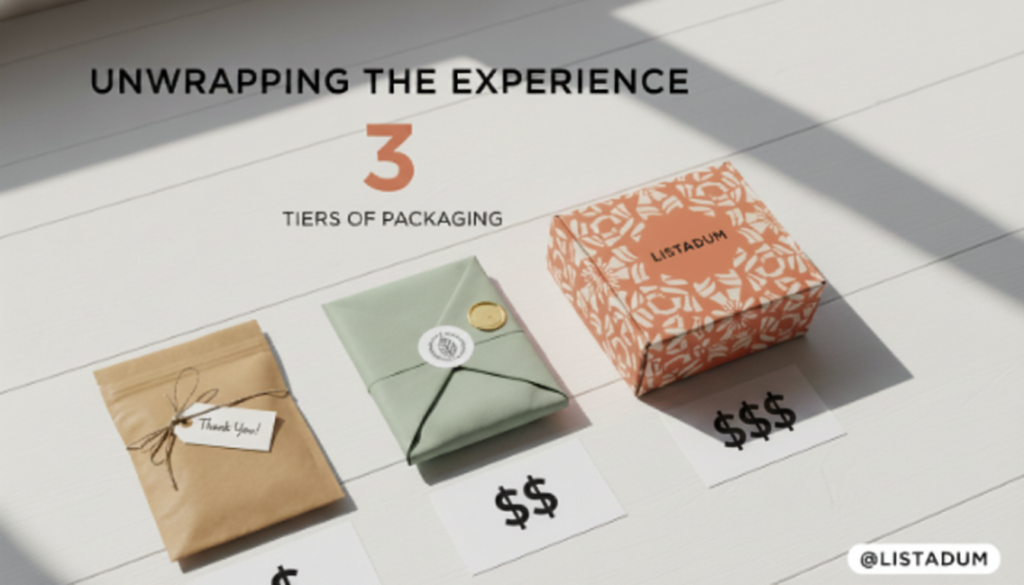
Packaging doesn’t have to be expensive to feel intentional. It just has to be consistent and appropriate for your brand.
Free tier: Use clean brown kraft paper or white tissue. Add a handwritten thank-you note on a notecard (you can buy plain ones in bulk). If your handwriting is messy, print thank-you notes and sign them by hand. Fold everything neatly. No random-size boxes or wrinkled paper.
Low-cost tier ($20–$50 setup): Get a custom rubber stamp with your logo or shop name and stamp plain kraft mailers, tissue paper, or thank-you cards. Or order stickers with your logo (sites like Sticker Mule or Moo start around $20 for small batches). Use the same color tissue or ribbon every time.
Higher-investment tier ($100+): Custom printed mailers (poly or kraft), branded tissue paper, or custom boxes. Worth it if you’re shipping 50+ orders a month and your margins support it. This tier makes sense for higher-priced items or when unboxing is part of the experience.
The tier you choose should match your price point. If you’re selling $8 stickers, custom mailers might eat your profit. If you’re selling $80 jewelry, plain packaging might undersell the value.
The most important thing is consistency. Don’t use cute floral tissue one month and plain brown paper the next. Pick a look and repeat it.
What to Include in Every Package
There are three must-haves:
1. Care instructions (if relevant). If your item needs special handling (hand wash, avoid water, store flat, polish with this, don’t leave in sun), include a small printed card. Buyers appreciate it, and it prevents “this broke because I didn’t know how to care for it” problems.
2. Thank-you note. It can be printed or handwritten. It can be one sentence or three. The point is acknowledgment. “Thank you for supporting my small shop” is enough. Personalize it if you have time (mention the item or add their name).
3. Business card or postcard with your shop info. Include your shop name, URL, and social handles. Make it pretty enough that they might keep it or pass it to a friend. This is your repeat-customer tool. If they love the item but lose the packaging, they need a way to find you again.
What not to include: Don’t beg for five-star reviews. Don’t include discount codes for their next purchase in every single package (save those for repeat buyers or special promotions). Don’t include a novel about your journey unless it’s printed beautifully and clearly part of your brand.
Keep it simple, useful, and on-brand.
The Follow-Up Message (Without Being Pushy)
Timing matters. Send a follow-up message one to two weeks after the delivery date (not the ship date).
The goal is to check in, invite a review if they’re happy, and leave the door open for problems.
Here’s a template:
“Hi [Name], I wanted to check in and make sure your [item name] arrived safely and you’re happy with it. If something’s not right, please let me know and I’ll make it right. And if you’re loving it, I’d be so grateful if you’d leave a review. Either way, thank you for supporting my shop!”
Keep it short. Don’t guilt-trip. Don’t say “reviews really help small businesses like mine” three times. Just ask once, kindly, and move on.
If they respond with a problem, fix it immediately. If they respond with a compliment, thank them and invite them to follow you on social or sign up for your email list (if you have one).
Most won’t respond, and that’s fine. You’ve done your part. You’ve reinforced that you care about their experience, and you’ve reminded them you exist.
Measuring What’s Working (and What Isn’t)
You can’t improve what you don’t measure. But you also don’t need to track 47 metrics. Focus on the ones that tell you whether your branding and service are actually working.
Track Your Repeat Customer Rate
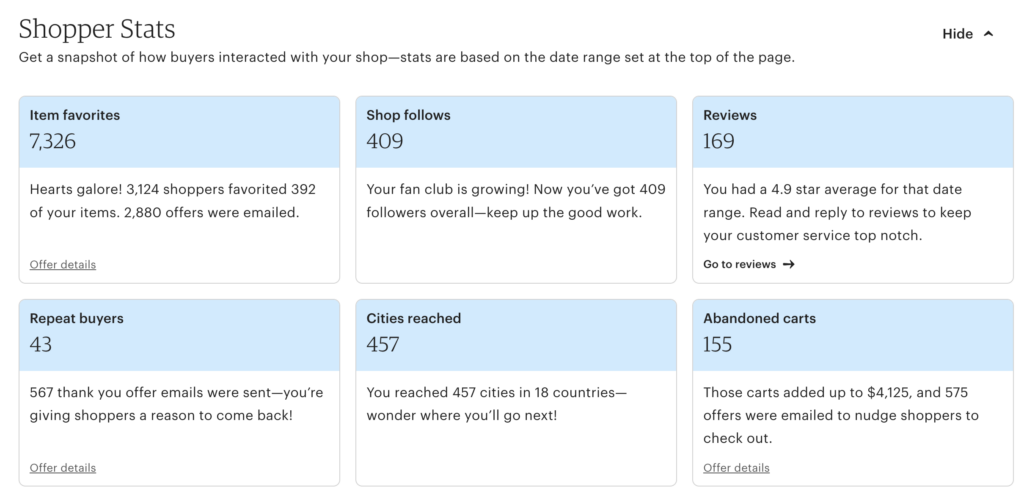
This is the single most important metric for branding and customer experience. It tells you whether people trust you enough to come back.
Find it in Etsy Stats > Repeat customers. Etsy shows you what percentage of your orders came from buyers who’ve purchased from you before.
20% to 30% repeat rate is strong for handmade shops. If you’re above that, your post-purchase experience is working. If you’re below 10%, something’s broken: your packaging, your follow-up, your product quality, or your messaging.
If your repeat rate is low, ask yourself:
- Are you staying top of mind? (Do you have a business card in every package? Are you on social media? Do you send follow-ups?)
- Are you easy to find again? (Is your shop name memorable? Do you have a consistent visual style?)
- Is the experience good enough that they’d want to repeat it?
Repeat customers cost nothing to acquire and tend to leave better reviews. They’re your most valuable metric.
Monitor Review Themes (Not Just Star Count)
Your average star rating matters for search ranking, but the words in your reviews matter more for improvement.
Read your last 20 reviews and look for patterns:
- Do people mention fast shipping? That’s a brand strength. Emphasize it in your policies and listings.
- Do they mention beautiful packaging? That’s proof your post-purchase experience is working. Take photos of your packaging and share them on social.
- Do they mention helpful responses or great communication? That’s your customer service paying off. Highlight it in your About section.
- Do they say things like “smaller than expected” or “took forever to arrive”? That’s a listing clarity problem or a shipping expectation problem. Fix your descriptions and processing times.
Negative patterns are your fix-it list. If three people in a row say “photos made it look bigger,” add a size reference photo (a hand holding it, a ruler next to it, the item on a model).
Don’t just collect stars. Read the reviews like feedback from a focus group.
Measure Time Spent on Customer Service
This one’s less precise, but still useful. Track (roughly) how many hours per week you spend on messages and issues.
If your customer service time is growing faster than your sales, something’s wrong. Your listings might be unclear. Your policies might be confusing. Your product quality might be inconsistent.
If your customer service time is low and your reviews are good, your system is working. You’ve set clear expectations, you’ve answered questions proactively in your listings, and you’re shipping quality products.
You’ll never get to zero messages. But if you’re spending 10 hours a week on customer service for 20 orders, that’s not sustainable. Look for patterns in the questions and fix them upstream (in your listings, photos, or policies).
Step-by-Step: Your First 48 Hours After a Sale
Let’s walk through a real example so you can see how branding and customer service work together in practice.
Scenario: A buyer orders a custom watercolor pet portrait. It’s their first time purchasing from your shop. The order comes in on Monday at 9 a.m.
Here’s what happens next.
Monday, 9:15 a.m. — Send an order confirmation message.
You see the order notification. You check the photo they uploaded (a golden retriever named Benny). You send this message:
“Hi Sarah, thank you so much for trusting me with Benny’s portrait! He’s adorable. I’ll start sketching today and send you a proof by Wednesday morning. If you have any special requests (like his favorite toy in the background or a specific color palette), just reply here and let me know.”
Why this works: You used the buyer’s name and the pet’s name. You set a clear timeline (proof by Wednesday). You invited input, which makes it feel collaborative. You sent it within 15 minutes of the order, which builds confidence immediately.
Monday, 4 p.m. — Start the piece.
You sketch Benny. If your brand is behind-the-scenes and process-focused, you take a quick in-progress photo (your desk, the sketch, a mug of coffee) and post it to your Instagram story with a tag like “Starting Benny’s portrait today!” You don’t send it to the buyer yet, but it’s brand content that builds trust with future buyers.
Wednesday, 10 a.m. — Send the proof.
You’ve finished the sketch and the first layer of paint. You photograph it in good light and send this message:
“Hi Sarah, here’s the first version of Benny! I can adjust colors, add more detail, or change the background before I finalize it. Let me know what you think, or let me know it’s perfect as-is. I’ll wait to hear from you before I finish.”
Why this works: You’re giving her control. You’re preventing the nightmare scenario where you ship it and she hates it. You’re building excitement (she gets to see it early). You’re proving you care about getting it right.
Wednesday, 3 p.m. — Buyer replies.
Sarah writes back: “This is perfect! I love it. Go ahead and finish it!”
You reply: “Amazing! I’ll have it finished and shipped by Friday. Can’t wait for you to see it in person.”
Thursday, 2 p.m. — Finalize and package.
You finish the painting. You let it dry. You package it carefully: a protective sleeve, a backing board, a flat mailer, a printed care card (“Keep out of direct sunlight. Frame behind UV-protective glass if possible.”), and a handwritten thank-you note on a card with your logo.
The note says: “Sarah, thank you for letting me paint Benny. I hope this brings you joy every time you see it. – [Your name]”
Thursday, 5 p.m. — Ship and send tracking.
You drop the package at the post office. You mark it as complete in Etsy. Etsy auto-sends tracking, but you send your own message too:
“Sarah, Benny’s portrait is on its way! Here’s your tracking link: [link]. It should arrive by Monday. I included care instructions in the package so you know how to keep it looking great for years. I can’t wait for you to see it in person!”
Why this works: You’ve reinforced professionalism (tracking, care instructions). You’ve reminded her to watch for delivery. You’ve set up a positive unboxing moment.
Key branding touchpoints in this 48-hour window:
- Personalized messages using her name and Benny’s name (brand voice: warm, attentive)
- Proactive proof sent before she had to ask (brand value: quality and collaboration)
- Clear timelines at every step (brand value: reliability)
- Thoughtful packaging with care card (brand value: craftsmanship)
- Handwritten thank-you note (brand personality: personal and human)
Each one says “I care about your experience.” That’s your brand promise, delivered.
Frequently Asked Questions
Do I need a logo to have a brand on Etsy?
No. A consistent photo style, a clear shop name, and a recognizable voice matter more than a logo.
Plenty of successful Etsy shops don’t have a logo. They have a clean, readable shop name and a visual style that’s consistent across every listing. That’s enough to build recognition.
If you do want a logo, a simple text-based wordmark works fine. Open Canva (free), pick a clean font, type your shop name, and save it as a PNG. Use it in your shop banner, on your business cards, and on your packaging. Done.
Focus on consistency first. Logo second.
How do I handle a customer who’s upset without breaking my brand voice?
Stay calm and empathetic, even if your usual brand voice is playful or casual. You can still sound like you while being serious.
If your brand is normally light and funny, you don’t need to crack jokes when someone’s upset. But you also don’t need to suddenly sound like a lawyer. Just dial back the humor and dial up the care.
Here’s an example:
Normal voice (playful): “Your earrings are on the way! Can’t wait for you to wear them everywhere.”
Problem voice (still you, but serious): “I’m really sorry your earrings arrived damaged. That’s completely my fault. I’d like to send you a new pair today, and you can keep or toss the broken ones. Does that work?”
See? Same person. Same values. Different situation, so you adjusted the tone without losing yourself.
The key is to acknowledge the problem, apologize sincerely, and offer a solution. Don’t get defensive. Don’t blame the post office or the buyer. Just fix it.
Should I offer refunds or just replacements?
It depends on the problem.
If the item is damaged,wrong, custom, or your fault, offer a replacement first. Most buyers just want the item they ordered. Shipping a replacement costs you less than a refund (you keep the sale), and it often leads to a grateful customer and a good review.
If the item is lost in mail, offer both options: “I can send a replacement right away, or issue a full refund. Whatever works best for you.”
If the buyer is unhappy with the item but nothing is wrong (they just don’t like it, it doesn’t match their decor, they changed their mind), check your shop policies. If you accept returns, honor it. If you don’t, you can offer store credit as a goodwill gesture, but you’re not required to.
If you sell custom or personalized items, you’re not obligated to accept returns for buyer’s remorse. Etsy’s seller protections support this. Just make sure your policies are clear upfront.
Default to replacement when it’s your fault. Default to your stated policies when it’s not. Be kind either way.
How do I get customers to leave reviews without sounding desperate?
Ask once, at the right time, in a helpful way.
The best time to ask is 7 to 14 days after delivery (when they’ve received and used the item, but it’s still fresh in their mind). Send a short message that checks in first and asks second.
Here’s the format:
“Hi [Name], I wanted to make sure your [item] arrived safely and you’re happy with it. If anything’s not quite right, please let me know and I’ll make it right. And if you love it, I’d really appreciate a review. Thank you for supporting my shop!”
That’s it. One ask. No guilt. No begging. No “reviews mean the world to small businesses” speech.
If they don’t respond, don’t follow up again. Move on.
You can also include a small printed card in your packaging that says “Loved your order? I’d be grateful for a review!” with a QR code linked to your shop. Some buyers prefer to leave a review right when they open the package. Make it easy, but don’t make it pushy.
The truth is, most buyers won’t leave a review no matter what you do. Focus on the experience. The reviews will come from the people who feel compelled to share, and those are the most authentic ones anyway.
What if my brand voice feels fake when I write it?
You’re overthinking it.
Your brand voice isn’t a character you play. It’s just the version of yourself that shows up to do business. You probably already adjust your tone depending on the situation (you don’t talk to your best friend the same way you talk to your dentist). This is the same thing.
If your “brand voice” feels forced or fake, it’s probably because you’re trying to sound like someone else. Go back to your three words (warm, clear, professional, or whatever yours are) and write the way you’d explain your product to a friend who asked about it.
You don’t need to be overly formal. You don’t need to be overly quirky. You just need to be consistent and appropriate for your audience.
If you’re still stuck, read your message out loud. If it sounds like something you’d actually say, keep it. If it sounds like you’re reading a script, rewrite it.
Your customers want to buy from a person, not a marketing team. Be the person.
How formal should my customer service messages be?
Formal enough to be professional. Casual enough to be human.
You’re not writing a legal document. You’re not texting your college roommate. You’re somewhere in the middle.
Use the buyer’s name. Use complete sentences. Fix typos. Don’t use all caps or excessive exclamation points. Don’t use slang unless it’s clearly part of your brand.
Here’s a good test: Would you send this message to a friendly acquaintance you respect? If yes, it’s probably the right level of formality.
Too formal: “Dear Valued Customer, Your inquiry has been received and will be addressed within one business day.”
Too casual: “hey! got ur message lol, ill ship it tomorrow”
Just right: “Hi Sarah, thanks for reaching out! I’ll have your order shipped by tomorrow. Let me know if you need anything else.”
Match the tone your buyer uses. If they’re formal, you can be slightly more formal. If they’re warm and friendly, match that energy. But always stay professional. You’re running a business.
Should I have a separate email list or just use Etsy messages?
If you want repeat customers, you need a way to reach them outside of Etsy.
Etsy owns the customer relationship. If your shop gets suspended, if Etsy changes their algorithm, if a buyer deletes their account, you lose contact. An email list is yours. You control it.
Start simple. Include a small card in every package that says “Want first access to new designs and shop updates? Join my email list: [your link].” Use a free tool like Mailchimp (free up to 500 subscribers) or ConvertKit.
Send one email a month. That’s it. New product launches, behind-the-scenes updates, or exclusive discounts for subscribers. Keep it short, keep it valuable, and don’t spam.
You don’t need a huge list. Even 50 engaged subscribers who open your emails and click through to your shop are worth more than 5,000 random followers on social media.
Email is the most reliable way to stay in touch with people who already love your work. If you’re serious about repeat customers, start building your list now.
How do I stay consistent when I’m busy or burned out?
Build systems so you don’t have to think every time.
Save your message templates. Write them once, save them in a doc or in Etsy’s saved replies, and use them every time. Customize the name and details, but don’t rewrite from scratch.
Batch your tasks. Answer all messages at once. Package all orders at once. Take all your photos for the week in one session. Batching saves mental energy.
Set boundaries. Decide your shop hours and stick to them. If you don’t want to answer messages at 10 p.m., don’t. Set an auto-reply that says “I’ll respond within 24 hours” and let yourself rest.
Use tools that save time. A tool like Listadum helps with listing optimization, bulk editing, and analytics so you’re not manually updating 50 listings one at a time. The Etsy app lets you answer messages from anywhere. Use what’s available.
If you’re burned out, scale back before you quit. Pause custom orders. Increase your processing time. Reduce your product line. Put your shop on vacation mode for a week. It’s better to take a break and come back strong than to push through and deliver inconsistent service.
Your customers will forgive a slower response time or a temporary pause. They won’t forgive sloppy work or a bad attitude. Protect your energy so you can show up as the version of yourself your brand promises.
What’s the one thing I should focus on first?
Response time.
If you do nothing else, answer messages within 24 hours. That one habit will improve your reviews, your search ranking, your buyer confidence, and your stress levels.
Everything else in this guide (branding, packaging, follow-ups, templates) builds on that foundation. But if buyers can’t get a simple answer from you, none of the rest matters.
Set a phone reminder. Check messages twice a day. Save templates so you can answer fast. Make it a non-negotiable part of your routine.
Once response time is consistent, add packaging improvements. Then add follow-up messages. Then refine your brand voice. Build one habit at a time. That’s how you create a system that lasts.
Your 48-Hour Action Plan
You’ve read the guide. Now here’s what to do in the next two days to start seeing results.
Day 1: Brand and Messaging Clarity (2 hours)
Step 1 (30 minutes): Define your brand in three words. Write them down. Examples: warm, clear, professional. Or: playful, bold, eco-conscious. These are your filter for every decision.
Step 2 (30 minutes): Rewrite your About section. Answer these three questions in 3 to 5 sentences: Who makes this? Why do you make it? What can buyers expect? Make it specific, not generic.
Step 3 (30 minutes): Review your last five listings. Do they sound like the same person who wrote your About section? If not, rewrite the first paragraph of each description in your brand voice.
Step 4 (30 minutes): Write or update your shop policies. Make them clear and conversational. Include processing times, shipping methods, and your return/exchange policy. No legal jargon.
At the end of Day 1, you should have: three brand words, a strong About section, consistent listing voice, and clear policies. That’s your brand foundation.
{Use the free Shop Critique tool to see how your shop looks to a first-time visitor]
Day 2: Customer Service Systems (2 hours)
Step 1 (30 minutes): Write four message templates (order thank-you, shipping update, delayed order apology, problem resolution). Save them in a doc or in Etsy’s saved replies. Use your brand voice.
Step 2 (30 minutes): Set up a message routine. Block two times in your day to check and respond to messages (morning and evening works for most people). Put it in your calendar. Treat it like a meeting.
Step 3 (30 minutes): Design a simple package insert. It can be a printed thank-you card, a business card, or a small postcard with your shop info. Keep it simple and on-brand. Order a small batch (Vistaprint, Moo, or Canva Print).
Step 4 (30 minutes): Write a follow-up message template for 7 to 14 days post-delivery. Save it. Set a reminder to send it to buyers from your last few orders this week.
At the end of Day 2, you should have: message templates, a message routine, a package insert design, and a follow-up system ready to go.
[Use the Listing Analyser to check if your listings are clear enough to prevent common questions]
What to Measure After 30 Days
Give these changes a month to show results, then check:
- Response rate: Are you hitting 24 hours consistently? Check your Etsy stats.
- Repeat customer rate: Has it gone up? Even 5% is progress.
- Review themes: Are people mentioning your communication, packaging, or professionalism more often?
- Time spent on messages: Are you spending less time because you’re using templates and being proactive?
If something isn’t improving, revisit that section of the guide and adjust. Not every strategy works for every shop. Test, measure, tweak.
Tools to Speed Up Branding and Customer Service
You don’t need a lot of tools. You need the right ones.
For listing optimization and shop management: Listadum helps you optimize listings with completion scores, research keywords, bulk-edit across your shop, and track your analytics. If you’re managing more than 20 listings, bulk editing alone will save you hours. Free plan available. Try it here.
For message templates: Use Etsy’s built-in saved replies (Settings > Info & Preferences > Saved Replies), or keep a Google Doc with templates you can copy and paste. Both are free.
For photography: Your phone camera and a window. Seriously. Natural light near a window, a clean background (white poster board or a plain wall), and a steady hand will outperform expensive gear used poorly. If you want to level up, a $20 phone tripod and a $15 foam board reflector (Amazon) will do it.
For packaging: Noissue (custom tissue paper and stickers, eco-friendly), Sticker Mule (custom stickers and mailers), Moo (business cards and postcards), or Vistaprint (budget-friendly printing). Order small batches first to test.
For analytics: Etsy Stats (built-in and free) gives you everything you need: traffic sources, conversion rates, repeat customers, and popular listings. Check it weekly. If you want deeper insights, Listadum’s analytics dashboard breaks down trends over time.
For email marketing: Mailchimp (free up to 500 subscribers), ConvertKit (free up to 1,000 subscribers), or Flodesk (paid, $38/month, beautiful templates). Start simple. One monthly email is enough.
For free tools to improve your shop:
- Shop Critique: Get feedback on what first-time visitors see
- Listing Analyser: Check your listing quality and SEO
- Etsy Fee Calculator: Understand your true profit margins
- Keyword Explorer: Find keywords your buyers are actually searching
- Chrome Extension: Manage messages and stats faster
You don’t need all of these. Pick the ones that solve your biggest current problem and ignore the rest.
Final Thoughts
Branding isn’t a logo. Customer service isn’t just being polite. Together, they’re how you show up consistently and build trust over time.
You don’t need a big budget or a marketing degree. You need clarity about who you are, systems that help you deliver on your promises, and the discipline to show up the same way every time.
Buyers remember how you made them feel. They remember whether you answered their question. They remember whether the package felt like it mattered. They remember whether you fixed a problem without making them beg.
Those moments add up. That’s your brand. That’s what turns a one-time buyer into a repeat customer, and a repeat customer into someone who tells their friends.
Start with the 48-hour action plan. Write your templates. Set your message routine. Clarify your About section. The rest will build from there.
Your shop isn’t just what you sell. It’s how you sell it. Get that right, and everything else gets easier.
About the Author
Neha Chandelier is the Co-founder of Listadum and has been selling on Etsy since 2020. She’s built systems for branding and customer service that let small shops compete with bigger sellers without burning out. When she’s not working on Listadum, she’s testing new packaging ideas and answering messages in under 12 hours.
Great branding gets the click. A great shop keeps the customer.
Listadum makes sure the listings behind your brand are optimized and consistent, so the experience lives up to the promise.
Free plan · no credit card · connect your real Etsy shop in minutes