
If I had to open a brand-new Etsy shop today with zero sales, these are the five types of businesses I’d seriously consider.
Not because they’re easy.
Not because they’re “unsaturated.”
And definitely not because they’re some secret Etsy loophole.
I’d choose them because they all share the same characteristics:
- They solve real customer problems.
- They have proven demand.
- They can grow from a side hustle into a sustainable business.
The biggest mistake new Etsy sellers make isn’t choosing the wrong product.
It’s choosing products they want to make instead of products customers already want to buy.
Let’s look at five business models that consistently work on Etsy—and why.
1. Products Customers Naturally Buy Again and Again
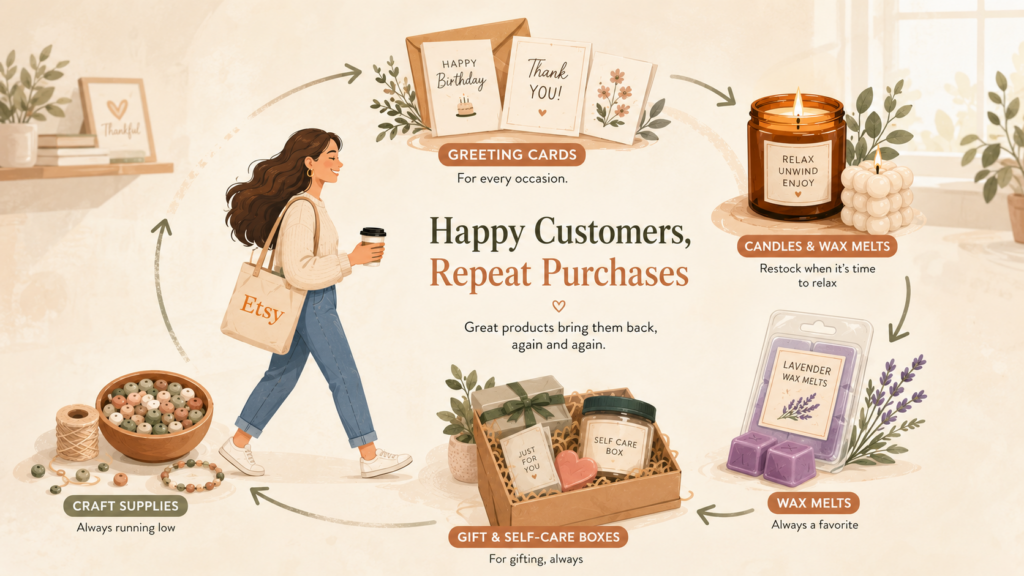
Most Etsy sellers spend all of their energy trying to find new customers.
The smartest businesses figure out how to keep existing customers coming back.
Products like greeting cards, candles, wax melts, craft supplies, corporate gift boxes, and self-care packages naturally encourage repeat purchases.
Someone who loves your greeting cards isn’t buying once.
They’re coming back for birthdays, anniversaries, Christmas, Valentine’s Day, Mother’s Day, and countless other occasions.
The same is true for another Etsy seller buying your craft supplies.
They won’t buy beads once.
They’ll buy them every time they launch a new collection.
Why this works
Every returning customer reduces the amount of marketing you have to do.
Instead of constantly chasing new buyers, your existing customers continue generating revenue over time.
That’s one of the biggest differences between a hobby and a real business.
2. Products That Help Other Etsy Sellers

One of the most overlooked opportunities on Etsy is selling to other Etsy sellers.
Think about products like:
- Clip art
- SVG bundles
- Digital papers
- Mockup photos
- Canva templates
- Etsy banner templates
- Listing templates
- Product photography templates
- Public domain image collections
Unlike regular consumers, business owners don’t spend money just because something looks nice.
They spend money because it saves them time.
Or helps them make more money.
If your template saves another seller an hour every week, it’s incredibly valuable.
You’re not selling a ZIP file.
You’re selling productivity.
Confidence.
Growth.
3. Sell Your Craftsmanship
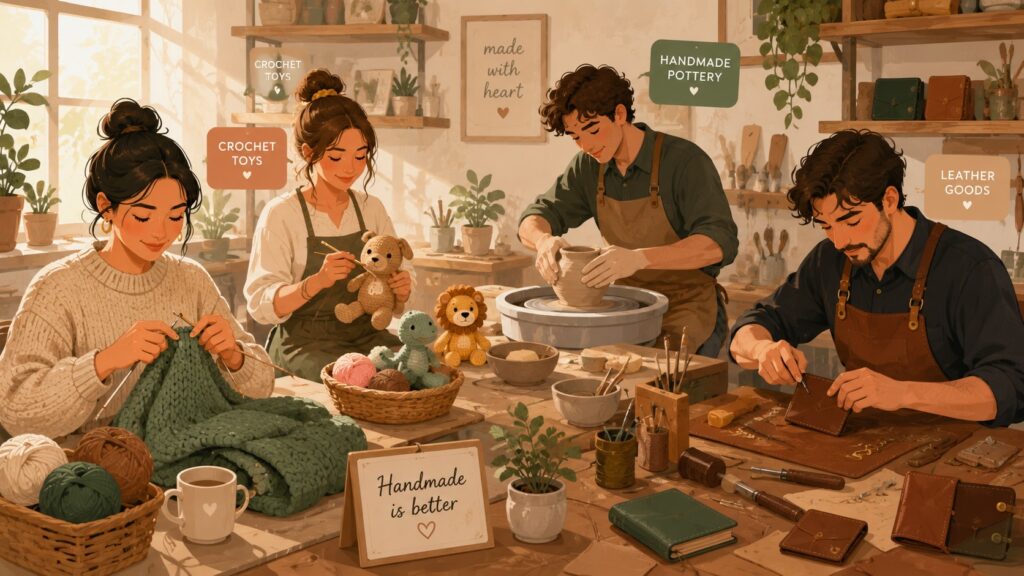
Factories will always be cheaper than handmade products.
Trying to compete on price is a losing battle.
Instead, compete on craftsmanship.
Products like handmade sweaters, crochet toys, leather goods, pottery, custom dresses, woodworking, and hand-painted artwork all have something factories struggle to replicate:
Human skill.
People don’t buy these products because they’re the cheapest option.
They buy them because they appreciate quality.
They want something unique.
They want something made by a real person.
The better your craftsmanship becomes, the harder it is for competitors to copy you.
That becomes your competitive advantage.
4. Personalized Products

Few marketplaces are better suited for personalized products than Etsy.
Some of the strongest categories include:
- Watercolor house portraits
- Family portraits
- Pet portraits
- Personalized jewelry
- Name necklaces
- Personalized clothing
- City maps
- Travel prints
- Wedding keepsakes
- Baby gifts
The reason these products perform so well isn’t because of the object itself.
It’s because of the story behind it.
A watercolor painting isn’t just art.
It’s someone’s first home.
A necklace isn’t just jewelry.
It’s celebrating a daughter.
A custom map isn’t just decoration.
It’s remembering the place where someone got engaged.
The emotional value often becomes much greater than the product itself.
That’s why personalized products are often able to command premium prices.
5. Print-on-Demand Brands

Print-on-demand deserves a place on this list—but only with one important warning.
Print-on-demand is not a business.
It’s simply a manufacturing method.
The successful shops don’t win because they use Printify or Printful.
They win because they’ve built a real brand.
They have:
- A clearly defined niche.
- Original artwork.
- Consistent branding.
- High-quality product photography.
- Great customer experience.
Print-on-demand simply handles production and shipping.
That’s it.
Treat it as your supplier—not your business model.
What All Five Businesses Have in Common
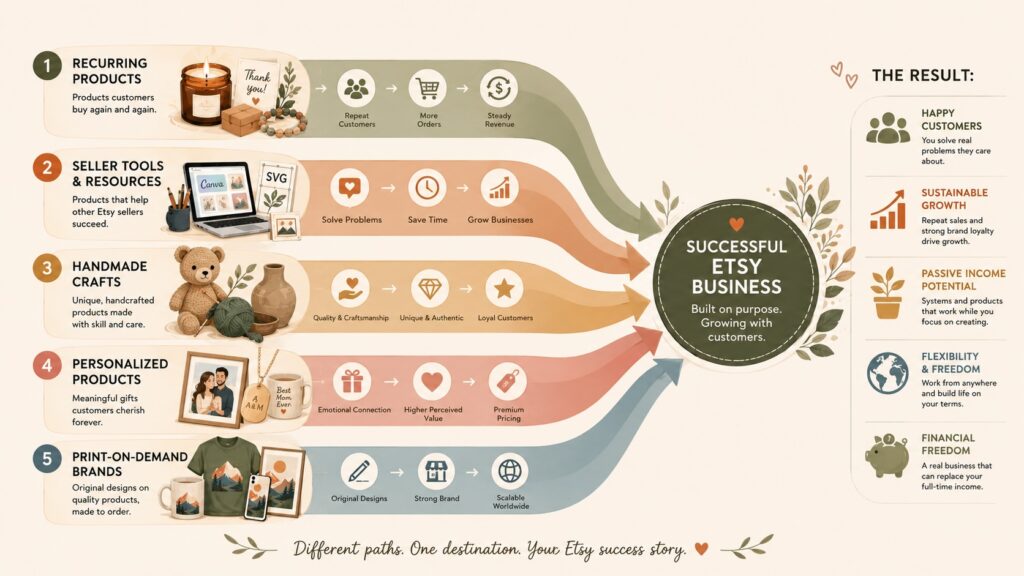
At first glance, these five businesses look completely different.
But they’re built on exactly the same principles.
They solve real problems.
They target a specific customer.
They have proven demand.
And they avoid trying to appeal to everyone.
One of the biggest lessons we’ve learned after analyzing thousands of Etsy shops is this:
Specific beats broad.
Don’t sell candles.
Sell calming soy candles for teachers who need to relax after work.
Don’t sell sweaters.
Sell personalized knitted newborn sweaters for first birthday photos.
Don’t sell wall art.
Sell vintage botanical prints for dark academia home offices.
The more specific your niche becomes, the easier every part of your business gets.
Your SEO improves.
Your branding becomes memorable.
Your listings convert better.
Customers immediately recognize that your products were made specifically for them.
Conclusion
There isn’t one perfect Etsy business to start.
The best business is the one that matches both your skills and a genuine customer need.
Whether you’re building a handmade brand, creating digital products, selling personalized gifts, or launching a print-on-demand business, the same advice applies:
Don’t chase trends.
Don’t try to appeal to everyone.
Find a specific customer with a specific problem and become the best solution for that person.
That’s how hobby shops become full-time businesses.
Running the shop should pay you, not just keep you busy.
Listadum gives you the money side in one place: real profit per order, true take-home on every price, and the tools to fix what is leaking.
Free plan · no credit card · connect your real Etsy shop in minutes
Related: Etsy SEO guide · Listing Optimization guide