
By Neha Chandelier, co-founder of Listadum. Last updated June 7, 2026.
Part of our Etsy SEO guide. Pairs with Etsy tags and product descriptions.
Your title is the first thing Etsy reads and the first thing a buyer reads. It has to win a search and win a click, in that order.
Most titles do neither. They either read like a poem (“Whispers of Autumn”) or like a keyword pile-up (“mug coffee mug gift mug ceramic mug present”). Both lose.
There is a simple formula that does both jobs at once. Let me show you.
TL;DR
- Front-load the exact phrase a buyer types. The first 40 or so characters carry the most weight, with you and on the search results page.
- The formula: core phrase, then variations, then attributes and occasion. In that order.
- Write the buyer’s words, not the maker’s. “personalized name necklace,” not “dainty whispered initials.”
- Your title and tags must agree. The strongest words should appear in both.
- Readable beats stuffed. Etsy gives you up to 140 characters; use them, but a human still has to want to click.
- Verify your lead phrase actually gets searched. Check it in Etsy Marketplace Insights before you front-load it; the differentiating words that feel special to you often get near-zero searches.
What an Etsy title is actually for
It is tempting to treat the title as branding space, somewhere to be clever or poetic.
It is not. The title is query-matching space.
Etsy uses the words in your title to decide which searches you show up in. The buyer then reads that same title to decide whether to click. So every word is doing one of two jobs: helping you get found, or helping you get chosen. Words that do neither are dead weight.
Etsy’s own Seller Handbook says the same thing in gentler language: prioritize key information, use relevant search terms, keep it clear. The formula below is just that advice made concrete.
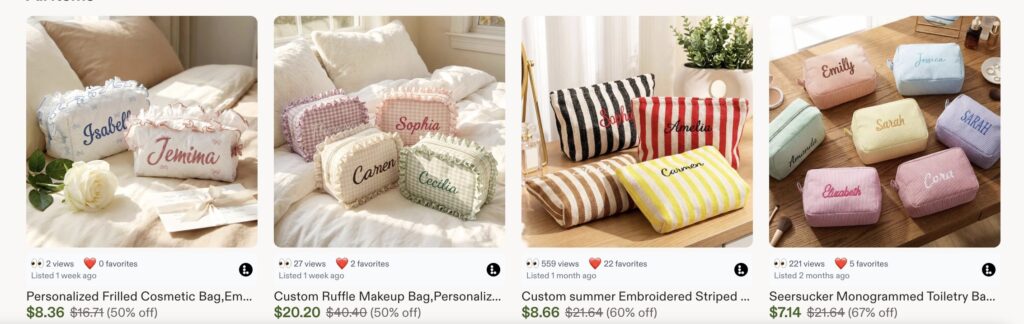
“Etsy search results page showing listing titles truncated after the first few words.”
The Etsy title formula
Here is the structure that works, in order:
- Core phrase first. The single phrase that best describes your item, the one a buyer is most likely to type. “personalized leather journal.” Put it at the very front.
- Then a close variation or two. Different ways people search for the same thing: “custom notebook,” “monogrammed diary.” This widens your match without repeating yourself.
- Then attributes. Material, color, size, style: “A5 refillable, brown full-grain leather.”
- Then occasion or recipient. Who and when: “graduation gift for him, anniversary gift.”
So a finished title might read:
Personalized Leather Journal, Custom Monogrammed Notebook, A5 Refillable Brown Leather, Graduation Gift for Him
Front to back, it goes from most important to least. That is the whole formula.
Free Etsy SEO Guide. Your title is one piece of it. Get the whole search picture, titles, tags, descriptions, and photos, in one free guide you can work through listing by listing.
Front-load the words a buyer actually types
Why does order matter so much?
Two reasons. Etsy gives slightly more weight to words near the start of your title. And on phones, where most of your traffic is, the title gets cut off after the first few words. If your key phrase is buried at the end, the buyer never sees it and the algorithm half-ignores it.
So your first 40 characters are prime real estate. Spend them on the phrase that matters most.
Here is the catch most sellers miss: write the buyer’s words, not your own.
You might call it a “dainty celestial talisman.” Your buyer is typing “tiny gold star necklace.” Etsy matches their words, not your branding. So lead with the words they use.
A quick gut check: would a stranger type these first three words into the search bar? If not, move them back and lead with something they would.
Pro tip: verify your lead phrase actually gets searched. Before you commit a phrase to the front of your title, check it in Etsy Marketplace Insights (in your shop’s search analytics). The most common version of this mistake is front-loading your differentiating factor, the one-of-a-kind scent name, the collection name, the clever descriptor, the very thing that makes your product special to you. Buyers are not searching that. If Marketplace Insights shows close to zero searches for your lead phrase, move it back and lead with the words people actually type, then keep your special name later in the title.
Make your title and tags agree
Your title does not work alone. It works with your 13 tags.
When the same strong phrase shows up in both your title and your tags, Etsy reads it as a clear, consistent signal: this listing is really about this thing. That agreement is itself a ranking factor.
So build them together:
- Pick your primary phrase once. It goes at the front of the title and becomes one of your tags.
- Use your tag research to fill the title. The green, high-demand phrases you found for tags are exactly the variations and attributes your title needs.
- Don’t let them drift apart. A title about “boho wall hanging” with tags about “macrame plant hanger” splits your relevance in two.
If you research tags and titles as one job instead of two, they line up naturally. A keyword tool that scores demand and competition feeds both at once.
Stuffing vs readability: the honest answer
So should you cram in as many keywords as possible?
No. And this is the question the old “should I add a lot of keywords to my title” post was really asking.
Here is the balance:
- Use your characters. A three-word title leaves search traffic on the table. Etsy gives you up to 140 characters; a fuller, well-built title genuinely helps you get found.
- But keep it human. A title that is just repeated words (“mug coffee mug ceramic mug gift mug”) reads as spam to buyers and does not help with Etsy either. Repetition past the first use adds nothing.
- Never repeat a word more than you have to. Once “mug” is in there, more “mug”s do not stack relevance.
- No misleading words. Putting “leather” on a faux-leather bag gets clicks that bounce, and bounce hurts your ranking. Be accurate.
The test: read your title out loud. If it sounds like a phrase a helpful shop assistant would say, you are good. If it sounds like a robot hiccuped, trim it.
Worked example: weak title to strong title
Start with a common weak title for a ceramic mug:
Cute Coffee Mug ☕ Perfect Gift Handmade with Love
What is wrong with it:
- The first words (“Cute Coffee Mug”) are vague and emoji-padded.
- No specific phrase a buyer would actually type.
- No material, style, or recipient detail.
- “Handmade with Love” is branding, not search.
Now the rebuilt version:
Personalized Coffee Mug, Custom Name Ceramic Mug, Handmade Stoneware Cup, Coffee Lover Gift for Her
Why it works:
- Front-loaded: “Personalized Coffee Mug” is the exact high-intent phrase, right up front.
- Variations: “Custom Name Ceramic Mug” catches related searches.
- Attributes: “Handmade Stoneware Cup” adds material and type.
- Recipient: “Coffee Lover Gift for Her” catches gift searches.
Same mug. The second title can show up for a dozen real searches instead of one vague one, and it still reads like a sentence a person would write.
FAQ
What is the best Etsy title formula?
Lead with the core phrase a buyer would type, then add close variations, then attributes (material, color, size), then the occasion or recipient. Ordering from most important to least puts your strongest keywords in the prime front position.
How long should an Etsy title be?
Etsy allows up to 140 characters and it is usually worth using most of them, because a fuller title can match more searches. Just keep it readable: the first 40 characters matter most, since that is what shows on mobile and carries the most ranking weight.
Should I put a lot of keywords in my Etsy title?
Use your characters, but do not just repeat words. A fuller, varied title helps you get found, while a pile of duplicated keywords reads as spam to buyers and does not stack ranking value. Aim for several distinct, relevant phrases that still read naturally.
Do my Etsy title and tags need to match?
They should overlap on your strongest phrases. When the same key phrase appears in both your title and your tags, Etsy reads it as a consistent relevance signal that helps you rank. Research them together rather than as two separate tasks.
Should I use my own creative product names in the title?
Lead with the words buyers actually type, not your branding. You can keep a creative name, but put it after the searchable phrase. Etsy matches the buyer’s language, so “tiny gold star necklace” should come before “celestial talisman.”
How do I know if my title phrase actually gets searched?
Check it in Etsy’s own Marketplace Insights, inside your shop’s search analytics. It shows the real search volume for a term (currently about 30 days of data, with a 12-month window rolling out). If your intended lead phrase gets close to zero searches, that is a sign you are front-loading a differentiating descriptor buyers do not type. Lead with a phrase that has real volume instead.
Do emojis help Etsy titles?
Not for search, and they can push your real keywords out of the valuable front of the title. Etsy does not rank emojis, so spend those early characters on the phrase a buyer would type instead.
Your title is doing two jobs. Make sure it is doing both.
Listadum scores the phrases buyers actually search, so you can front-load your title with terms you can rank for and keep your title and tags in sync.
Free plan · no credit card · connect your real Etsy shop in minutes
Related: Finding high-demand, low-competition tags · How to write good product descriptions