
Last updated: August 10, 2026 · By Neha Chandelier, Co-founder of Listadum
I have sold on Etsy since 2020, alongside helping build Listadum, so I know the exact sinking feeling when another EU acronym lands in your inbox. It is calmer than it looks.
Seller to seller: the new packaging law is real, but for a lot of shops there is nothing to do, and for the rest it is smaller and cheaper than the panic posts suggest.
This guide does three things: tells you whether it even touches your shop, explains why it is happening so the rules actually make sense, and walks you through exactly what to do. No fear, no fluff.
First, which shop are you?
The law treats each type of shop differently. Find your row, then jump to your part.
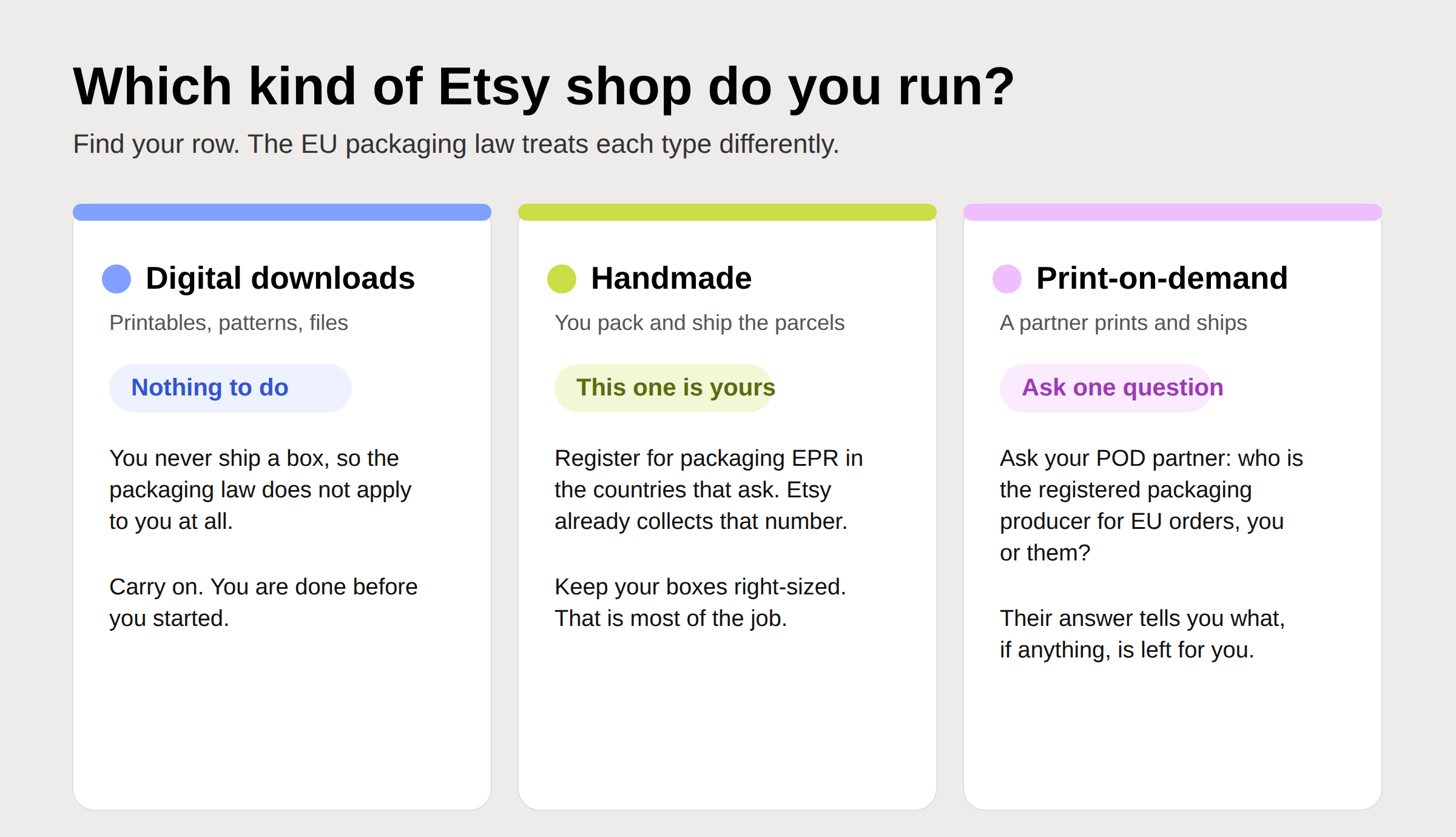
- Digital downloads: nothing to do. You do not ship a box.
- Print-on-demand: usually your printer covers it. There is one number to grab.
- Handmade, you pack and ship: this is the real one. Keep reading.
What is this law, in plain words?
The law is the Packaging and Packaging Waste Regulation, or PPWR (Regulation (EU) 2025/40). It started on 12 August 2026.
One line clears up half the confusion. This is not the product safety law. That one is GPSR. GPSR is about your product being safe. PPWR is about the box and wrap it ships in. Two different laws. We have a plain GPSR guide if you need it.
Over the next few years, PPWR wants packaging to be recyclable, smaller, and made from more recycled material.
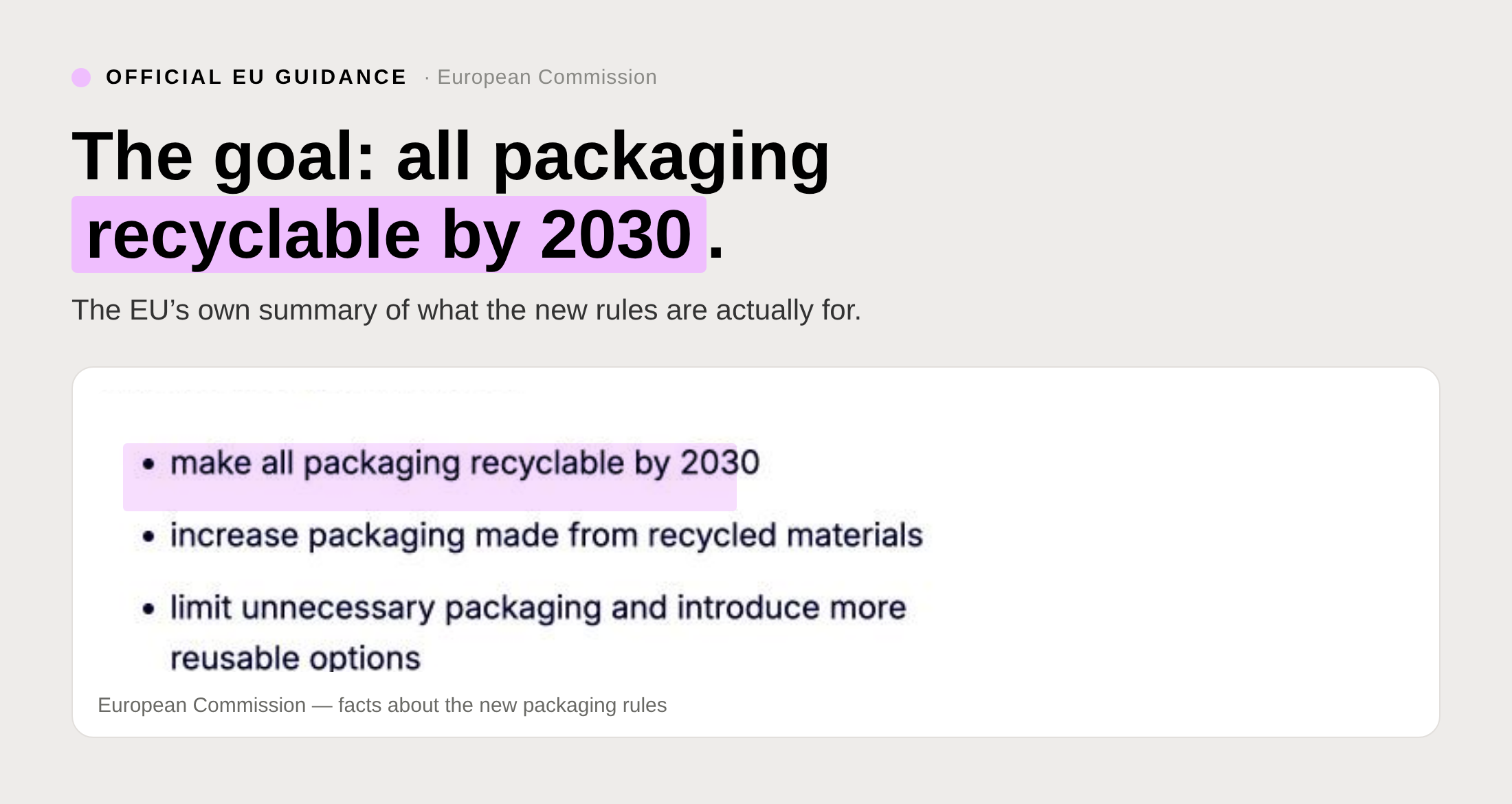
Most of the scary rules are not even live in 2026. The empty-box rule and the recycled-content rules are 2030. The recycling labels are 2028. The only piece that is real for you right now is packaging EPR, so let us start there.
Why the EU is doing this (and where it’s going)
This is not red tape for its own sake.
Packaging is a huge deal in Europe. It eats up about 40% of all the plastic and 50% of all the paper used across the EU, and it makes up more than a third of household waste. Most of it is used once and thrown away. That is the problem the EU is trying to fix.
So the plan is to turn packaging from a make-it, use-it, bin-it line into a loop: less packaging overall, more of it recyclable, more of it made from recycled material, and more of it reused.
There is a second reason that matters for you and me. Until now, every country had its own packaging rulebook, which is a headache when you ship to five of them. This one regulation is meant to replace that patchwork with a single EU-wide system. Annoying to set up once, simpler to live with after.
None of the big design stuff changes overnight. It phases in through 2030. The single piece that is live for you today is helping fund recycling in the countries you ship to. That is where we go next.
What Etsy already does for you (and what it doesn’t)
You have probably seen a note like this on your EU orders:
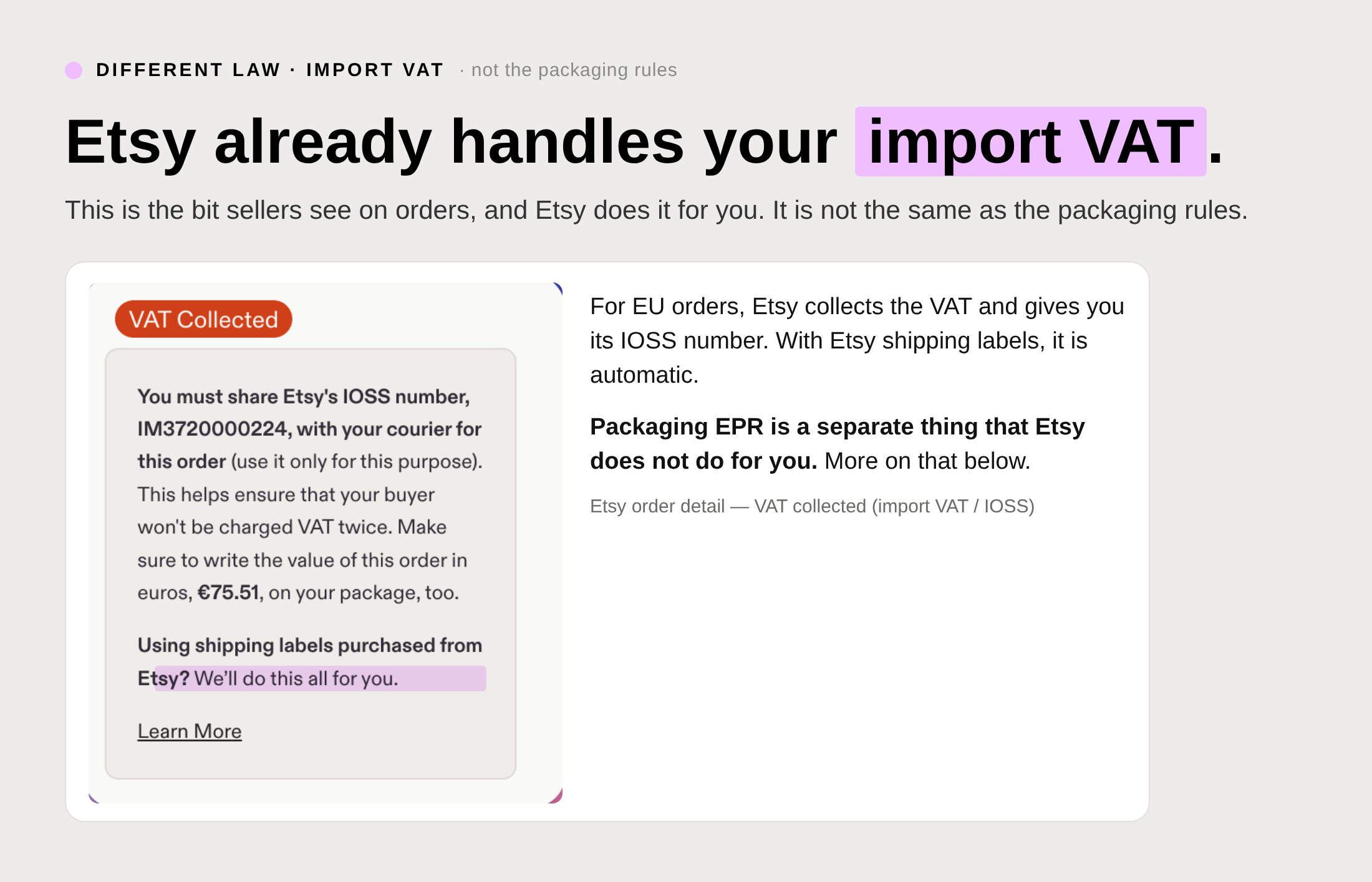
That note is about import VAT, not packaging. Etsy collects the VAT for EU orders, gives you its IOSS number, and if you buy Etsy shipping labels, it handles the customs part for you. This is the same world as the end of the $800 duty-free rule. Etsy does a lot of it for you.
This is where sellers get confused. Etsy quietly handles the VAT you can see, so you assume it handles everything. It does not touch packaging EPR.
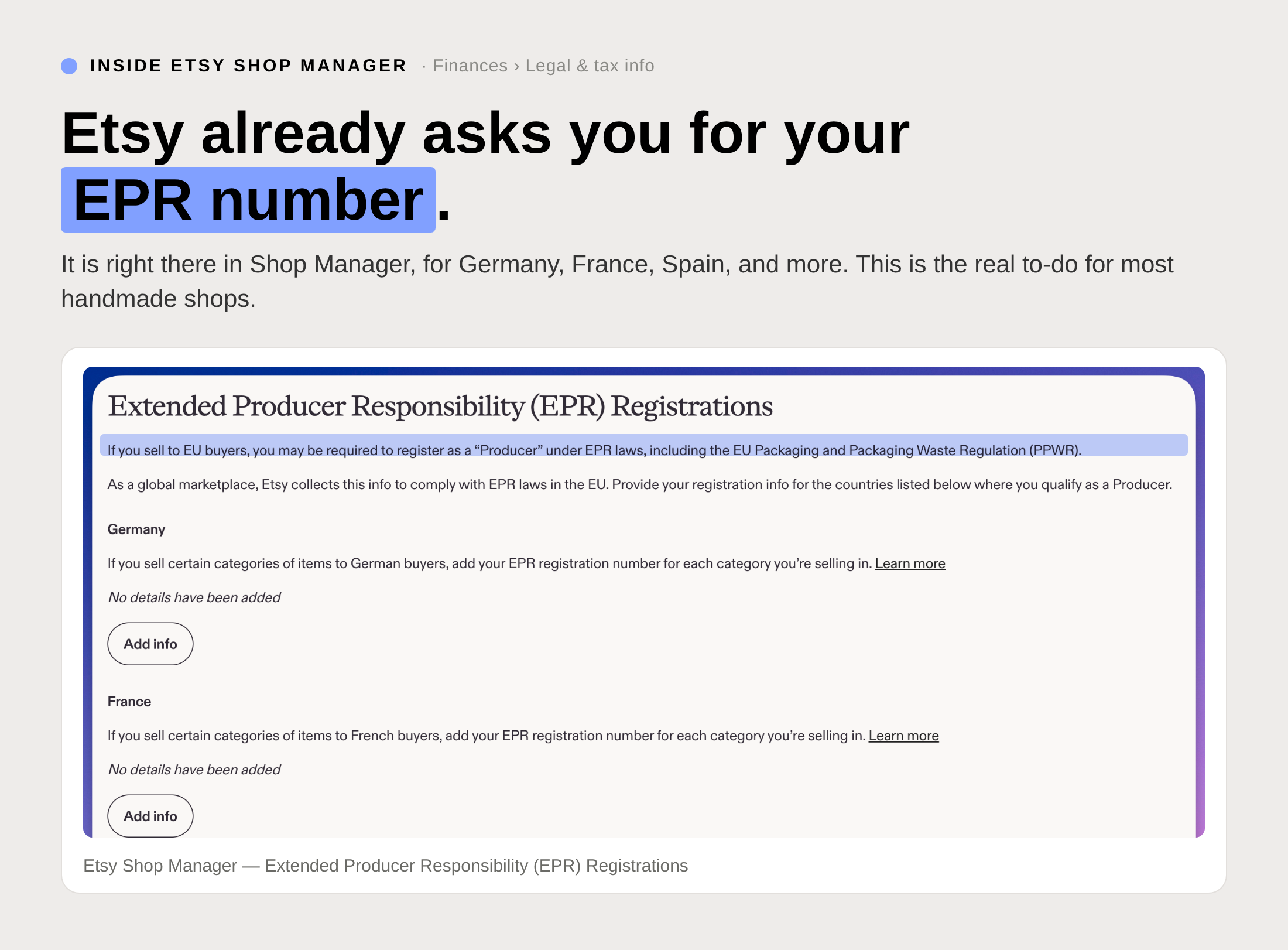
Most sellers open that panel, see “No details have been added,” and close it again. Etsy is asking. Almost no one answers.
The real task: packaging EPR (and yes, it is fiddly)
EPR stands for Extended Producer Responsibility. Plain version: if you send packaging into a country, you pay a small yearly fee to help recycle it. You register with that country’s scheme, then declare and pay.
Quick word on the two acronyms, since they get mixed up. PPWR is the whole packaging law (design rules, labels, targets, and EPR). EPR is just the “register and pay to fund recycling” part, it is older than PPWR, runs country by country, and it is the one piece that is live for you today.
This is not new. Germany has asked since 2022 (the LUCID number). France asks too (a unique ID through ADEME/Citeo). Spain, Italy, and Austria have their own versions.
A few honest catches:
- France has no small-seller exemption. Every foreign seller must register, no matter how tiny.
- Germany wants you registered from your very first order to a German buyer.
- From 12 August 2026, non-EU sellers must appoint a local “authorized representative” in each country they register in. That is the piece that adds cost (more on that below).
- Etsy only collects your number. You still register yourself, join a scheme, and pay.
- If you skip it, your sales can get blocked. Marketplaces have to check your registration, so the usual enforcement is your sales to that country getting paused until you comply. Fines exist too (France up to €30,000; Germany up to €100,000, or up to €200,000 for skipping a recycling scheme), but those are last-resort, not what a small shop gets for shipping a few parcels.
So no, this is not a breezy afternoon. It is a real, slightly fiddly admin task. Most small sellers have not done it. That is a quiet risk, not a free pass.
Which countries, and what it actually costs
Here is the reassuring part: you only register where you actually ship. Nobody registers in all 27. Most sellers start with the one or two countries that make up their EU orders and stop there.
Cost splits into two pieces. The recycling fee itself is tiny (often 1 to 3 euro cents per parcel, a few euros a year). What you really pay for is the yearly scheme fee, plus the authorized representative if you are outside the EU. Rough all-in ranges for a small seller:
- Cheapest: Germany is near-free to do yourself today (the LUCID register is free; a small dual-system license starts around €39 a year). The Netherlands is free below a volume threshold most small shops never hit.
- Mid (~€300 to €700 a year each): France, Italy, Ireland, Sweden, Belgium.
- Pricier (~€450 to €1,200 a year each): Spain (needs a Spanish tax ID), Austria, Portugal, Hungary, Slovenia.
So the honest math: if you ship mostly to Germany and France, you are looking at a few hundred euros a year, not the thousands the scary posts imply. The expensive countries are rarely worth registering for at low volume, so plenty of sellers simply cap which countries they ship to.
Want the full picture? We built a free companion guide with the cost for every EU country, the labels by country, and how each print-on-demand service handles it. Get the free EU packaging guide →
So what do you actually do?
The realistic path for each shop type, easiest first.
If you sell digital downloads
Nothing. You never ship packaging. Go make more listings.
If you use print-on-demand (the confusing one)
If one print partner fulfils and ships everything for you, and they are registered, use their packaging number. You do not register yourself. Three big providers publish theirs clearly:
| Print partner | Handles EU packaging EPR? | What to do |
|---|---|---|
| Printful | Yes, registered (LUCID DE4402313676935) |
Add their number to Etsy for Printful-shipped orders |
| Printify | Yes, registered (LUCID DE4139628009499) |
Add their number for Printify-shipped orders |
| Gelato | Yes, registered (LUCID DE2478308883224) |
Add their number for Gelato-shipped orders |
| Prodigi, Gooten, SPOD, Amazon Merch, Redbubble | No clear public statement | Ask them directly before you rely on it |
Add the number to Etsy under Finances > Legal and tax information. Numbers can change, so grab the current one from your provider’s own help page before you paste it in.
Two catches. Their number only covers the orders they fulfil, so if you use more than one partner or ship some yourself, those orders are back on you. And the big three confirm this for Germany; coverage in France or Italy is less certain, so check if those are big markets for you.
If you make and ship your own items into the EU
The regulation counts you as the “producer” of that packaging, even from outside the EU. You have three realistic routes. Start with the countries Etsy already enforces: Germany and France.
Route 1: Register yourself. It is free to start, and the steps are less scary than the jargon.
Germany (the LUCID number):
- Register free at verpackungsregister.org and get your LUCID number right away.
- Sign up with a “dual system” (a recycling scheme such as Der Grüne Punkt or Reclay). This is the part you pay for, priced on how much packaging you send.
- Report your packaging amounts to both. Small shops report once a year.
- Paste your LUCID number into Etsy.
France (through Citeo):
- Sign up with an eco-organisation, usually Citeo, and give a rough estimate of your yearly packaging.
- You get your unique number (your “identifiant unique”).
- Declare your amounts and pay the eco-contribution, which for a small shop is small.
- Paste that number into Etsy.
Since 12 August 2026, a non-EU seller also needs an authorized representative in each country. Budget-friendly providers offer this from around €190 a year per country, which is Route 2.
Route 2: Pay a service to do it for you. If the forms defeat you (many are not in English), an EPR service will register, file, and act as your authorized representative across countries for a yearly fee. This is what a lot of busy sellers do.
Route 3: Buy packaging that is already EU-compliant. Some suppliers sell EU-recyclable stock and handle the EPR on the packaging they make. It helps, but read the fine print: that covers the packaging itself, not your own producer duty for what you put on the EU market. Treat it as a head start, not a get-out.
Being honest: plenty of small sellers watch and wait. That is a gamble on enforcement, and the lever is your listings getting paused. Your call, but go in with eyes open.
What to actually print on your box (labels), by country
There is no single EU label yet. The official harmonized one is not published; it is expected around 2028. So do not wait for it. Use what already works:
- Everywhere (safe default): the material code (the little number-in-a-triangle, like
20 PAPfor cardboard or04 LDPEfor a poly mailer). It is free, understood across the EU, and never wrong. - France: the Triman + Info-tri label is required, in French, on the packaging. Generate your exact artwork through Citeo.
- Italy: material codes on all packaging, plus a short Italian disposal line on consumer packs.
- Spain: a short Spanish “which bin” line on consumer packs.
- Germany and most others: nothing special to print. Your registration is what matters.
One thing to skip: you do not need QR codes. The regulation makes them optional.
Right-size your box (a 2030 rule, worth doing now)
You may have read that your box cannot be more than half empty. That is real, but it is a 2030 rule, not a 2026 one.
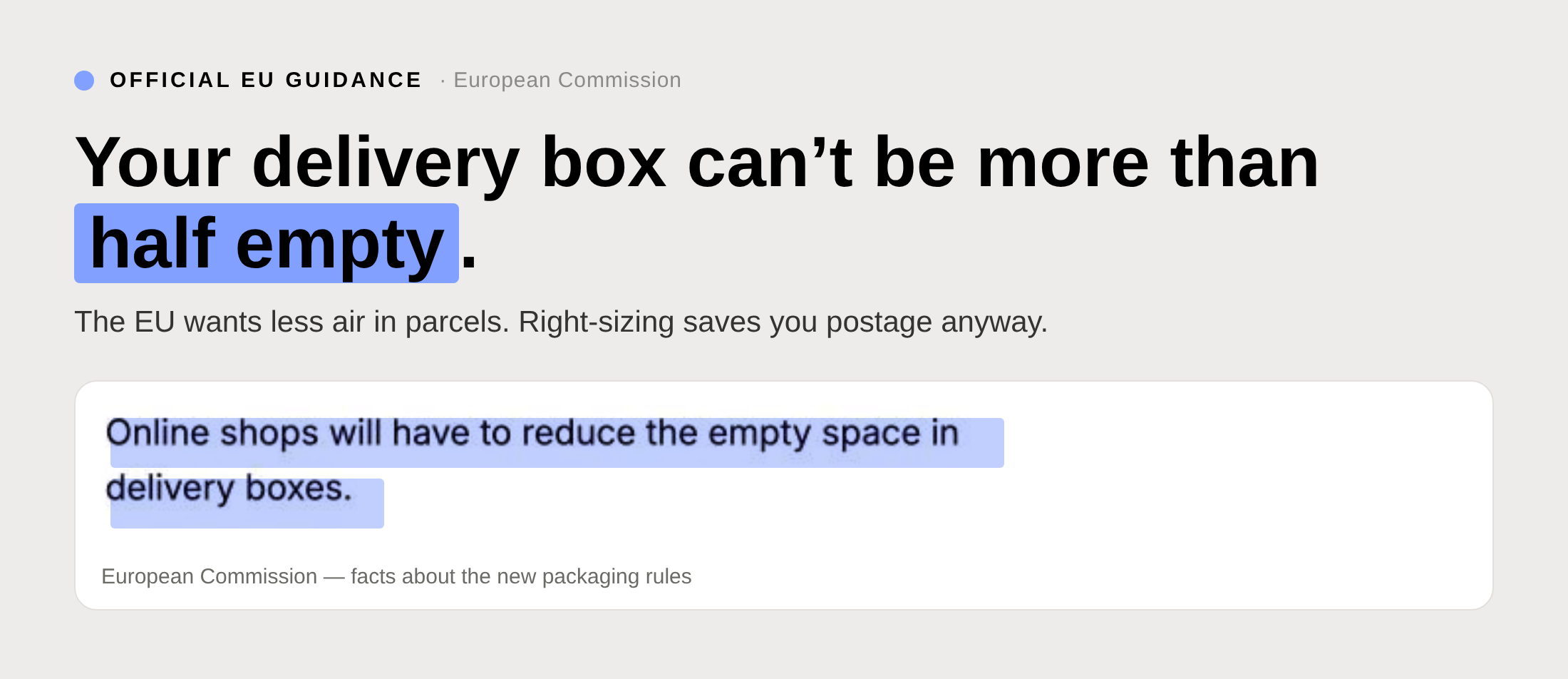
From 2030, e-commerce boxes can be at most 50% empty. One detail catches people out: bubble wrap, paper, and foam count as empty space, not as filler that helps you.
Do it now anyway. Smaller boxes cost less to post, so this pays for itself long before anyone checks.
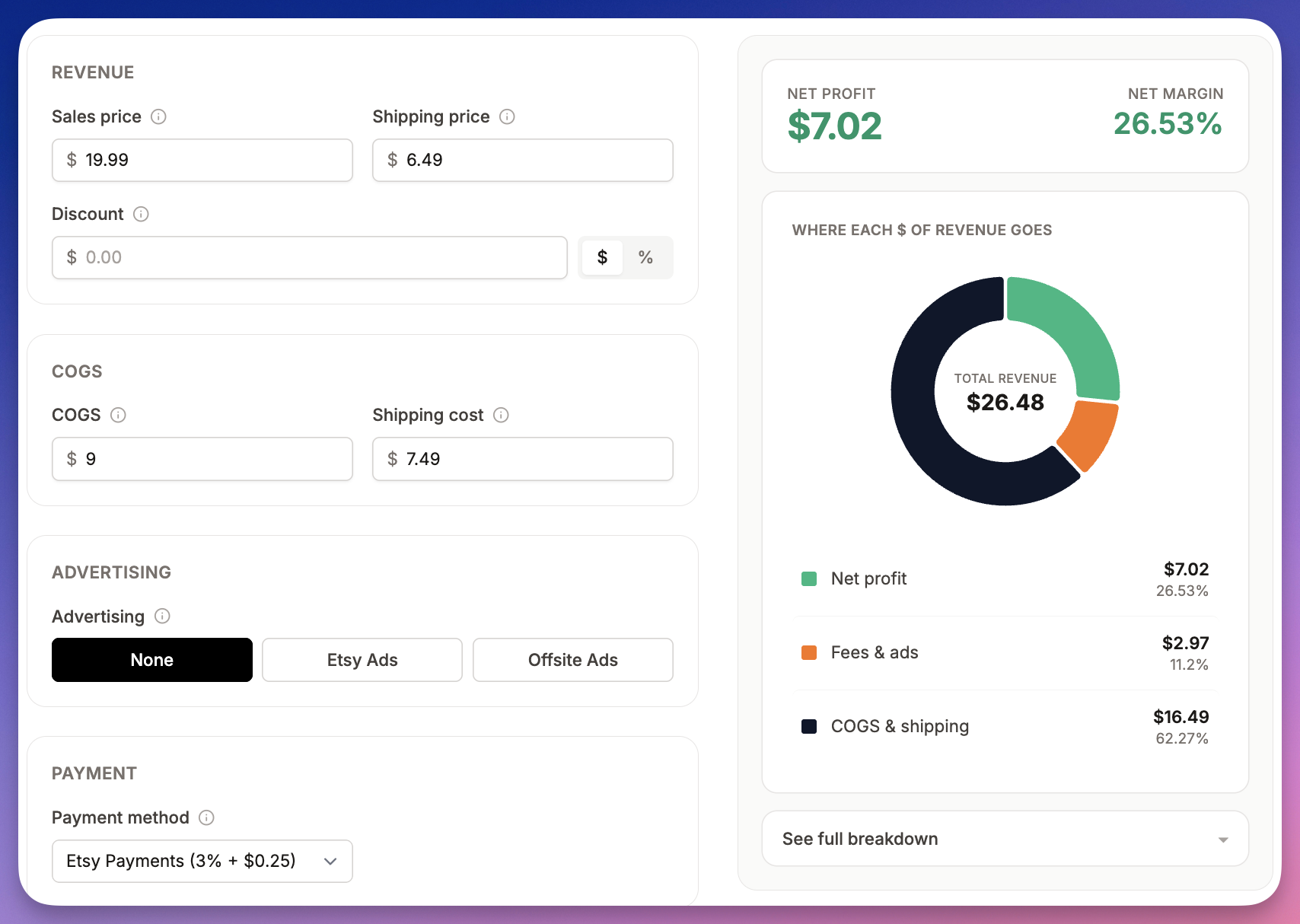
See what each order really nets you. Our free Etsy Fee Calculator adds up Etsy’s cut, shipping, and your costs so packaging changes never catch you out.
Drop the worst materials
Paper, cardboard, glass, metal, and recyclable plastics are fine. The ones on the way out are non-recyclable plastics like PVC and polystyrene. Swap those when your current stock runs out.
Keep a quick note or receipt of what your packaging is made of. If anyone ever asks for proof, you will have it.
What you can safely ignore for now
A lot of the scary headlines are years away, or aimed at big packaging factories, not a one-person shop.
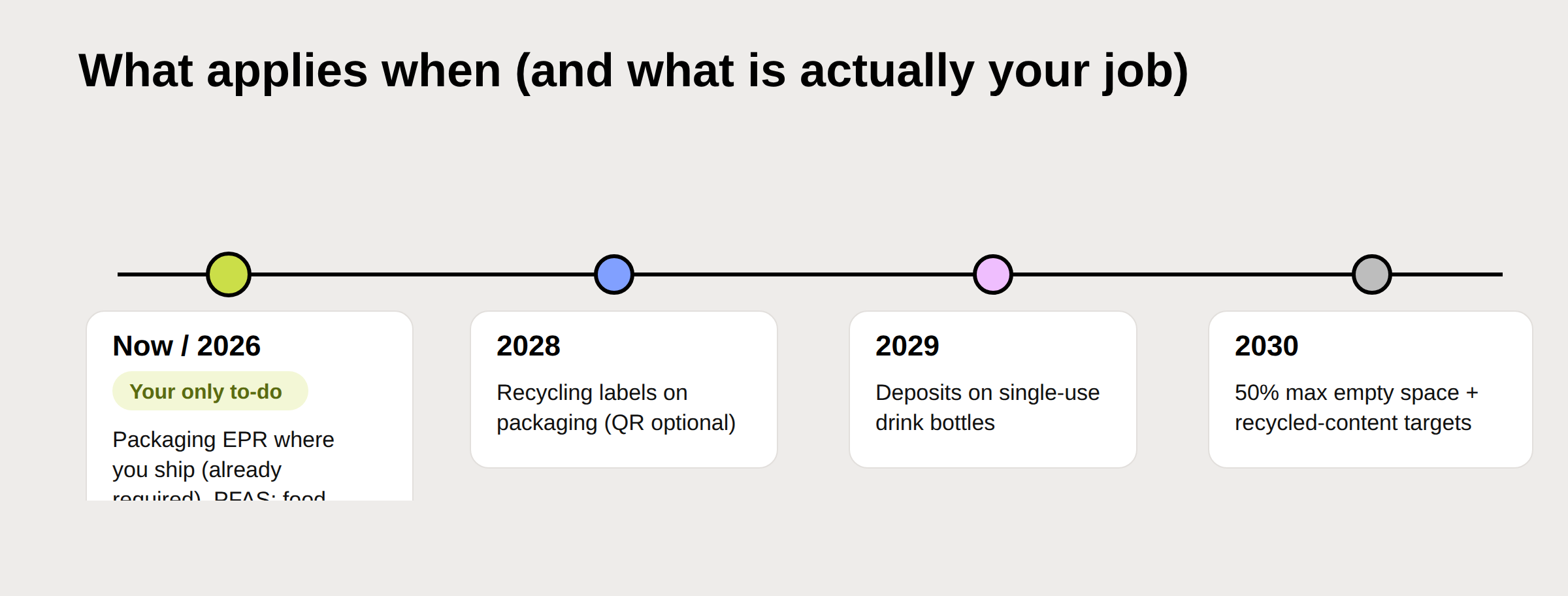
- Recycling labels (2028). No QR codes needed. The standard labels come in 2028.
- Recycled-content rules and the 50% box rule (2030). These land in 2030 and mostly hit the companies that make packaging, not you mailing a candle in a paper box.
Small shops also get lighter rules on some of this.
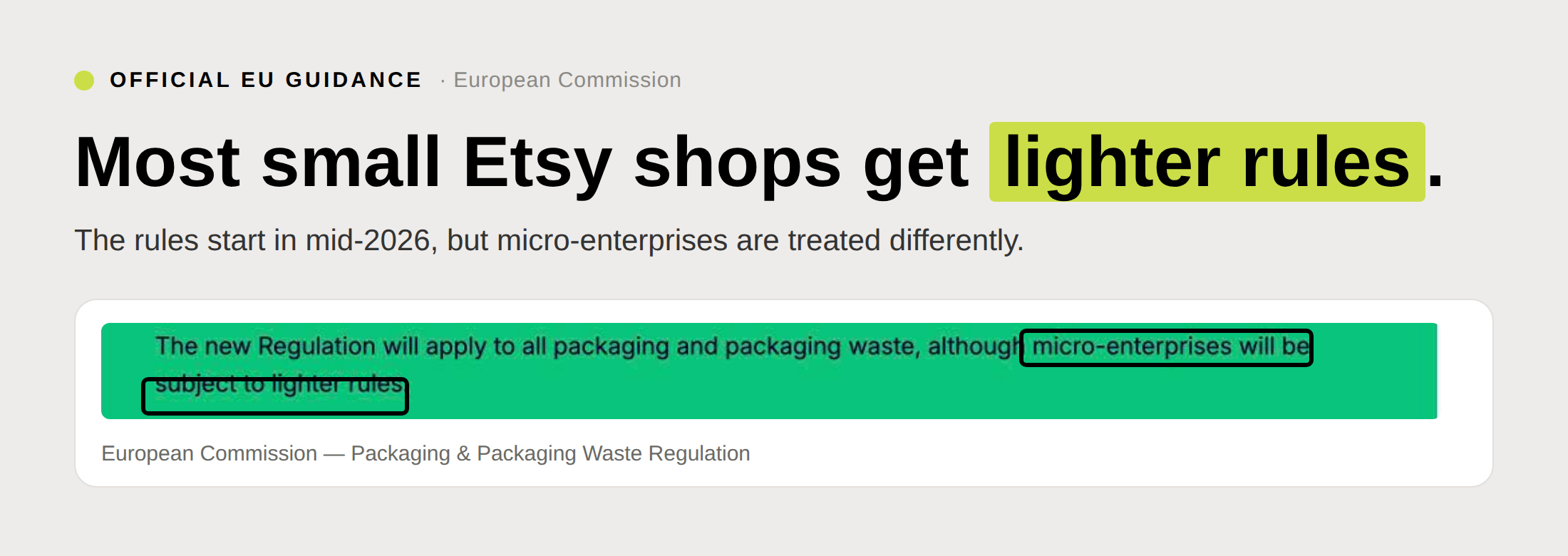
One important catch: those lighter rules are for the packaging-design and reuse targets. They do not exempt you from EPR registration. France, remember, has no small-seller exemption at all.
Your honest checklist
- Digital only: nothing.
- POD through one partner: grab their number (Printful, Printify, Gelato above), add it to Etsy.
- Mixed POD or self-shipped handmade into the EU: register EPR for the countries you ship to (start with Germany and France), add each number to Etsy, add France’s Triman label if you ship there, and use a service if the forms defeat you.
- Everyone shipping physical goods: print the material code on your packaging and right-size your boxes. It saves money now and it is the rule in 2030.
FAQ
What is the difference between EPR and PPWR?
PPWR is the whole new packaging law (design rules, labels, targets, and EPR). EPR, Extended Producer Responsibility, is just the part where you register and pay a fee to help recycle your packaging. EPR is older than PPWR and runs country by country, and it is the one piece that actually applies to you right now.
Does Etsy do all this for me?
Etsy handles import VAT for you (that is the note you see on orders). It does not handle packaging EPR. Etsy collects your EPR number, but you register and pay yourself.
Which countries do I actually register in?
Only the ones you ship to. Most sellers start with Germany and France. Germany is nearly free to do yourself and the Netherlands is free below a volume threshold, while Spain, Austria, and a few others cost more, so many sellers skip those at low volume.
How much does this actually cost a US seller?
The recycling fee is tiny, about 1 to 3 cents per parcel. The yearly cost is the scheme fee plus, for non-EU sellers, an authorized representative. Germany can be near-free to self-register; France runs from about €190 a year with a representative. Budget a few hundred euros a year for the one or two countries you ship to, not thousands.
What label do I put on my box?
The material code (like 20 PAP for cardboard) works everywhere and is free. Add France’s Triman label if you ship to France, and a short local disposal line for Italy and Spain. You do not need QR codes.
My print-on-demand company asked me to register. Why?
Their number only covers the orders they fulfil. If you use more than one partner, or ship some yourself, those orders are your responsibility.
Is the 50% empty-box rule live now?
No. That is a 2030 rule. Right-size anyway, since smaller boxes cost less to ship.
I sell digital downloads only. Anything to do?
No. No packaging, no obligation.
The short version
Strip away the acronyms and this is the EU nudging all of us toward less packaging waste, with most of the real change landing in 2028 to 2030. For today: check your shop type, register the one or two countries you actually ship to, print a material code on the box, and get back to making. You have handled harder things than a government web form. You’ve got this.
Get the whole thing as a free guide.
We turned all of this into one plain-English guide: the step-by-step plan, the cost for every EU country, the labels to print, and how each print-on-demand service handles it. Keep it next to you when you set this up.
Download the free EU packaging guide →
Free · plain-English · not legal advice
Running an Etsy shop? Listadum connects your real shop and shows fees, margins, and your best listings in one place, free.
Neha Chandelier, Co-founder of Listadum, selling on Etsy since 2020. She writes about Etsy tips and tricks, how to sell on Etsy, and growing a handmade shop.
Sources: Regulation (EU) 2025/40, full text (EUR-Lex) · EU Commission: facts about the new packaging rules · Etsy: German Packaging Act (VerpackG) · Etsy: EPR in France · Printify LUCID · Printful VerpackG · Gelato LUCID · France Triman/Info-tri (Citeo) · Italy CONAI labelling · France EPR for non-EU sellers · Lizenzero (German dual-system pricing) · Eldris (per-country EPR pricing)
UPGRADE (10 Aug 2026): Article refreshed with deeper verified research from the full PPWR read + this session: per-country cost tiers (all 27 EU + EEA), fuller POD table with confirmed vs unconfirmed providers, label-by-country specifics (FR Triman/Info-tri, IT material codes + disposal text, ES B2C disposal, DE none), corrected penalties (FR up to EUR30k; DE up to EUR100k/EUR200k) and the mandatory authorized representative from 12 Aug 2026. Added a CTA to the companion free guide at /free/eu-packaging-rules.