
By Neha Chandelier, Co-founder of Listadum · Last updated July 2026
I once sold a run of hand-poured candles that I was sure were my most profitable listing. They sold well, the reviews were glowing, and the little “sold” notifications kept coming. Then I actually sat down and did the math on one sale. After my wax, jar, wick, label, box, and Etsy’s cut, I was clearing about 40 cents a candle. I had priced by looking at what everyone else charged, shaved a dollar to feel competitive, and never once counted my own time.
That is the most common pricing mistake on Etsy, and it is quiet. Nothing warns you. Your shop looks busy while your bank account barely moves.
This guide fixes that. You will get one formula you can run on any product, the real Etsy fee numbers to plug in, and market price data for 20 popular product types so you can sanity-check your number at the end. Not before. We will get to why the market check comes last.
The Etsy pricing formula, in one line
Here is the whole thing:
Materials + Labor + Fees + Shipping + Profit = Price
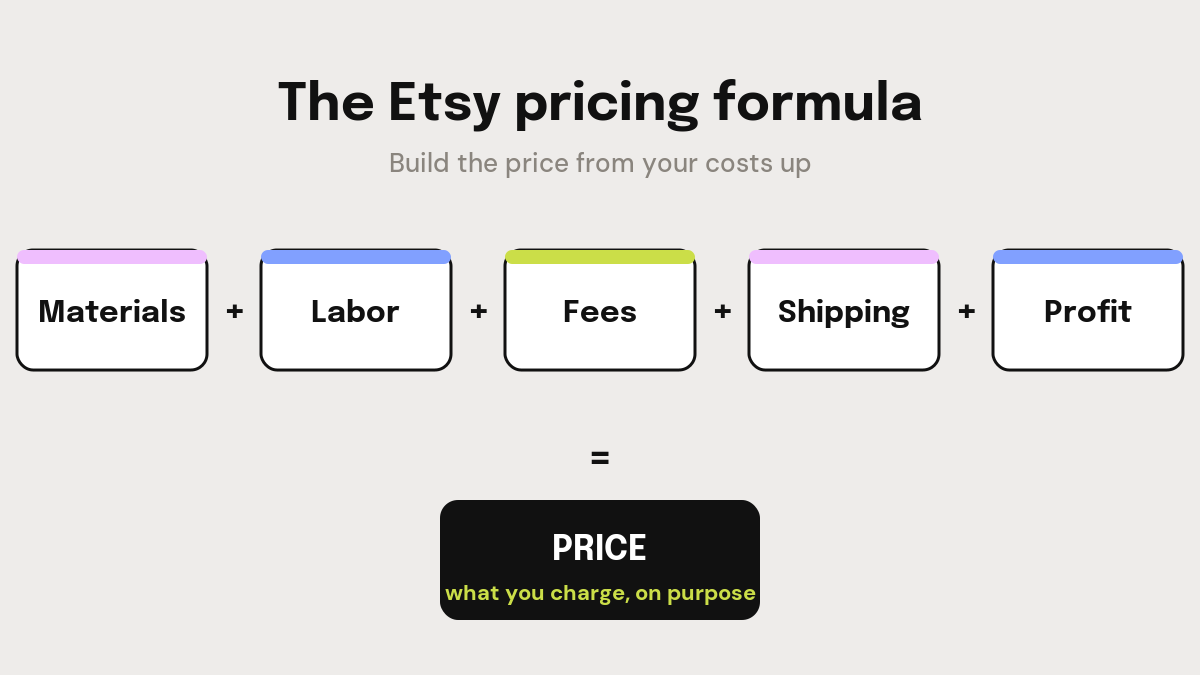
Every term matters, and the two most sellers skip are labor and fees. Skip either one and you are not pricing, you are guessing. The rest of this guide walks each term in order, then runs a real product through it start to finish.
One thing to get straight before we start: you build this price from your costs up. You do not start from a competitor’s number and work backward. Your costs are yours. Someone sourcing supplies in bulk, or printing in-house, has a different floor than you do, and copying their price copies their margin structure without their cost structure.
Step 1: Add up your true materials cost
Materials is everything physical that goes into one finished item and out the door. Not just the obvious stuff.
For that candle, my honest materials list was wax, wick, fragrance oil, the jar, the lid, the label, and the shipping box. Sellers routinely count the wax and forget the box. Then there is waste: the pours that fail, the misprints, the returns. If one in ten candles fails, your real per-unit material cost is about 11 percent higher than your receipt says.
Add it all, including a small waste allowance. For my candle, that came to $8.00.
Step 2: Pay yourself for your time
This is the term that turns a “profitable” shop into a break-even one. Your time has a price even when you do not charge for it, because every hour you spend making is an hour you cannot spend growing, resting, or working a job that pays.
Set an hourly rate. It does not need to be high to start, but it cannot be zero. Then track how long one item actually takes, start to finish, including the parts that do not feel like work: answering the buyer’s question, packing, the post office run.
My candles felt fast because I poured a batch of eight at once. Two hours of work for eight candles is 15 minutes each. At a modest $20 an hour, that is $5.00 of labor per candle. Suddenly my “cheap” candle has $13.00 of cost in it before Etsy has taken a cent.
Step 3: Account for every Etsy fee
Etsy’s fees are small individually and meaningful stacked. Here are the current US numbers, from Etsy’s own fees policy (last updated February 2026):
| Fee | Amount |
|---|---|
| Listing fee | $0.20 per item |
| Transaction fee | 6.5% of item + shipping + personalization |
| Payment processing (US) | 3% + $0.25 |
| Offsite Ads (if attributed) | 15% under $10k/yr, 12% above |
For a seller who has opted out of Offsite Ads, the base take works out to roughly 9.5% plus about 45 cents per order. On my $15-ish candle, that is about $1.90. Not scary on its own, which is exactly why it gets ignored. But it comes off your margin, not your customer’s wallet, so it belongs in the formula.
If you leave Offsite Ads on, budget for 12 to 15 percent on the orders it drives. That single lever can swing a thin-margin product from green to red.
Want the exact take-home on a specific price without doing the arithmetic yourself? Run it through the free Etsy Fee Calculator. Type in a price and it shows you what actually lands in your account.
Step 4: Fold in shipping
Shipping is a cost like any other, and where you put it changes your price.
If you charge shipping separately, it mostly passes through, though note Etsy’s transaction fee applies to the shipping you charge, not just the item. If you offer free shipping, and Etsy nudges hard toward free shipping over $35 because those listings get a search boost, then the shipping cost is baked into your item price. That is fine, as long as you actually baked it in and did not just absorb it.
A $6 shipping cost hidden inside a “free shipping” listing is a $6 hole in your margin if you forgot to add it to the price first.
Step 5: Set your profit margin
Everything so far just gets you to break-even. Profit is the number you add on top, on purpose, because the business exists to make money.
A common handmade target is a healthy margin on the final price, often in the 40 to 60 percent range for handmade goods once labor is already counted as a cost. Keystone pricing (doubling your cost) is a rough shortcut, but it breaks down once real labor is in your cost base, so I prefer to set a target margin and solve for the price.
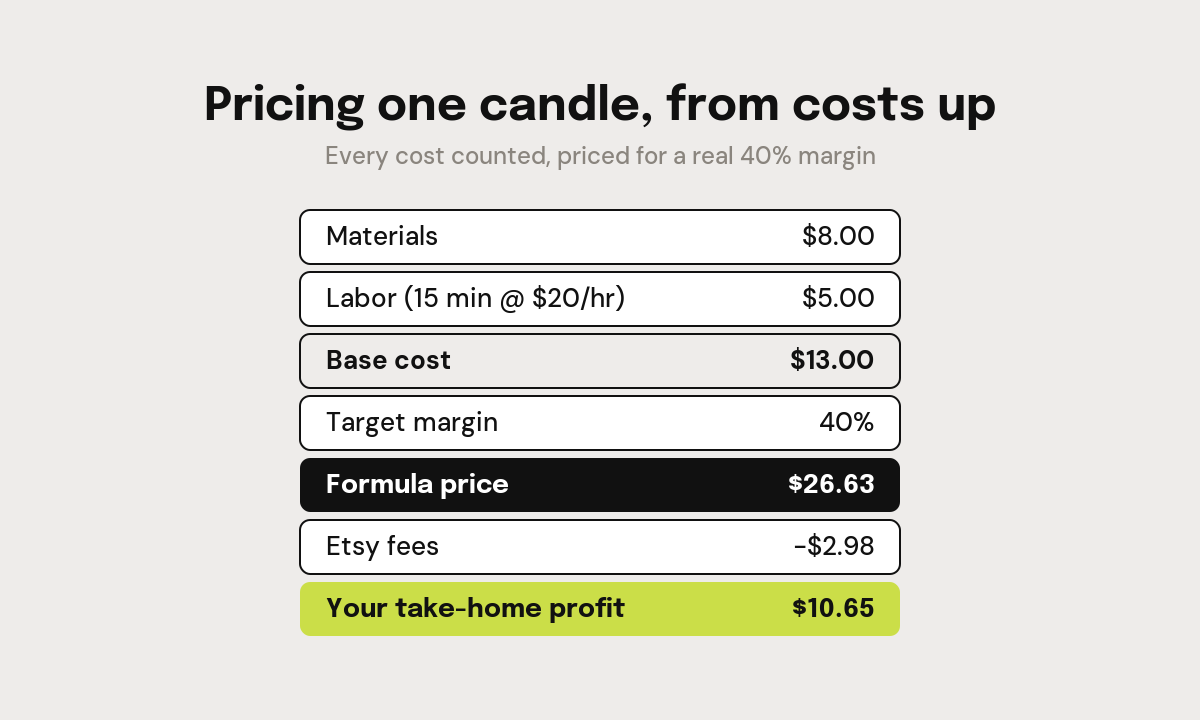
Here is my candle, priced for a 40 percent margin:
| Line | Amount |
|---|---|
| Materials | $8.00 |
| Labor (15 min at $20/hr) | $5.00 |
| Base cost | $13.00 |
| Target profit margin | 40% |
| Formula price | $26.63 |
| Etsy fees at that price | $2.98 |
| Your take-home profit | $10.65 |
The formula says price this candle at about $26.63 to keep a real 40 percent margin.
Now, and only now, check the market
Here is where the market comes in, as a reality check on the number you already built, not as the starting point.
I pulled the average selling price for 20 popular Etsy product types using Listadum’s Keyword Explorer. These are the averages across the top listings for each search, current as of July 2026:
| Product | Avg selling price | Type |
|---|---|---|
| Resin art | $66.39 | Physical |
| Wall art | $63.03 | Physical |
| Custom neon sign | $57.34 | Physical |
| Leather wallet | $44.97 | Physical |
| Embroidered sweatshirt | $39.05 | Physical |
| Personalized necklace | $38.23 | Physical |
| Baby blanket | $34.65 | Physical |
| Earrings | $31.22 | Physical |
| Phone case | $30.63 | Physical |
| Personalized jewelry | $27.15 | Physical |
| Custom t-shirt | $20.17 | Print-on-demand |
| Tote bag | $18.11 | Print-on-demand |
| Mug | $17.81 | Print-on-demand |
| Candle | $15.29 | Physical |
| Dog bandana | $14.36 | Physical |
| Keychain | $11.84 | Physical |
| Wedding invitation | $10.29 | Digital |
| Digital planner | $8.36 | Digital |
| Printable wall art | $5.94 | Digital |
| Crochet pattern | $5.55 | Digital |
| Sticker | $4.23 | Physical |
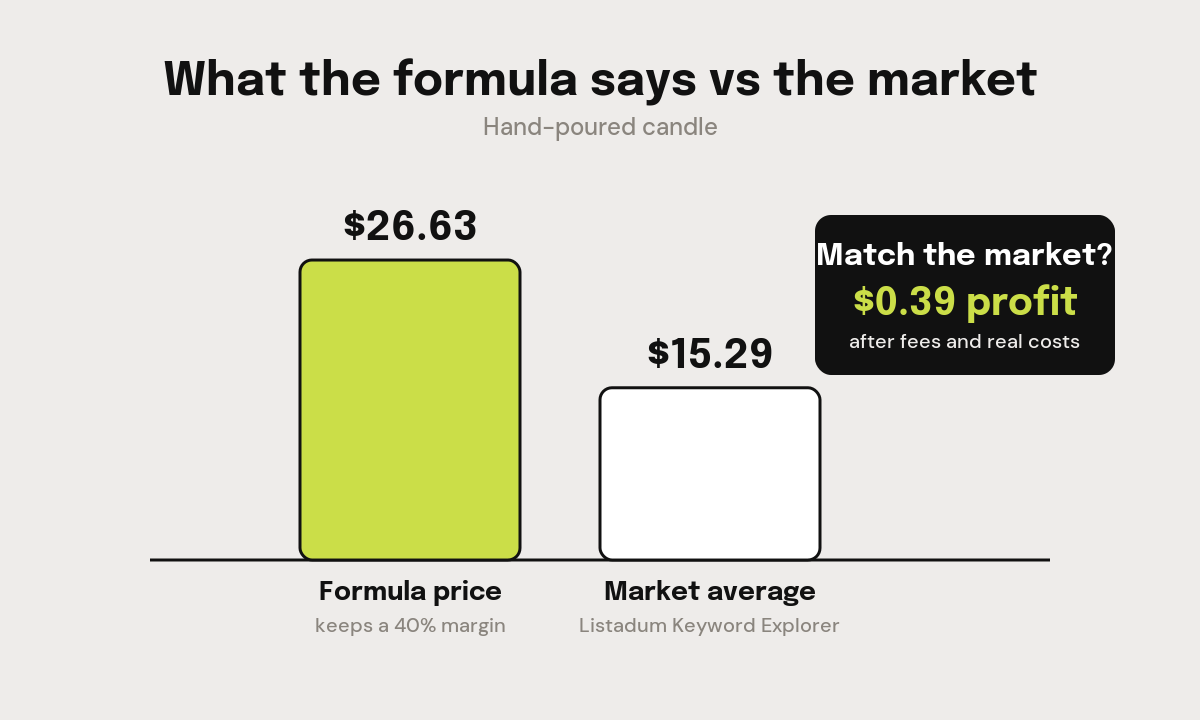
Now look at my candle. My formula said $26.63. The market average is $15.29. That gap is the most useful thing pricing data can tell you, and most sellers read it exactly backward.
The wrong lesson: “I’m too expensive, drop to $15.” At $15.29, after fees and my real costs, I would clear 39 cents. That is the candle I actually sold, and it is not a business.
The right lesson: the market is full of candles priced by people who never counted their labor. Matching them means joining them at break-even. Your options are to justify a higher price with better materials, branding, and photos, to genuinely lower your cost base, or to pick a product where your economics work. Lowering your price to match a number built on someone else’s ignored labor is the one move that guarantees you lose money.
The danger zone: print-on-demand and low-ticket items
Look at the print-on-demand tier in that table: t-shirts at $20.17, mugs at $17.81, totes at $18.11. These sit mid-table and feel safe. They are the trap.
A custom t-shirt has a high base cost before you touch it, roughly $12 for a blank plus printing, and 10 minutes of your time to design, upload, and handle the order. Run the market price of $20.17 through the formula:
| Line | Amount |
|---|---|
| Blank + print | $12.00 |
| Labor (10 min at $20/hr) | $3.33 |
| Etsy fees | $2.37 |
| Total cost | $17.70 |
| Profit at $20.17 | $2.47 (12%) |
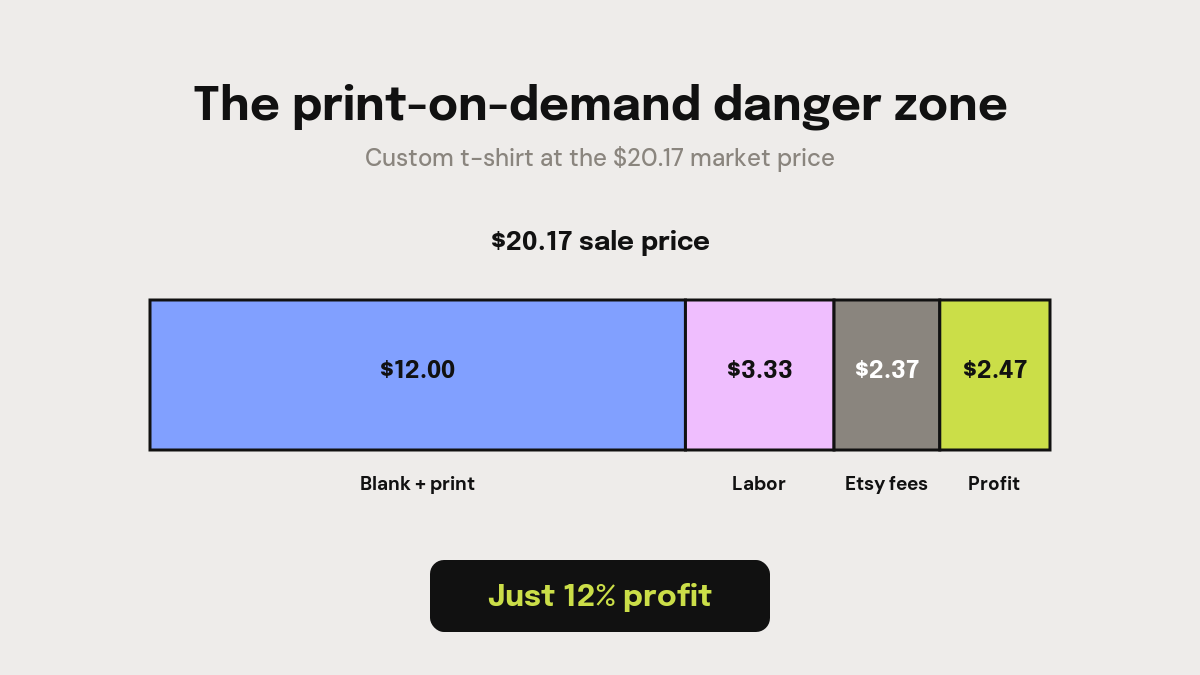
Twelve percent, and that assumes nothing goes wrong. One reprint or one Offsite Ads sale and you are underwater. To hit a 30 percent margin on that shirt, the formula wants about $26, well above the market average. That is not a reason to quit print-on-demand. It is a reason to compete on design and niche rather than price, so you can charge above the crowd. High base cost plus fees is exactly where pricing discipline pays for itself.
Digital products sit at the opposite end. A $5.55 crochet pattern has almost no materials cost, so it can clear 80 percent margin and out-earn a $30 physical item after everything is counted. If you sell both physical and digital, digital’s economics are worth understanding on their own terms.
Common Etsy pricing mistakes
Pricing off competitors first. You inherit their margin math without their cost structure. Build from your costs, check the market last.
Forgetting labor. The single most common reason a busy shop makes no money. If your rate is zero, your profit is an illusion.
Ignoring fees until payout. They are about 9.5 percent plus 45 cents in the US, predictable, and belong in the price, not in a monthly surprise.
Absorbing “free” shipping. Free to the buyer, not to you. Bake it into the price before you offer it.
Setting a price once and never revisiting. Supply costs drift, Etsy’s fees change, your time gets more valuable. Re-run the formula on your top listings a couple of times a year. Tracking your real per-listing margin over time is exactly what profit tracking is for.
Frequently asked questions
What is a good profit margin on Etsy?
For handmade physical products, 40 to 60 percent of the final price is a healthy target once your own labor is already counted as a cost. Digital products can clear 80 percent or more because materials are near zero. Print-on-demand runs thinner, often 30 to 45 percent, because the blank and printing eat into every sale. If your margin is under about 20 percent after labor and fees, the price or the product needs to change.
How much does Etsy take per sale?
For a US seller opted out of Offsite Ads, roughly 9.5 percent plus about 45 cents per order: a $0.20 listing fee, a 6.5 percent transaction fee, and 3 percent plus $0.25 in payment processing. Offsite Ads, when they drive the sale, add 12 to 15 percent on top, capped at $100 per order. The free Etsy Fee Calculator gives you the exact take-home on any price.
Should I offer free shipping on Etsy?
Free shipping over $35 gets a visibility boost in Etsy search, so it is often worth it, but only if you have added the shipping cost into your item price first. Free to the buyer is never free to you. Do the math on your heaviest, farthest-shipping order and build that into the price before you switch it on.
How often should I raise my Etsy prices?
Re-run the formula on your top listings at least twice a year, and any time your supply costs jump or Etsy changes its fees. Small, regular adjustments are easier for buyers to absorb than one big jump, and they keep your margin from quietly eroding as costs creep up.
Price from your costs, not your competitors
The candle story has a happy ending. I re-priced from the formula, improved the photos and the packaging to justify the number, and sold fewer candles for more money, which is to say I actually made money. Fewer sales, more profit, less burnout.
Run your best-selling listing through the five steps today. Add up materials, pay yourself for your time, subtract the real fees, fold in shipping, and set a margin you can live on. Then, and only then, glance at the market.
Stop guessing which listings actually pay you.
Connect your shop to Listadum free and see your true margin on every listing, with the real fees and shipping already subtracted, so you can find the products quietly losing you money before you pour another batch.
Free plan · no credit card · connect your real Etsy shop in minutes
Neha Chandelier, Co-founder of Listadum, selling on Etsy since 2020. She writes about Etsy tips and tricks, how to sell on Etsy, and growing a handmade shop.