


I have tried print-on-demand on and off for years, so let me be straight with you: it is not the effortless money machine every Etsy guru makes it sound like. Getting real sales takes real work. But it is still the easiest way I know to get your hands dirty, open a shop without spending money on stock, and actually learn how ecommerce works. You upload a design, a printing partner makes the product only after someone buys it, and you never hold a box of inventory in your spare room. You can start this week, with no experience and no design software you have never opened.
There is one Etsy rule that quietly gets new print-on-demand shops shut down, and almost none of the “8 easy steps” posts written by the printing companies mention it. I will get you to your first listing the right way, so you are building on solid ground.
To set expectations with real numbers: top “custom mug” listings on Etsy average around 33,800 views. The demand is real. Your job is to claim a slice of it without breaking a rule or pricing yourself to nothing. Let’s do it step by step.
In this article
- What print-on-demand actually is
- Is print-on-demand still worth starting in 2026?
- First, the two Etsy rules that get new POD shops removed
- Step by step: start your POD Etsy shop
- Common print-on-demand partners for Etsy
- No design skills? How to get designs the right way
- The easiest and most profitable products to start with
- What you will actually make: a beginner pricing formula
- Your first 90 days, and how to scale
- Things you must know
- Beginner mistakes to avoid
- Why most POD shops close (and how to be one that doesn’t)
- Frequently asked questions
What print-on-demand actually is
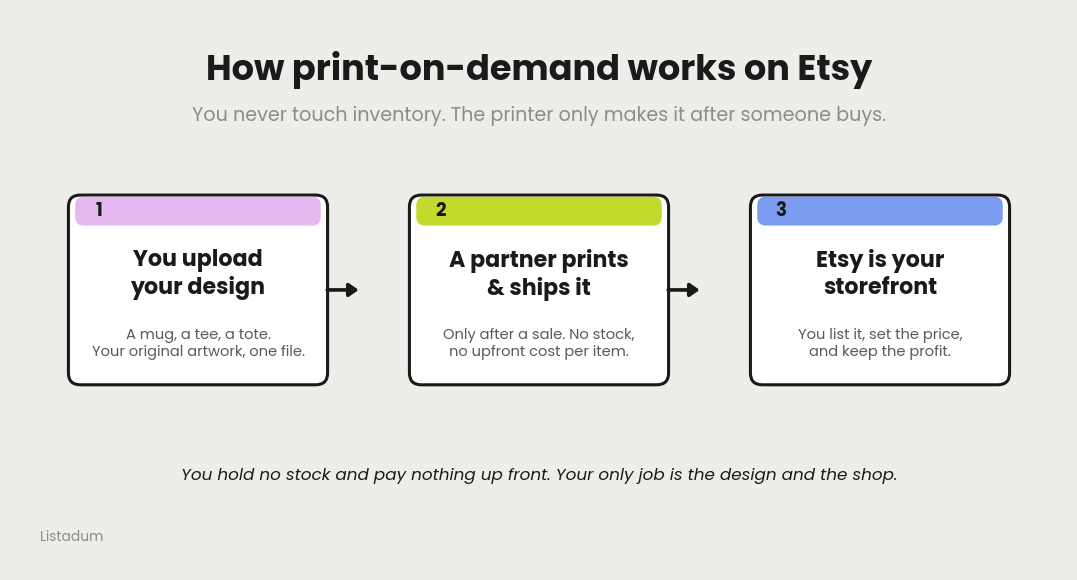
Print-on-demand (POD) means you sell products that are printed one at a time, only after a customer orders them. You design the artwork. A production partner (a printing company) prints it on a mug, a shirt, a tote, or a poster and ships it straight to your buyer. Etsy is your storefront and checkout.
You never buy stock up front. You pay the partner their base cost only when a sale happens, and you keep the difference. That is why POD is such a low-risk way to start: no money tied up in inventory, no leftover boxes if a design flops.
If the idea of selling without holding stock is new to you, we have a whole guide on selling on Etsy without inventory that pairs well with this one.
Is print-on-demand still worth starting in 2026?
Short answer: yes, but go in with your eyes open. POD is popular because it is easy to start, which means the easy niches are crowded. A plain “funny t-shirt” competes with millions of listings. You will not win there.
What still works is a specific design for a specific person, in a category with real demand and a bit less competition. Think a mug for pediatric nurses, not “custom mug.” A tote for a named hobby, not “tote bag.” The narrower and more original your idea, the easier you are to find and the less you compete on price.
So treat POD as a real side hustle you can start this week, not passive income that runs itself. The setup is genuinely fast. The part that earns money is choosing a good product, making an original design, and listing it well. That is the work, and it is learnable. Here are the nine skills it comes down to, in three stages.
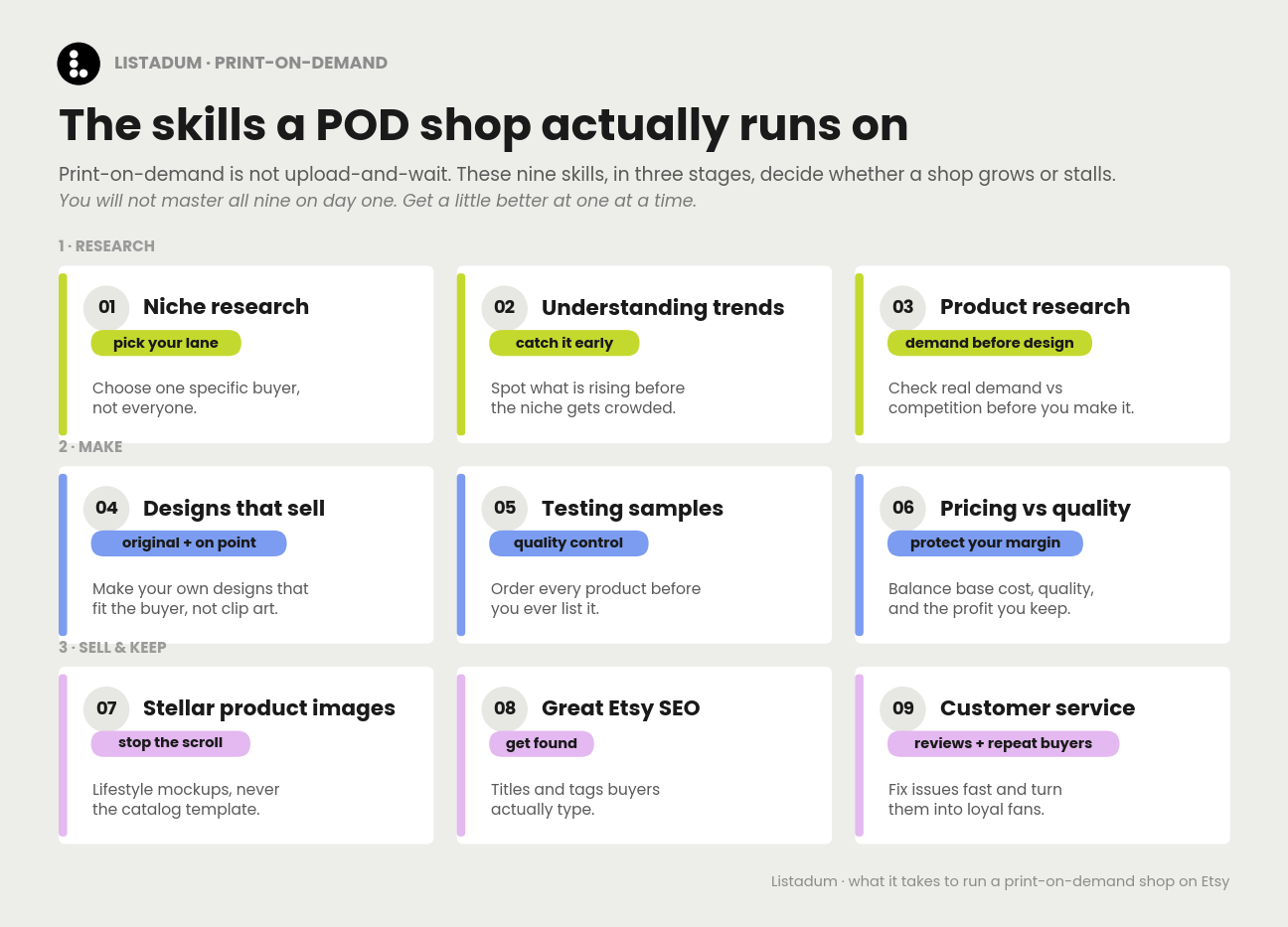
You will not master all nine in week one, and you do not need to. Get a little better at one at a time, and the rest of this guide walks through them in order.
First, the two Etsy rules that get new POD shops removed
Before you list anything, know these two rules. They are the difference between a shop that grows and a shop that gets suspended. I am giving you the short version here; our full guide to Etsy’s rules for print-on-demand sellers covers every detail.
Rule 1: You must disclose your production partner. Etsy defines a production partner as a company outside your shop that helps make your items. Every POD company you use (the one printing your mugs or shirts) has to be listed in your shop settings as a production partner. Buyers can see it, and your listing shows that you designed the item. Etsy is strict here: passing off a partner’s work as fully your own, or running a plain resell or dropship operation, can lead to penalties up to losing your account.
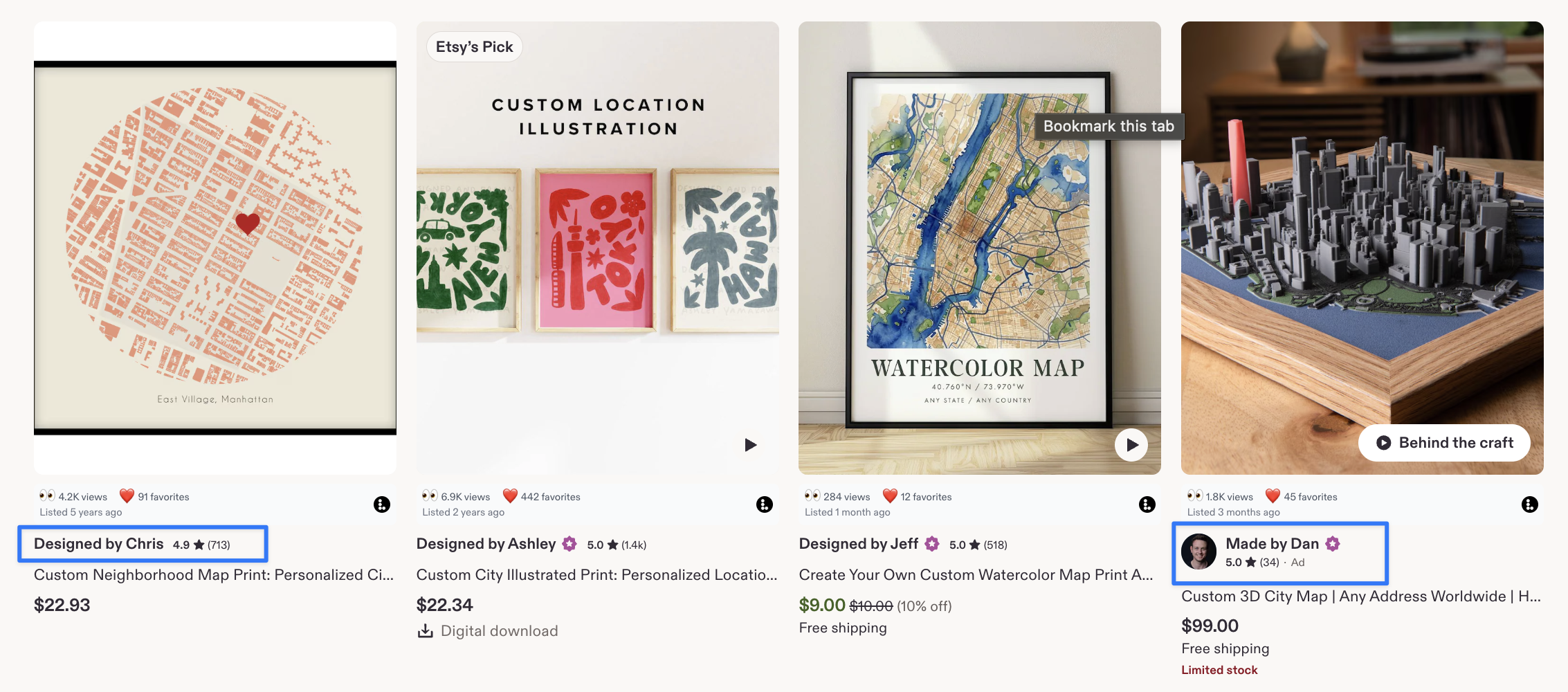
Rule 2: The design has to be your own original work. This is the one most guides miss. Etsy’s Creativity Standards require that items made with computerized tools (which is exactly how POD is printed) be based on the seller’s own original design. Buying a ready-made graphic and slapping it on a shirt unchanged does not count. Your artwork needs to be created by you, commissioned by you, or meaningfully transformed into something new.
Neither rule is hard to follow once you know it. Disclose your printer, keep your designs original, and you are on the right side of both. The next section shows how to get designs that qualify even if you cannot draw.
Step by step: start your POD Etsy shop
Here is the whole path from nothing to a live, compliant listing. You can do the setup in an afternoon.
- Pick a product and a specific niche. Start with one product type and one clear audience. A mug for dog moms, a tote for teachers, a onesie for a specific milestone. One product, one buyer. (More on choosing below.)
- Get your design. Make it original. If you cannot design, the next section covers your options.
- Open your Etsy shop. Set your language, country, currency, and shop name, then add a payment method. If you want the full walkthrough of the account setup, follow our step-by-step guide to starting an Etsy shop so I do not repeat it all here.
- Choose and connect a POD partner. Compare partners on the things that actually matter: product range, base cost, production and shipping time, print quality, and whether they print near your buyers (US and EU printing cuts delivery time). Connect the partner to Etsy, then add it as a production partner in your settings so you are disclosed from day one.
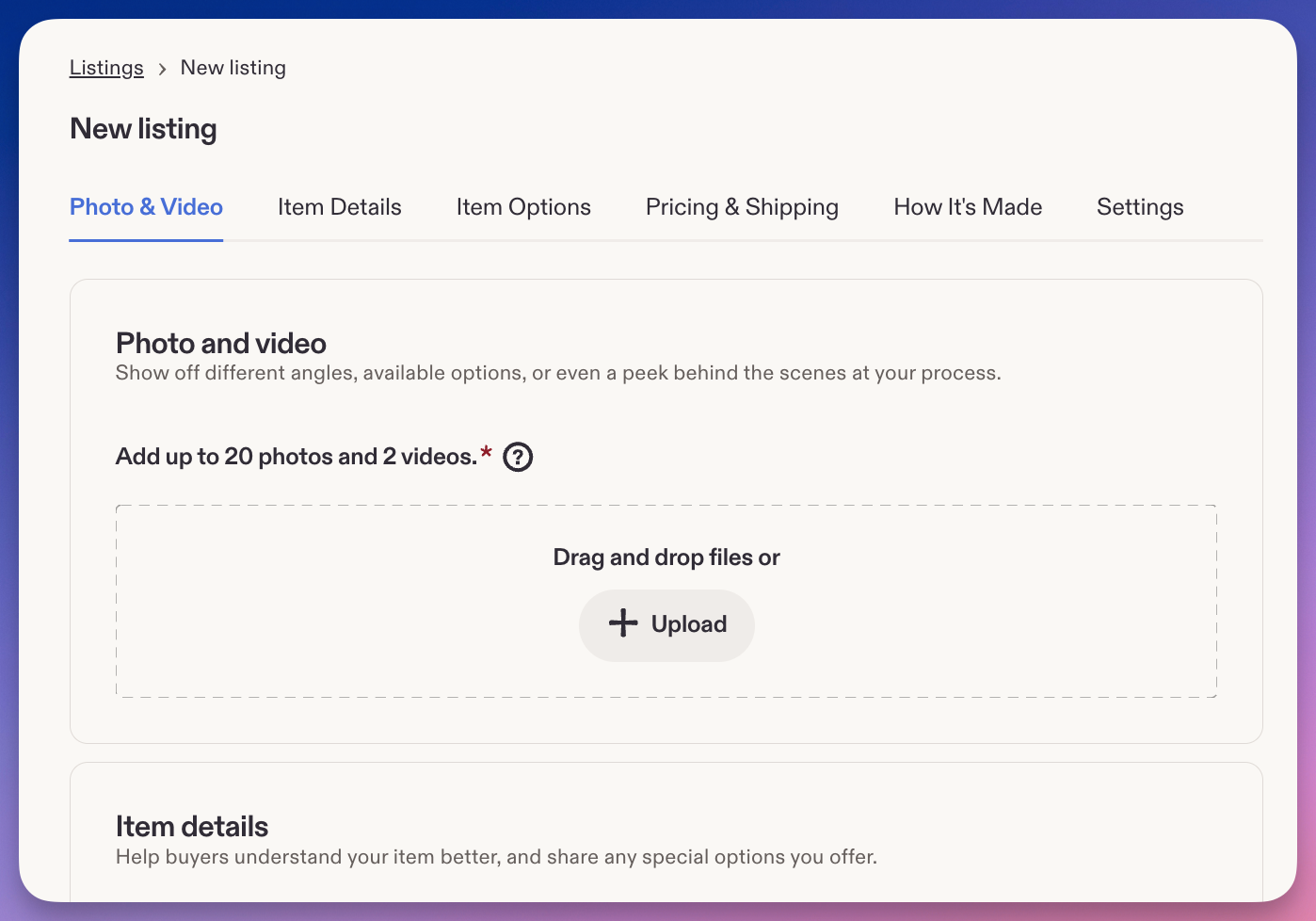
- Create your first listing. Write the title and tags for the buyer, describing the product and who it is for. Never use “print on demand” as a keyword. Shoppers search for “dog mom mug,” not the way it was made. Use clear mockup photos, and set your price with real margin (see the pricing section).
- Order a sample. Buy your own product before you sell it. You will catch color, size, and print-quality problems before a customer does.
- Publish. Hit list, and your first product is live.
None of this needs to wait for the “right” season. People starting in January (New Year gifts, resolutions) and people starting mid-summer both do fine, because you are building a shop, not chasing one holiday.
Common print-on-demand partners for Etsy
When you reach the “choose a partner” step, here are the ones most Etsy sellers start with. This is not a ranking, and there is no single best one. The right partner depends on your product and where your buyers live.
| Partner | Best known for | Prints in |
|---|---|---|
| Printful | Apparel, embroidery, and branded extras like neck labels and packing inserts | US, EU, and more |
| Printify | The widest catalog, through a network of print providers you choose between | Global (varies by provider) |
| Gelato | Localized printing that ships from near your buyer; strong for posters and wall art | 30+ countries |
| SPOD | Fast production times on apparel | US and EU |
| Gooten | Home goods and apparel with routed production | Mostly US |
| CustomCat | US apparel and gifts with quick domestic turnaround | US |
| Teelaunch | Products beyond apparel, like drinkware, home goods, and electronics | US and international |
| Prodigi | Art prints and photography, with a focus on image quality | Global network |
| FinerWorks | Gallery-quality fine-art and photo prints (giclée) | US |
A few things to know before you pick one:
- Most are free to start. You usually pay only the base cost per order, and some offer a paid tier that lowers those base costs once you sell more.
- You can use more than one. Plenty of sellers use one partner for mugs and another for apparel, based on quality and price.
- Always order a sample from your shortlist, and add whichever you choose as a production partner in your Etsy settings before you sell.
No design skills? How to get designs the right way
This is the fear I hear most: “I want to do POD but I cannot design.” You do not need to be an artist. You do need the design to be original under Etsy’s rules. Here are your honest options.
- Commission a designer. Hire someone on a work-for-hire basis so the finished design belongs to you. Now it is your original work, which is exactly what Etsy wants.
- Design it yourself with simple tools. Plenty of beginner-friendly design tools let you make original text-based and graphic designs. A clever phrase in a nice layout is a real design, and it is yours.
- Transform an idea into your own version. Inspiration is fine; copying is not. Take a concept and make something genuinely new with your own words, style, and layout.
What to avoid: buying a ready-made file and selling it unchanged, or copying a design you saw trending. That is the fast track to the originality problem in Rule 2. If you use AI tools to help, read our take on disclosing mockups and AI images in your listings so you stay transparent.
The easiest and most profitable products to start with
Not all POD products are equally beginner-friendly. Some are cheap to make and forgiving on sizing and returns. Others carry a higher price and better profit but need better designs. Here is what the live data says.
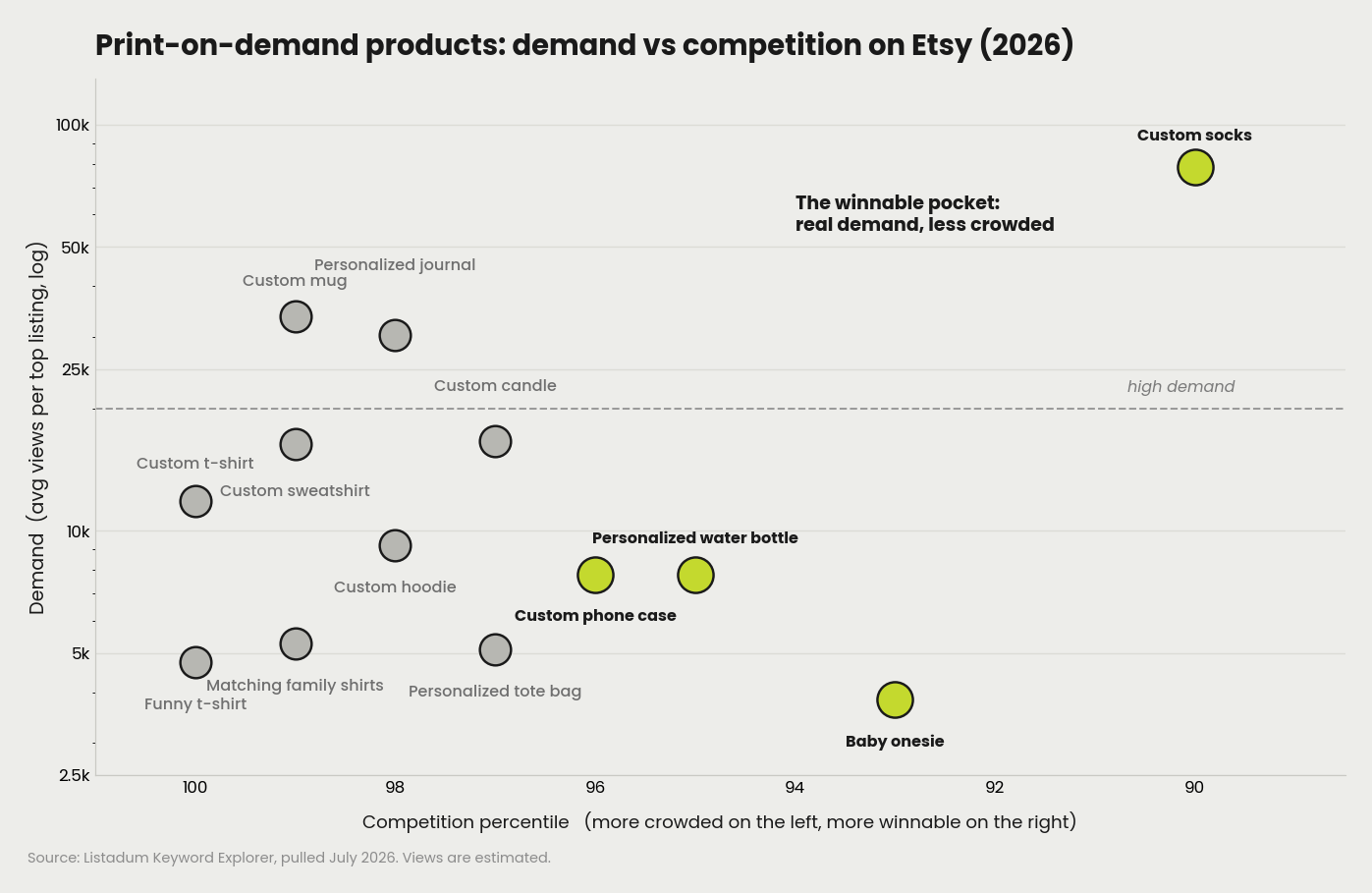
Easiest to start with (low base cost, forgiving, gift-driven):
- Custom mugs. Big demand (top listings average about 33,800 views), low base cost, and people buy them as gifts year-round.
- Tote bags. One size fits all, cheap to produce, and demand is rising.
- Stickers. The cheapest entry point, great for testing designs, though prices are low so you need volume.
Less crowded, still strong demand (good places to stand out):
- Custom socks. One of the least crowded pockets I found, with very high demand and a friendly price.
- Custom phone cases. Higher price point (around $31 average) and less competition than apparel.
- Baby onesies (custom). A specific, gift-driven niche with lower competition.
Higher price, higher profit (worth it once your designs are solid): hoodies and sweatshirts sell for $32 to $38 on average, so a strong design earns more per sale, but the apparel space is the most crowded, so you need to be specific to be seen.
The pattern holds across all of them: the generic term is a bloodbath, the specific niche is winnable. We are writing dedicated deep-dives on the best POD products and the best POD niches to expand on this, but the demand map above is enough to pick your first one.
Want to check demand for your own idea before you commit? The Listadum Keyword Explorer shows you views and competition for any Etsy search, so you are choosing with data, not a hunch.
Free download: Grab our SEO Guide for Etsy Sellers to write titles and tags that actually get your POD listings found.
What you will actually make: a beginner pricing formula
POD margins are thinner than the hype suggests, so pricing matters more than almost anything else you do. The formula is simple: base cost, plus Etsy fees, plus the profit you want, equals your price.
Here is a real example on a custom mug sold for $22 with free shipping:
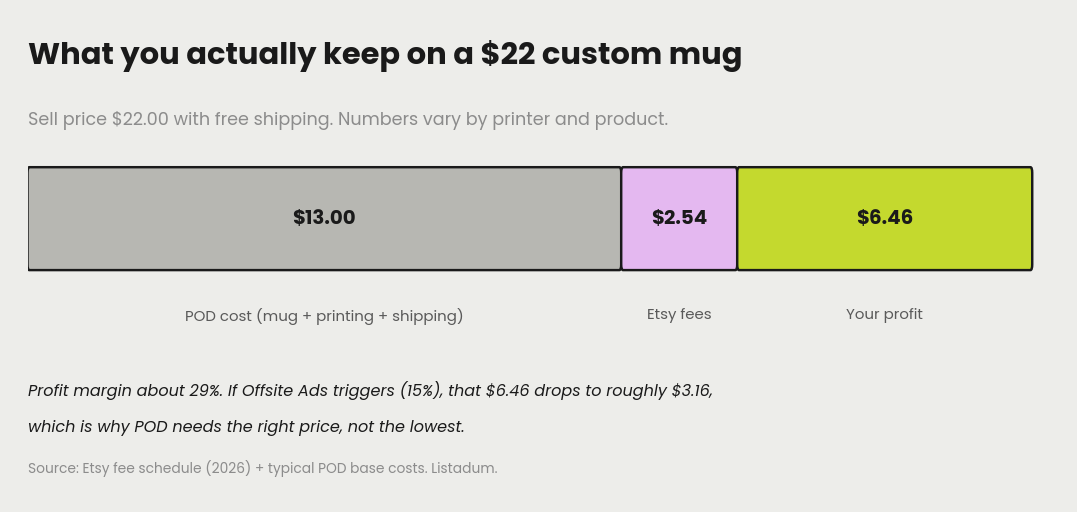
- POD cost (the mug, printing, and shipping the partner charges you): about $13.00
- Etsy fees: $0.20 listing fee, plus a 6.5% transaction fee ($1.43), plus payment processing at 3% + $0.25 ($0.91). That is about $2.54.
- Your profit: roughly $6.46, or a 29% margin.
Two honest notes. First, if your sale comes through Offsite Ads, Etsy takes an extra 15% (for shops under $10,000 in the last year), which would cut that $6.46 to about $3.16. Second, base costs vary a lot by partner and product, so always run your own numbers.
The takeaway: do not price low to compete. Price for a real margin and win on a design people actually want. Our friendly breakdown of Etsy’s fees explains every fee if you want the full picture.
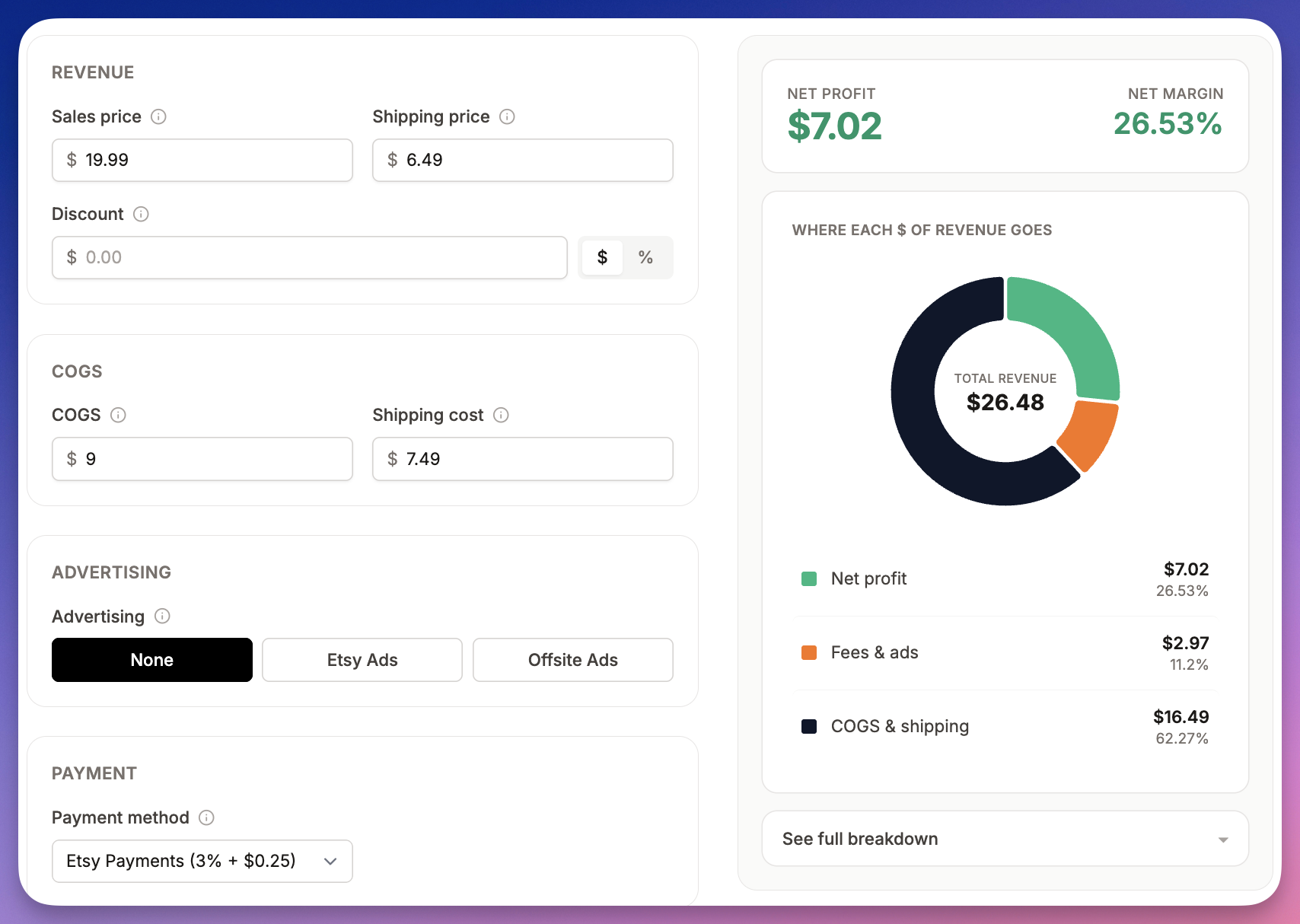
Run your own product through the free Etsy Fee Calculator before you set a price, so you know your profit on every sale.
Your first 90 days, and how to scale
One listing is a start, not a shop. Here is what the first three months look like when it goes well.
- Weeks 1 to 4: Get 10 to 20 listings up. Variety teaches you what your audience responds to faster than agonizing over one design.
- Weeks 5 to 8: Watch which listings get views and favorites. Views without sales usually means the photo or price; no views usually means the title and tags.
- Weeks 9 to 12: Lean into what is working. Make more designs in the same winning direction, and retire the duds.
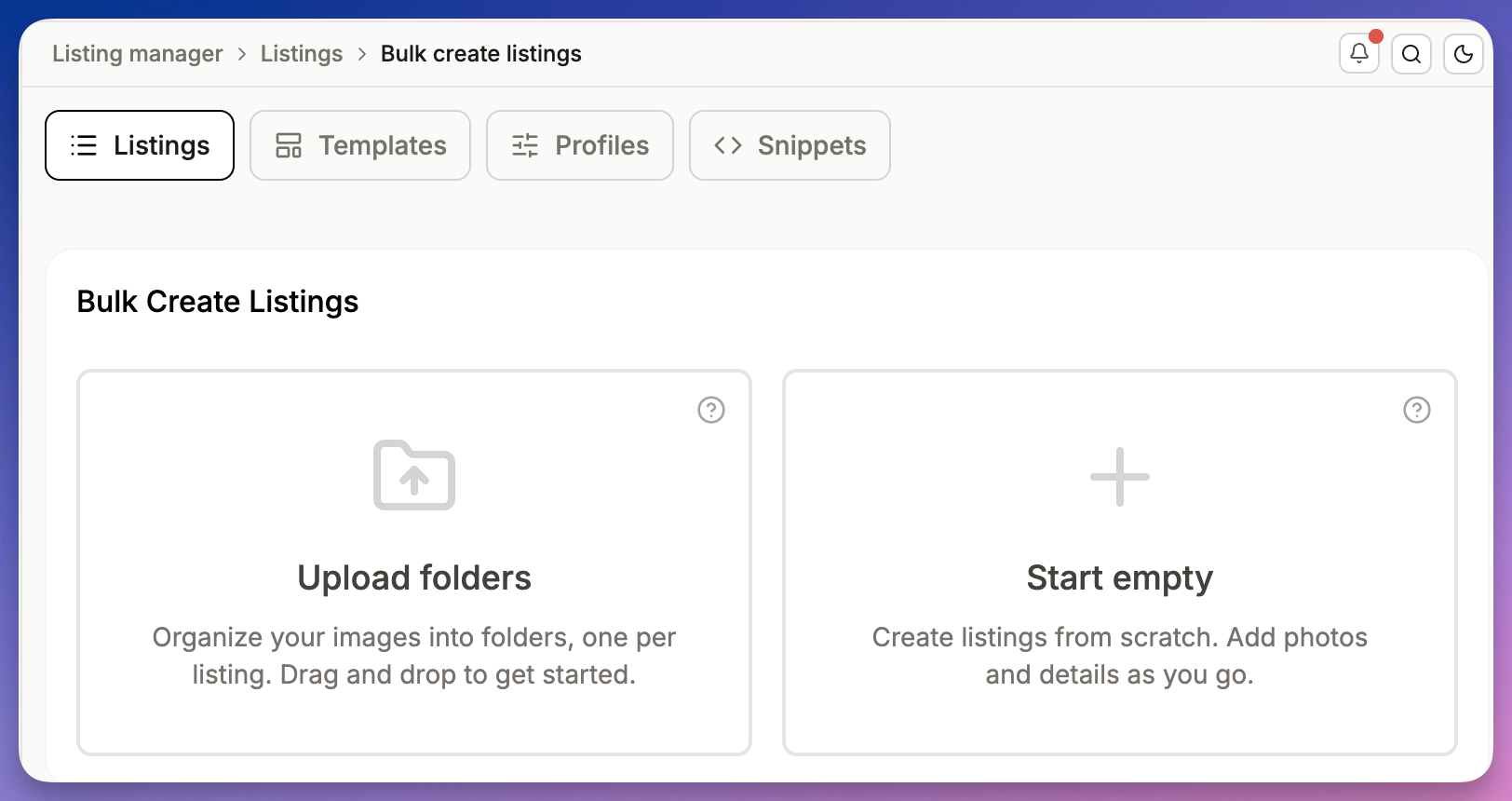
Once you have a direction that works, the bottleneck becomes listing volume. That is where Bulk Create helps: you can build many listings at once from templates instead of one at a time, which is how POD sellers go from a handful of products to a real catalog without burning out.
When sales are not coming, the fix is almost always in the listing (title, tags, photos, or price), not the product. We are writing a full guide on why POD shops stall and how to fix it; until then, the pricing and SEO sections above cover the usual culprits.
Things you must know
A few truths about running a POD shop that took me longer to learn than they should have.
- You are signing up to be great at customer service. With POD, a third party makes and ships every order, so delays, a smudged print, or a wrong size will happen, and the buyer messages you, not the printer. How you handle those messages decides your reviews. Reply fast, fix problems without arguing, and treat a bad order as a chance to win a loyal customer.
- Buyer satisfaction is the whole game. Etsy gives better placement to shops that keep buyers happy, and one genuine five-star review does more for you than a dozen new listings. Your photos, your processing times, and your replies should all point at the buyer leaving happy.
- You are not married to one POD partner. If a printer is slow, inconsistent, or too expensive, switch. You can move a product to a better partner whenever you want. Test a couple early and stay with the one whose quality and turnaround you actually trust.
- Personalized items sell on Etsy. Etsy buyers come looking for something made for them: a name, a date, an inside joke. A personalized version of your product almost always outsells the plain one, and it is much harder for a copycat to undercut. Add a personalization option wherever it fits.
- Watch your printer’s processing times closely. Their turnaround directly affects your shipping-on-time rate and your Star Seller standing. If a partner starts slipping, your ratings drop even though the delay was not your fault. Track it, and switch before it costs you.
- Add a little branding to your products. A branded neck label, a custom packing insert, or a thank-you card makes a POD order feel like a real brand instead of a generic drop-ship. Those few extra cents per order buy repeat buyers and word of mouth, which is the cheapest marketing there is.
- Master one product before you add a second. Pick one product type and get genuinely good at it: strong designs, high-quality listings, great photos. Build a range of designs within that one product and learn what converts before you spread yourself across mugs, shirts, and totes at once. Depth first, then width.
- Never use the plain mockups your POD company gives you. Those flat, catalog-style mockups are the fastest way to blend in and get scrolled past. Every beginner uses them, so they quietly signal “generic POD.” Your photos are your storefront; do not hand them over to a template.
- Learn to make great mockups. This is worth real time and effort. A lifestyle mockup (your design on a real-looking person, in a real setting, styled like a photo someone would actually save) is often the difference between a listing that sells and one that does not. It is a skill, and one of the highest-return skills in all of POD. Our free Etsy Listing Image Playbook walks through exactly which images sell.
Beginner mistakes to avoid
These are the ones that cost me time and money early on, and the ones I still watch new sellers repeat. None of them are hard to avoid once you know they exist.
- Using “print on demand” as a keyword. This one is sneaky because it feels productive. You add “print on demand” to your title and tags and feel like you did your SEO. But no buyer types “print on demand mug” into Etsy. They search “coffee mug for nurses” or “funny dad mug.” The data makes the point: the “print on demand” search has 126,000 listings fighting over it at an average price under $5, because it is sellers talking to sellers, not buyers. Spend those characters on the product and the person who wants it.
- Skipping the sample. Order every product yourself before you list it, with no exceptions. Screens lie about color, print placement drifts, and a mug that looks perfect in a mockup can arrive faded. One bad review in your first month costs you far more than one sample did.
- Not disclosing your production partner. Two minutes in your shop settings keeps your shop alive. Etsy treats an undisclosed printer as reselling, which can end in suspension. Do it the day you connect your printer, not “later.”
- Copying a design you saw trending. If you found it by scrolling Etsy, so did a hundred other sellers, and it probably fails Etsy’s originality rule anyway. Copied designs also invite takedowns. Make your own version of the idea instead of lifting someone else’s execution.
- Printing a trademarked phrase or character. Band names, sports teams, cartoon characters, and viral slogans someone has trademarked are among the fastest ways to get a listing pulled or your shop reported. When a phrase feels suspiciously popular, assume someone owns it and check before you print.
- Pricing too low to “compete.” New sellers panic and undercut, but POD margins are already thin once you add base cost and fees. Racing to the bottom just means you work for free. Price for a real margin and win on a design people actually want, not on being the cheapest.
- Ignoring production and shipping times. Your printer’s turnaround becomes your delivery promise. If a partner takes 7 to 10 days to make an item, set your processing time to match so you are not fielding “where is my order?” messages. Buyers forgive a longer wait they were warned about; they do not forgive a surprise one.
- Listing one product and waiting. One listing is a lottery ticket, not a shop. Get a range of designs up, watch what earns views and favorites, then make more of what works. The sellers who win treat the first month as testing, not a verdict.
Why most POD shops close (and how to be one that doesn’t)
Let me end with the pattern I have watched play out more times than I can count. Someone opens a shop dreaming of quitting their day job, picks a plain t-shirt store because it looked easy in a video, uploads a handful of designs, and waits. The sales never come, because they are one of more than two million t-shirt listings with no strategy behind them. A few months later, the shop quietly closes, and they decide “POD does not work.”
POD works. Opening a generic t-shirt store and hoping does not. That is where most dreams get crushed: not because the model is broken, but because nobody went in knowing what they were going to sell or who they were selling it to.
The sellers who are still here a year later did one thing differently. They started with a plan instead of a hope. They picked a specific product for a specific person, checked that real demand existed before they designed anything, made something original, and priced it to actually profit. That is the whole difference. Not talent, not luck, not a secret printer.
So do not try to build the next big brand this week. Open one shop, for one kind of buyer, with designs that are yours and a price that pays you. Stay consistent through your first ninety days, and you are already ahead of almost everyone who started the same week you did.
Frequently asked questions
Is print-on-demand allowed on Etsy?
Yes. POD is allowed as long as the design is your own original work and you disclose your production partner in your shop settings. Reselling or dropshipping generic products without your own design is not allowed.
Do I need design skills to start print-on-demand?
No. You can commission a designer on a work-for-hire basis, make simple original designs yourself with beginner tools, or transform an idea into your own version. The design just has to be original and belong to you.
How much does it cost to start print-on-demand on Etsy?
Very little to begin. There is no inventory to buy. You pay Etsy’s $0.20 listing fee per item and the printing partner’s base cost only after a sale. Ordering a sample or two is a small, worthwhile upfront cost.
Is print-on-demand too saturated in 2026?
The generic categories are crowded, but specific niches with original designs are still very winnable. Custom socks, phone cases, and baby onesies, for example, show strong demand with less competition than plain t-shirts.
Which POD company is best for Etsy beginners?
There is no single best one. Choose a partner based on product range, base cost, production and shipping speed, print quality, and whether they print near your buyers. Order a sample from your shortlist before you commit.
Do I have to disclose my print-on-demand partner?
Yes. Etsy requires you to list every production partner that helps make your physical products in your shop settings. It is a quick step and it keeps your shop compliant.
How long until my first sale?
It varies. Some sellers see a sale in the first few weeks; many take longer while they add listings and refine their titles, tags, and photos. Consistency in the first 90 days matters more than luck.
Start your shop the right way
POD is one of the lowest-risk ways to start selling on Etsy: no inventory, no upfront stock, and a setup you can finish this week. Keep your designs original, disclose your partner, price for real profit, and list consistently, and you have a real shop rather than a risky experiment.
When you are ready, analyze your shop free with Listadum to catch listing and compliance issues before they cost you a sale. It connects to your real Etsy shop and points out what to improve first.
Related guides: Etsy’s rules for print-on-demand sellers · How to sell custom t-shirts on Etsy · Selling on Etsy without inventory
Neha Chandelier, Co-founder of Listadum, selling on Etsy since 2020. She writes about Etsy tips and tricks, how to sell on Etsy, and growing a handmade shop.