Last week I was looking at a Baltic amber pendant in Listadum. Beautiful piece — real butterscotch stone, silver filigree setting, the kind of thing that photographs brilliantly in natural light. Six days live. 2 views. Zero favorites.
The SEO score was 86. Tags filled in, title long enough, attributes present. Everything the algorithm asks for, technically done. And still invisible.
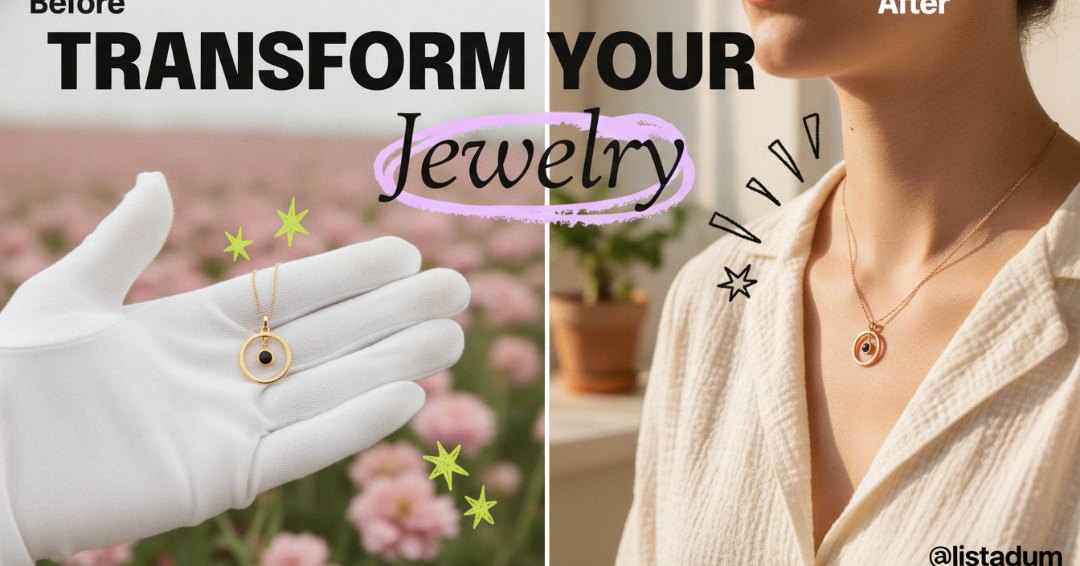
I see this constantly. Jewelry sellers who clearly know how to make something gorgeous, spending their energy on the wrong things — keyword-stuffing titles, running permanent 65% off sales, uploading five identical photos of the same gloved hand. The listing is what’s letting the piece down, not the craft.
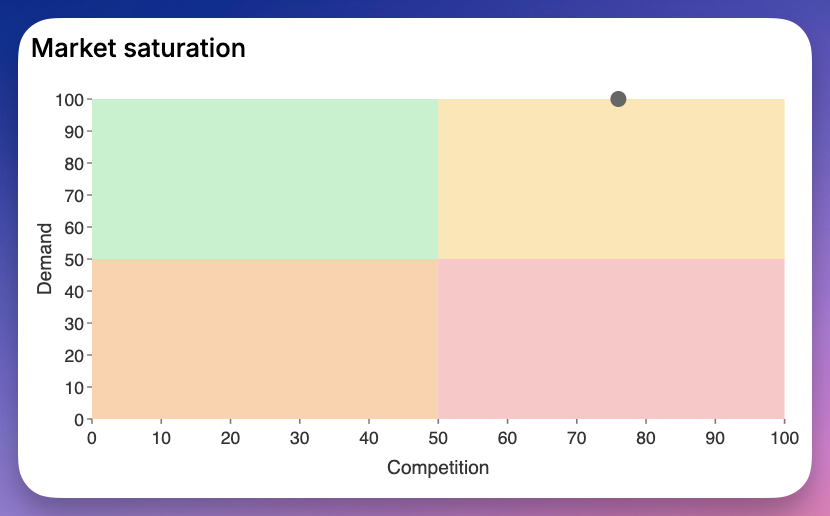
Here’s the thing about jewelry on Etsy: it is the most crowded category on the platform. Over 18 million listings. About 15% of all active sellers are in it. You cannot out-generic your way to the top of it. But you can absolutely stand out — if you understand what the shops that actually sell are doing differently.
This guide covers the four things I see consistently in listings that convert: how they handle photos, titles, personalization, and pricing. Plus a real listing teardown so you can see all of it applied at once.
In this guide:
- The mistakes I see in almost every jewelry listing
- How to pick a sub-niche that’s actually searchable
- What your photos, title, and tags are (and aren’t) doing for you
- Why personalization is the highest-converting angle in the category
- How to price for 2026 material costs without underselling your work
- How to build reviews that do the conversion work for you
- A real listing, torn apart and rebuilt from scratch
The mistakes I see in almost every jewelry listing
Before we get into what works, here is what does not. These come up so consistently across Listadum data that I think of them as the default state for a jewelry listing that is not selling.
- Five identical photos. Not bad photography — repetition. Five angles of the same pendant on the same gloved hand. Buyers get one piece of information five times instead of five answers to five different questions. No worn shot, no macro, no scale reference, no packaging.
- A title that front-loads the wrong words. “Beautiful Handmade Jewelry Gift for Her” tells Etsy’s algorithm almost nothing. The first 40 characters carry about 80% of the SEO weight. Spending them on adjectives instead of the specific material, stone, and product type is the single most common SEO mistake I see.
- Tags that repeat two ideas thirteen times. Five gift tags and three boho tags = eight of thirteen slots saying the same two things. Etsy already recombines words across tags automatically. Those slots should cover thirteen different buyer searches, not circle the same three.
- No personalization at all. 33% of all Etsy sales involve personalized items. Jewelry is one of the top gifted categories on the platform. Opting out of personalization means opting out of the highest-converting angle in the category — and it does not require new products, just a text input field.
- Prices set in 2023 and never updated. Gold hit $4,223/oz in June 2026 — up 54% from the 2024 average. Sellers who haven’t repriced are often selling at a loss without realizing it. A permanent 65% off sale is a signal that something is wrong with the original price, not a strategy.
- No plan for reviews. Jewelry buyers can’t feel the piece before they buy. Reviews with customer photos are the substitute. A shop with 200 reviews on its top listings converts at a dramatically different rate than one with three. Most sellers wait and hope — the ones with strong review counts have a system.
If any of those sound familiar, keep reading. Each section below is the fix.
Before you optimize anything: pick your sub-niche
You cannot SEO your way out of the wrong category.
“Jewelry” is not a niche. Neither is “necklaces” or “earrings.” These are categories with millions of listings, and no amount of keyword research will get a new or mid-size shop to the top of them. The first decision — the one that determines whether everything else you do works — is getting specific about who you make jewelry for and what kind.
“Dainty 14k gold filled initial necklace” is a niche. So is “sterling silver Celtic knotwork rings,” “raw Baltic amber pendants,” or “hypoallergenic titanium earrings for sensitive ears.” These searches have real volume, but the competition is a fraction of “necklace” or “gold jewelry.”
The rule is: the more specifically you can describe who your buyer is and what they are looking for, the more searchable your shop becomes.
A few ways to find your sub-niche:
- Search your main keyword in Etsy and look at the autocomplete suggestions. Each phrase Etsy suggests is a real search someone typed.
- Use Listadum’s Keyword Explorer to see the demand vs. competition ratio for different phrases. You are looking for terms with real search volume that are not yet dominated by established shops.
- Look at your own bestsellers (or your competitors’ bestsellers). The listings that actually sell are usually the most specific ones, not the broadest.
Once you have your sub-niche, every decision below — your photography, your titles, your tags, what you choose to personalize — gets easier because you know exactly who you are talking to.
What your listing is actually telling buyers
Most jewelry listings I see have the same problem: the photos, title, and tags are each trying to do everything at once, and as a result none of them do any single thing well.
Let me break this into two parts.
Your photos: 10 images, 10 jobs
Etsy now allows up to 20 photo slots per listing plus two videos. The average jewelry listing uses five to six, almost all of the same type.
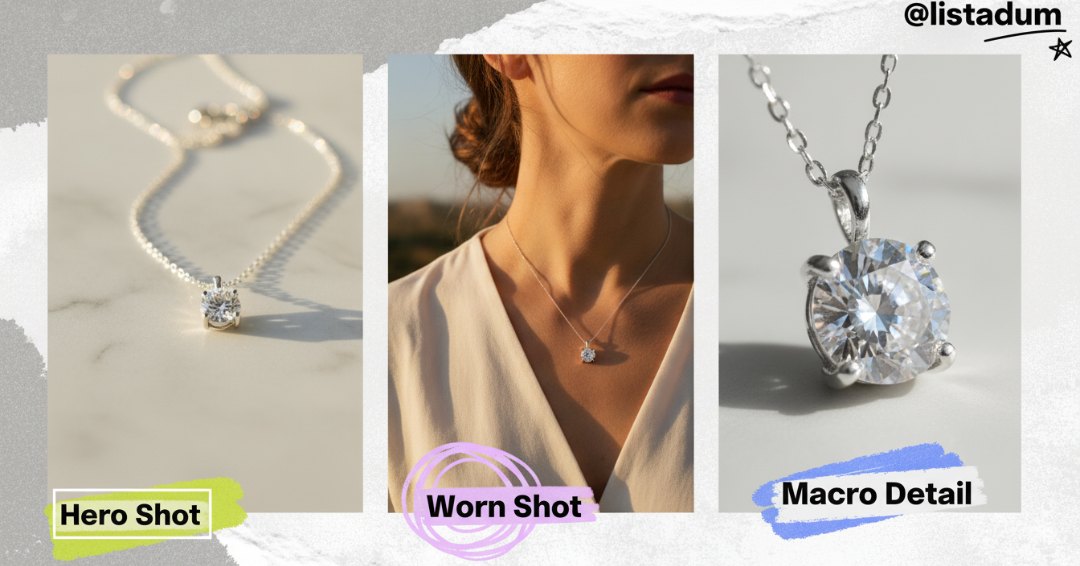
Here is the framework we use in the Etsy Listing Image Playbook: think of your image sequence as a story in ten images, where each shot answers a different question a buyer has before they purchase.
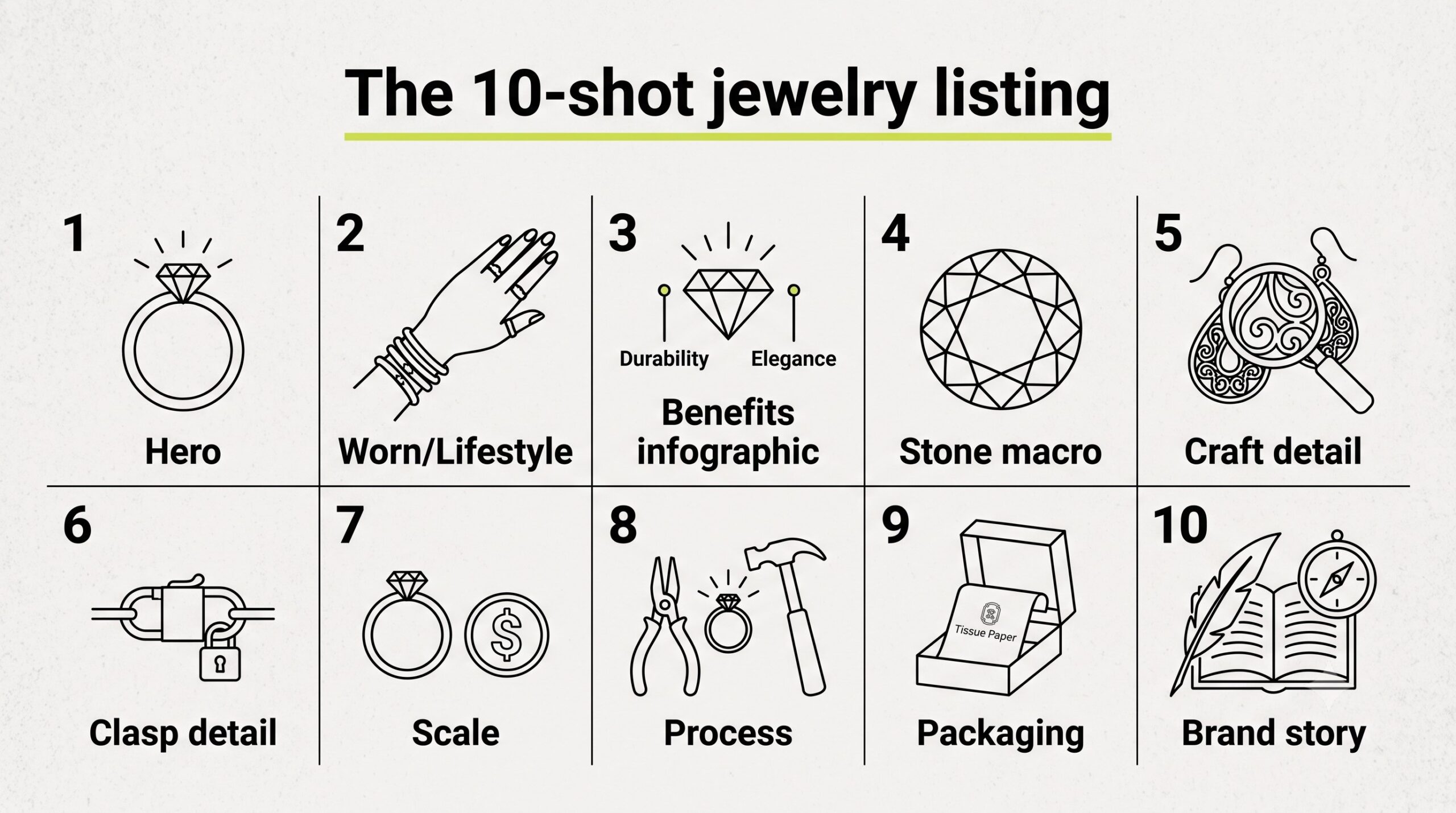
1. Hero / thumbnail
- Scroll-stopper: communicates what the piece is, who it’s for, and the vibe in half a second
- Styled beats plain white on Etsy — match the aesthetic to your niche (airy for dainty, moody for statement, earthy for organic/gemstone)
2. Lifestyle / in-use
- The piece actually being worn — pendant on a collarbone, ring on a hand, earrings on an ear
- The single highest-converting shot type for jewelry; without it, buyers are making a blind purchase
3. Key benefits infographic
- Clean, soft graphic listing 3–5 facts: materials, hypoallergenic status, care instructions, what’s included
- Especially important for buyers who filter by metal type or have allergies
4–6. Detail and close-up shots — three separate shots, each with a job:
- Stone or focal material (butterscotch amber depth, ruby clarity, opal play of color — the thing that makes the piece worth the price)
- Craftsmanship (filigree detail, prong setting, wire wrapping, hand-stamping)
- Clasp, bail, or structural element buyers worry about
A macro of a well-set stone and polished metal justifies your price without a single word of copy.
7. Size and scale
- Piece next to something familiar — a hand, a coin, a ruler
- For necklaces: show chain length on a body or dress form; buyers will not read the description for measurements
8. Process / behind the scenes
- One photo of your hands working (casting, soldering, setting, coiling)
- Proves a real maker made this, justifies a price above mass-manufactured alternatives, separates you from dropshippers on the same keywords
9. Packaging
- Gift box, velvet pouch, tissue paper — photograph it
- A huge percentage of jewelry on Etsy is bought as a gift; this shot answers the gift-buyer’s question before they ask
10. Brand story
- Studio, tools, a portrait, or a few words about your inspiration
- Buyers support people, not just products — this is where you give them a reason to come back
After the core ten: customer photo reviews and a clear shot of each variation (metal color, stone choice, length). The two video slots rolling out on Etsy are worth using — a five-second clip of the pendant catching light does what no still photo can.
The honest check: pull up your listing right now and count how many of those ten shot types you have. If the answer is “all of mine are basically the same angle,” that is the first thing to fix — before you touch a single tag.
Your title and attributes: specificity is the strategy
The first 40 characters of your title carry roughly 80% of its SEO weight on Etsy. That means the first five or six words need to contain your most important keywords, and those keywords need to be specific.
Here is the difference in practice:
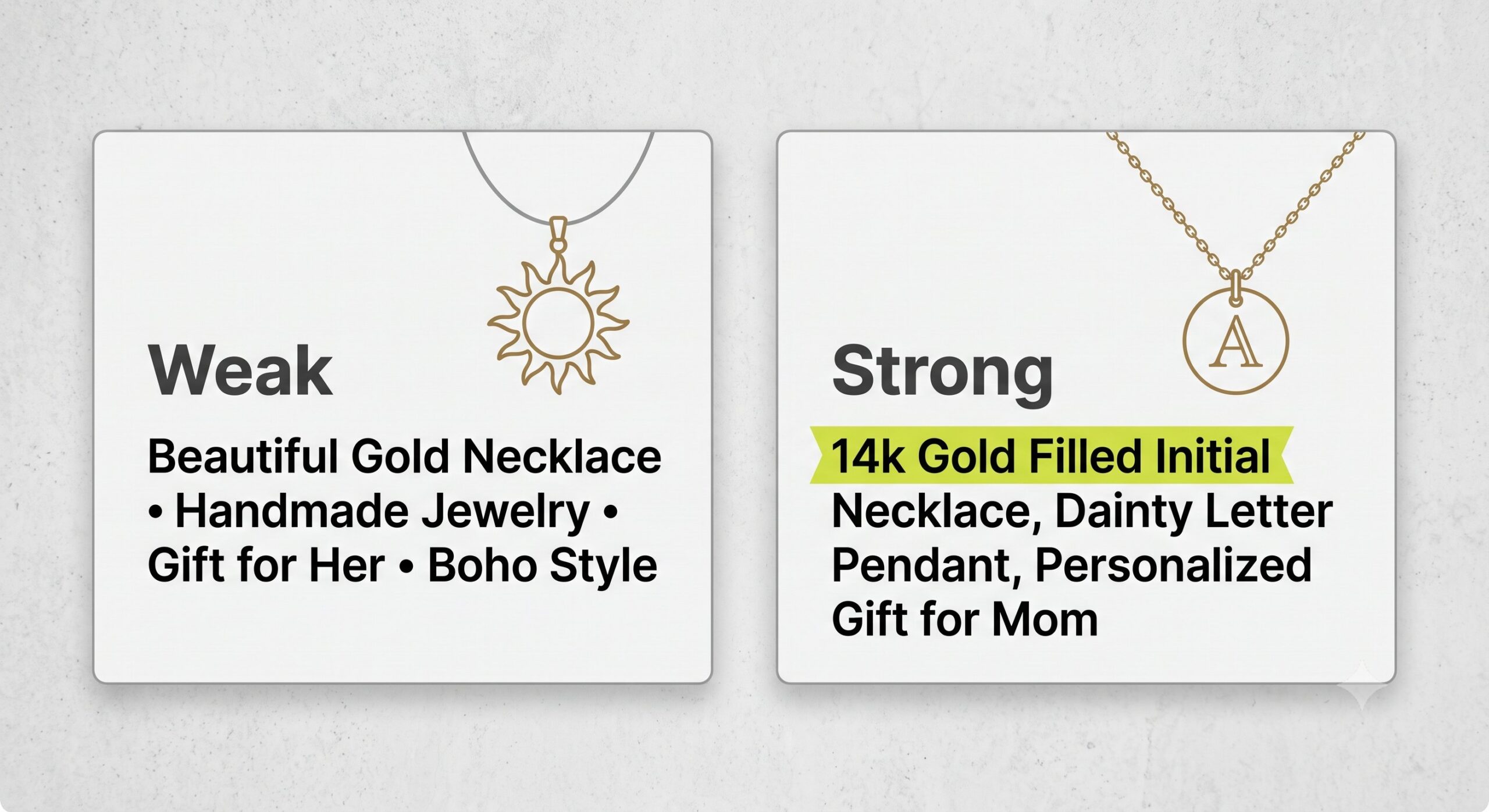
Weaker: `Beautiful Gold Necklace • Handmade Jewelry • Gift for Her • Boho Style`
Stronger: `14k Gold Filled Initial Necklace, Dainty Letter Pendant, Personalized Gift for Mom`
The second title leads with material, product type, style, and use case. A buyer searching any combination of those terms finds this listing. “Beautiful gold necklace” gets nobody.
Material specificity matters more in jewelry than almost any other category because buyers filter by it:
- 14k solid gold — fine jewelry buyer, high budget
- 14k gold filled — quality-conscious buyer, mid budget
- Gold vermeil — fashion-forward, wants gold look with sterling base
- Gold plated — budget buyer who understands the trade-off
These are four different people with four different searches. “Gold necklace” is invisible to all of them.
Attributes are equally important and almost universally under-used. The material, style, occasion, and color fields in your listing become the filters buyers use when they refine a search. If you don’t fill them in, your listing doesn’t show up in filtered results — even if your title has the right keywords. Fill out every attribute field Etsy offers for your category.
Your tags: cover more ground, not the same ground
You have 13 tag slots. The goal is to cover 13 different search angles, not 13 variations of the same two or three concepts.
Here is a real example of what over-saturated tags look like in one niche:
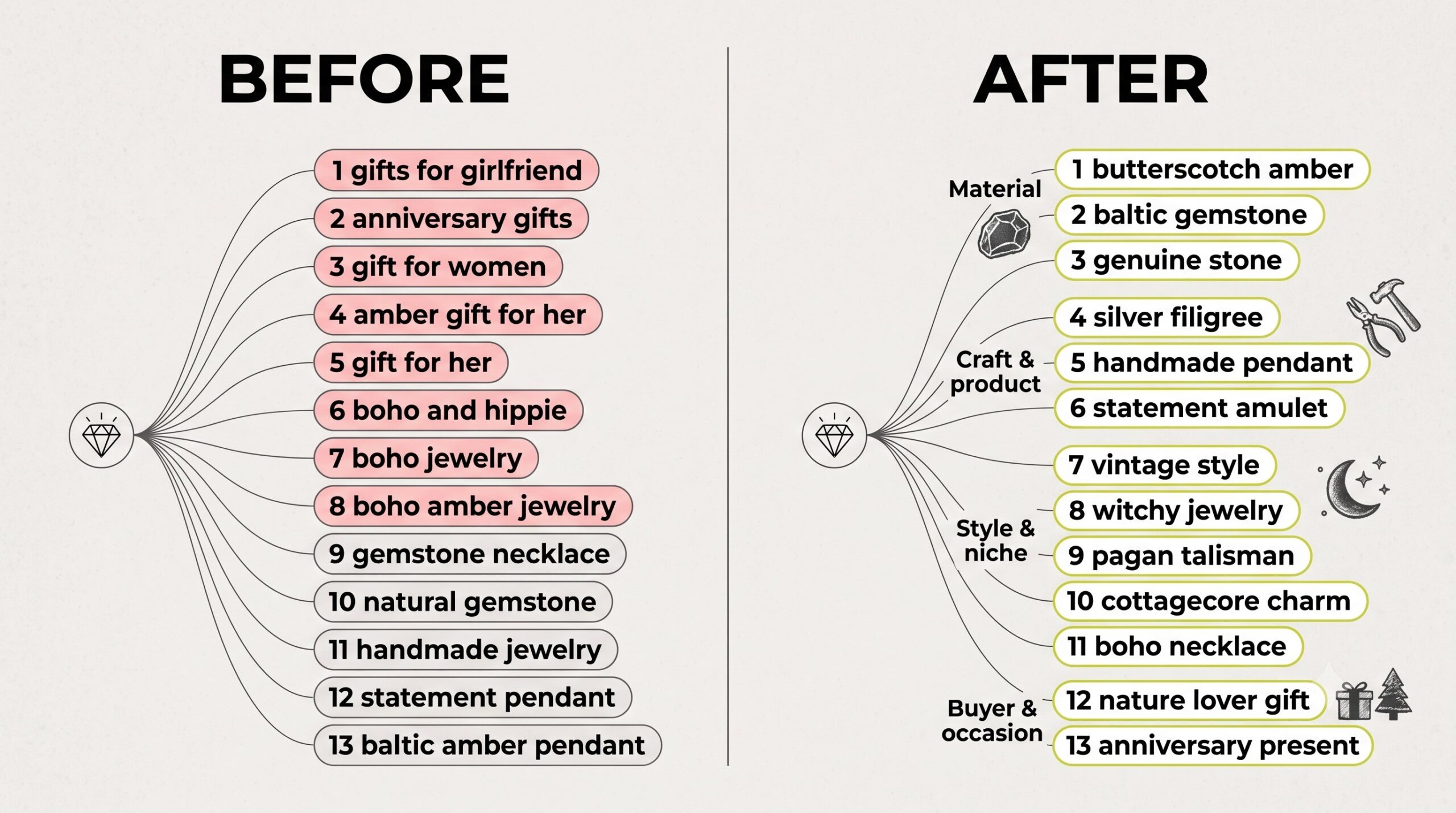
gifts for girlfriend / anniversary gifts / gift for women / amber gift for her / gift for her / boho and hippie / boho jewelry / boho amber jewelry
That is five gift tags and three boho tags out of 13 slots. Eight slots used to say the same two things. The other five slots are doing all the rest of the work.
Etsy’s algorithm recombines words across your tags automatically. If you have “boho,” “amber,” and “pendant” as separate tags, Etsy already creates the combination “boho amber pendant” algorithmically. Writing “boho amber jewelry” as a tag burns a slot to recreate something the system already built.
A stronger tag strategy for the same amber pendant spreads across angles and never repeats a word, so Etsy can recombine them for you:
- Material: “butterscotch amber,” “baltic gemstone,” “genuine stone”
- Craft and product: “silver filigree,” “handmade pendant,” “statement amulet”
- Style and niche: “vintage style,” “witchy jewelry,” “pagan talisman,” “cottagecore charm,” “boho necklace”
- Buyer and occasion: “nature lover gift,” “anniversary present”
Every word appears once. “amber,” “silver,” “boho,” “pendant,” and the rest each live in a single tag, and Etsy stitches them into “baltic amber pendant,” “silver boho necklace,” and dozens of searches you never had to spell out. That is the whole point: 13 different doors, not the same three knocked on louder.
Free download: The Etsy Listing Image Playbook covers the full image sequence, infographic principles, thumbnail styling, and safe margin rules — 42 pages built specifically for Etsy sellers. Get it free →
Make personalization your main offer
33% of all Etsy sales involve personalized items. In jewelry specifically, that number drives the category’s biggest revenue — personalized pieces command a 20 to 40% higher average order value than their non-personalized equivalents, and buyers will pay 50% or more above comparable non-personalized prices simply because of emotional value.
If you are making jewelry and not offering any personalization, you are leaving a significant amount of money on the table. The good news is that you do not need a new product line to do this.
The quick win: add a personalization field to existing designs. A simple sterling silver disc pendant becomes a name necklace with a text input field. A birthstone ring becomes a custom order with a dropdown for month. This alone moves you from a fixed product into a gifting staple that buyers return to for every occasion.
The higher-leverage move: go deeper than initials. The sellers making serious revenue from personalization have moved past “initial necklace” into territory that is genuinely hard to copy:
- Handwriting engraving — customers upload a photo of someone’s handwriting (a loved one’s signature, a child’s first written word) and it gets engraved onto a cuff, ring, or pendant. Emotionally irreplaceable.
- Fingerprint impressions — cast or etched fingerprint jewelry, often memorial or parent-child themed. Extremely high emotional value, justifies $100+ even in silver.
- Soundwave jewelry — customers provide an audio clip (a voicemail, “I love you,” a heartbeat) and the waveform gets engraved. Relatively new, still growing, and difficult for competitors to undercut on price because the emotional stakes are too high.
- Coordinate engraving — latitude and longitude of a meaningful place. Simple to produce, high-meaning, easy to pitch as a wedding or anniversary gift.
Any of these moves your shop from “one of many jewelry sellers” into a category where you are the only option for that specific buyer’s specific memory.
Optimize for the gift market. Jewelry sales spike 16% in Q4, but the gift market runs all year. Most sellers optimize for the obvious occasions:
- Mother’s Day, Valentine’s Day, anniversary, birthday, wedding
The overlooked ones — where competition is lower and purchase intent is high — are where the real opportunity is:
- Pregnancy announcements (“promoted to grandma” necklace)
- Adoption milestones
- Cancer-free anniversaries
- Sobriety milestones
- Graduation, first job, new home
Include occasion keywords in your tags and title, and write descriptions that acknowledge the moment: “Looking for something meaningful to mark the occasion? Here is how to add a name or date.”
Price for what your materials actually cost in 2026
This is the mistake I see most often in fine jewelry shops, and it is costing sellers real money.
Gold spot price hit $4,223 per ounce in June 2026 — up 54% from the 2025 annual average of $2,736. Silver is near $76 per ounce, roughly double what it was through most of 2024. If you set your prices six months ago and haven’t looked at them since, you are almost certainly selling at margins that make the shop unsustainable.
The pricing formula for Etsy jewelry is:
(Materials + Labor + Overhead) × 3 to 4 = retail price
The 3–4× multiplier absorbs:
- Etsy’s 6.5% transaction fee
- Payment processing fees
- Listing fees
- Ad spend
- And still leaves real profit margin
If you’re using a 2× multiplier, you’re covering costs but not building a business. Materials as a share of total cost: 30–50% for fine jewelry, 15–30% for fashion/costume.
A practical approach to 2026 metal pricing:
- Re-cost your pieces when spot price moves more than 5 to 10% from the price you last costed at. Set a threshold and check when you cross it — you do not need to reprice every week.
- For gold-heavy pieces, the new entry floor is roughly $200 to $500. The “$99 sterling silver necklace” baseline that worked in 2023 is not viable at today’s metal prices without cutting corners.
- If you use gold fill rather than solid gold, your title should say “14k gold filled” explicitly. Buyers who understand the difference will pay fairly for it. Buyers who see “gold necklace” at $35 assume it’s plated and expect it to tarnish.
Use a tiered pricing structure. A healthy jewelry shop has pieces at multiple price points:
- Entry ($20–$60): Accessible pieces — simple chain necklaces, small stud earrings, cord bracelets. Impulse buys and first-purchase items that bring buyers in.
- Mid-range ($60–$150): The heart of your shop. Sterling silver with semi-precious stones, gold fill pieces, personalized items. This is where most of your revenue lives.
- Premium ($150+): Solid gold, precious stones, complex craftsmanship, custom commissions. These sell less frequently but elevate perceived brand value and make mid-range items look accessible by comparison.
Entry items capture new buyers. Mid-range items are your reliable sellers. Premium items elevate the whole shop. Having all three is a strategy, not an accident.
One more thing on pricing: avoid running permanent deep discounts. If a listing sits at 65% off for weeks, buyers learn to wait for the sale. Use promotions for specific occasions, not as a permanent pricing state.
Get your first reviews, then let them sell for you
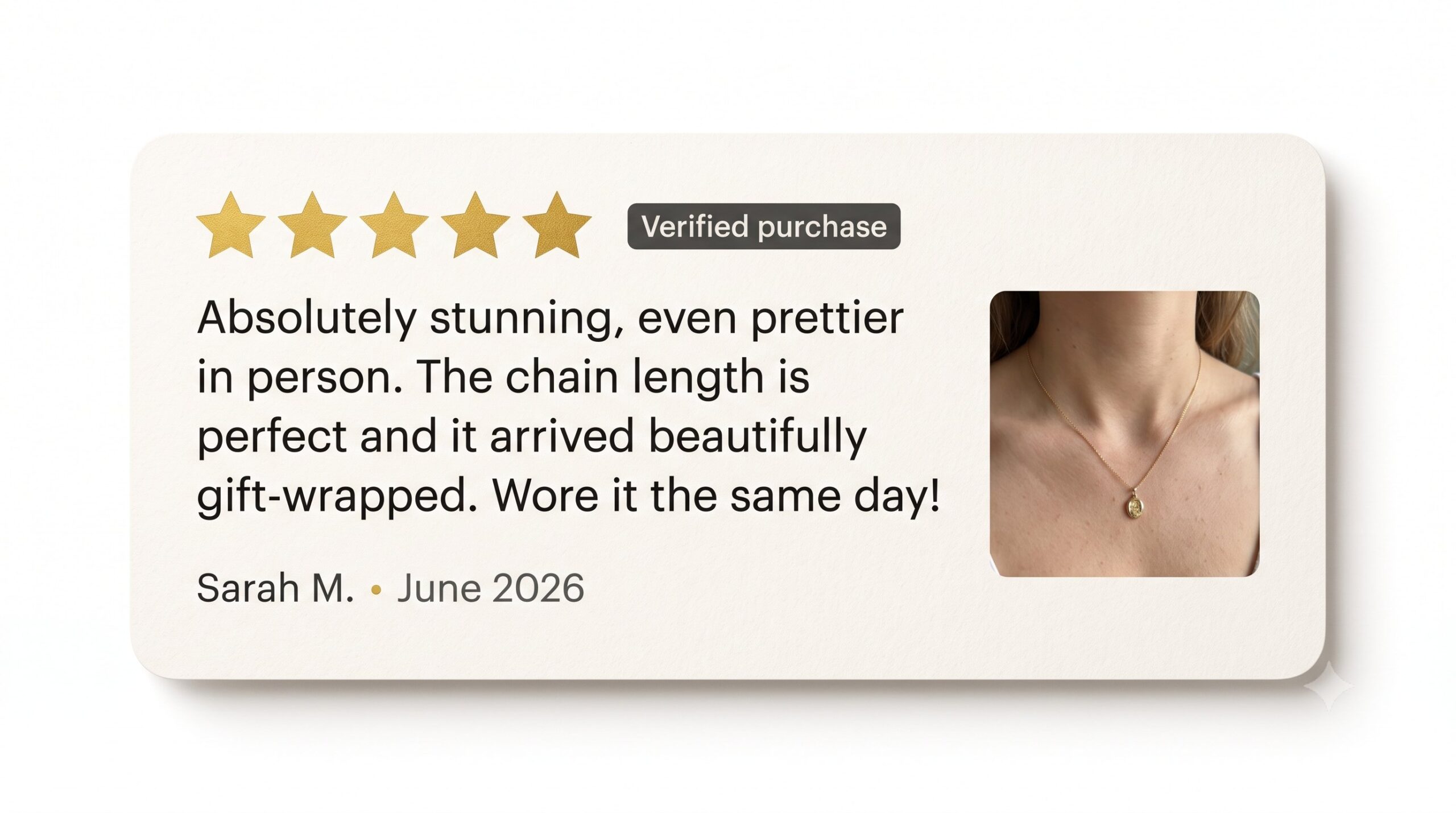
Jewelry buyers can’t touch the piece before they buy. They can’t feel the weight, test the clasp, or see how the stone catches light in person. A genuine five-star review with a customer photo does more conversion work than any product shot you take — it answers “did it look like the listing?” in a way only someone who received the piece can.
High-performing jewelry shops share three things:
- A lot of reviews
- A high percentage with photos
- Concentration on their top few listings, not spread thin across the whole catalogue
That last point matters — Etsy’s algorithm factors review velocity and rating into listing visibility.
How to build reviews consistently:
Most buyers won’t leave a review without a prompt. Make it easy and natural:
- A care card in the package. Every piece ships with a small card explaining how to care for the metal or stone. At the bottom: “Loved it? A photo review helps other buyers and means the world to a small shop.” This works because it catches the buyer at the moment they are unwrapping the piece and feeling good about it.
- A follow-up message timed to delivery. Three to five days after the estimated delivery date, send a short note: “Hope your piece arrived safely — I’d love to see how you’re wearing it.” Not a demand, just a genuine check-in. It reminds buyers the order exists and gives them an easy moment to respond.
- Ask for a photo specifically. Most buyers don’t realize that photo reviews are more useful than text alone. A simple “a photo of you wearing it would make my week” is enough.
- Respond to every review. Publicly, warmly, specifically. Buyers read the responses. A seller who replies thoughtfully to each review signals a shop that cares about the customer experience, and that signal converts new buyers who are on the fence.
On difficult reviews: Jewelry is tactile and personal — occasionally a buyer will be disappointed by something a photo couldn’t convey (size, weight, color in different lighting). Respond calmly, offer a solution, don’t be defensive. Future buyers read how you handle problems more closely than the problem itself.
What this looks like in practice
Let me walk through a real listing — pulled from Listadum’s listing explorer — so you can see every issue in one place.
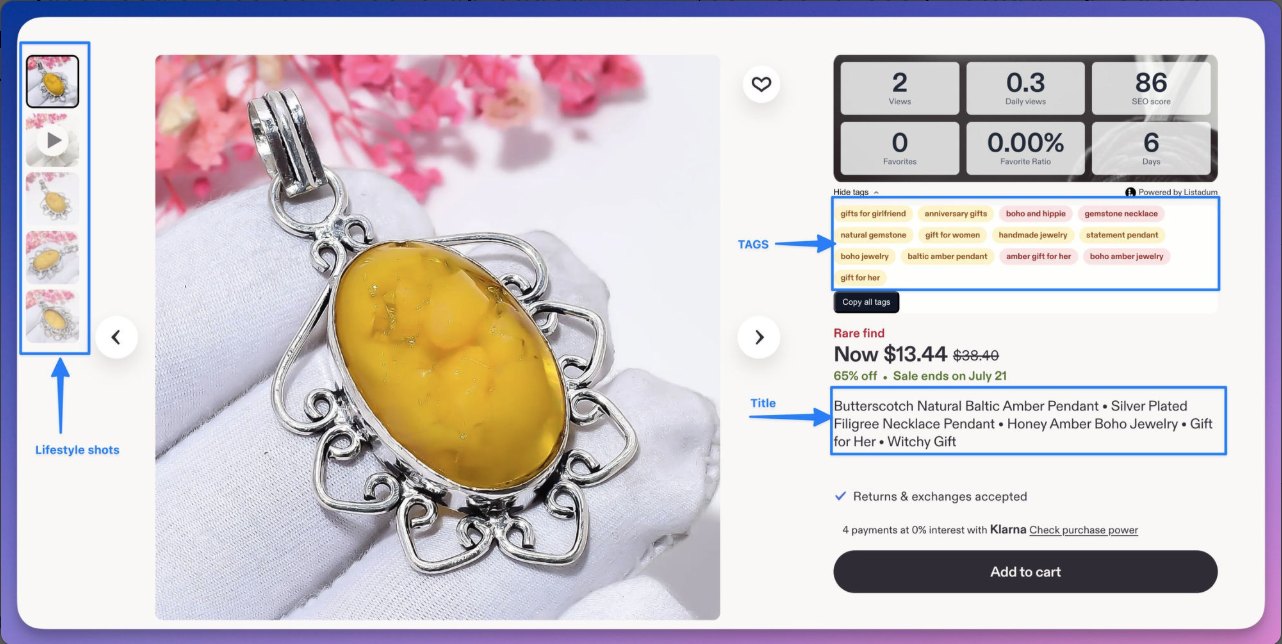
The listing: A butterscotch Baltic amber pendant in a silver plated filigree setting. Genuinely beautiful piece — real stone, handcrafted setting, the kind of thing that would stop a buyer mid-scroll if the listing gave it a chance.
Stats after 6 days: 2 total views. 0 favorites. 0.3 daily views. 86 SEO score.
That 86 SEO score is the first thing worth understanding. It tells you the mechanical boxes are ticked — tags filled in, title long enough, attributes present. What it does not tell you is whether the listing is actually visible to the right buyers. These are not the same thing.
Photos: 5 images, 1 idea
Every thumbnail is the same composition — pendant resting on a white gloved hand, pink flowers in background, slight angle variation between shots. Here is what is missing against the 10-image sequence:
| Shot type | Present? | What it costs the listing |
|---|---|---|
| Hero / thumbnail | Partial | The glove-and-flowers setup reads as a product shot, not a styled lifestyle image |
| Lifestyle / worn | No | Buyer cannot see how the pendant sits on a neckline or judge the chain length |
| Benefits infographic | No | No communication of materials, hypoallergenic status, or what’s included |
| Amber stone macro | No | The butterscotch depth and natural inclusions — the whole value story — are invisible |
| Filigree detail | No | The craftsmanship that justifies the price is never shown |
| Scale reference | No | Buyer has no idea if this pendant is 3cm or 7cm |
| Process / maker | No | Nothing proving a real person made this by hand |
| Packaging | No | This is clearly a gift item; the buyer doesn’t know how it arrives |
| Brand story | No | |
| Video | No | Both video slots unused |
9 of 10 image types missing. 15 of 20 photo slots unused. The piece has a beautiful stone that photographs brilliantly in natural window light — and none of the 5 images show it.
Title: strong start, falls apart fast
Butterscotch Natural Baltic Amber Pendant • Silver Plated Filigree Necklace Pendant • Honey Amber Boho Jewelry • Gift for Her • Witchy Gift
The first six words — “Butterscotch Natural Baltic Amber Pendant” — are actually good. Material, color descriptor, product type. That section is working.
Everything after the first bullet is wasted space:
- “Necklace Pendant” repeats “Pendant” already used and misnames the product (it’s a pendant, not a necklace)
- “Honey Amber” is a synonym for Butterscotch — same concept, second time
- “Gift for Her • Witchy Gift” are two back-to-back gift phrases that add nothing the tags don’t already cover
A stronger title builds on the strong opening instead of abandoning it:
Butterscotch Baltic Amber Pendant, Silver Filigree Necklace Pendant, Genuine Amber Boho Jewelry, Witchy Gift for Her
Same keywords, no repetition, reads as a description rather than a keyword dump.
Tags: 13 slots, 2 ideas
| Tag | Category |
|---|---|
| gifts for girlfriend | Gift |
| anniversary gifts | Gift |
| gift for women | Gift |
| amber gift for her | Gift |
| gift for her | Gift |
| boho and hippie | Boho |
| boho jewelry | Boho |
| boho amber jewelry | Boho |
| gemstone necklace | Product |
| natural gemstone | Material |
| handmade jewelry | Product |
| statement pendant | Style |
| baltic amber pendant | Material + product |
Five gift tags. Three boho tags. That is eight of thirteen slots saying the same two things. The remaining five are doing all the differentiation work.
Missing entirely: anything about the filigree craft (“silver filigree pendant,” “filigree necklace”), the amber provenance (“genuine baltic amber,” “real amber stone”), or the buyer communities hinted at by “Witchy Gift” in the title (“pagan jewelry,” “witchy accessories,” “nature lover gift”).
A retagged version covering the same piece:
butterscotch amber / baltic gemstone / genuine stone / silver filigree / handmade pendant / statement amulet / vintage style / witchy jewelry / pagan talisman / cottagecore charm / boho necklace / nature lover gift / anniversary present
Thirteen slots, thirteen different doors.
Pricing: below sustainable margin
$13.44 for genuine Baltic amber and silver plated filigree work. At Etsy’s 6.5% transaction fee plus payment processing plus listing fee, the seller is netting approximately $11.50 before materials and labor. For a handmade piece using a real semi-precious stone, that math does not work.
The 65% off “sale” has been running long enough that Etsy is showing the “Rare find” badge — meaning the algorithm is surfacing this listing partly because of the discount, not because of organic search traction. This is a pattern to avoid: permanent discounting trains buyers to wait for the sale and signals to the algorithm that the undiscounted price is not the real price.
The fix — none of it requires making a different piece:
- Macro shot of the amber stone in natural window light (10 minutes and a phone camera)
- One worn shot showing the pendant on a collarbone with the chain length visible
- A scale reference image next to a familiar object
- Retag across stone type, craft style, and the witchy/pagan niche the title already hints at
- Price that reflects (materials + labor + overhead) × 3, with a sale used for specific occasions rather than permanently
- A care card in the packaging inviting a photo review
The piece is good. The listing is what is holding it back.
Check your keyword angles before you rewrite anything
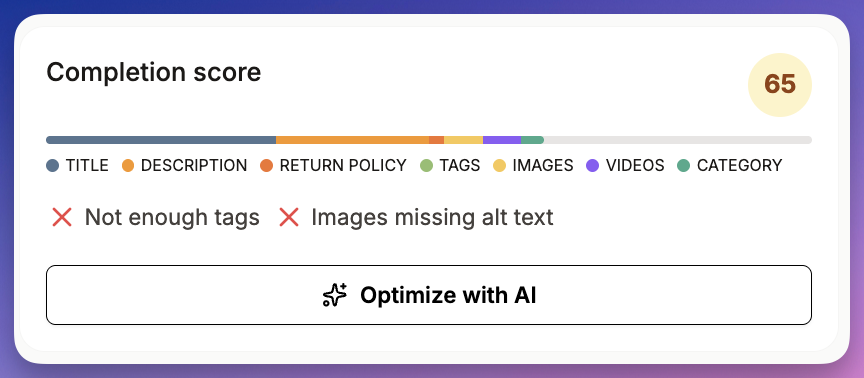
Before you rework a listing, it helps to know which phrases are worth targeting. Listadum’s Keyword Explorer shows you demand vs. competition for any search phrase — so you can see whether “butterscotch amber pendant” has enough search volume, or whether “baltic amber jewelry gift” is where buyers are actually looking. The Listing Analyser flags specific issues — missing attributes, thin titles, underused tag slots — so you know what to fix first.
Frequently asked questions
How many photos should a jewelry listing on Etsy have?
Etsy now allows up to 20 photo slots per listing plus two videos. Most sellers use five to six, and almost all of the same type. A well-built listing works through the full image sequence: hero shot, worn/lifestyle shot, benefits infographic, three close-up detail shots, a scale reference, a process image, a packaging shot, and a brand story image. That is ten images covering ten different buyer questions. Use the remaining slots for customer photos, variation shots, and video.
What is the most important part of an Etsy jewelry listing for SEO?
The first 40 characters of your title carry roughly 80% of the SEO weight. Lead with your most specific, material-rich keywords: the metal type and karat, the stone (if applicable), and the product type. “14k Gold Filled Initial Necklace, Dainty Letter Pendant” is stronger than “Beautiful Gold Jewelry for Her.” Fill out all attribute fields too — these power Etsy’s filter system and are widely under-used.
Is personalization worth the extra work for jewelry sellers?
Yes. 33% of all Etsy sales involve personalized items. Personalized jewelry commands 20 to 40% higher average order value than non-personalized equivalents. The simplest version — a text field that accepts a name or initial — can be added to an existing design in minutes. The higher-leverage versions (handwriting engraving, fingerprint impressions, soundwave jewelry) create listings that competitors cannot undercut on price because the emotional value is too high.
How do I price handmade jewelry on Etsy in 2026?
Start with your true cost: materials plus labor plus a share of overhead. Apply a 3 to 4× multiplier to get your Etsy retail price — this absorbs the 6.5% transaction fee, payment processing, listing fees, and ad spend while leaving real margin. For fine jewelry, re-cost your pieces whenever gold or silver spot price moves more than 5 to 10% from your last costing date. Gold hit $4,223 per ounce in June 2026 (up 54% year-over-year) — many sellers who haven’t repriced since 2024 are selling at a loss.
What types of jewelry sell best on Etsy?
Personalized pieces consistently top the category: initial necklaces, name rings, birthstone jewelry, coordinate pieces, and anything engraved with meaningful text. Minimalist and dainty styles (stacking rings, thin chain necklaces) sell year-round. Celestial and zodiac designs remain strong. The most reliable approach is to pick a specific sub-niche — not “jewelry” or “necklaces” but a precise combination of material, style, and buyer — and build a reputation there rather than competing on the broadest possible terms.
Author
Neha Chandelier — Co-founder of Listadum, selling on Etsy since 2020. She writes about Etsy tips and tricks, how to sell on Etsy, and growing a handmade shop.
Last updated: June 2026
Start selling smarter on Etsy
Listadum helps Etsy sellers find the right keywords, fix listing issues, and track what is working — all in one place. The free plan connects a real Etsy shop and gives you a full shop analysis.