


Wondering how many listings you should have on Etsy? Learn what number helps your shop get found, get sales, and grow, backed by data and real seller results.
Many Etsy sellers wonder if having more listings helps get more sales. The truth is, the number of listings does matter, but not in the way most people think. It’s not just about quantity; it’s about visibility, consistency, and how Etsy’s search algorithm works.
We’ve seen shops with only 5 listings making thousands of sales, and shops with thousands of listings still struggling to get consistent sales.
You’ve probably heard it a thousand times: the product you’re selling matters more than the number of listings in your shop. Demand and competition are two key factors that decide how many views your listing gets.
If your product is in demand, then having high-quality, SEO-optimized listings is the key to getting views and increasing your chances of sales.
Why the number of listings matters on Etsy
Some might say that “more listings = more chances to appear in search,” but that’s only partially true.
Say you have 1,000 listings selling candles. You write titles, tags, and descriptions for all of them and start appearing in Etsy search results, but your conversion rate is still low. You wait weeks, if not months, for those first few sales.
Etsy’s algorithm thinks: “This listing is being shown to a lot of buyers, but it’s not selling much.” So it assigns a low engagement score to your listings. Now, because you have 1,000 listings but not enough sales, your shop quality score drops, which affects the visibility of all your listings.
To successfully manage that many listings, you need a solid Etsy SEO strategy backed by data and a strong listing optimization plan. The best approach is to master a few listings first and grow your shop slowly, making sure each listing screams “high quality.”
Adding a lot of listings might temporarily increase your visibility, but if they don’t convert, it can hurt your shop in the long run.
👉 Learn how Listadum measures your engagement score and what it means for visibility.
How many listings do successful Etsy shops have?
Let’s define “success” first. An Etsy shop is considered successful if it has consistent monthly sales, meaning your product is in demand and your shop is trustworthy enough for buyers to click “buy” without hesitation.
If you’re great at finding in-demand micro niches, you’ll have an easier time making sales. Early mover advantage is your friend here.
For example, if you have only 5 listings but one is so unique that buyers can’t find it elsewhere, Etsy recognizes that desirability and sends more organic traffic your way. More sales = more listing quality score = better visibility.
On the other hand, if you prefer steady, sustainable growth, making what you love, improving quality, and slowly building your brand, that’s success too. With time, you’ll rack up thousands of sales and repeat buyers who remember your shop.
What the data shows
As your shop grows, so does your product catalog. You keep improving your offerings and adding new products that you know sell well.
Based on Listadum’s analysis of 5 million+ Etsy shops, here’s what we observed:
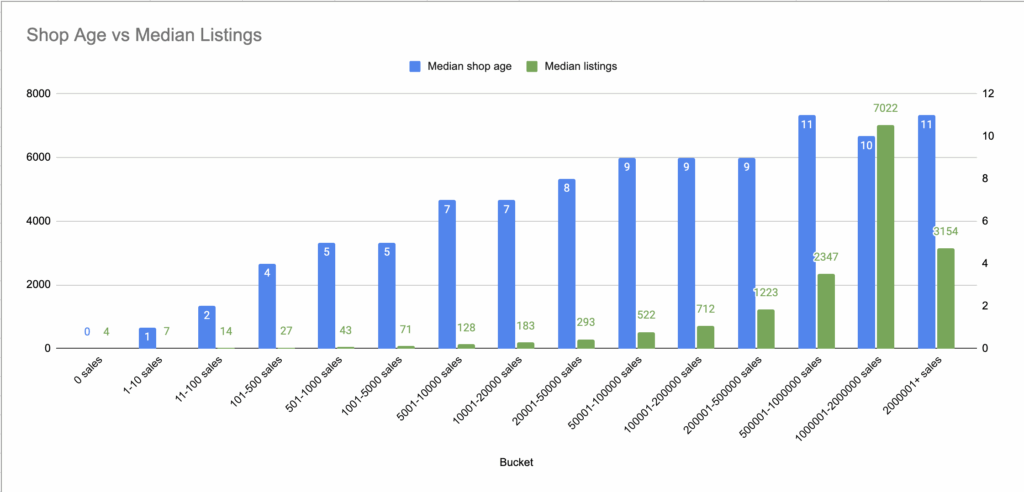
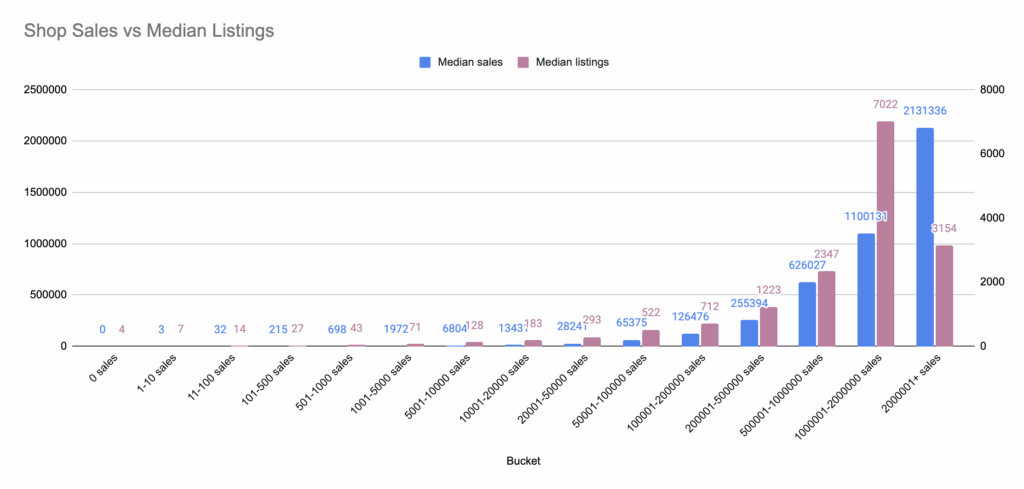
🟣 The top 1% of Etsy sellers have a median of 183 listings.
🟣 There’s no strong correlation between the number of listings and total sales.
🟣 Most shops in the 20K–50K sales range have fewer than 300 listings.
Our takeaway: focus on quality, not quantity.
My personal recommendation is to have anywhere between 100–200 listings, as long as you can maintain high-quality product images and consistent SEO. Ten great listings are better than 300 low-quality ones.
Is it better to have more listings or fewer good ones?
We always say it: quality over quantity. If your listings are optimized with the right Etsy tags, photos, and titles, and your product is in demand, you’ll start seeing steady sales.
Having too many listings can overwhelm buyers, especially if your shop isn’t well-organized. Focus on improving what you already have before adding more.
👉 Use the Shop Critique Tool to see how complete your shop is and what to fix first.
How often should you add new listings?
Etsy has something called the “recency factor.” Adding new listings signals to the algorithm that your shop is active. Every time you make a sale, your listing renews automatically, which tells Etsy your shop is healthy and generating revenue.
But one common myth is that renewing listings early boosts your visibility. It doesn’t, not sustainably. Constantly renewing or posting new listings just to “feed the algorithm” won’t help unless those listings perform.
Instead, aim for steady activity.
💡 Pro tip: If you have many listings ready to go, try adding or renewing 1–3 per week instead of bulk uploading. It keeps your shop active and gives followers consistent updates.
PS: You can now schedule listings automatically using Listadum, so your shop stays active without extra work.
What’s a good number of listings to start an Etsy shop?
Etsy requires at least 1 listing to open a shop. We recommend starting with collections, for example, launching 10 greeting cards instead of 1. This gives buyers variety and improves your shop’s perceived completeness.
As you grow, you’ll build workflows for product creation, photos, and admin tasks like uploading listings.
One of the most common beginner mistakes? Not batching your listings. Uploading one product at a time interrupts creative flow. Use batch workflows and tools like Listadum’s Listing Manager to streamline your process.
For a strong launch, aim for 20–40 listings. It gives your shop depth and helps SEO drive early traffic.
Tips to grow your Etsy shop (Beyond just adding listings)
If you want to grow faster, your workflow for launching a new product should include promotion and optimization. Every time you create a listing make sure the SEO is in place and you have images ready to promote it.
Here’s what we recommend:
- Improve listing titles and tags → Use Listadum’s Keyword Explorer to find what buyers actually search for.
- Use great product photos → Learn from Etsy’s product photography guide.
- Drive external traffic → Use Pinterest, your email list, or your blog.
- Keep shop sections organized for a better shopping experience.
FAQs about Etsy listings
Q1: Does having more listings help on Etsy? Yes, more listings mean more keywords and visibility, but only if each one is optimized.
Q2: Can I have too many listings? Not really, but make sure you can maintain and renew them regularly.
Q3: How many listings do top Etsy sellers have? Many top shops have between 200–500 listings, but most started seeing traction around 40–100.
The number of listings you have on Etsy isn’t a fixed rule, it’s about staying active, testing what sells, and improving visibility. Aim for consistency, not perfection.
👉 Want to know how your listings stack up? Try the free Shop Critique Tool on Listadum.com to get personalized insights and next steps.
See how your listings actually score
Listing count only matters if each listing is built to be found. Connect your shop to Listadum’s free plan and you will see a 0 to 100 score for every listing, plus the exact issues holding each one back.
Free plan · no credit card · connect your real Etsy shop in minutes