


Selling rugs on Etsy isn’t hard because your rugs aren’t good.
It’s hard because most rugs are listed in a way that doesn’t match how Etsy buyers shop.
The good news? You usually don’t need to change your product.
You need to change how you frame it.
This guide shows exactly how to reposition rugs for Etsy buyers based on what we see working across real Etsy shops.
First, a quick mindset shift
Most rug sellers think:
“I’m selling a handmade rug.”
Successful Etsy listings think:
“I’m helping someone finish a room.”
That single shift changes everything: your title, photos, description, and even how Etsy’s algorithm responds to your listing.
1. Stop selling a rug. Sell what the room becomes.
Most rug listings lead with materials and technique:
- handwoven wool
- traditional methods
- region of origin
That matters but not first.
Etsy buyers start with questions like:
- Why does my living room feel empty?
- How do I make this space warmer?
- What ties the room together?
What to do instead
Lead with the outcome:
- “Warm Neutral Rug for Cozy Living Rooms”
- “Statement Rug for Modern Boho Spaces”
- “Soft Wool Rug for Calm Bedrooms”
Once the buyer is emotionally in the space, then they care about materials.
2. Remove size anxiety (this alone boosts conversions)
Rugs don’t fail because they’re expensive.
They fail because buyers are unsure:
- Is this the right size?
- Will it look too small?
- How does this work with my sofa or bed?
Uncertainty kills Etsy conversions.
How to fix it
Name sizes by use, not just dimensions
- “Living Room Rug – Sofa & Coffee Table”
- “Bedroom Rug – Queen Bed”
- “Entryway Runner”
Add a simple size guide image. Even a basic diagram works. It shows you care about helping them choose correctly.
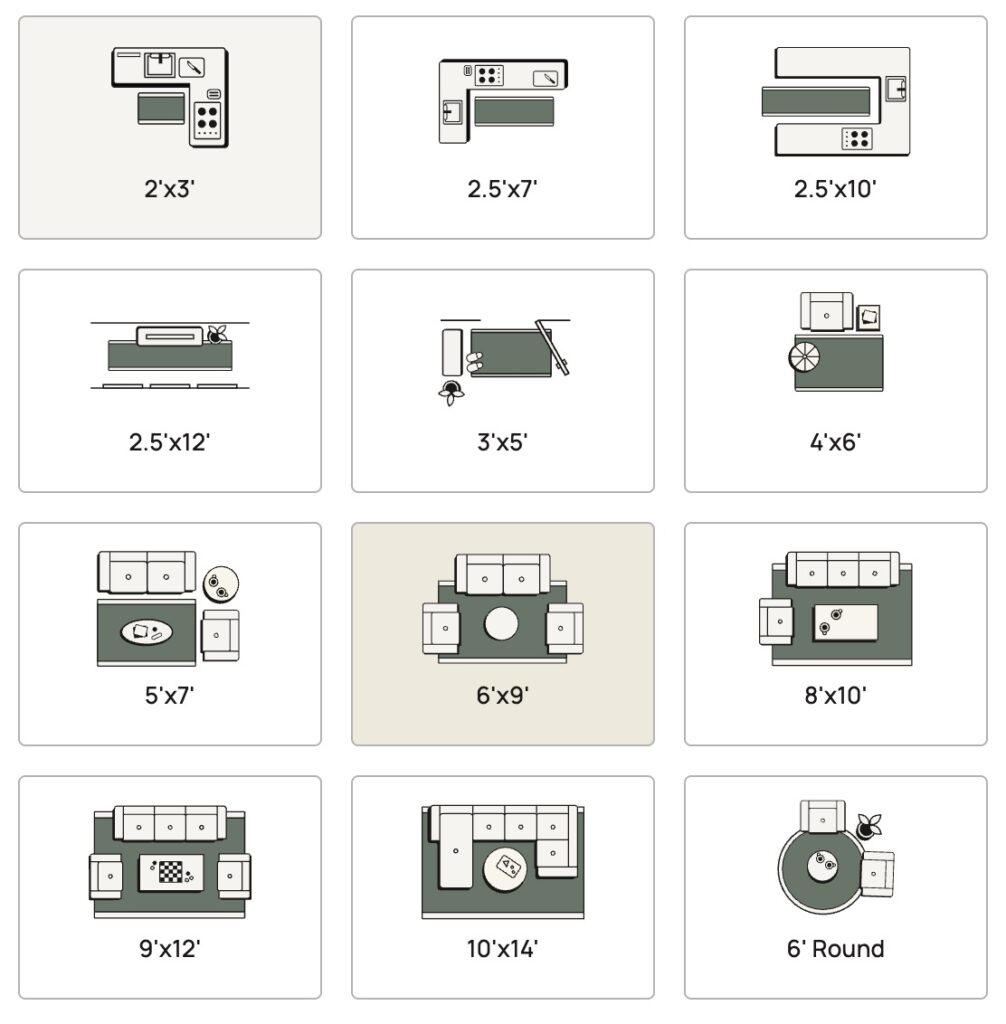
Repeat reassurance in your description
“This size works best when the front legs of the sofa rest on the rug.”
Confidence converts.
3. Use photos that answer: “Can I imagine this in my home?”
Studio-style rug photos look clean, but they rarely sell well on Etsy.
Etsy buyers want context.
What performs better
- rugs placed in real rooms
- natural light
- imperfect, lived-in styling
- visible furniture for scale
Minimum photo set that works
- Full rug in a room
- Close-up of texture
- Rug + furniture edge (scale reference)
- Detail shot (weave, fringe, corner)
- Optional: folded or rolled edge
Your photos should quietly say:
“This already belongs in a home.”
4. Translate craftsmanship into buyer benefits
Craft stories are powerful, but only if buyers understand why it matters to them.
Instead of only saying:
- traditional techniques
- ancestral weaving
Translate into benefits:
- lasts for years
- doesn’t shed
- soft underfoot
- durable for high-traffic areas
Help buyers justify a higher price without thinking too hard.
5. Add customization (even if most won’t use it)
Customization is an Etsy advantage, especially for higher-priced items.
You don’t need full custom rugs.
Simple options work:
- multiple size variants
- slight color tone options
- fringe vs no fringe
- made-to-order notice
Even a line like:
“Looking for a custom size? Send me a message.”
This builds trust, even if 90% of buyers never customize.
6. Make rugs giftable without forcing it
Rugs aren’t impulse gifts, but they are meaningful gifts.
Occasions that work:
- housewarming
- weddings
- anniversaries
- new homes
Subtle cues are enough:
- “Thoughtful housewarming gift”
- “Meaningful wedding gift for new homes”
You’re not cheapening the product. You’re expanding how buyers think about it.
7. Lower risk instead of lowering price
Discounting rugs rarely fixes the real problem.
Buyers hesitate because they’re thinking:
“What if something goes wrong?”
What helps more than a lower price:
- clear shipping timelines
- transparent return policies
- explanation of packaging & protection
- reassurance that you handle issues
Trust closes the sale.
8. Don’t let rugs carry your shop alone
High-ticket items struggle when they’re the only thing in a shop, especially for new shops with few sales or reviews where buyers need reassurance they are dealing with a serious, credible seller.
A smarter approach:
- add runners, mats, cushion covers, wall hangings, poufs, or small textile decor pieces
- keep the same aesthetic
- let lower-priced items collect reviews
This is the strategy we observe in the more successful shops that sell rugs, carpets and related items.
Etsy ranks shops based on performance signals.
Strong small listings lift your big ones.
9. Rewrite your description in the right order
Most rug descriptions are backwards.
A better structure
- What space this rug is for
- How it makes the room feel
- Size & placement guidance
- Material & durability
- Craft story
- Shipping & care reassurance
Think guide, not catalog.
10. Selling rugs from places like India, Morocco or Türkiye
Some of the world’s best rugs come from places like India, Morocco or Türkiye. The craftsmanship is often exceptional, the materials are beautiful, and the traditions run deep.
But on Etsy, origin alone does not build trust. For a buyer about to spend hundreds of dollars, distance introduces friction.
Common buyer fears include:
- long or unclear processing times
- high or unpredictable shipping costs
- customs duties or tariff surprises
- concerns about returns or damage
- uncertainty about who they are actually buying from
None of these mean you cannot sell successfully. They mean you must make these concerns explicit non-issues.
How to lower friction and build trust
Use your own photos whenever possible
Avoid relying only on supplier-style or reused imagery. Original photos. especially lifestyle shots or behind-the-scenes glimpses signal that this is a real workshop, not a faceless reseller.
Be very clear about timelines
Instead of vague wording, explain how long it takes to:
- make or prepare the rug
- ship it, especially to places like the USA (main market for Etsy)
- deliver it to the buyer’s door
Clarity beats speed.
Address shipping and tariffs head-on
If you ship internationally, say exactly what buyers can expect. If duties are included, state it clearly. If not, explain how it usually works and what is typical.
Silence creates fear. Transparency builds confidence.
Explain how rugs are packed and protected
Buyers worry about damage over long distances. Show or describe:
- how rugs are wrapped
- how moisture and bends are avoided
- how issues are handled if something goes wrong
Put a human face on your shop
A short section about you or your workshop helps immensely. Even one photo or paragraph explaining who is behind the shop reassures buyers that this is a serious seller who stands behind their work.
When distance feels managed and explained, buyers stop fixating on where the rug ships from and focus on whether it fits their home.
The takeaway
Rugs fail on Etsy when they’re treated like artifacts.
They sell when they’re presented as:
- solutions
- room anchors
- confidence purchases
Same rug. Different framing.
That’s usually the difference.
Final checklist: repositioning rugs for Etsy buyers
Use this as a practical checklist to review or relaunch your rug listings.
Product & positioning
- ☐ Title focuses on room use or outcome, not just materials
- ☐ Description leads with how the room will feel, not technique
- ☐ Benefits are clearly explained (durability, softness, longevity)
- ☐ Craft story is included, but translated into buyer value
Sizes & variants
- ☐ Sizes are named by use case (living room, bedroom, entryway)
- ☐ Clear size guidance is included in photos AND text
- ☐ A size diagram or visual guide is added in photos
- ☐ Custom or made-to-order option is mentioned
Photos
- ☐ At least one lifestyle photo in a real room
- ☐ Natural light, not studio-flat lighting
- ☐ Scale reference included (sofa leg, bed, chair)
- ☐ Close-ups for texture and details
Trust & conversion
- ☐ Shipping times are clear and realistic (use an image for this too!)
- ☐ Packaging and protection are explained
- ☐ Return or issue-handling policy is reassuring
- ☐ Gift occasions are subtly mentioned
Shop strategy
- ☐ Shop includes lower-priced items (runners, mats, decor)
- ☐ Visual style is consistent across listings
- ☐ Reviews are actively being built on non-rug listings
About your Listadum completion score
Getting a 100/100 completion score on Listadum is a great milestone, but it’s important to understand what it does (and does not) do.
A perfect completion score means:
- your listing follows Etsy’s guidelines
- required fields are filled correctly
- you’re not missing elements that could hurt visibility
- your listing is not being penalized by Etsy’s system
What it does not guarantee:
- views
- favorites
- sales
Think of the completion score as the foundation.
It tells you:
“This listing is clean, compliant, and ready to compete.”
But Etsy doesn’t reward readiness. It rewards momentum.
From a good listing to real traction: creating momentum
After your listing is structurally sound, performance comes from signals:
- views that turn into clicks
- clicks that turn into favorites
- favorites that turn into sales
That momentum can come from a few places:
1. Etsy Ads (used strategically)
Ads can help:
- test whether a rug converts
- generate initial visibility
- kickstart early sales signals
They work best when the listing is already conversion-ready, not as a fix for weak positioning.
2. Bringing your own traffic
External traffic helps Etsy see demand:
- email lists
- direct links from your website or social profiles
If that traffic converts, Etsy pays attention.
3. Patience + iteration
Rugs are high-consideration purchases.
Momentum builds slower, but when it clicks, it compounds.
Track what gets:
- views but no clicks (photo problem)
- clicks but no sales (positioning or sizing problem)
- favorites but no purchases (trust or price hesitation)
The real takeaway
A perfect listing doesn’t win by itself.
It simply gives your rug a fair chance.
From there, success comes from:
- buyer-focused positioning
- reduced uncertainty
- strong photos
- and deliberate momentum-building
Same rug. Better framing. Smarter signals.
Ready to take the next step?
If you want to apply this to your own shop, you have two clear options.
- Create a Listadum account and improve your listings so they follow Etsy guidelines, avoid hidden penalties, and are ready to build momentum.
- Book a consultation with our team to get direct, actionable feedback on your shop, your rug listings, and where to focus next.