

The first product I ever tried to sell on Etsy was a throw pillow with a couple’s last name embroidered across the front, in a script font I spent an evening picking. It felt like the obvious move — everyone gets married, everyone redecorates, everyone wants their name on something. It sat there. A handful of views, almost no saves, and I quietly blamed the algorithm.
Years and a lot of data later, I know it was not the algorithm. It was the design. When I ranked 594 top throw-pillow listings by whether real people actually save them, the name pillows, the photo pillows, and the monograms — the exact “personalize it” lane I had walked straight into — landed at or below the middle of the pack.
The pillows quietly running away with it were decorative: a loose floral, a charming little animal, a botanical or nature motif. Art, not a name.
This is the tenth teardown in an ongoing series where Listadum ranks the biggest print-on-demand products on Etsy by favorite ratio — the one number that separates what genuinely sells from what just fills a search page, so you can see what is worth your time and what is not.
Throw pillows turned out to be a textbook version of the pattern: one enormous lane that looks like the whole market and pulls below its weight, and a few small decorative lanes that pull more than twice as hard.
I captured the top listings for the biggest throw-pillow searches on Etsy, deduplicated them down to 594 unique designs, and ranked every one by that single number. Then I hand-coded all of them by theme, aesthetic, and mockup so I could see the pattern underneath.
This is the long version: the full ranking, the design types that win with a ready-to-use prompt to make each one, the two traps, the benchmark to grade your own pillow, and the mockup finding that will save you a lot of second-guessing. Grab a coffee.
The one number that tells you if a design sells
A listing’s view count tells you almost nothing on its own — ads and age both inflate it. Favorites are the honest signal of wanting, but Etsy keeps both numbers off the search cards.
The free Listadum browser extension prints the views and favorites right onto every card as you scroll a normal search, so instead of guessing from where a pillow happens to sit in the grid, you can read real demand at a glance. That one addition is what made this whole study possible.
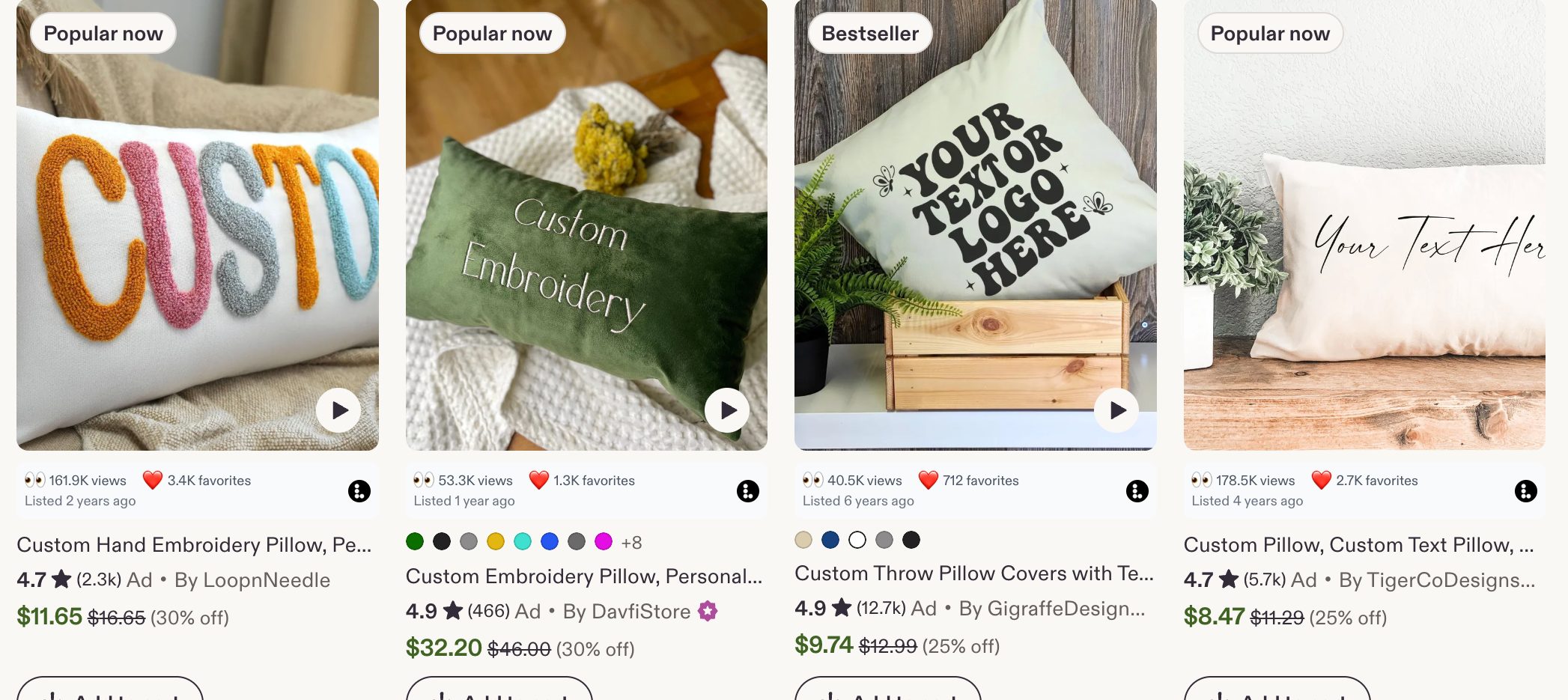
What the Listadum extension adds to a normal Etsy search — the views and favorites count on every card. Those two numbers are the raw material for everything below.
Divide one by the other and you get something useful:
Favorite ratio = favorites / views.
Inside Listadum we call this your favorite ratio, and it is the number I trust most when I judge a design. Of the people who saw this pillow, what share liked it enough to save it. That single ratio strips out the noise.
A brand-new listing from a tiny shop and a three-year-old listing from a shop with 10,000 sales can finally be compared fairly, because the favorite ratio cancels out ad spend, age, and shop size. It measures the design’s pulling power and nothing else — and pulling power is the part you actually control when you sit down to make a new pillow.
When I re-ranked all 594 listings by favorite ratio, the order scrambled hard. Pillows Etsy had buried out-pulled pillows sitting in the top row. Etsy’s default sort tells you what Etsy is promoting. The favorite ratio tells you what buyers love. Those are not the same list.
One thing to know going in: throw pillows are a busy, ad-heavy market that sits mid-pack among print-on-demand products. The median favorite ratio here is 3.8%, and a genuine top-10% winner reaches 9.7%.
About 69% of ranked listings run ads, and the median price is a comfortable $22. Cheap to make, crowded to sell, and dominated by one lane that most sellers pile into by default. Which is exactly why picking the right design, instead of the obvious one, matters more here than it looks.
Decorative art wins — and the personalization lane everyone floods loses
Here is the headline finding, and it is a clean split.
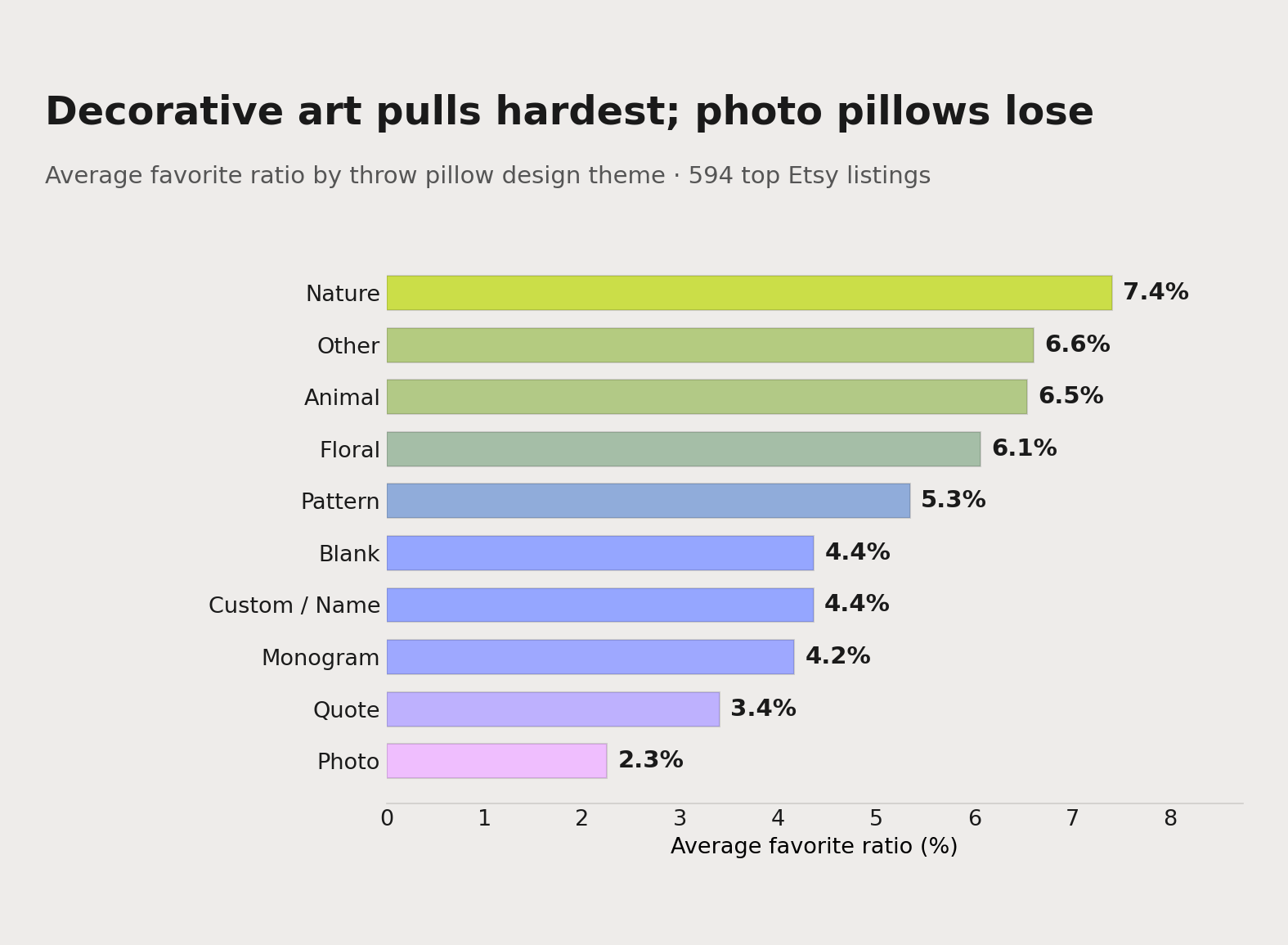
Group the decorative-art themes together — floral and animal — and they are just 16% of the shelf but pull a 6.3% average favorite ratio and produce 36% of all the winners. Widen it to include nature motifs and the small “other” decorative bucket and the gap only grows. That is the winning half of the market hiding in the smallest lanes.
Now the lane that looks like the whole category. Name and photo customization is the shelf. Custom-name pillows alone are 32% of every listing I studied — nearly a third — and pull a 4.4% average, barely above the median.
Add photo pillows (8.9% of the shelf, a 2.3% average — the single weakest theme, with zero winners) and monograms (4.7%, 4.2%), and the three personalization themes together make up 45% of the shelf but deliver only 20% of the winners. The most-made kind of throw pillow is one of the worst-pulling.
The plain-English version: a throw pillow is décor, and buyers save décor that adds something to a room.
A hand-drawn floral, a characterful animal, a calming botanical reads as a piece someone chose for their space. A last name in script or a photo printed on fabric reads as a personal gift for one specific person — lovely for that person, invisible to everyone else scrolling. Say something decorative with the image, and let the name be an option, not the whole product.
That is the big picture. Now let me show you the whole board, not just the top of it.
The full ranking: winners, runners-up, and what to skip
No theme is a simple win or lose. There are tiers, and the runners-up matter as much as the champions, because they are less crowded and still pull well. First, here is how the shelf is actually built — each lane sized by how much of the market it occupies and colored by how hard it pulls. The overall median is 3.8%.
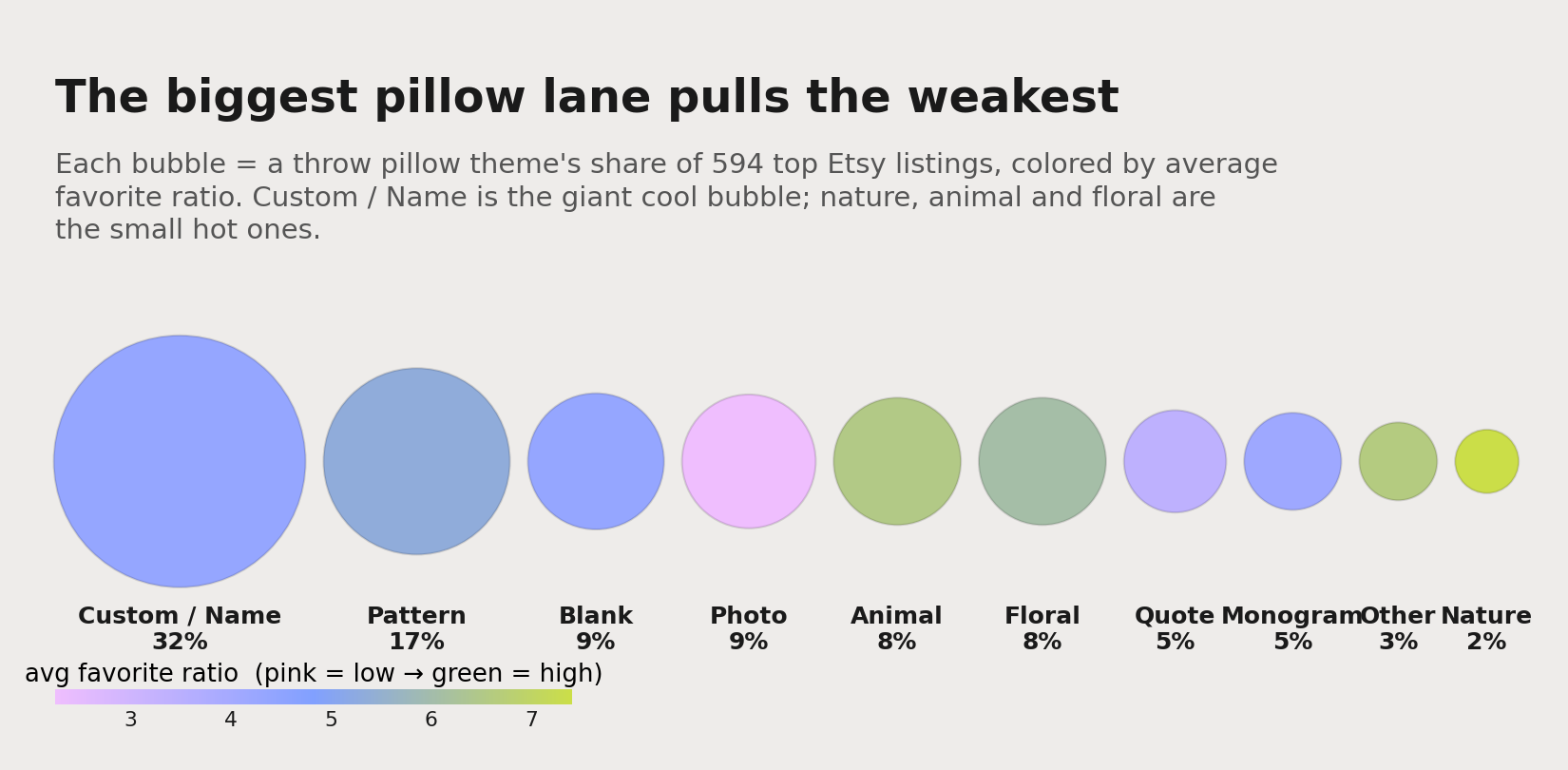
The bubbles make the mismatch obvious: the biggest circle by far (custom / name) is a cool, low-pulling one, and the hottest colors sit in the small circles off to the side. Now the same themes read by pull — how many winners each lane delivers for the shelf space it takes up:
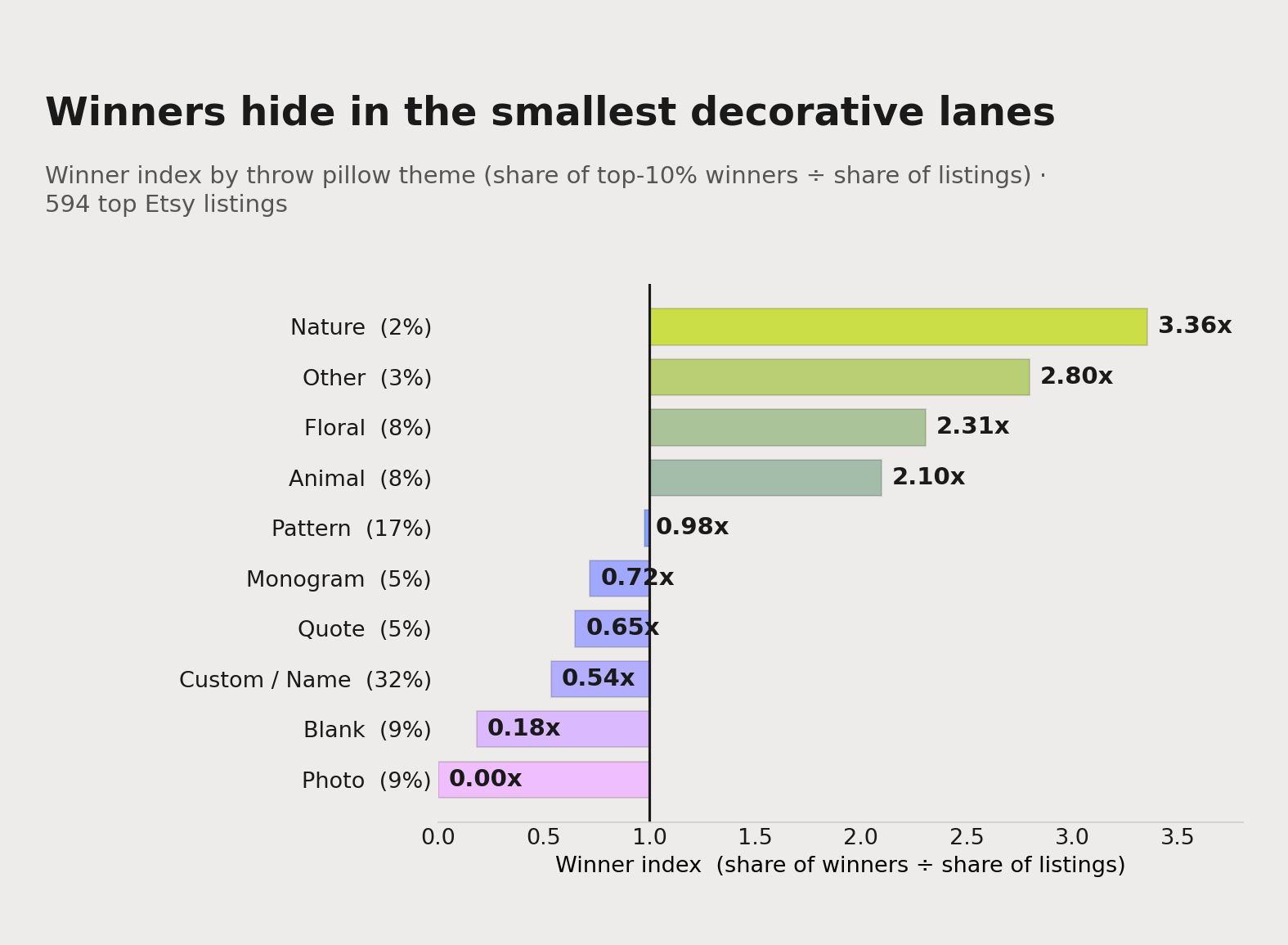
That second chart is the real map of where the open lanes are. The winner index is a theme’s share of the top-10% winners divided by its share of listings — above 1.0x means it over-delivers winners, below means it under-delivers. Read top to bottom:
The top pullers (over-index hard). Nature motifs (7.4% average, 3.36x), the “other” decorative bucket (6.6%, 2.80x), floral (6.1%, 2.31x), and animal (6.5%, 2.10x). Small slices of the shelf, big shares of the winners. High demand, low supply — the best combination on Etsy.
The par lane (holds its weight). Pattern (5.3% average, 0.98x) is the second-biggest lane at 17% of the shelf and pulls right at its weight. Woven and printed patterns are a broad, reliable, decorative middle — not a sure win, but not a red ocean either.
The mid-pack (below median on pull). Blank / solid pillows (4.4% average but a brutal 0.18x winner index — people buy them, almost nobody saves them), custom / name (4.4%, 0.54x), monogram (4.2%, 0.72x), and quote / statement (3.4%, 0.65x). Respectable-looking averages, but all heavily supplied and all under-delivering winners.
The floor. Photo pillows (2.3% average, 0.00x) — the weakest theme in the study, and out of 594 listings they produced not a single top-10% winner. More on that trap below.
Two things jump out. First, the gap between the top decorative puller and the photo floor is more than 3x. Second, the winners are not exotic. They are pieces of decorative art from lanes almost nobody is crowding into, while the whole shelf tilts toward the one lane that pulls worst.
The winning design types (with a prompt to make each)
This is the part I wish someone had handed me the night I made that name pillow. For each winning type: what the data says, why it works, and a Gemini prompt you can use to generate your own original version — written to output the printable artwork itself, ready to drop onto a print-on-demand pillow.
Two rules before you generate anything, because they decide whether your shop survives. Keep it original, since Etsy requires print-on-demand art to be your own. And never prompt for a real brand, character, logo, or copyrighted image. Every prompt below is written to stay clear of that. Swap the CAPS placeholder for your niche so the output is yours, not a generic AI print a hundred other sellers can also make.
1. Floral (a top decorative puller at 6.1%, punches 2.3x its weight)
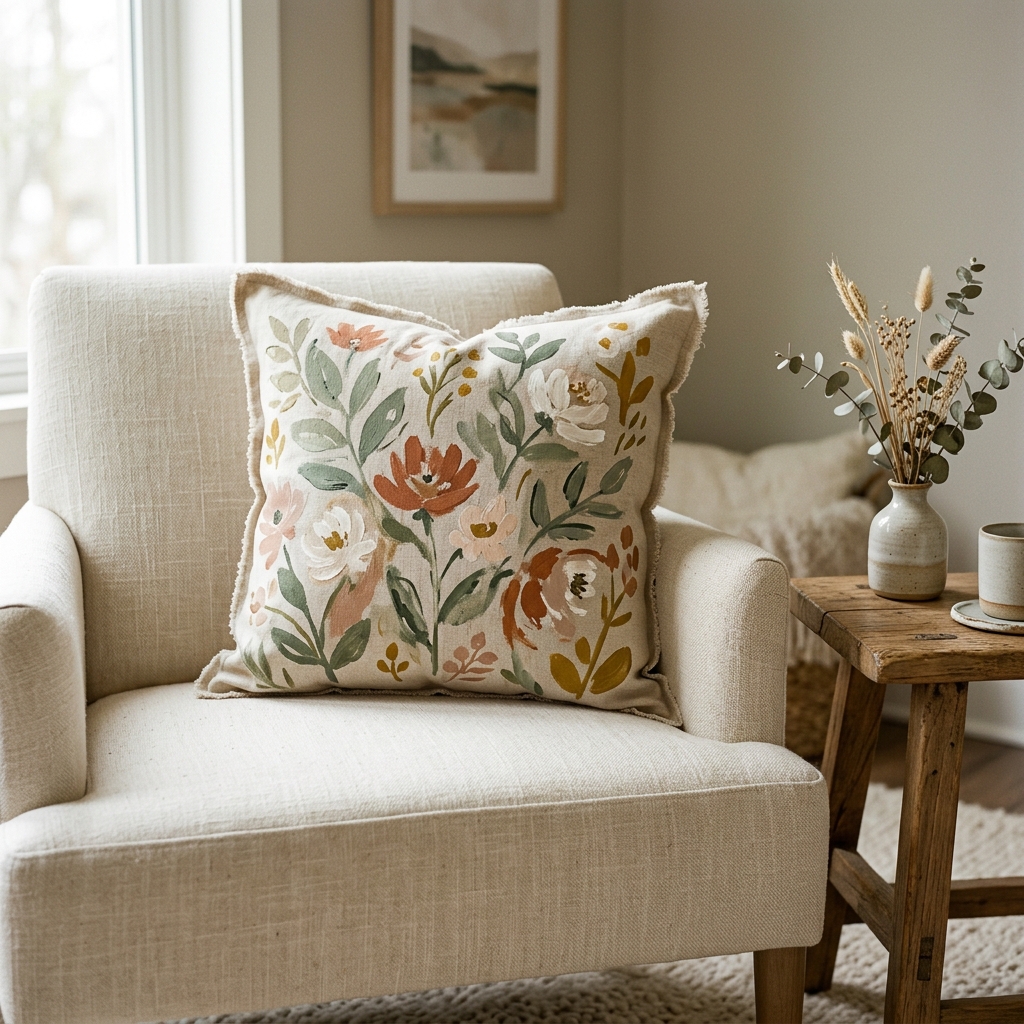
One of the strongest decorative lanes and still a small slice of the shelf. Buyers reward a floral that feels hand-made — loose brushwork, a considered palette, a little imperfection — over a stiff, photo-real bouquet. It suits almost any sofa, bed, or bench, which is why it saves so well.
A hand-painted floral design for a decorative throw pillow. A loose, painterly arrangement of FLOWERS OF YOUR CHOICE (soft peonies, wild poppies, dried grasses) in a muted, sophisticated palette of sage, terracotta and cream, with visible brushwork and gentle negative space. Fine-art textile feel, high resolution, printable square artwork, no pillow, no couch, no mockup, no text. Just the artwork on a clean transparent or off-white background.
2. Animal (6.5%, broad and giftable, 2.1x its weight)
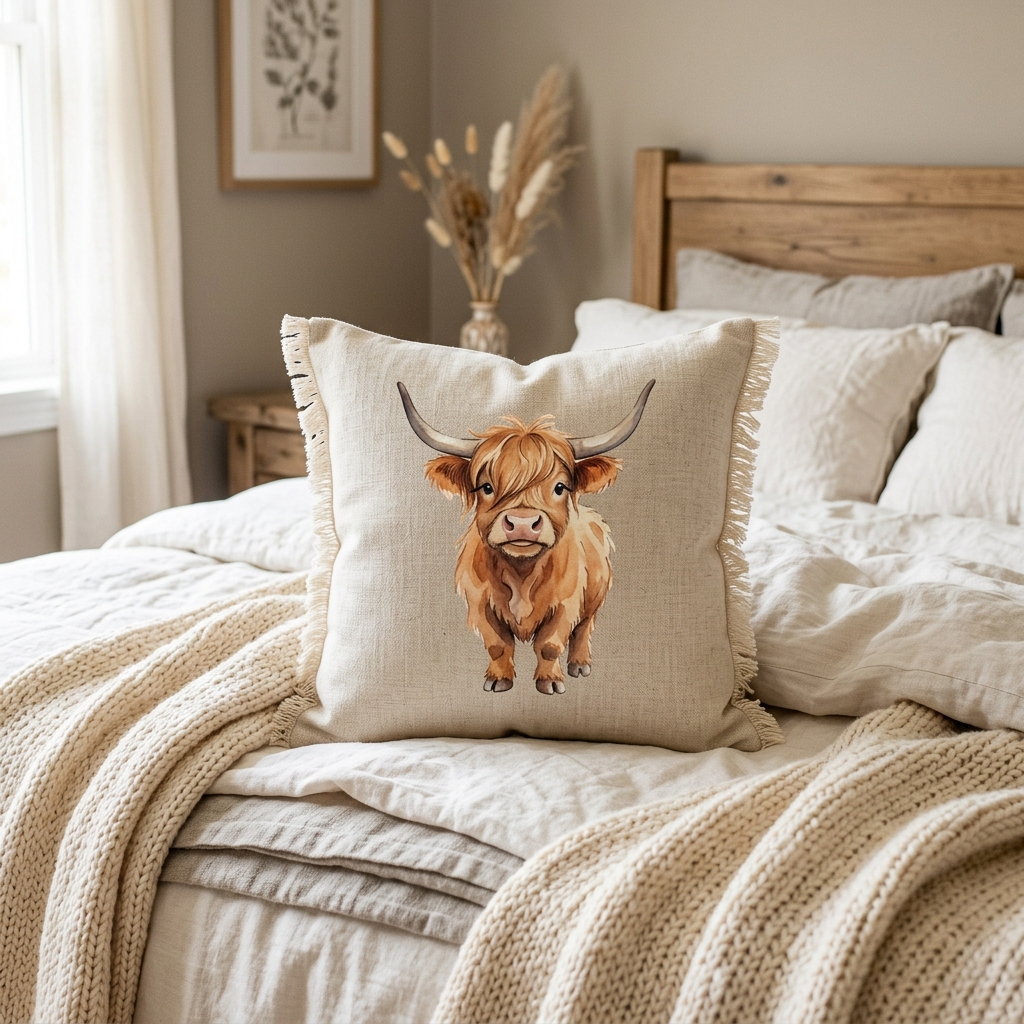
The most dependable decorative theme with the widest buyer base — kids’ rooms, sunrooms, reading nooks, and gifts all pull from it. A single characterful creature illustrated with warmth, not a stock wildlife photo. Whimsy wins here, and a little personality in the eyes goes a long way.
A whimsical illustrated animal design for a decorative throw pillow. A single ANIMAL OF YOUR CHOICE (a proud rooster, a curious fox, a chubby highland cow) drawn in a charming, slightly folk-art or watercolor style with a limited earthy palette, gentle personality in the eyes. Cozy home-décor feel, high-resolution printable square artwork, no pillow, no couch, no mockup, no text. Isolated artwork only.
3. Nature and botanical (the highest pull in the study at 7.4%, 3.4x its weight)
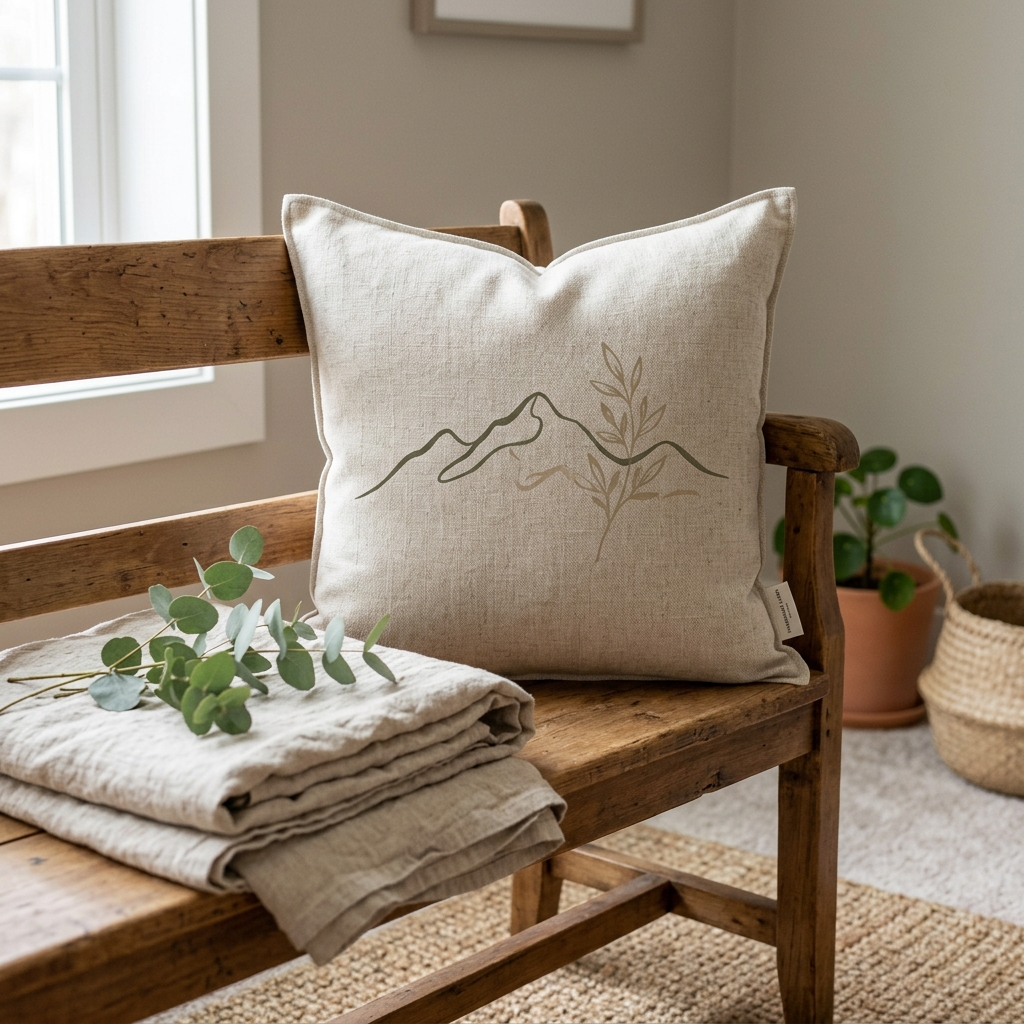
The tiniest lane and the single highest-pulling one — a fern frond, a mountain-line silhouette, a pressed-leaf study, a calm horizon. It reads as grown-up, grounding, and endlessly giftable, and almost nobody is making it. Small supply, top demand: the best pocket on the whole board.
A minimal nature-and-botanical design for a decorative throw pillow. A single calming MOTIF (a fern frond, a simple mountain-range line, a eucalyptus sprig, a soft horizon) in a muted, tonal palette of sage, sand and slate, delicate line and generous negative space, like a modern textile study. Elegant, high-resolution printable square artwork, no pillow, no couch, no mockup, no real brand or text. Isolated artwork.
4. Pattern (the bonus lane at 5.3%, holds at par and is far from a red ocean)
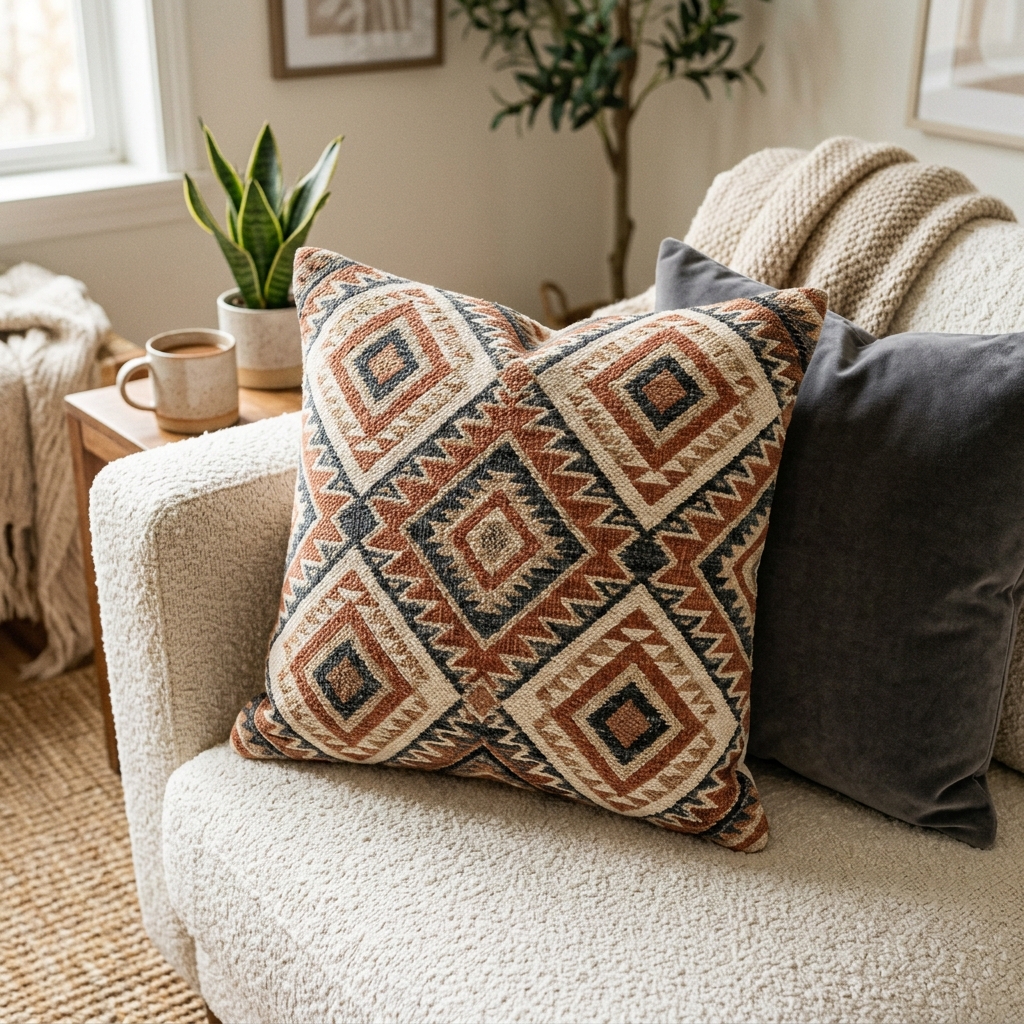
Not the highest puller, but worth flagging because it holds exactly at its weight (0.98x) while being genuinely decorative and much less crowded per-design than the name lane. A confident repeating motif — boho, checkerboard, mudcloth, scandi — reads as an interior-design choice, and buyers who want a set often save the whole family. Keep the palette tight and the repeat clean.
A decorative repeating pattern design for a throw pillow. A confident geometric or organic PATTERN OF YOUR CHOICE (boho diamonds, soft checkerboard, mudcloth lines, scandi florals) in a tight earthy palette of clay, oat and charcoal, balanced and seamless-looking, textile-print feel. High-resolution printable square artwork, no pillow, no couch, no mockup, no brand names. Just the pattern artwork.
After you generate any of these, shrink it to about 200 pixels wide and see if it still reads as something. A throw pillow lives or dies at thumbnail size in the search grid, competing against a wall of near-identical cushions. If it turns to mush, simplify: bolder shapes, higher contrast, more negative space. That thumbnail test is the difference between a design that pulls and one buyers scroll past.
💡 Pro tip — one motif, one palette. The decorative winners share a discipline: a single subject — one bloom, one animal, one leaf — in three or four colors a buyer can picture against their own wall. Resist bolting on a name, a date, or a second motif; every extra element you add drags the design back toward the crowded personalization lane it should be avoiding.
The two traps that look busy but rarely sell
Two kinds of pillow flood these searches. Because there are so many of them, they look like proof of demand. The favorite ratio says otherwise.
Name and monogram pillows. Custom-name pillows are 32% of every listing I studied — the single most-crowded theme — and pull a 4.4% average, barely above the median, while delivering only about half the winners their footprint should (0.54x). Monograms are more of the same at 4.2%.
The problem is baked in: when the design is the buyer’s own name, you are not competing on creativity, you are competing on turnaround time, review count, and ad spend. That is a fight a new shop rarely wins — and on throw pillows, where about 69% of listings run ads, it is the most expensive fight on the board. This is the “add your name” red ocean, and it is a third of the shelf.
Photo pillows. The weakest theme in the entire study at 2.3%, and it produced zero top-10% winners out of 594 listings. A face printed on fabric, a pet photo, a memorial collage — they are deeply meaningful to the one buyer and completely generic to everyone else, so they blur together and the buyer shops on price and reviews, not your design.
Enormous supply, no differentiation, bottom-of-the-board pull. And a quiet third trap sits right next to it: the blank or solid-color pillow (0.18x winner index) — people buy them, but almost nobody saves them, so they will never win you organic visibility.
None of this means these pillows are worthless. They are crowded and undifferentiated. Supply is enormous and it is hard to stand out, so the next new listing gets ignored. Spend most of your energy in the under-supplied, high-pull decorative lanes instead.
💡 Pro tip — count the competition before you list. Search your exact angle on Etsy and scroll page one. If it is a wall of near-identical name or photo pillows, you are signing up for a price-and-ads fight, not a design one. A decorative motif with only a handful of close matches is worth far more than a clever name in a lane that is already a thousand pillows deep.
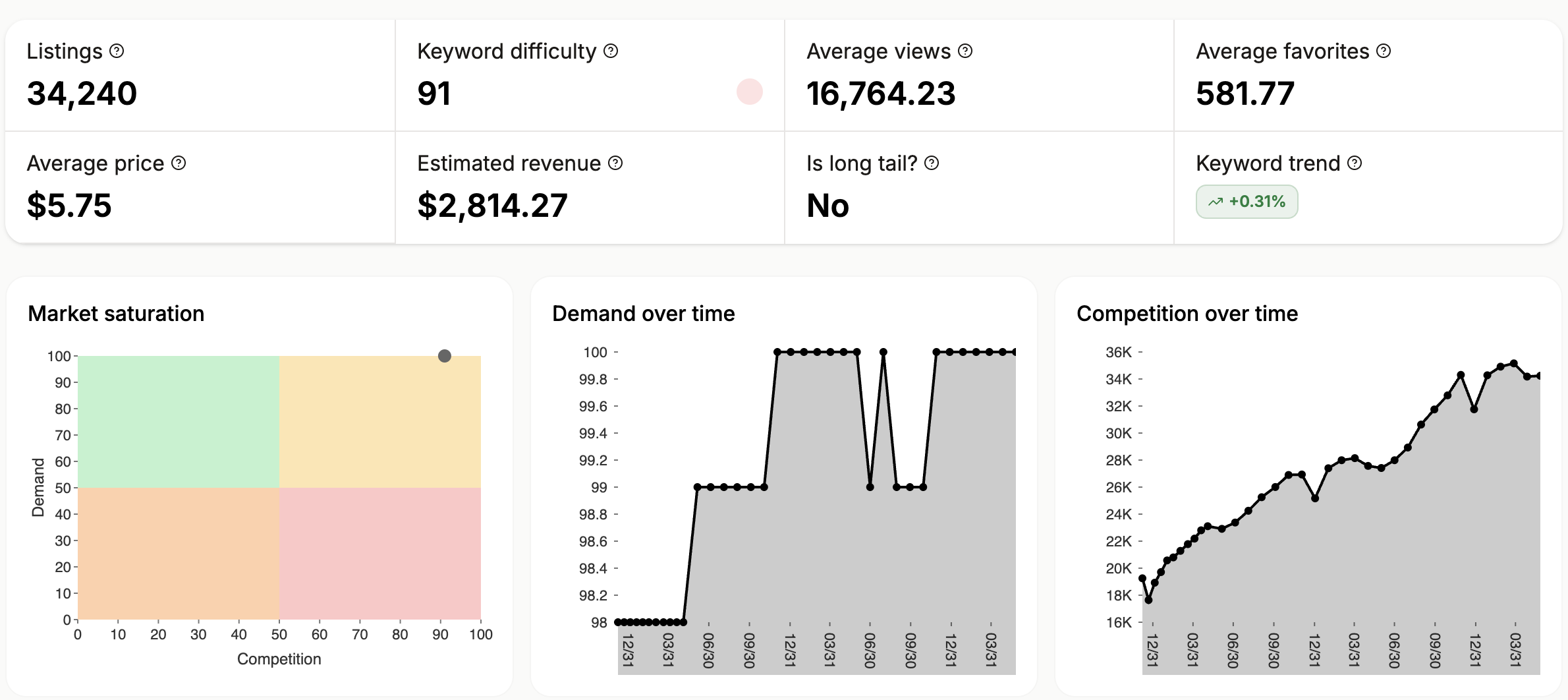
Want to see how crowded a design angle is before you commit to it? That is what the free Keyword Explorer shows you: demand against competition for any phrase, so you can aim at a pocket that is not already a red ocean.
Your yardstick: is your design a winner?
Numbers are only useful if you can hold your own work up against them. So here is the scale for a throw-pillow design that already ranks on Etsy.
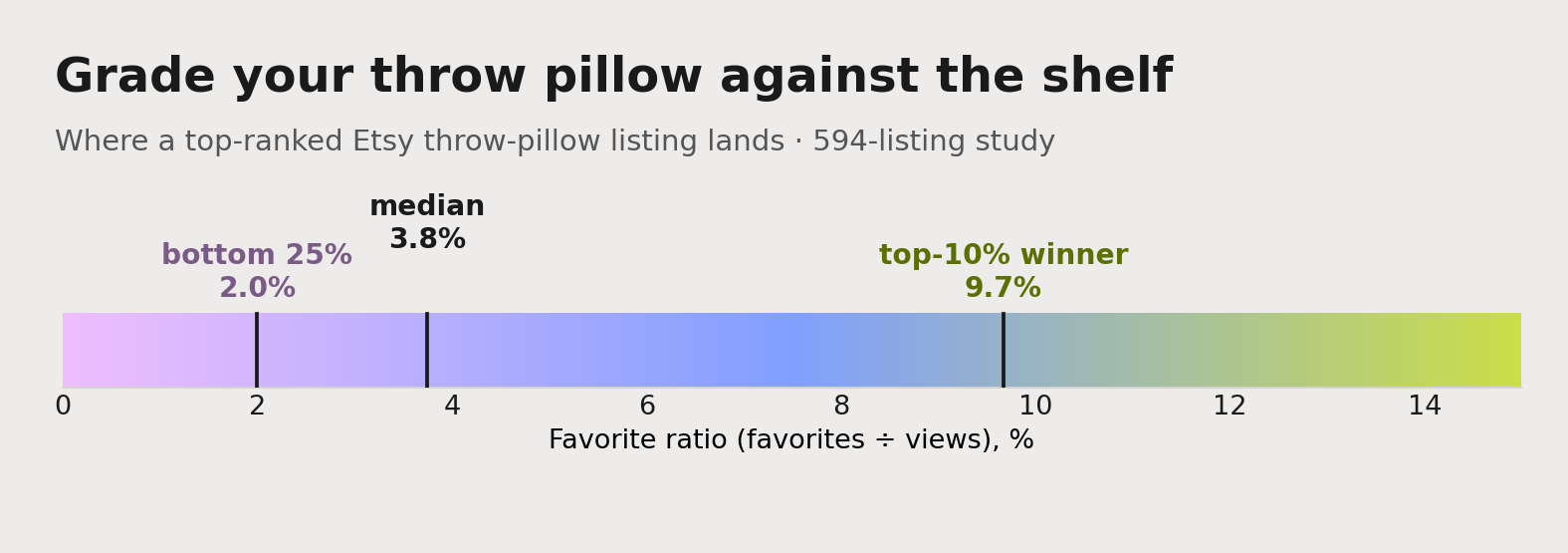
- Under 2.0%: the bottom quarter. People are seeing it and scrolling past. Rethink the design.
- Around 3.8%: dead average. Fine, not a winner.
- 6 to 9%: top third. A strong decorative design.
- 9.7% and up: the top 10%. A genuine winner.
If you sell on Etsy, you can run this check on your own listings tonight. Open a listing’s stats, divide favorites by views, and see where it lands. A pillow sitting under 3.8% is telling you something, and it is usually the design, not the traffic.
💡 Pro tip — grade a pillow tonight. Open one of your live listings, divide its favorites by its views, and drop the number on the scale above. Under 3.8% and the design is not pulling its weight — hold it up against a floral or animal winner and ask what a stranger would actually want on their own couch.
Two rules a design has to survive first
Before a design can sell, it has to stay up. Two Etsy rules quietly end more print-on-demand shops than any trend miss.
It has to be your own. Etsy’s Creativity Standards require that items made with production tools — which is all print-on-demand — are based on your own original design. Buying a trending pattern file or a stock floral pack and printing it unchanged fails that test, and it is a common reason listings get deactivated. Our guide to Etsy’s rules for print-on-demand sellers walks through what “original” actually means in practice.
It cannot borrow someone else’s work. Copying a hot design, using a famous artwork, or lifting a photographer’s image is the fastest route to a takedown and a shop at risk. This one bites pillow sellers especially, because it is so easy to feed a copyrighted image into an AI tool or print a photo you do not own. The safe move is your own take on a theme, not someone else’s asset. If copycats are a worry the other direction too, there is a hidden setting that helps protect your shop from copycats.
Neither rule blocks you from selling a hand-painted floral or a whimsical animal pillow. Plenty of shops do. They block you from selling the exact one someone else already made. Original beats borrowed, and it is also the only version that lasts.
The mockup finding: style the pillow, don’t grid it
Now the part that will save you hours of second-guessing.
Sellers agonize over how to present a pillow. On a couch? On a bed? A clean flat-lay? A grid showing every color option? I checked across the whole set.
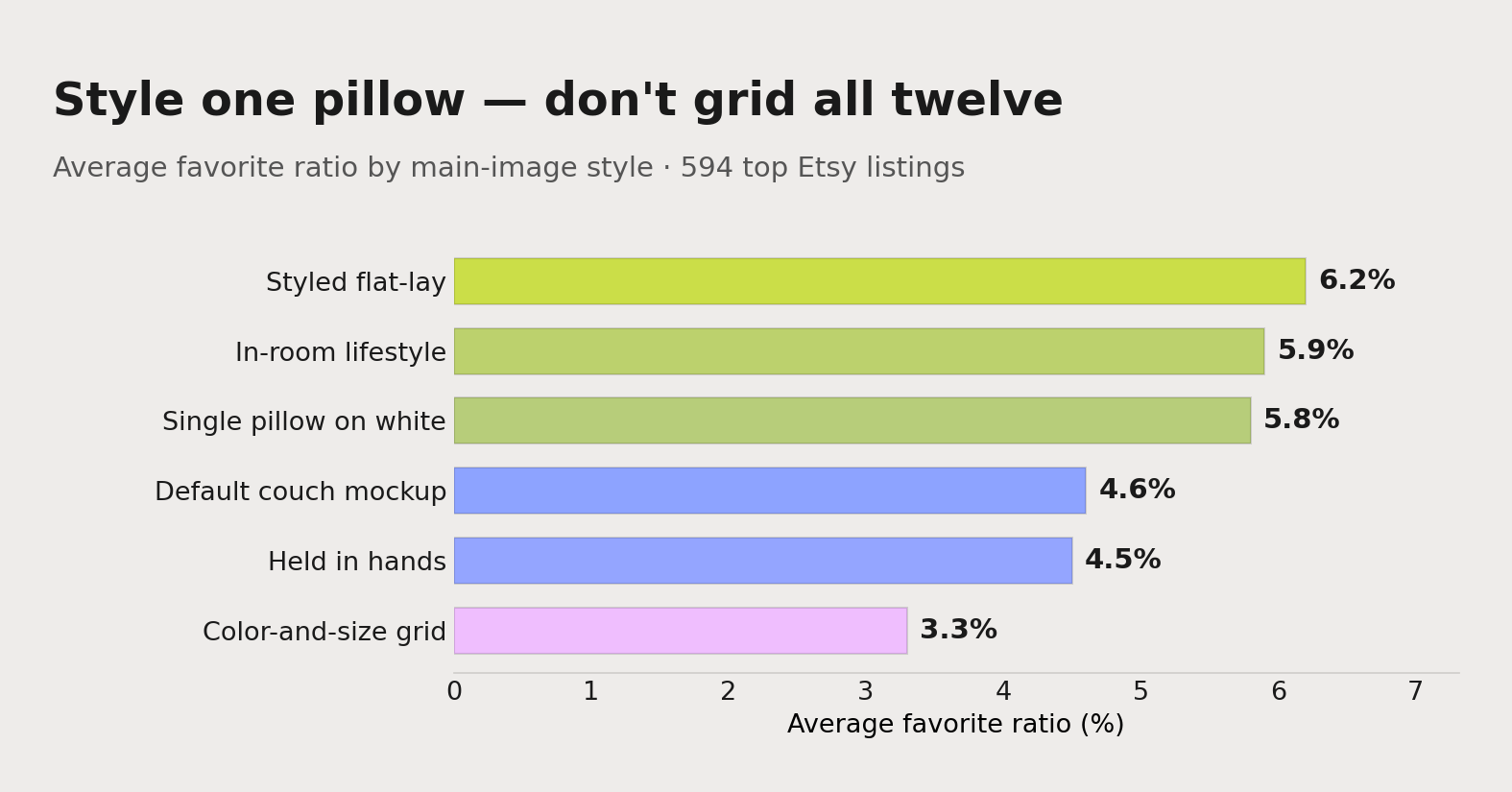
The signal is clear and it is about styling one pillow well, not showing all of them. A styled flat-lay — the pillow shot from above with a bit of texture, a throw, a sprig of greenery — pulls a 6.2% average, the best of any style. A styled in-room lifestyle scene (5.9%) and a clean single pillow on white (5.8%) trail just behind.
The default couch mockup everyone uses pulls a middling 4.6%, a held-in-hands shot 4.5%, and dead last is the color-and-size grid at 3.3% — the busy “here are all 12 options” main image that so many sellers lead with. Buyers are not shopping a spec sheet; they are imagining one beautiful pillow in their room, and a single styled hero does that imagining for them.
💡 Pro tip — make the hero do the imagining. Your main image is the entire pitch, so give it one styled pillow — a textured flat-lay or a real-room scene — not a contact sheet of colors. The styled shots pulled 6.2% and 5.9% against just 3.3% for the “here are all 12 options” grid; move that grid to slot two or three where it belongs.
So the guidance is: lead with one pillow, styled — a flat-lay or a real-room scene — and save the color grid for slot two or three. A few things that still move mockups:
- Do not ship the default Printify or Printful stock couch mockup. Everyone uses them, so your listing blends into a wall of identical cushions on identical grey sofas. A realistic smart-object flat-lay or room scene is worth the small effort. Here is what we learned about better listing images with mockups.
- Use most of your ten slots. A styled hero for the thumbnail, then a scale reference on a real sofa, size and insert options, a close-up of the fabric and stitching, and a “what you get” graphic. The full sequence is in our guide to listing image types that drive sales.
- Match the real product. If you sell a cover only, do not lead with a plump stuffed mockup and hide the “cover only” detail. Etsy requires the thumbnail to represent what ships, and mismatches drive returns and unhappy reviews.
- Add a simple video. A ten-second pan across a styled pillow on a sofa gets impression priority without any on-camera work.
- Disclose it. When an image is a mockup or AI-assisted, say so, both for Etsy’s standards and for buyer trust. Here is how and why to disclose mockups and AI images.
Free download: the Etsy SEO Checklist
A winning pillow still has to be found. This one-page checklist walks the titles, tags, and attributes that get throw pillows ranking, so the design you just made actually gets seen.
Grab the free Etsy SEO Checklist →
New shops break in — with a genuinely good design
If all of this feels like the top of Etsy is locked up by big shops with ad budgets, the data says: this is one of the more open lanes.
I flagged a listing as “rising” when it was new, pulling a high favorite ratio, from a small or mid-size shop. Those rising listings were about 7% of the whole top set.
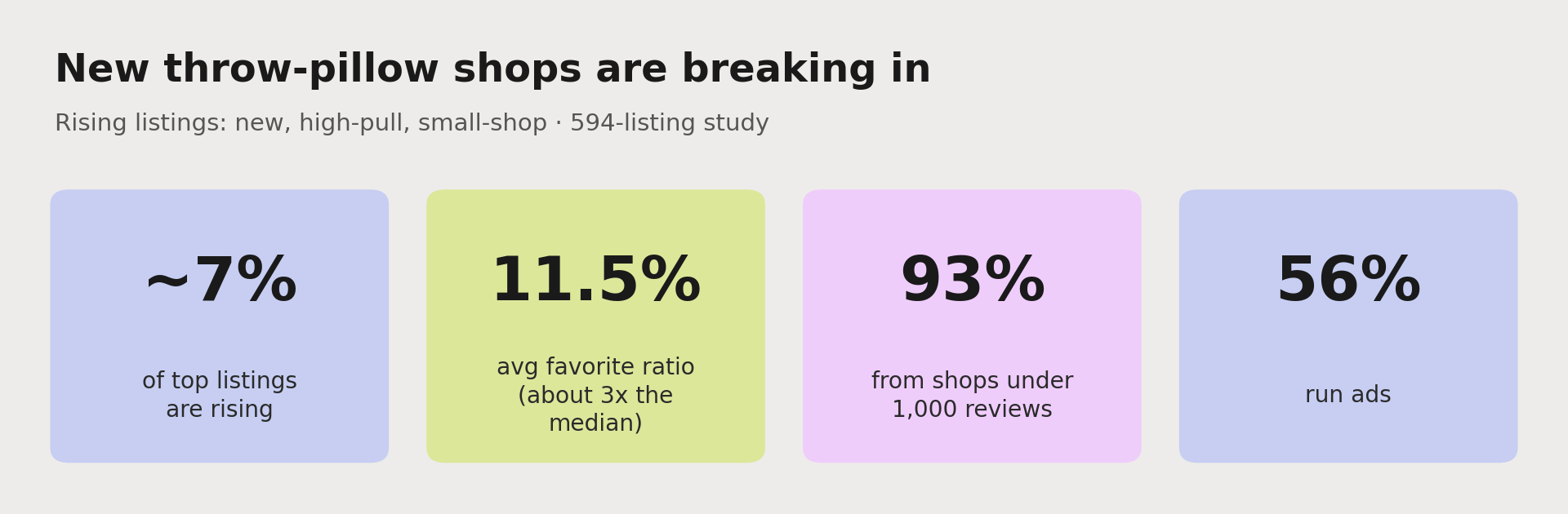
The rising listings averaged an 11.5% favorite ratio, about three times the overall median and well past the winner line. A striking 93% came from shops with fewer than 1,000 reviews — throw pillows are genuinely open to newcomers. And about 56% run ads, a reminder that on pillows a great design plus a small ad budget is often how a new shop gets its first views.
And the rising designs win with the exact playbook above: a hand-painted floral, a whimsical animal, a botanical or nature motif, a clean decorative pattern. Not another last name in script, not a photo on fabric. A fresh, specific, well-made decorative design from a small shop is breaking into these searches every week. That could be your shop. The design is the lever, and it is a lever you fully control.
Every throw pillow niche plays differently
“Throw pillow” is not one market. Each search term pulls a different buyer and a different mix of designs, and the personalization terms behave very differently from the broad decorative ones. I pulled the full ranked results for the two most personalization-heavy searches — the crowded lanes most new sellers start with — and OCR’d every card to read its real views and favorites. Here is how they compare, ranked by median favorite ratio.
| Search term | Listings (ranked set) | Median favorite ratio | Winner line (top 10%) | What dominates | Rising | Ads |
|---|---|---|---|---|---|---|
| custom throw pillow | 76 | 3.5% | 7.2% | Custom / name 51%, quote 12%, monogram 9% | 4% | 70% |
| personalized pillow | 70 | 3.0% | 5.9% | Custom / name 53%, photo 19%, quote 10% | 0% | 79% |
Both terms sit below the 3.8% overall median, both are more than two-thirds ads, and both are dominated by exactly the personalization themes that pull worst across the whole study. The “personalized pillow” search is the harder of the two — a lower median, a lower winner line, nearly four-in-five listings running ads, and essentially no rising newcomers.
The lesson is the same at the term level as at the theme level: the searches where a name or a photo is the product are the hardest, most ad-heavy, lowest-pulling lanes on the board. The open, higher-converting demand lives in the decorative terms — floral, animal, botanical, boho pattern — not the “personalize it” ones. If you are starting out, aim your listings and your SEO at the decorative lanes, not the name-generator ones.
Where to start this week
If you came in thinking name and photo pillows were the throw-pillow business — the way I once did — I hope this traded that assumption for a map. You do not need to guess what is hot. You need to make a genuine piece of decorative art with a point of view, style it well in a real room, then check whether people actually save it.
Here is the whole post as five steps:
- Pick an open lane: a hand-painted floral, a whimsical animal, a botanical or nature motif, or a clean decorative pattern. Skip the name, monogram, and photo red oceans that dominate the shelf.
- Make it look like art someone chose for a room, not a personal gift for one person. A decorative point of view beats a name.
- Run the thumbnail test: if it does not read at 200 pixels wide, simplify.
- Lead with one styled pillow — a flat-lay or a real-room scene — and save the color/size grid for a later slot. Do not ship the bare stock couch mockup.
- List it, then read its favorite ratio. Under 3.8% and buyers are scrolling past. Above 9.7% and you have a winner.
Most sellers never get to that last step. They make a design, cross their fingers, and move on. But that number is the whole game. Make something, check its favorite ratio a couple of weeks later, keep the ones that pull, and let the rest go. Do that enough times and the guessing quietly stops. One day you might even be the shop someone else is pulling apart in a post like this one.
Keep reading on Listadum. New to print-on-demand? Start with selling on Etsy without inventory. Ready to run the print-on-demand niche properly? See our guide to Etsy’s rules for print-on-demand sellers.
The rest of the series
This is one spoke in Listadum’s print-on-demand teardown — every big POD product on Etsy, ranked by favorite ratio, so you can see what sells and what is not worth your time.
- The pillar: The Complete Guide to Niche Etsy Strategies — how to pick a niche and a product worth your time.
- The apparel siblings, already live: What T-Shirt Designs Actually Sell on Etsy and What Sweatshirt Designs Actually Sell on Etsy.
- More product teardowns in the series: wall art, tote bags, phone cases, and stickers.
Frequently asked questions
What kind of throw pillow sells best on Etsy?
Decorative art, not personalization. In my study of 594 top listings, the decorative themes — nature motifs (7.4% average favorite ratio), animal (6.5%), floral (6.1%) — topped the board, while floral and animal together were only 16% of the shelf but produced 36% of the winners. Custom-name pillows (4.4%) and especially photo pillows (2.3%, zero winners) pulled worst despite being the most-listed themes.
Why don’t name and photo pillows sell as well on Etsy?
Because they are crowded and undifferentiated. Custom-name pillows are 32% of the shelf and photo pillows another 9%, so buyers have endless near-identical options and shop on price, reviews, and ad spend rather than your design. When the buyer’s own name or photo is the product, a new shop has almost no way to stand out — and photo pillows produced zero top-10% winners in the study.
What is a good favorite ratio for a throw pillow listing?
The median top-ranked throw-pillow listing sits at a 3.8% favorite ratio (favorites divided by views). The bottom quarter is under 2.0%, and a genuine top-10% winner reaches 9.7% or higher. Check your own listing by dividing its favorites by its views.
How should I photograph a throw pillow for Etsy?
Lead with one styled pillow — a flat-lay with a bit of texture or a real-room lifestyle scene. Those pulled 6.2% and 5.9% average favorite ratios in the study, versus just 3.3% for a color-and-size grid main image and 4.6% for the default couch mockup. Save the grid of color options for a later slot and show scale on a real sofa.
Are print-on-demand throw pillows still worth selling on Etsy in 2026?
Yes, and they are one of the more open POD lanes: about 93% of rising listings come from shops with under 1,000 reviews, the median price is around $22, and about 69% of listings run ads. The design is the differentiator. A genuine, original decorative design in an under-supplied lane — floral, animal, botanical, pattern — is what separates a winner from the pile of name and photo pillows.
Can I use AI to make throw pillow designs to sell on Etsy?
You can, but the design must be your own original work, and you must not feed in a copyrighted image, a famous artwork, or someone else’s photo. Etsy’s Creativity Standards require print-on-demand art to be based on your own design, and many sellers disclose AI assistance for buyer trust. Use AI to generate an original decorative style you direct, not to copy an existing piece.
Which throw pillow search terms should a new seller target?
Aim at the decorative terms, not the personalization ones. The two personalization-heavy searches I studied — custom throw pillow and personalized pillow — both pulled below the 3.8% median and were 70% and 79% ads. The open demand lives in decorative searches like floral, animal, botanical, and boho pattern pillows.
Stop guessing which of your designs is pulling and which is dead weight.
Listadum reads every listing in your shop and flags the ones losing you sales: weak images, no video, thin titles, low engagement. You get a clear, prioritized list of what to fix first, in plain English.
Free plan · no credit card · connect your real Etsy shop in minutes
About the author
Neha Chandelier, Co-founder of Listadum, selling on Etsy since 2020. She writes about Etsy tips and tricks, how to sell on Etsy, and growing a handmade shop.
Sources: Listadum Keyword Explorer (demand data, pulled July 2026); Listadum study of 594 top-ranked Etsy throw-pillow listings ranked by favorite ratio; per-term OCR of the “custom throw pillow” and “personalized pillow” searches; Etsy Creativity Standards.