
By Neha Chandelier, co-founder of Listadum · Last updated August 13, 2026
A woman at my local pet store spent ten minutes at the engraving machine spelling out her dog’s name for a little brass tag. Watching her, you would swear the pet business runs on names — that the thing people buy for the animal they love is the animal’s name, stamped on something. Search Etsy for “dog collar” and the whole first page agrees: name, name, name, on nylon, on leather, on a metal disc.
Then I ranked the pet shelf by whether real buyers actually save these listings, and the name-on-a-tag lane came apart in my hands. The thing people save at nearly twice the rate it is listed is not a name at all. It is a little painted picture of the dog.
This is the seventeenth teardown in an ongoing series where Listadum ranks the biggest print-on-demand products on Etsy by favorite ratio — the one number that separates what genuinely sells from what just fills a search page.
Pet products are the most interesting entry in the whole study, because they look like the one place personalization finally wins, and they are — but only one kind of personalization, and it is not the kind everyone is making.
I captured the top listings across the four biggest pet-product searches on Etsy — pet products, dog collar, custom dog bandana, custom pet portrait — deduplicated them down to 1,097 unique designs, and hand-coded every one by theme, medium, and mockup. Then I ranked the 965 with a clean favorite ratio to see what actually pulls.
This is the largest single-product sample in the series, and it produced the sharpest medium signal I have seen. This is the long version: the full ranking, the winning design types with a ready-to-use prompt for each, the traps that eat new sellers alive, the benchmark to grade your own work, and the mockup finding that decides whether your art gets seen. Grab a coffee.
The one number that tells you if a design sells
A view count tells you almost nothing on its own — ads and age both inflate it. Favorites are the honest signal of wanting, but Etsy keeps both numbers hidden on the search cards.
The free Listadum browser extension solves that: it prints the real views and favorites straight onto every listing while you scroll a pet search, so instead of guessing which collar or portrait is actually popular, you can read the demand off the card. That is the piece that made this entire study possible.
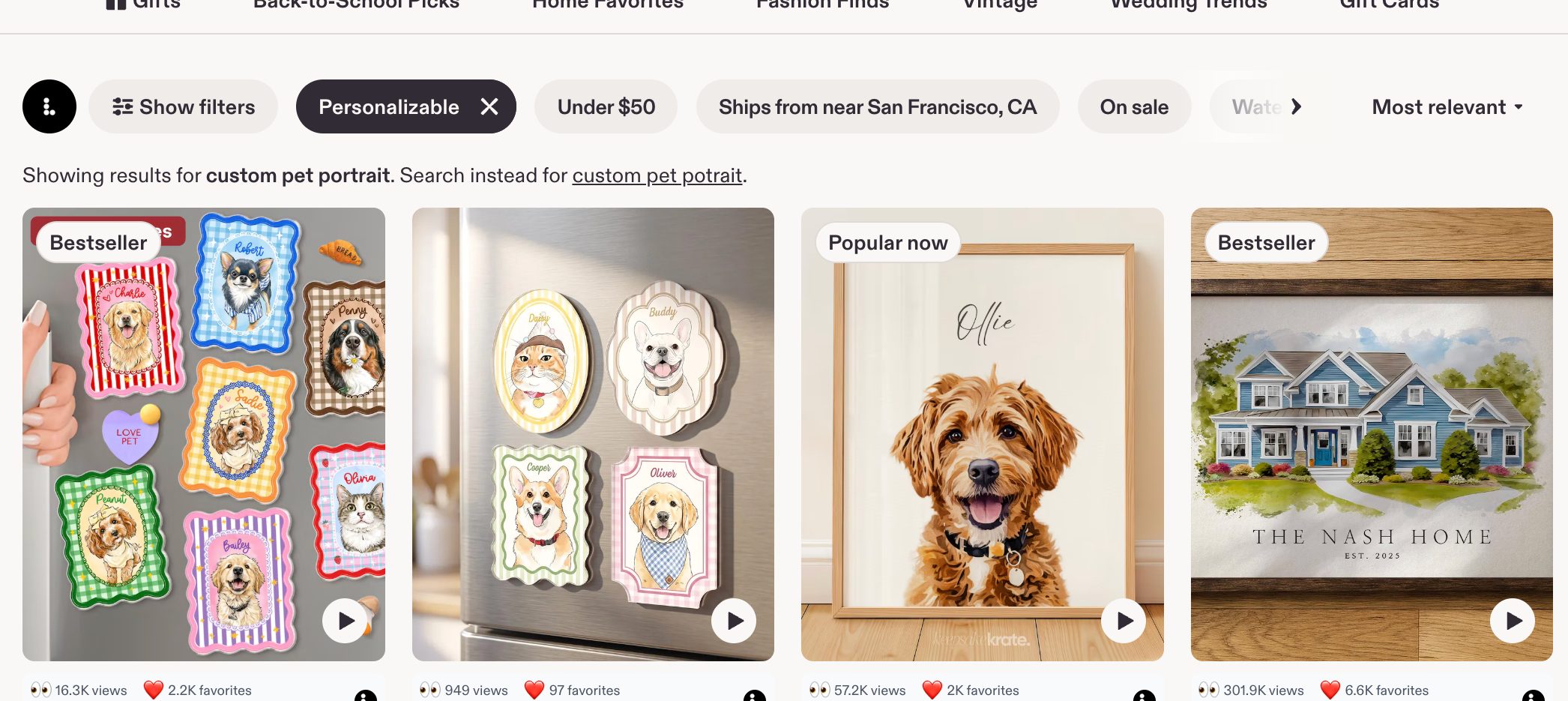
The Listadum extension overlaid on a live Etsy pet search — views and favorites on every card. Those two numbers are the raw material for everything below.
Divide one by the other and you get something you can trust:
Favorite ratio = favorites / views.
Inside Listadum we call this your favorite ratio, and it is the number I lean on hardest when I judge a design. Of everyone who saw this item, what share liked it enough to save it. That single ratio strips out the noise.
A brand-new listing from a two-person shop and a three-year-old listing from a shop with 40,000 sales can finally be compared fairly, because the favorite ratio cancels out ad spend, age, and shop size. It measures the design’s pulling power and nothing else — which is exactly the part you control when you sit down to make something new.
When I re-ranked all 965 listings by favorite ratio, the order scrambled. Collars Etsy had promoted to the top row got out-pulled by portraits buried three pages deep. Etsy’s default sort tells you what Etsy is boosting. The favorite ratio tells you what buyers love. Those are not the same list.
One thing to know going in: pets are, by the standards of this study, a healthy market. The median favorite ratio is 4.2% — higher than baby onesies or hats — and a genuine top-10% winner reaches 9.6%. Only 60% of listings run ads, the lowest ad load in the recent batch, and the median price is a friendly $14.95.
Cheaper to enter, less pay-to-play, and more open to new shops than almost anywhere else in the series. The catch is that most of that shelf is piled into one lane that pulls below average. Picking the right design here matters more than out-spending anyone.
The illustrated portrait wins — and the name-on-a-tag lane loses
Here is the headline, and it is a clean split down the middle of “personalization.”
Nearly 80% of the pet shelf is personalized in some way, so it is tempting to conclude that personalization is the winning move for pets. Look closer and the two personalization lanes behave like opposites.
The custom pet portrait — an artist’s illustrated rendering of someone’s specific dog or cat — is 43% of the shelf and over-indexes at 1.63x, taking almost 70% of every winner in the study.
The custom-name lane — the pet’s name printed on a collar, a metal tag, or a bandana — is 37% of the shelf and under-indexes at 0.56x, pulling far fewer winners than its footprint. Two lanes, nearly the same size, sitting side by side, and one produces three times its share of winners while the other produces barely half.
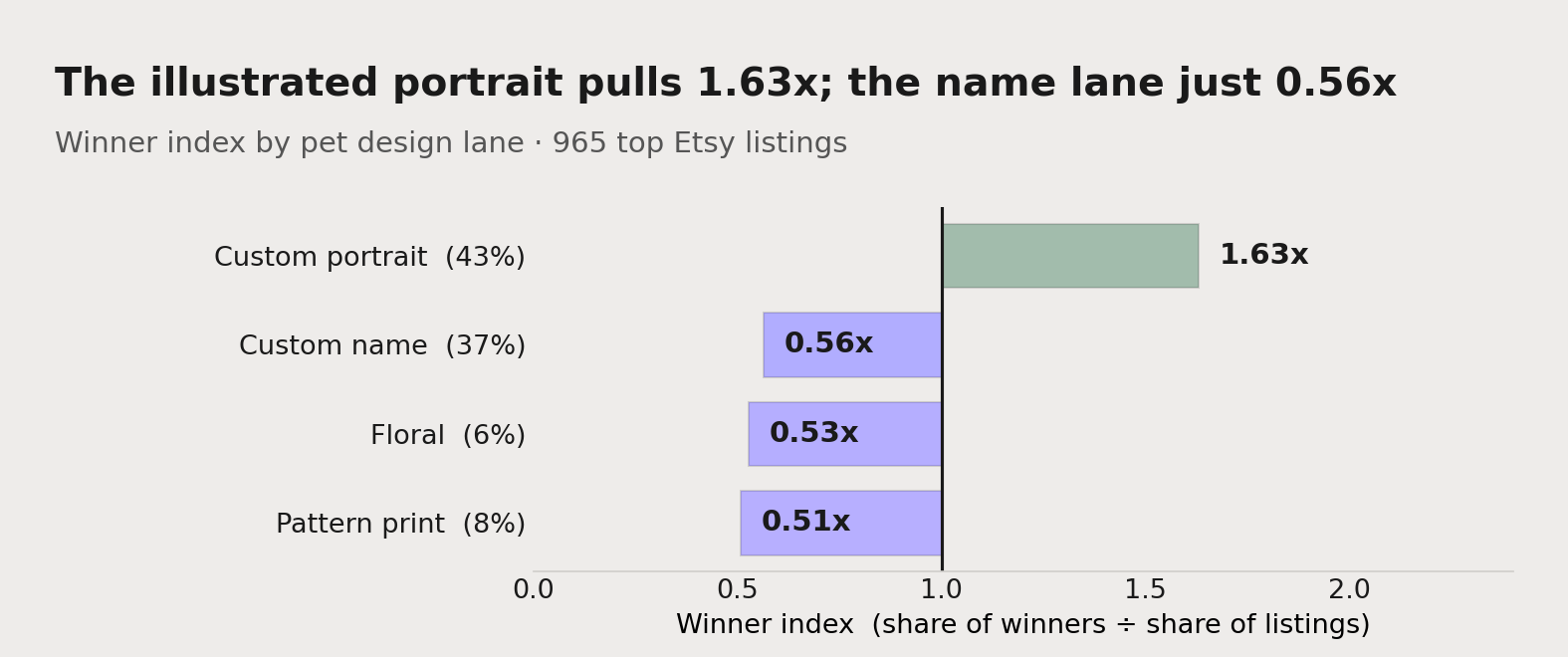
The plain-English version: buyers are not really shopping for personalization. They are shopping for a portrait of their animal — a designed object with a point of view, a little piece of art that happens to be their dog. A name engraved on a disc is a thousand near-identical products separated only by the letters; there is no design to fall in love with.
So the lesson is not “personalization wins for pets.” It is the same rule that holds in every other category in this series: a designed thing beats a named thing. Here, the designed thing just happens to be a portrait of a specific pet.
That is the big picture. Now the whole board.
The full ranking: what fills the shelf versus what actually pulls
No lane is a pure win or loss, and the mismatch between how much of the shelf a lane occupies and how many winners it produces is the whole story. Here is every coded design lane, sized by its share of listings and colored by how hard it pulls. The overall median is 4.2%.
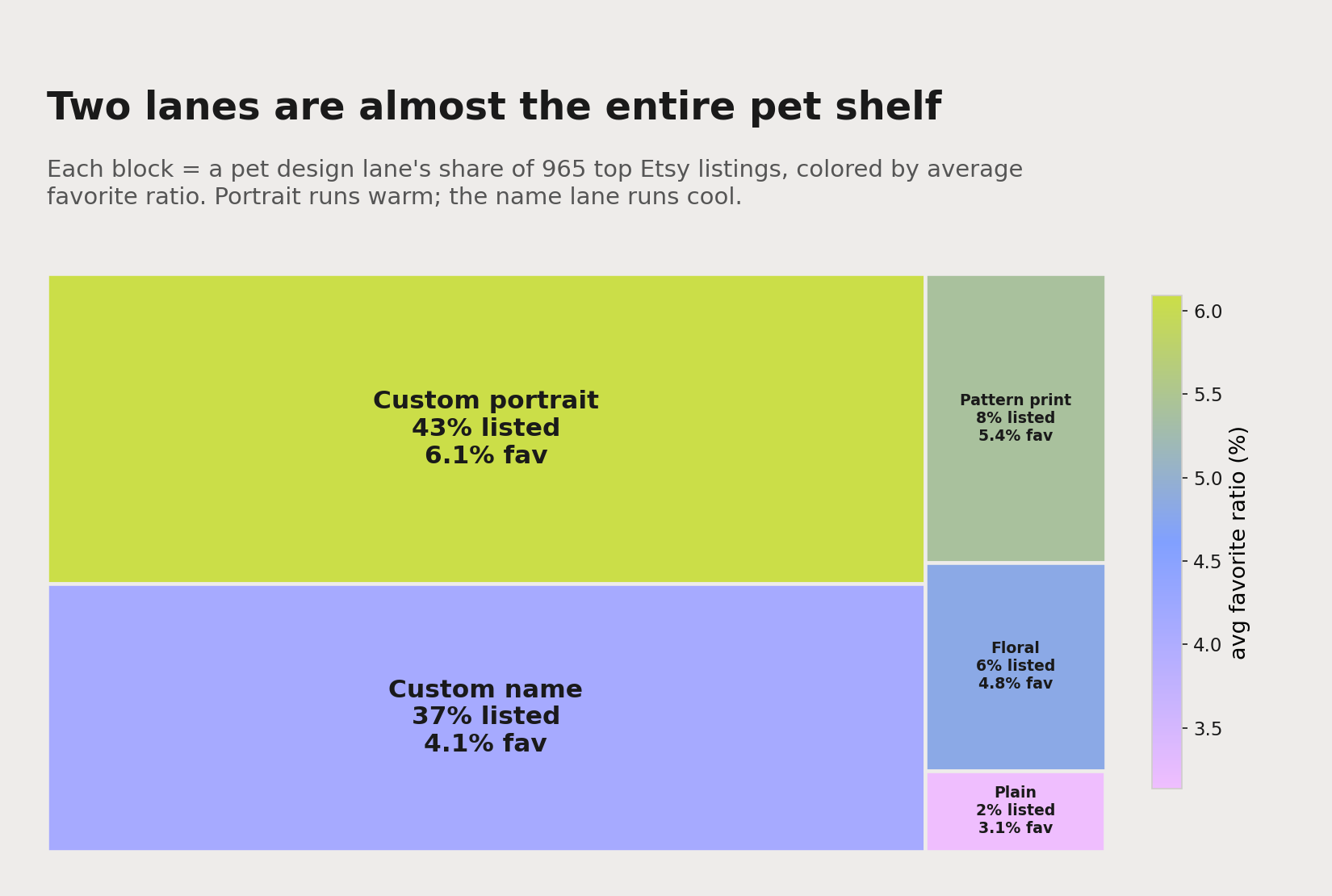
The treemap makes the crowding obvious: two lanes — custom portrait and custom name — are almost the entire shelf, and everything else (pattern prints, florals, plain) is a sliver. But the two giants are colored differently. The portrait block runs warm (a 6.1% average), the name block runs cool (4.1%, below the median). Now the same lanes read as a made-versus-wins gap, so you can see which one earns its space:
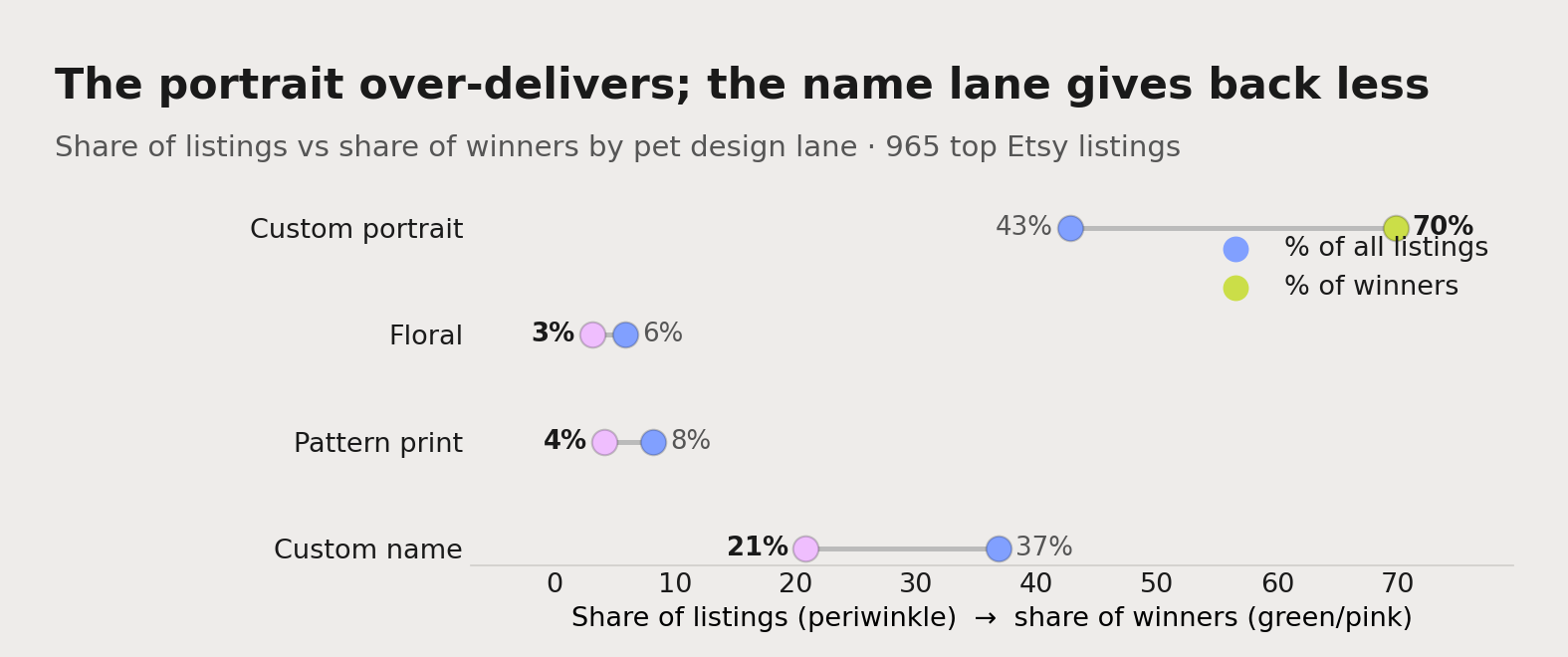
Read the dumbbell left to right. Custom portrait starts at 43% of all listings and jumps to 70% of the winners — it delivers far more than it takes. Custom name starts at 37% of listings and falls to 21% of the winners — it takes a third of the shelf and gives back a fifth of the wins.
Pattern print (8% of the shelf, 0.51x) and floral (6%, 0.53x) are pleasant, giftable, and both under-deliver too. The gap between the top lane and the name lane is nearly 3x on winner index.
Two things jump out. First, the portrait is not a niche corner you have to discover — it is the single biggest lane and the best-pulling one, which almost never happens on Etsy. Second, the losing lane is enormous. A third of every pet listing is a name on a collar or a tag, and it is quietly the weakest bet on the board.
Illustrate it — don’t photograph it, don’t engrave it
The design lane tells you what to make. The medium tells you how, and for pets the medium signal is the sharpest in the entire study — a spread from 2.03x down to 0.14x.
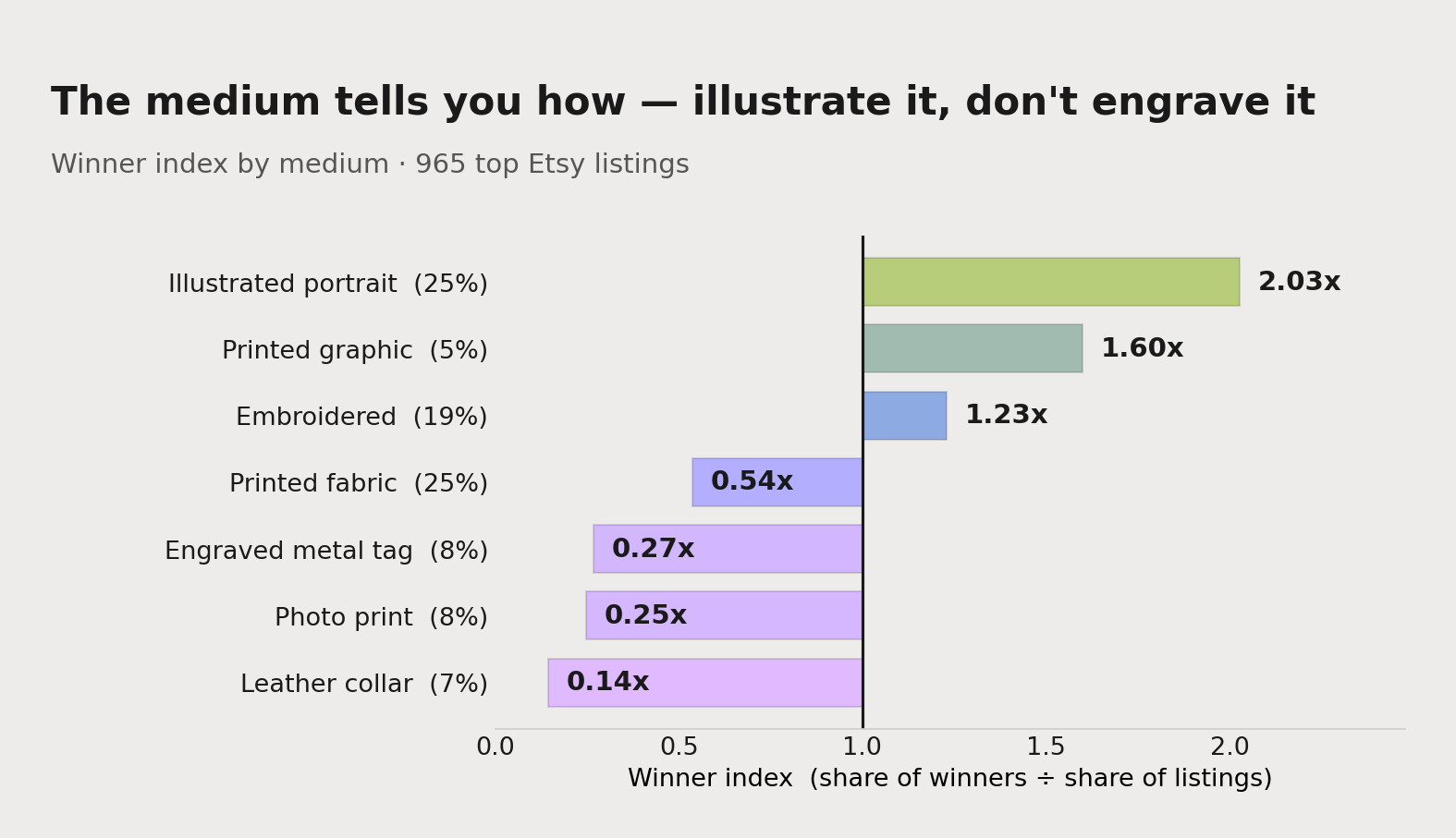
The illustrated portrait over-indexes at 2.03x and takes half of all winners on its own. Critically, it beats the literal photo print (0.25x) by a mile — buyers do not save a photograph of a dog, they save an artist’s rendering of the dog. That is the difference between a snapshot anyone could take and a piece someone chose to have made.
Printed graphics (1.60x) — an illustrated pet on a mug, a tee, a sticker — over-index too, and embroidery (1.23x), a stitched portrait or name, holds just above par.
Then the hardware collapses. The leather collar (0.14x) and the engraved metal tag (0.27x) are the two worst-pulling mediums in the whole study. The physical accessory — the thing the woman at the pet store was engraving — earns almost no saves at the favorite-ratio level.
The printed-fabric bandana (0.54x) sits below par too. The pattern is unmistakable: the more your product is a drawn image and the less it is a piece of pet hardware, the harder it pulls. Sell the picture, not the equipment.
The winning design types (with a prompt to make each)
This is the part I wish someone had handed me three years ago. For each winning type: what the data says, why it works, and a Gemini prompt you can use to generate your own original version — written to output the printable artwork itself, isolated and ready to drop onto a print-on-demand product.
Two rules before you generate anything, because they decide whether your shop survives. Keep it original, since Etsy requires print-on-demand art to be your own. And never prompt for a real brand, a cartoon character, a logo, or someone else’s photograph. Every prompt below is written to stay clear of that.
Swap the CAPS placeholder for the specific animal so the output is a real portrait, not a generic AI print a hundred other sellers can also make. In practice you would feed the buyer’s photo into your own illustration process — these prompts show the style to build.
1. Watercolor pet portrait (the core winner, illustrated portrait pulls 2.03x)
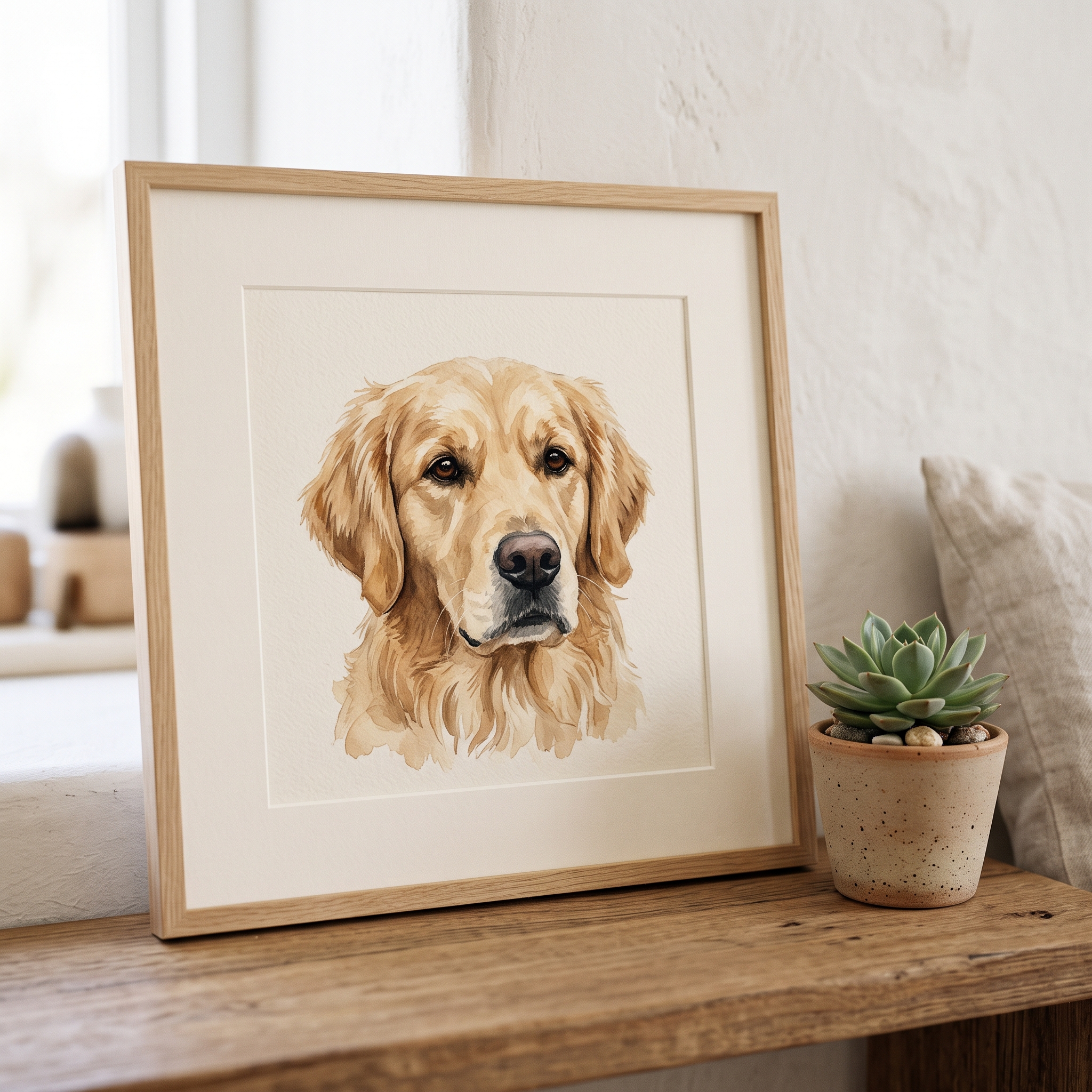
The most-saved thing on the entire pet shelf. Loose, warm watercolor reads as hand-made and heartfelt — a keepsake, not a product. It suits a memorial, a gift, a “new puppy” moment, which is why it saves across so many buyers. Keep the brushwork soft and the background simple so the animal’s face carries it.
A soft watercolor pet portrait. A gentle, painterly rendering of A SPECIFIC DOG OR CAT (describe the breed, coat color, and a bit of personality — a fluffy cream golden retriever with kind eyes), loose brushwork and delicate washes, a limited warm palette, generous negative space, no collar or text. Fine-art keepsake feel, high-resolution printable artwork, no product, no frame, no mockup. Just the portrait isolated on a clean transparent or off-white background.
2. Single-line pet portrait (modern, minimal, cheap to make well)
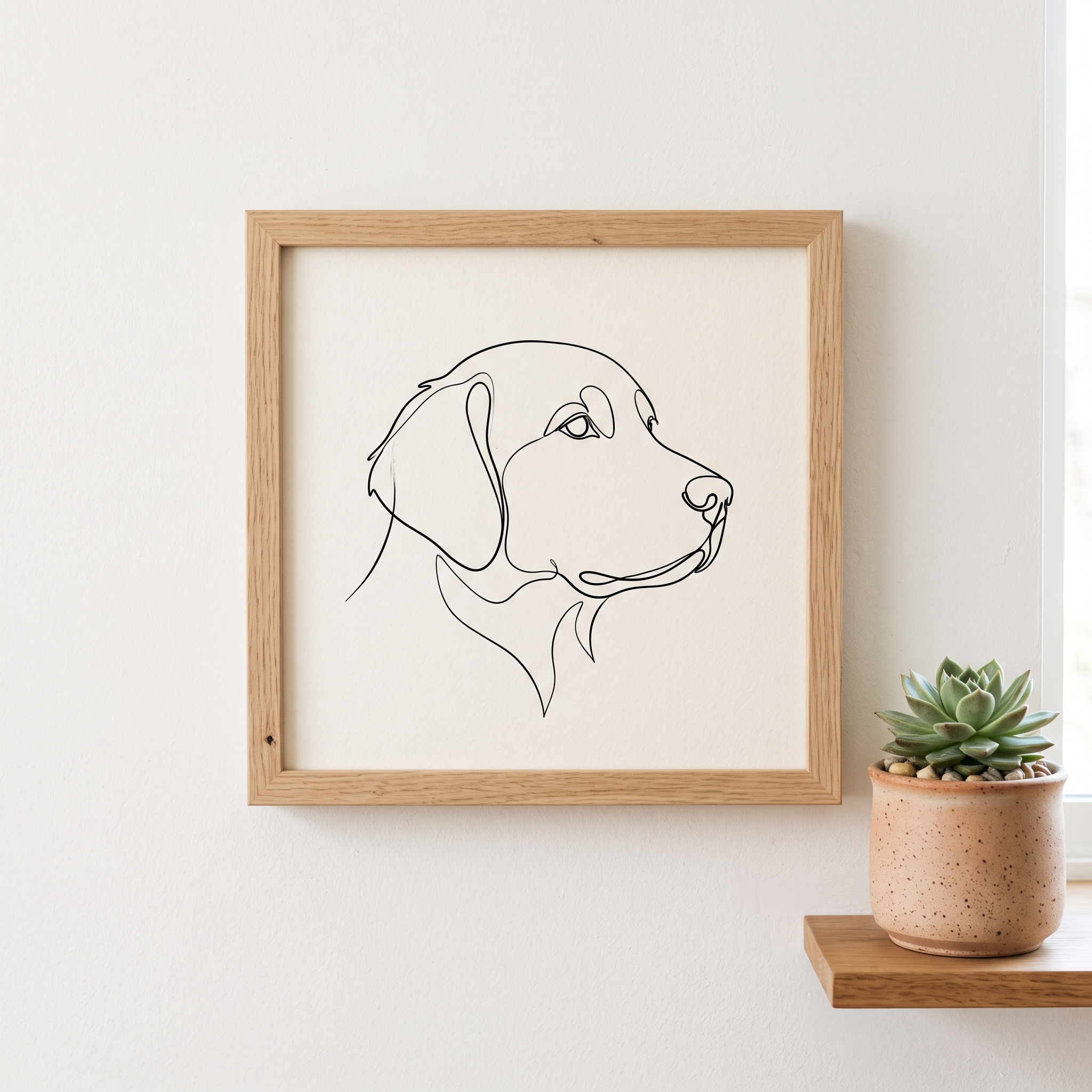
The illustrated portrait dressed in modern minimalism. One continuous line describing the animal’s face reads as gallery-modern and collected, and it is fast and cheap to produce at a high standard. It photographs beautifully close-up, which the data rewards. A clean, confident line beats a fussy one every time.
A minimalist single-line-art pet portrait. One continuous black line forming the head and shoulders of A SPECIFIC PET (a perky terrier, a lounging tabby cat), elegant and confident, lots of negative space, on a warm off-white background, no collar, no text. Modern fine-art style, high-resolution printable artwork, no product, no frame, no mockup. Just the line drawing, isolated.
3. Bold pop-art pet portrait (colorful, giftable, stands out in the grid)
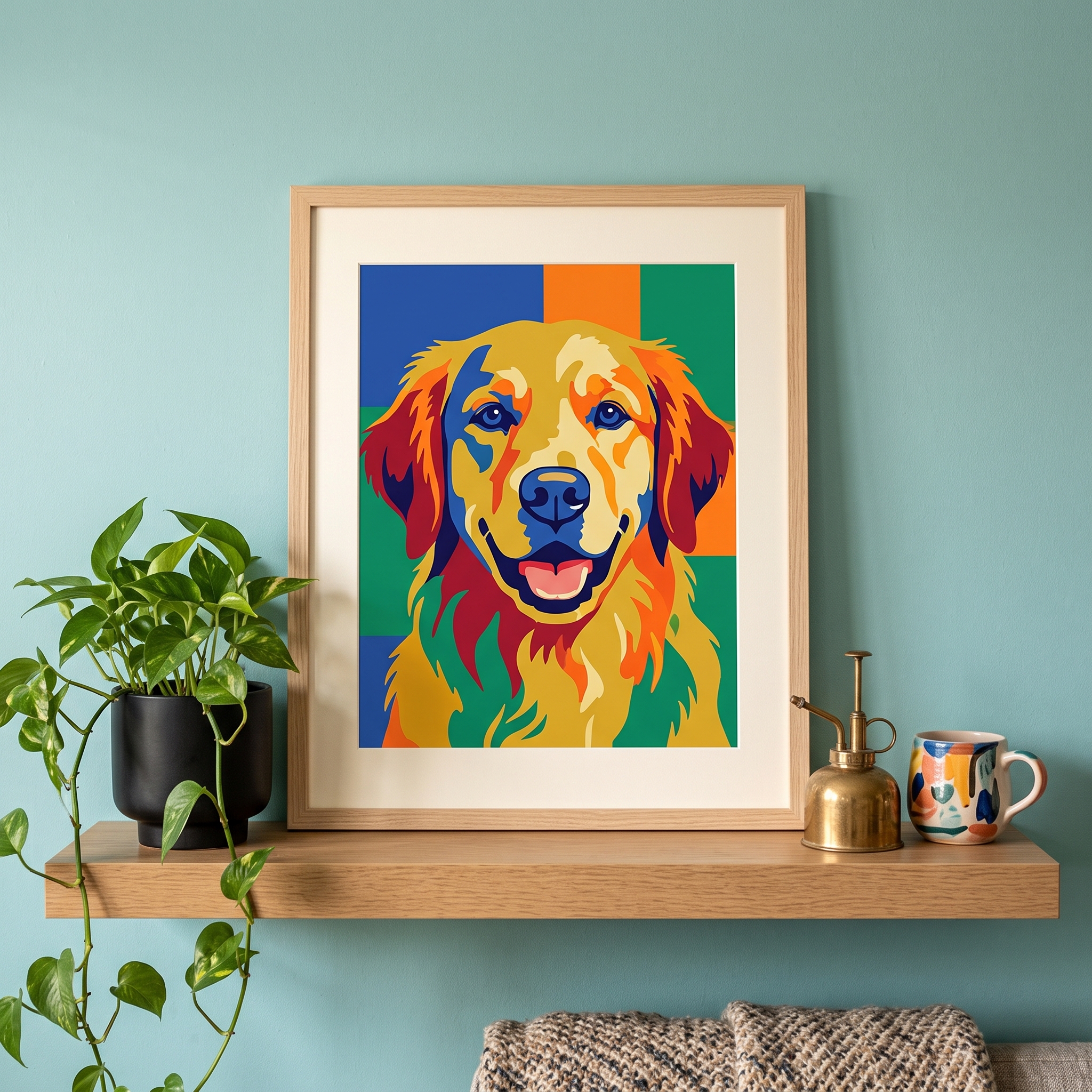
The portrait turned up loud. Flat, saturated color blocks and confident shapes pop at thumbnail size, which is where the grid is won. It reads as fun and giftable — the “made me smile” purchase — and it is the portrait style that survives being shrunk to 200 pixels. Great for buyers who want their pet as a statement piece.
A bold pop-art pet portrait. A SPECIFIC ANIMAL (a French bulldog, an orange cat) rendered in flat, saturated color blocks with confident graphic shapes and high contrast, a playful modern palette of two or three strong colors, no text, no logo. Screen-print / pop-art poster style, high-resolution printable artwork, no product, no frame, no mockup. Isolated artwork on a clean background.
4. Illustrated pet on a printed graphic (the bonus lane at 1.60x)
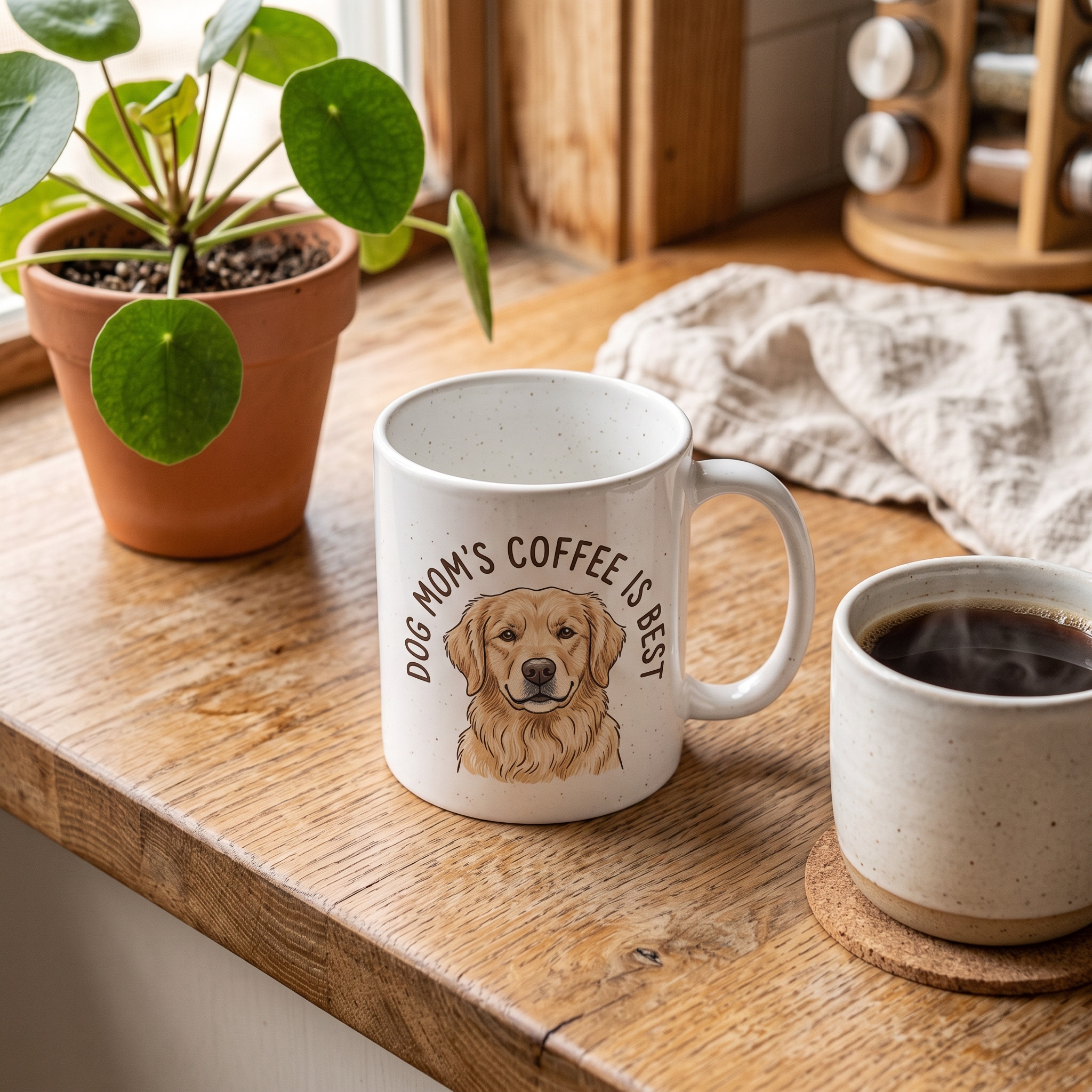
Not a wall portrait — the same illustrated pet, placed on a mug, a tee, a tote, or a sticker. Printed graphics over-index at 1.60x because they carry the winning ingredient (a drawn animal with character) onto a cheap, giftable product. A charming illustrated pet plus a small warm line of copy is a proven combination. Keep the illustration the hero and the text short.
A charming illustrated pet graphic for print-on-demand products. A cute, characterful cartoon-style drawing of A SPECIFIC PET (a smiling corgi, a grumpy black cat) with a simple, warm hand-lettered line beneath it (“YOUR SHORT PHRASE” — original, heartfelt, not a common slogan), a limited friendly palette, clean flat illustration. High-resolution printable artwork with a transparent background, no product, no mockup, no brand names.
5. Embroidered-style pet portrait (holds above par at 1.23x)
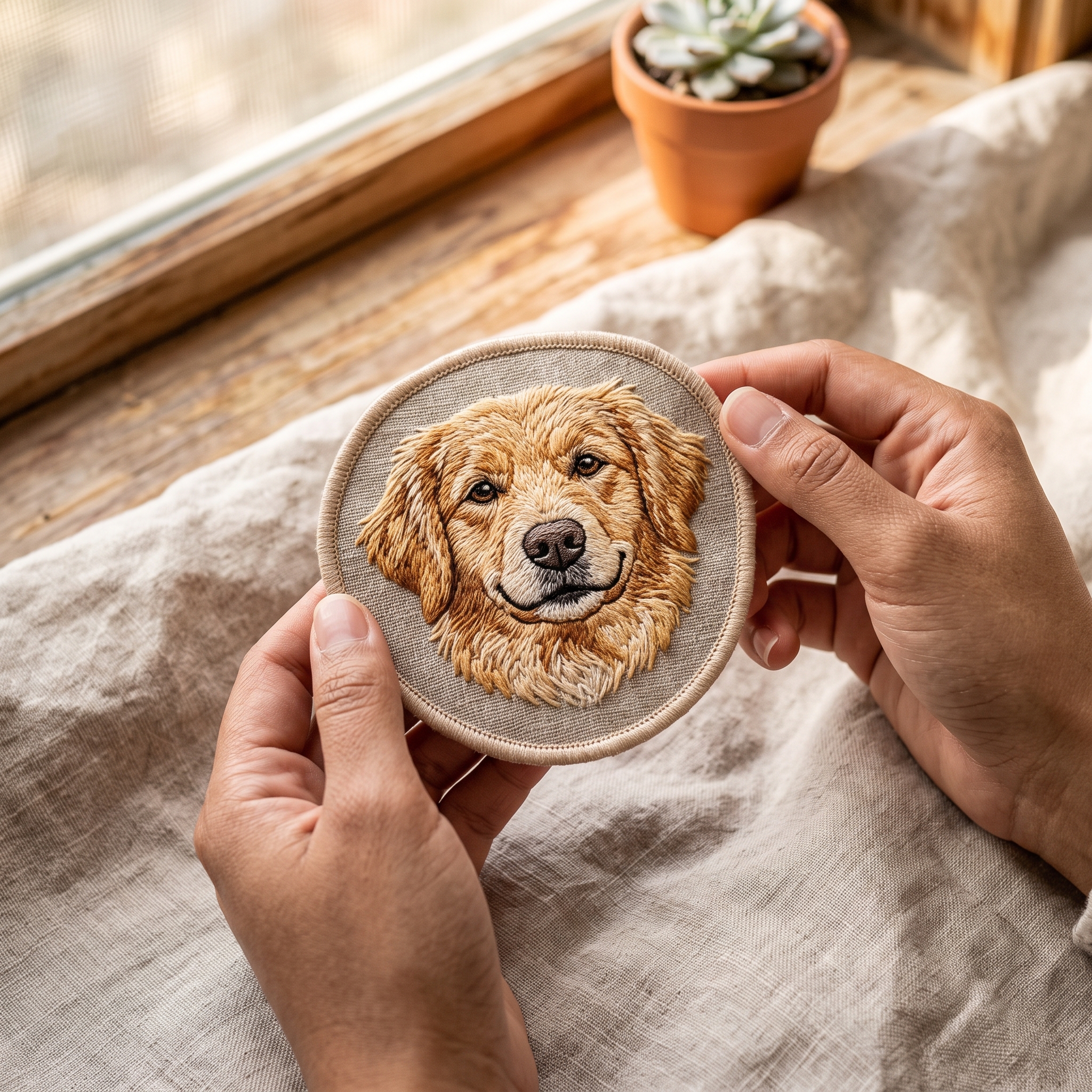
The stitched cousin of the portrait. Embroidery reads as craft and quality — a step up from a flat print — and it over-indexes, unlike almost every other “made” object here. It works as a patch, a hoop, or a sweatshirt motif. Keep the stitch count readable and the animal’s expression clear; detail gets lost in thread, so simplify.
A pet portrait designed as an embroidery pattern. A simplified, bold rendering of A SPECIFIC PET (a fluffy pomeranian, a sleepy beagle) with clear shapes suitable for satin-stitch and fill, a limited thread-color palette, strong readable features, no fine detail, no text. Embroidery-digitizing style artwork, high-resolution, isolated on a plain background, no product, no mockup.
After you generate any of these, shrink it to about 200 pixels wide and see if the animal still reads. Pet art lives or dies at thumbnail size in the search grid. If the face turns to mush, simplify: bolder shapes, higher contrast, more negative space. That thumbnail test is the difference between a portrait that pulls and one buyers scroll past.
💡 Pro tip — build one style you own. Buyers can print a photo themselves; what they save is your rendering of it. Pick one repeatable illustration style — a soft watercolor wash, a single confident line — and run every pet through it, so your shop reads as a studio with a point of view, not a stock-print reseller.
The two traps that look busy but rarely sell
Two kinds of pet listing flood these searches. Because there are so many of them, they look like proof of demand. The favorite ratio says otherwise.
The name on a collar or tag. The custom-name lane is 37% of the shelf and under-indexes at 0.56x — a third of everything, delivering barely a fifth of the winners. The problem is structural: when the product is a name stamped on nylon, leather, or metal, every listing looks the same and buyers choose on price, shipping speed, and reviews, not on your design. There is nothing to design. And the mediums this lane lives on are the worst pullers in the study — leather at 0.14x and engraved metal at 0.27x. This is the “spell out the name” red ocean, and it is where most new pet sellers plant their flag by default.
The literal photo print. The temptation with pets is obvious: the buyer already has a cute photo, so just print it. But the photo print under-indexes at 0.25x — one of the weakest mediums on the board. A photo on a mug reads as something the buyer could have made at any drugstore kiosk. The illustration is what they cannot make themselves, and it is what they save. Turning the photo into art is the entire value you add.
None of this means these designs are worthless — they are crowded and undifferentiated. Supply is enormous, differentiation is near zero, and the next new listing gets ignored. Spend your energy on the illustrated portrait instead, in a style you can own.
💡 Pro tip — the medium is the tell. Leather (0.14x) and engraved metal (0.27x) are the two worst-pulling mediums in the whole study. If your idea only exists as a piece of hardware — a stamped tag, a nylon collar — there is nothing for a buyer to fall in love with. Move the same pet onto a drawn portrait and the pull flips.
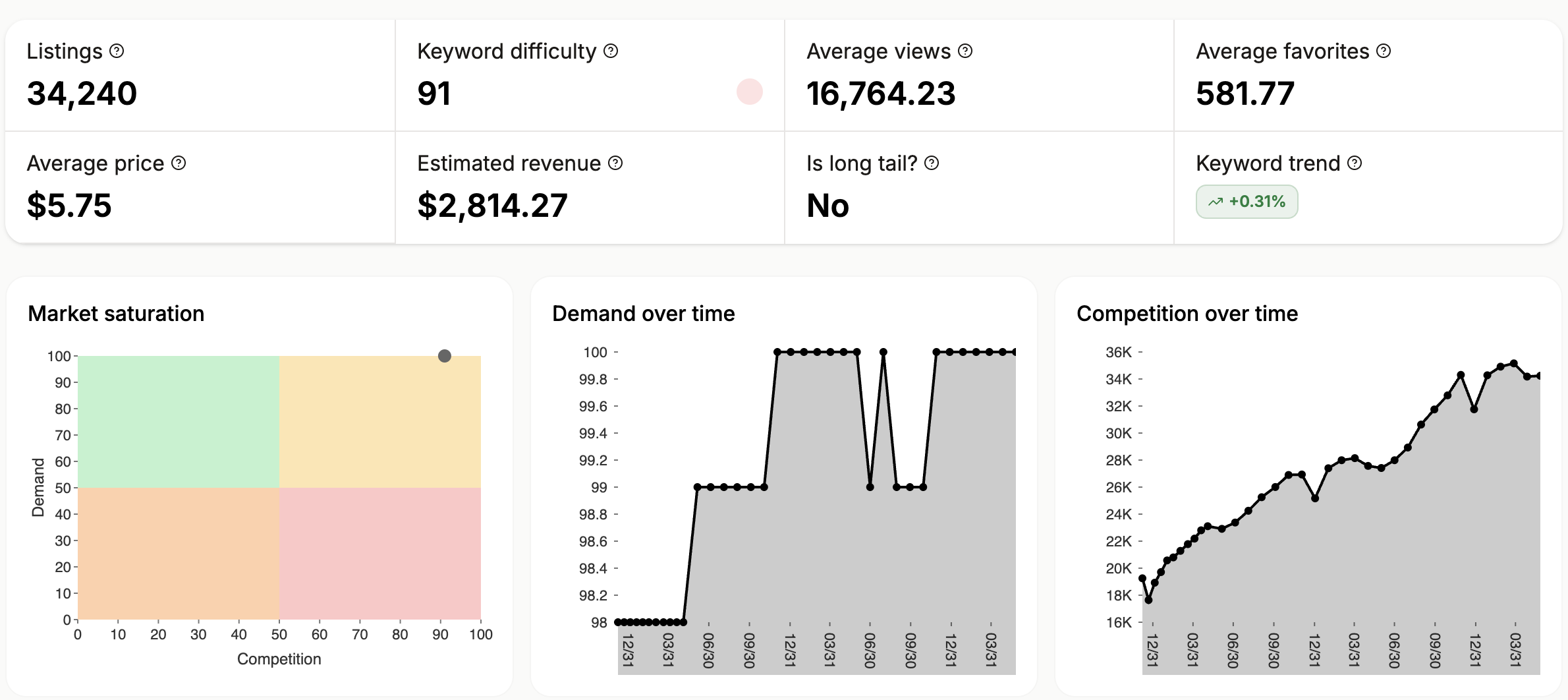
Want to see how crowded a pet angle is before you commit to it? That is what the free Keyword Explorer shows you: demand against competition for any phrase, so you can aim at a pocket that is not already a red ocean.
Your yardstick: is your design a winner?
Numbers only help if you can hold your own work up against them. So here is the scale for a pet listing that already ranks on Etsy.
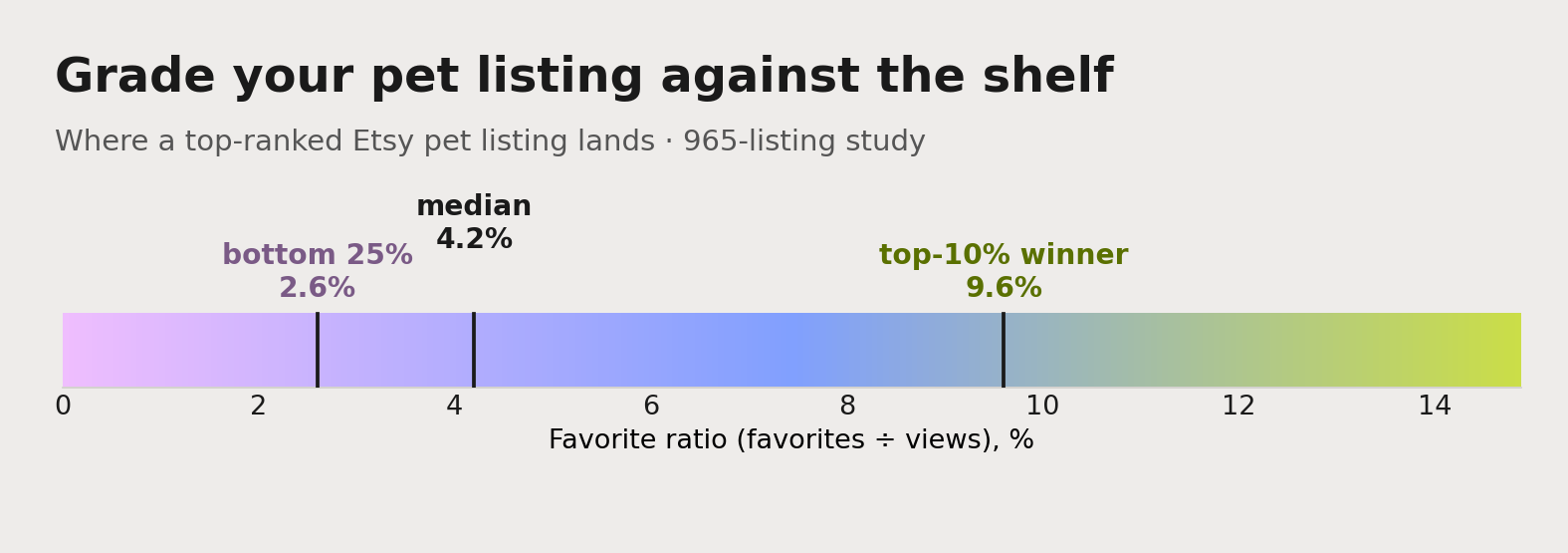
- Under 2.6%: the bottom quarter. People are seeing it and scrolling past. Rethink the design.
- Around 4.2%: dead average. Fine, not a winner.
- 6 to 9%: top third. A strong design.
- 9.6% and up: the top 10%. A genuine winner.
If you sell on Etsy, run this check on your own listings tonight. Open a listing’s stats, divide favorites by views, and see where it lands. A pet listing sitting under 4.2% is telling you something, and it is usually the design, not the traffic. A name-on-a-collar listing stuck at 2% is not a marketing problem — it is a “there is nothing here to fall in love with” problem.
💡 Pro tip — grade a listing tonight. Open one of your live pet listings, divide its favorites by its views, and drop the number on the scale above. Under 4.2% and it is the design talking, not the traffic — a name-on-a-collar stuck at 2% is a “nothing here to save” problem, not a marketing one.
Two rules a design has to survive first
Before a design can sell, it has to stay up. Two Etsy rules quietly end more print-on-demand shops than any trend miss.
It has to be your own. Etsy’s Creativity Standards require that items made with production tools — which is all print-on-demand — are based on your own original design. Buying a trending pet-portrait template or a stock illustration pack and printing it unchanged fails that test, and it is a common reason listings get deactivated. Our guide to Etsy’s rules for print-on-demand sellers walks through what “original” actually means in practice.
It cannot borrow someone else’s work. With pets this bites in a specific way: the buyer’s photo is not yours to reproduce as a photo print without permission, and feeding a copyrighted image or a recognizable brand into an AI tool is the fastest route to a takedown. The safe move — and the higher-pulling one — is your own illustrated interpretation of the animal, in a style you built. If copycats are a worry the other direction too, there is a hidden setting that helps protect your shop from copycats.
Neither rule blocks you from selling a watercolor dog portrait or a line-art cat. Plenty of shops do, beautifully. They block you from selling the exact one someone else already made. Original beats borrowed, and it is also the only version that lasts.
The mockup finding: show the art up close
Now the part that decides whether your winning design even gets seen.
Sellers agonize over how to present a pet item. On the animal? On white? In a flat-lay? I checked across the whole set, and the signal is blunt.
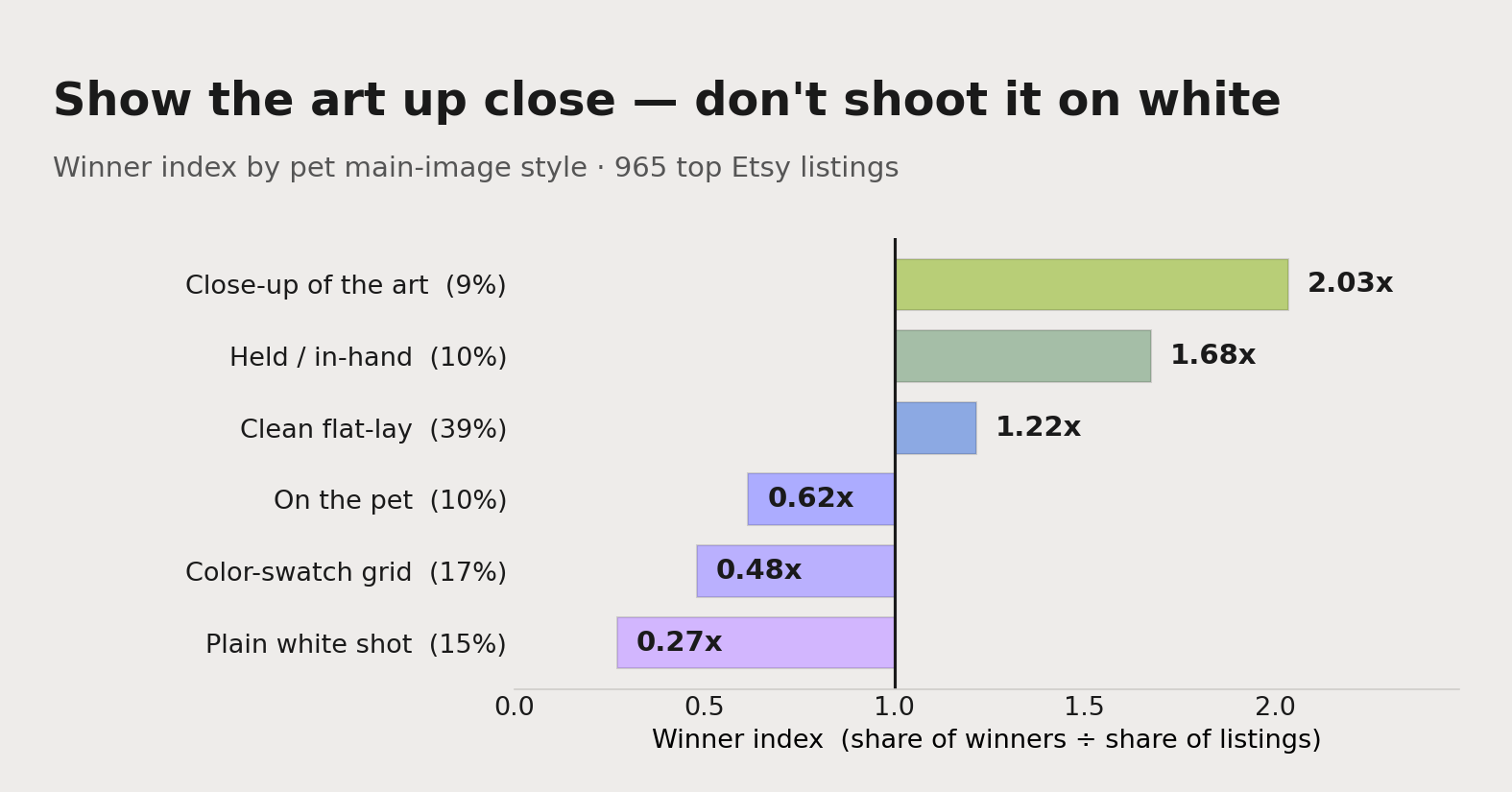
A close-up of the artwork over-indexes at 2.03x and a held / in-hand shot at 1.68x — both far above par. Buyers want to see the portrait’s detail, the brushwork, the expression. A clean flat-lay (1.22x) is fine.
The losers are exactly the formats that treat a pet item like generic inventory: the color-swatch grid (0.48x) and the plain white product shot (0.27x). And counter-intuitively, the on-the-pet shot under-performs (0.62x) — for a portrait, the product is not worn, so a photo of a dog wearing a collar hides the very thing being sold.
💡 Pro tip — lead with the brushwork. Make your thumbnail a tight close-up of the artwork itself, not a plain-white product shot — the close-up pulled 2.03x while plain white managed 0.27x. Let buyers read the expression and the texture straight from the search grid, before they ever click.
So the guidance is: lead with a close-up of the artwork itself, then a warm in-hand or styled shot. A few things that still move pet mockups:
- Do not ship the default Printify or Printful stock mockup. Everyone uses them, so your listing blends into a wall of identical mugs and framed rectangles. A close, warm, real-feeling shot of the art is worth the small effort. Here is what we learned about better listing images with mockups.
- Use your ten slots to sell the keepsake. A close-up hero for the thumbnail, then the piece styled in a real room, a size/scale reference, a “how it works — send your photo” graphic, and one warm lifestyle shot with the actual pet nearby. The full sequence is in our guide to listing image types that drive sales.
- Match the real product. If you sell a digital portrait file, do not lead with a lavishly framed print you do not ship. Etsy requires the thumbnail to represent what the buyer receives.
- Add a simple video. A ten-second pan across the portrait detail earns impression priority with no on-camera work.
- Disclose it. When an image is a mockup or the art is AI-assisted, say so — both for Etsy’s standards and for buyer trust. Here is how and why to disclose mockups and AI images.
Free download: the Etsy SEO Checklist
A winning portrait still has to be found. This one-page checklist walks the titles, tags, and attributes that get pet listings ranking, so the design you just made actually gets seen.
Grab the free Etsy SEO Checklist →
New shops break in — with a genuinely good portrait
If all of this sounds like the top of Etsy is locked up by big shops with ad budgets, pets are the happiest counter-example in the study. This is the most open category in the recent batch.
I flagged a listing as “rising” when it was new, pulling a high favorite ratio, from a small or mid-size shop. Those rising listings were about 7.6% of the whole top set — more than baby onesies (3.9%) or hats (5.5%).
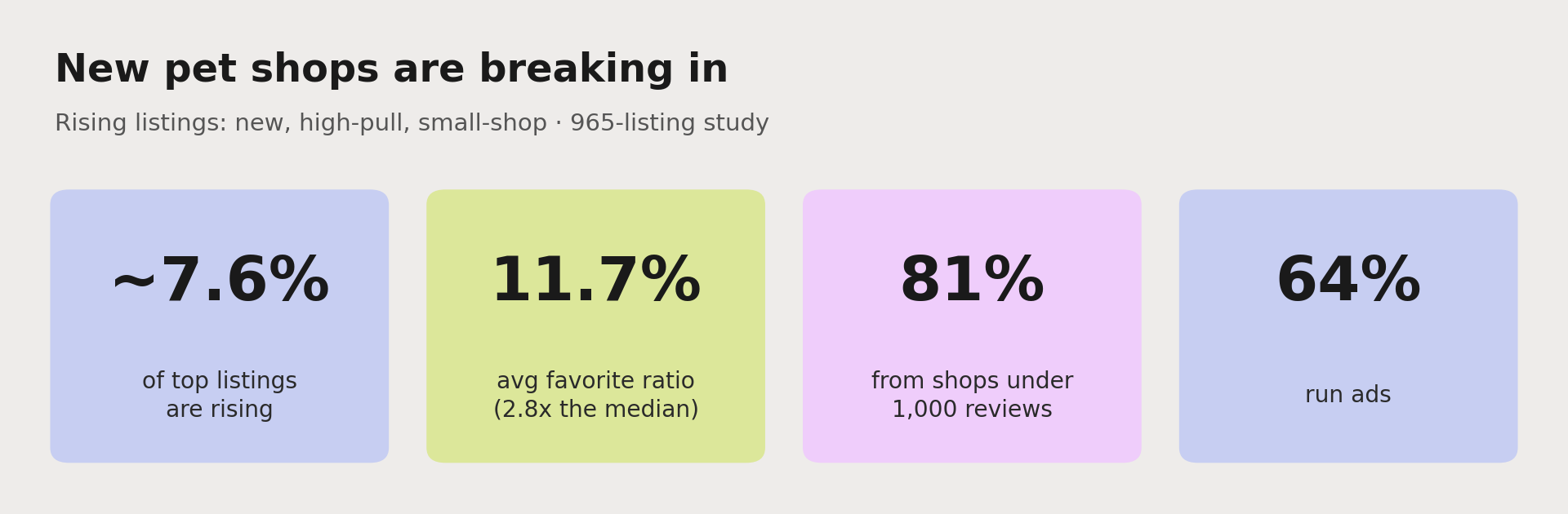
The rising listings averaged an 11.7% favorite ratio, about 2.8 times the overall median and well past the winner line. 81% came from shops with fewer than 1,000 reviews. And 64% ran ads — a reminder that on pets, a great portrait plus a small ad budget is often how a new shop lands its first views.
Notice what is not here: these are not new leather-collar or metal-tag shops breaking in. The rising designs win with the exact playbook above — a watercolor portrait, a line-art face, an illustrated pet on a mug — from a small shop, shown up close. That could be your shop. The art is the lever, and it is a lever you fully control.
Every pet niche plays differently
“Pet products” is not one market. Each search term pulls a different buyer and a different mix of designs — and the split between the portrait terms and the accessory terms is the whole thesis in miniature. I pulled the full ranked results for three of the biggest pet searches and matched each back to the coded study set. Here is how they compare, ranked by median favorite ratio.
| Search term | Listings (ranked set) | Median favorite ratio | Winner line (top 10%) | What dominates | Rising | Ads |
|---|---|---|---|---|---|---|
| custom pet portrait | 74 | 6.6% | 10.6% | Custom portrait 97% | 18% | 68% |
| custom dog bandana | 75 | 4.9% | 9.1% | Custom name 51%, pattern print 20%, portrait 17% | 9% | 63% |
| dog collar | 103 | 3.2% | 6.0% | Custom name 71%, pattern print 14%, floral 10% | 1% | 55% |
Read the table top to bottom and you can watch the thesis play out. The custom pet portrait term is almost pure illustrated portrait (97%), sits highest on median favorite ratio (6.6%, well above the 4.2% overall), and has the most new shops breaking in (18% rising). The dog collar term is the opposite pole: 71% names on hardware, the lowest median (3.2%), and almost no new shops rising (1%).
The custom dog bandana term sits in between, a genuine mix. The searches where a portrait is the product are the open, higher-pulling, most-winnable lanes. The searches where a name on an accessory is the product are the crowded, low-pulling grind. Point your listings and your SEO at the portrait terms.
Where to start this week
If you came in thinking the pet business is a name on a collar, I hope this traded that assumption for a map. You do not need to guess. You need to make one genuinely good illustrated portrait, show it up close, and check whether people actually save it.
Here is the whole post as five steps:
- Make an illustrated pet portrait, not a name on a collar and not a photo print. Watercolor, single-line, or bold pop-art — pick a style you can own.
- Turn the animal into art. The illustration is the value; a photograph is not.
- Run the thumbnail test: if the face does not read at 200 pixels wide, simplify.
- Lead with a close-up of the artwork, then a warm in-hand or styled shot. Skip the plain-white product photo and the swatch grid.
- List it, then read its favorite ratio. Under 4.2% and buyers are scrolling past. Above 9.6% and you have a winner.
Most sellers never reach that last step. They make a design, cross their fingers, and move on. But that number is the whole game. Make something, check its favorite ratio a couple of weeks later, keep the ones that pull, and let the rest go. Do that enough times and the guessing quietly stops. One day you might even be the shop someone else is pulling apart in a post like this one.
Keep reading on Listadum. New to print-on-demand? Start with selling on Etsy without inventory. Ready to run the print-on-demand niche properly? See our guide to Etsy’s rules for print-on-demand sellers.
The rest of the series
This is one spoke in Listadum’s print-on-demand teardown — every big POD product on Etsy, ranked by favorite ratio, so you can see what sells and what is not worth your time.
- The pillar: The Complete Guide to Niche Etsy Strategies — how to pick a niche and a product worth your time.
- The apparel siblings, already live: What T-Shirt Designs Actually Sell on Etsy and What Sweatshirt Designs Actually Sell on Etsy.
- More product teardowns in the series: wall art, baby onesies, hats, tote bags, and stickers.
Frequently asked questions
What pet products sell best on Etsy?
Illustrated pet portraits, not name-on-a-tag accessories. In my study of 1,097 top listings, the custom illustrated portrait was 43% of the shelf but took nearly 70% of the winners (a 1.63x winner index), and the illustrated medium over-indexed at 2.03x. The custom-name lane — names printed on collars, engraved metal tags, and bandanas — was 37% of the shelf but under-indexed at 0.56x, and leather (0.14x) and engraved metal (0.27x) were the two worst-pulling mediums in the entire study.
Do personalized pet products sell on Etsy?
Yes, but only one kind. A designed, illustrated portrait of a specific pet is the single best-pulling design in the category. A name stamped on a collar or a metal tag is also “personalized,” but it under-pulls badly because there is no design to fall in love with — buyers choose those on price and shipping, not on your work. The rule is design-beats-name: sell an artist’s portrait of the dog, not the dog’s name on hardware.
Why don’t custom pet name collars and tags sell as well?
Because they are crowded and undifferentiated. The custom-name lane is 37% of the shelf, so buyers have endless near-identical options and shop on price, reviews, and shipping speed rather than your design. The mediums it lives on — leather and engraved metal — pull the worst of any medium in the study (0.14x and 0.27x). When a name is the only variable, there is nothing for a buyer to save.
What is a good favorite ratio for a pet listing?
The median top-ranked pet listing sits at a 4.2% favorite ratio (favorites divided by views) — healthier than baby onesies or hats. The bottom quarter is under 2.6%, and a genuine top-10% winner reaches 9.6% or higher. Check your own listing by dividing its favorites by its views.
Should I use a photo or an illustration for a custom pet portrait?
An illustration, decisively. The literal photo print under-indexed at 0.25x — one of the weakest mediums on the board — while the illustrated portrait over-indexed at 2.03x and took half of all winners. Buyers save the artist’s rendering of their pet, not a photograph they could have printed themselves. Turning the photo into art is the value you add.
How should I photograph a pet product for Etsy?
Lead with a close-up of the artwork. A close-up shot over-indexed at 2.03x and a held/in-hand shot at 1.68x, while a plain white product photo pulled just 0.27x and a color-swatch grid 0.48x. Even the on-the-pet shot under-performed (0.62x), because for a portrait the product is not worn. Show the art’s detail first.
Are print-on-demand pet products still worth selling on Etsy in 2026?
Yes — pets are the most open category in this batch of the study. Only 60% of listings run ads (the lowest recent ad load), the median price is about $14.95, and 7.6% of top listings are rising new shops, more than any comparable product. The differentiator is an original illustrated portrait in a style you own, shown up close.
Stop guessing which of your designs is pulling and which is dead weight.
Listadum reads every listing in your shop and flags the ones losing you sales: weak images, no video, thin titles, low engagement. You get a clear, prioritized list of what to fix first, in plain English.
Free plan · no credit card · connect your real Etsy shop in minutes
About the author
Neha Chandelier, Co-founder of Listadum, selling on Etsy since 2020. She writes about Etsy tips and tricks, how to sell on Etsy, and growing a handmade shop.
Last updated August 13, 2026.
Sources: Listadum Keyword Explorer (demand data, pulled July 2026); Listadum study of 1,097 top-ranked Etsy pet-product listings ranked by favorite ratio; Etsy Creativity Standards.