By Neha Chandelier, co-founder of Listadum · Last updated August 13, 2026
Every December, the same box comes down from the attic. Inside, a few ornaments get handled like they are made of glass — the lumpy clay star a kid pressed by hand, the little felt fox from a trip, the carved wooden bird that belonged to somebody’s grandmother. The shiny printed baubles? They go on the back of the tree, if they go up at all.
That instinct — the one that keeps the handmade thing and quietly forgets the printed one — turns out to be exactly what happens on Etsy, too.
I ranked 523 top ornament listings by whether real people actually save them, and the split was blunt. The ornaments that got made the most were flat printed discs: a photo on a ceramic circle, a name in a script font on an aluminum round. They fill the entire search page. They also pull the worst.
The ornaments that quietly ran away with it were the ones with dimension and a made-by-hand feel — 3D and figural, embroidered and felt, stamped clay, engraved wood, hand-illustrated.
This is the twentieth teardown in an ongoing series where Listadum ranks the biggest print-on-demand products on Etsy by favorite ratio — the one number that separates what genuinely sells from what just fills a search page.
Ornaments turned out to be one of the cleanest splits in the whole series: one giant flat-printed lane that looks like the entire market and pulls below average, and a cluster of smaller handmade-looking lanes that pull almost twice as hard.
I captured the top listings for the biggest ornament searches on Etsy, deduplicated them down to 523 unique designs, and ranked every one by that single number. Then I hand-coded all of them by theme, construction, and presentation so I could see the pattern underneath.
This is the long version: the full ranking, the design types that win with a ready-to-use prompt to make each one, the two flat-printed traps, the benchmark to grade your own ornament, and the presentation finding that will save you a lot of second-guessing. Grab a coffee.
The one number that tells you if a design sells
A listing’s view count tells you almost nothing on its own — ads and age both inflate it. Favorites are the honest signal of wanting, but Etsy keeps both numbers off the search cards.
The free Listadum browser extension paints views and favorites straight onto every card as you scroll an ornament search, so you can read real demand at a glance instead of guessing from where a listing happens to land in the grid. That little overlay is the piece that made this whole study possible.
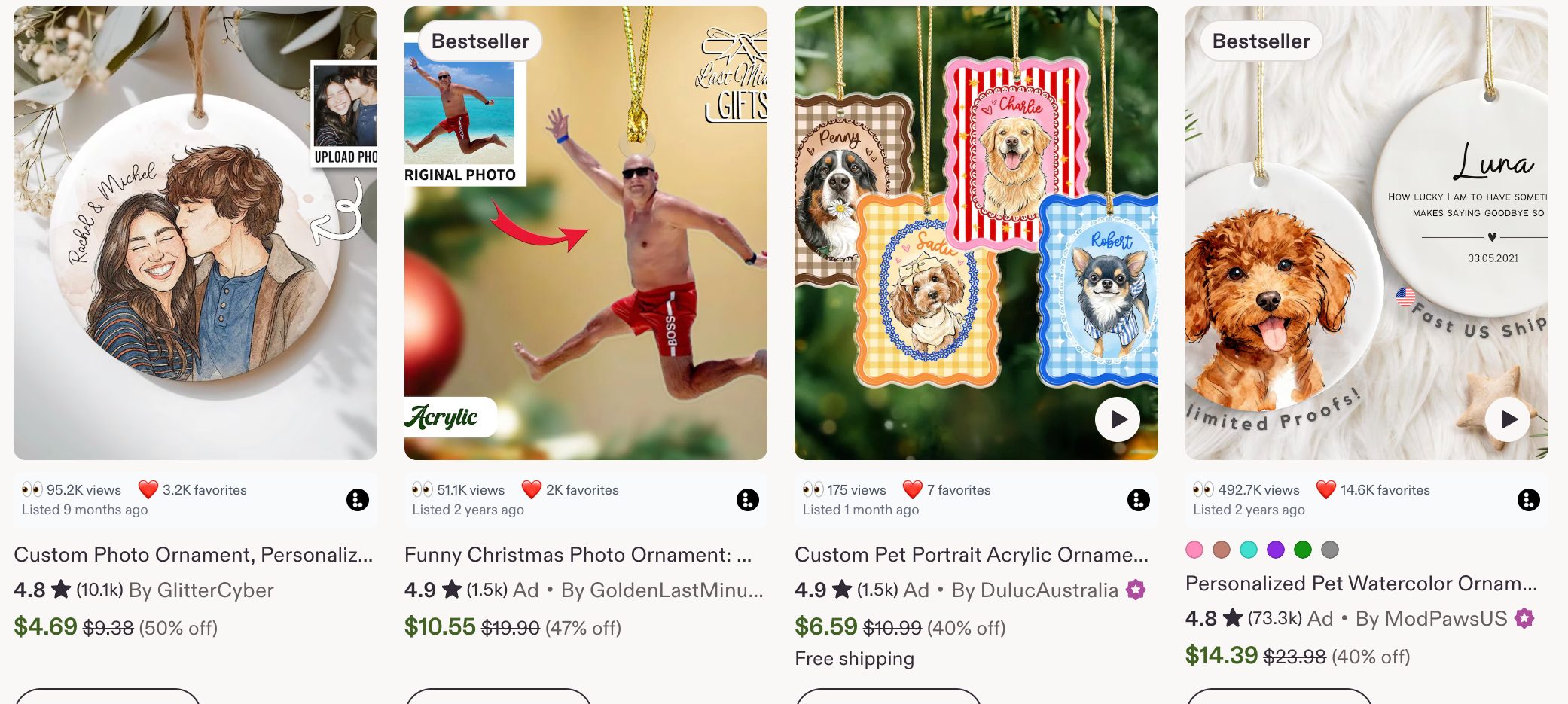
What the Listadum extension adds to a normal Etsy search — the views and favorites count on every card. Those two numbers are what this whole method runs on.
Divide one by the other and you get something useful:
Favorite ratio = favorites / views.
Inside Listadum we call this your favorite ratio, and it is the number I trust most when I judge a design. Of the people who saw this ornament, what share liked it enough to save it. That single ratio strips out the noise.
A brand-new listing from a tiny shop and a three-year-old listing from a shop with 20,000 sales can finally be compared fairly, because the favorite ratio cancels out ad spend, age, and shop size. It measures the design’s pulling power and nothing else — and pulling power is the part you actually control when you sit down to make a new ornament.
When I re-ranked all 523 listings by favorite ratio, the order scrambled hard. Ornaments Etsy had buried out-pulled ornaments sitting in the top row. Etsy’s default sort tells you what Etsy is promoting. The favorite ratio tells you what buyers love. Those are not the same list.
One thing to know going in: ornaments are a crowded, seasonal, ad-heavy market. The median favorite ratio here is 4.2%, and a genuine top-10% winner reaches 9.1%. More than two thirds of ranked listings (69%) run ads, and the median price is a gift-friendly $14.00.
Cheap to make, fierce to sell, and dominated by one lane that most sellers pile into by default. Which is exactly why picking the right kind of ornament, instead of the obvious one, matters more here than almost anywhere.
Handmade wins — and the flat printed disc that floods the shelf loses
Here is the headline finding, and it is a clean split by how the ornament is made.
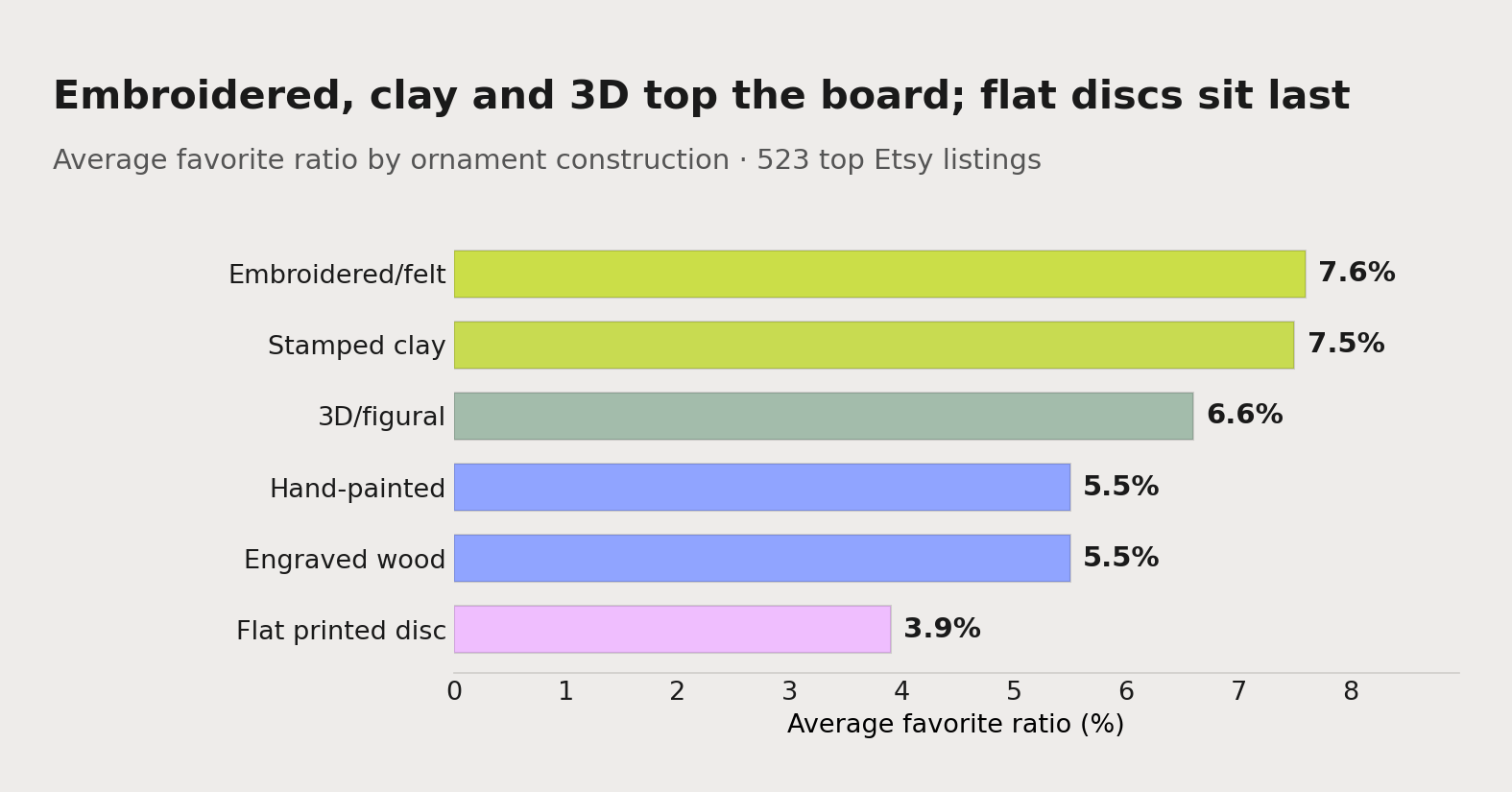
Group the handmade, dimensional makes together — 3D and figural, embroidered and felt, stamped clay, engraved wood, hand-painted — and they are 39% of the shelf but pull a 6.4% average favorite ratio and produce 77% of all the winners. That is the winning majority of the market hiding in the smaller lanes.
Now the lane that looks like the whole category. Flat printed discs are 60% of every listing I studied — a photo, a name, or a graphic printed on a ceramic, wood, or aluminum round — and they pull just 3.9% average, below the median, delivering only 21% of the winners despite being nearly two-thirds of the shelf. The single most-made kind of ornament is also the worst-pulling one.
The plain-English version: an ornament is not really a picture — it is an object someone hangs where they will see it every year. A dimensional 3D charm, a hand-stitched felt animal, a little pressed-clay star reads as a keepsake somebody chose. A photo or a name run onto a flat glossy disc reads as a template anyone could order in thirty seconds. Give it dimension and a handmade feel, even in the artwork, and it stops looking like a template.
That is the big picture. Now let me show you the whole board, not just the top of it.
The full ranking: winners, runners-up, and what to skip
No construction is a simple win or lose. There are tiers, and the runners-up matter as much as the champions, because they are less crowded and still pull well. Here is where each make landed, sized by how much of the shelf it occupies and colored by how hard it pulls. The overall median is 4.2%.
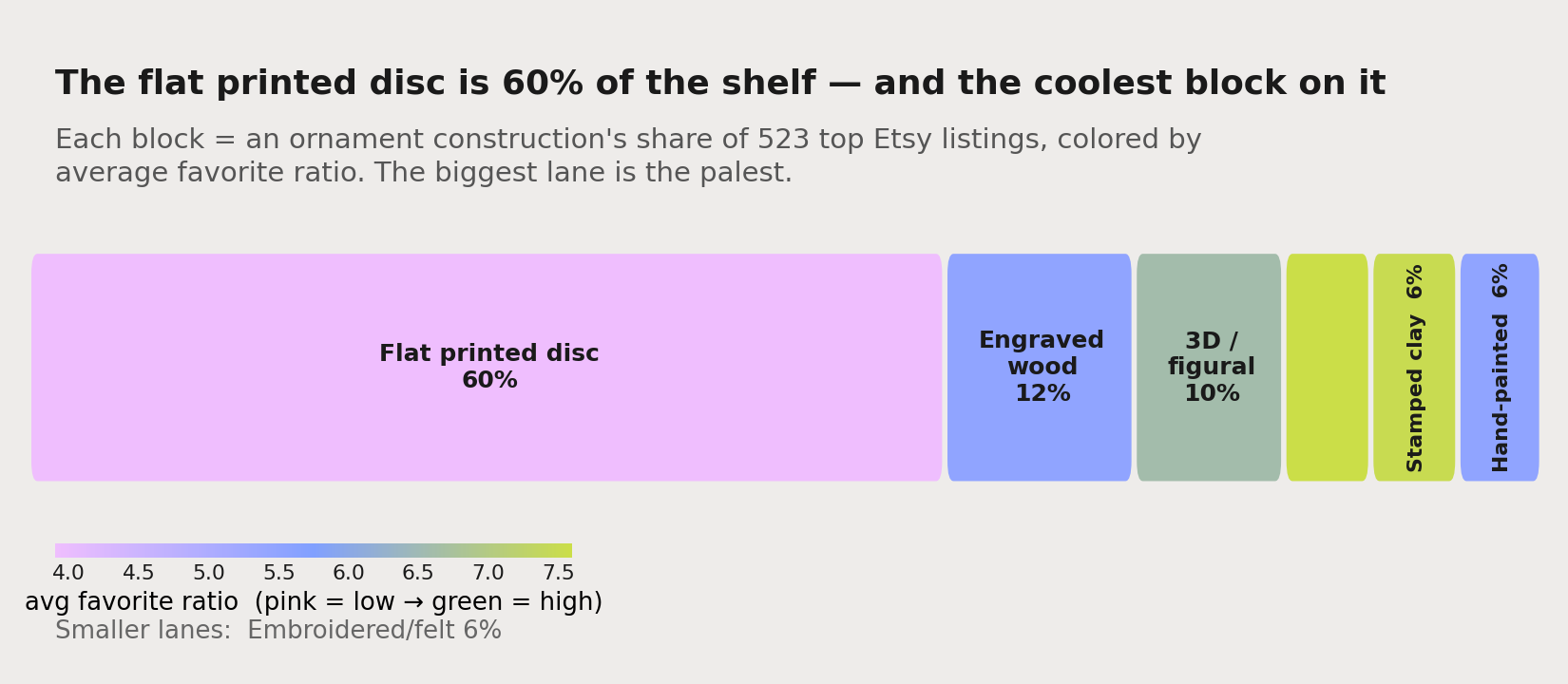
The strip makes the mismatch obvious: the biggest block by far — the flat printed disc — is the cool-colored, low-pulling one, and the hottest colors sit in the smallest blocks. Now the same makes ranked purely by pull, so you can read the tiers top to bottom:
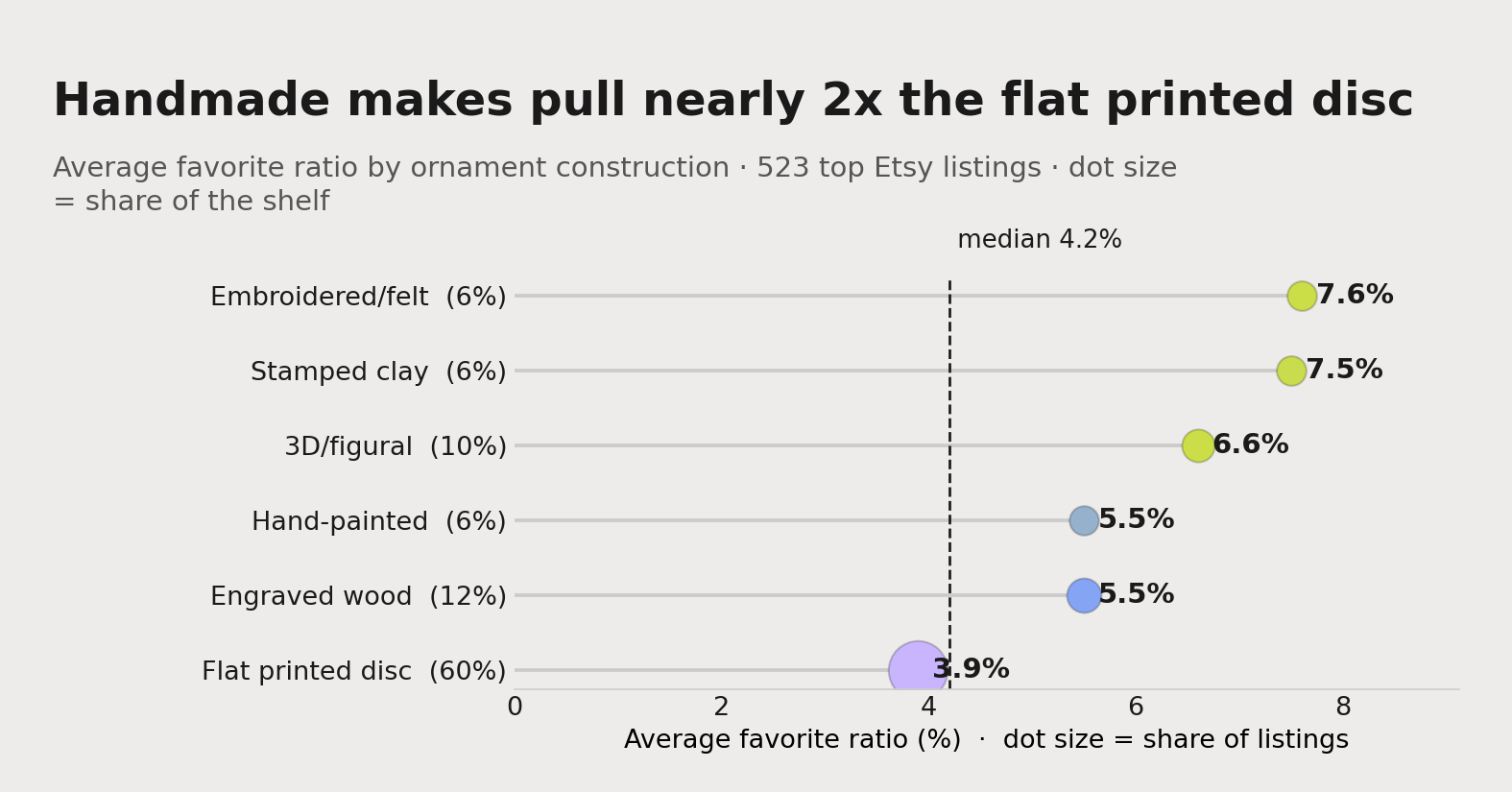
The top pullers (7% and up). Embroidered and felt (7.6%) and stamped clay (7.5%) are the two highest-pulling makes in the study, and together they are barely a tenth of the shelf. High demand, almost no supply — the best combination on Etsy.
The strong runner-up (6 to 7%). 3D and figural (6.6%). The most-supplied of the handmade lanes and still a strong puller — a dimensional charm, a shaped resin or acrylic piece, a little sculpted scene. This is the tier that scales.
The mid-pack (5 to 6%). Hand-painted (5.5%) and engraved wood (5.5%). Both comfortably above the median, both handmade-looking, both less crowded than the printed lane. Engraved wood in particular is the accessible entry point — plenty of print-on-demand suppliers offer real wood blanks.
The weak floor (below median). The flat printed disc (3.9%), dead last, and 60% of the entire board. Enormous supply, generic output, bottom-of-the-board pull — the worst possible combination. More on that trap below.
Two things jump out when you read it this way. First, the gap between the top puller and the printed floor is nearly 2x. Second, the winners are not exotic. They are ornaments that look made, from lanes almost nobody is crowding into.
Here is how much each make over- or under-delivers relative to the shelf space it takes up — its share of the top-10% winners divided by its share of listings. Embroidered and felt punches 3.0x its weight, 3D and figural 2.6x, stamped clay 2.4x, and hand-painted 1.4x. Engraved wood runs 1.1x.
Then the flat printed disc collapses to a brutal 0.35x — it produces barely a third of the winners its shelf space would predict. That ratio is the real map of where the open lanes are.
It is worth reading the theme layer too, because a couple of design subjects pull hard regardless of make. Sorted by favorite ratio: novelty and food-shaped ornaments lead at 10.2% (a tiny lane, only seven listings, so treat it as a hint not a law), then floral at 7.7%, animal at 7.4%, and pet at 5.3%.
The bottom of the theme board is exactly what you’d expect from the make finding: flat photo ornaments pull just 3.9%, the weakest meaningful theme, and printed name ornaments barely beat them. Illustrated animals and florals together — 8% of the shelf — average 7.5%. Draw the subject; don’t photograph it.
The winning design types (with a prompt to make each)
This is the part I wish someone had handed me three Decembers ago. For each winning type: what the data says, why it works, and a Gemini prompt you can use to generate your own original version.
One honest bridge first, because it changes how you read these prompts. Most print-on-demand suppliers can only make printed ornaments — art printed onto a ceramic, wood, aluminum, or acrylic blank. You cannot literally hand-stitch felt through Printify. But you do not have to.
The finding is that buyers reward the look of something made — dimension, texture, illustration, character. So every prompt below is written to output printable ornament artwork that mimics a winning handmade look: faux-embroidery, a stamped-clay texture, a carved-wood line, an illustrated 3D character. That is the move — a printed ornament that does not look like a flat printed ornament.
Two rules before you generate anything, because they decide whether your shop survives. Keep it original, since Etsy requires print-on-demand art to be your own. And never prompt for a real brand, character, logo, or copyrighted image. Every prompt below is written to stay clear of that. Swap the CAPS placeholder for your niche so the output is yours, not a generic AI print a hundred other sellers can also make.
1. Embroidered & felt look (the single highest pull at 7.6%)
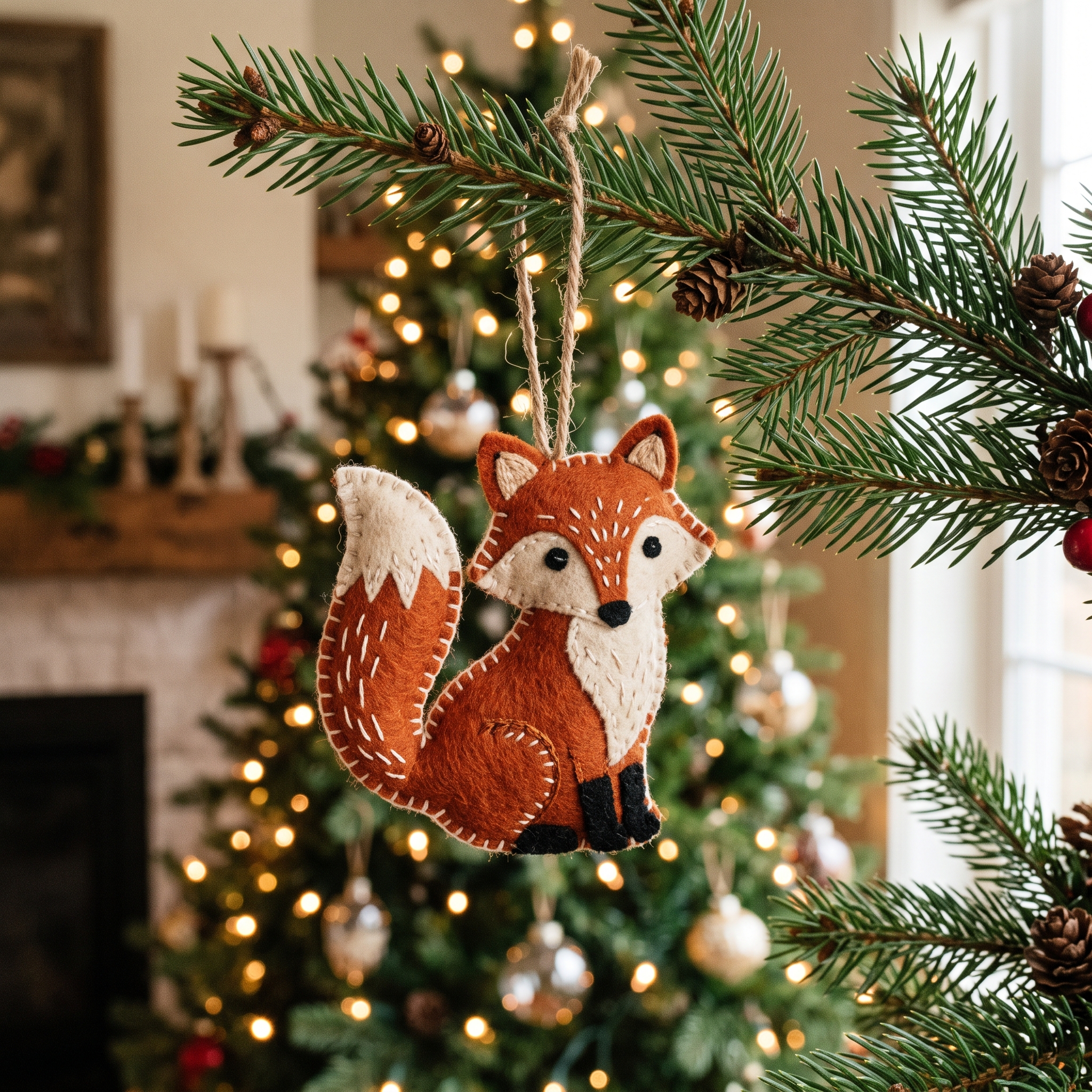
The highest-pulling make in the whole study, and one of the smallest slices of the shelf. Buyers reward the tactile, handmade warmth of stitch and felt over anything glossy. You can evoke it in printed artwork: soft felt textures, visible thread, a slightly imperfect hand-stitched edge.
A charming ornament design that looks like hand-stitched felt embroidery. A CUTE SUBJECT (a little fox, a robin, a gingerbread house) rendered in layered felt shapes with visible embroidery stitches, French knots, and a blanket-stitch border, soft muted holiday palette, cozy handmade texture. High-resolution printable ornament artwork, isolated on a transparent background, no product, no ornament blank, no string, no mockup, no text.
2. Stamped clay & ceramic look (7.5%, punches 2.4x its weight)
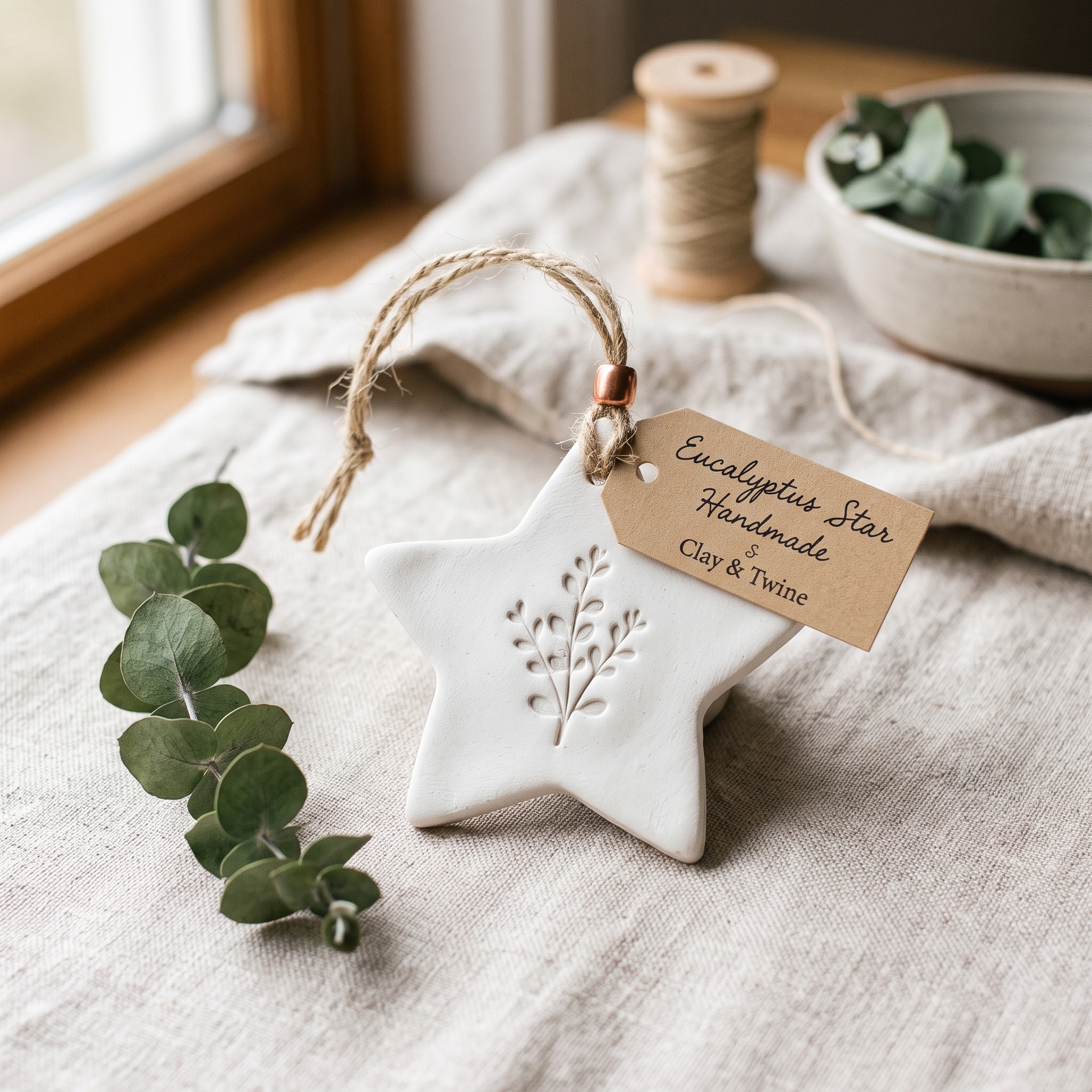
Nearly the top puller, and it reads as quiet, modern, and expensive. The signature is the pressed impression — a botanical sprig, initials, a tiny scene stamped into matte clay. In printed form, aim for that soft off-white, hand-pressed, low-relief look.
An ornament design that looks like hand-stamped white air-dry clay. A single MOTIF (a pressed eucalyptus sprig, a tiny reindeer, a simple star) imprinted in low relief into matte off-white clay, soft natural shadows in the impression, subtle uneven handmade edge, minimal and elegant. High-resolution printable ornament artwork, isolated on a transparent background, no string, no packaging, no mockup, no brand, no text.
3. 3D & figural look (6.6%, the lane that scales)
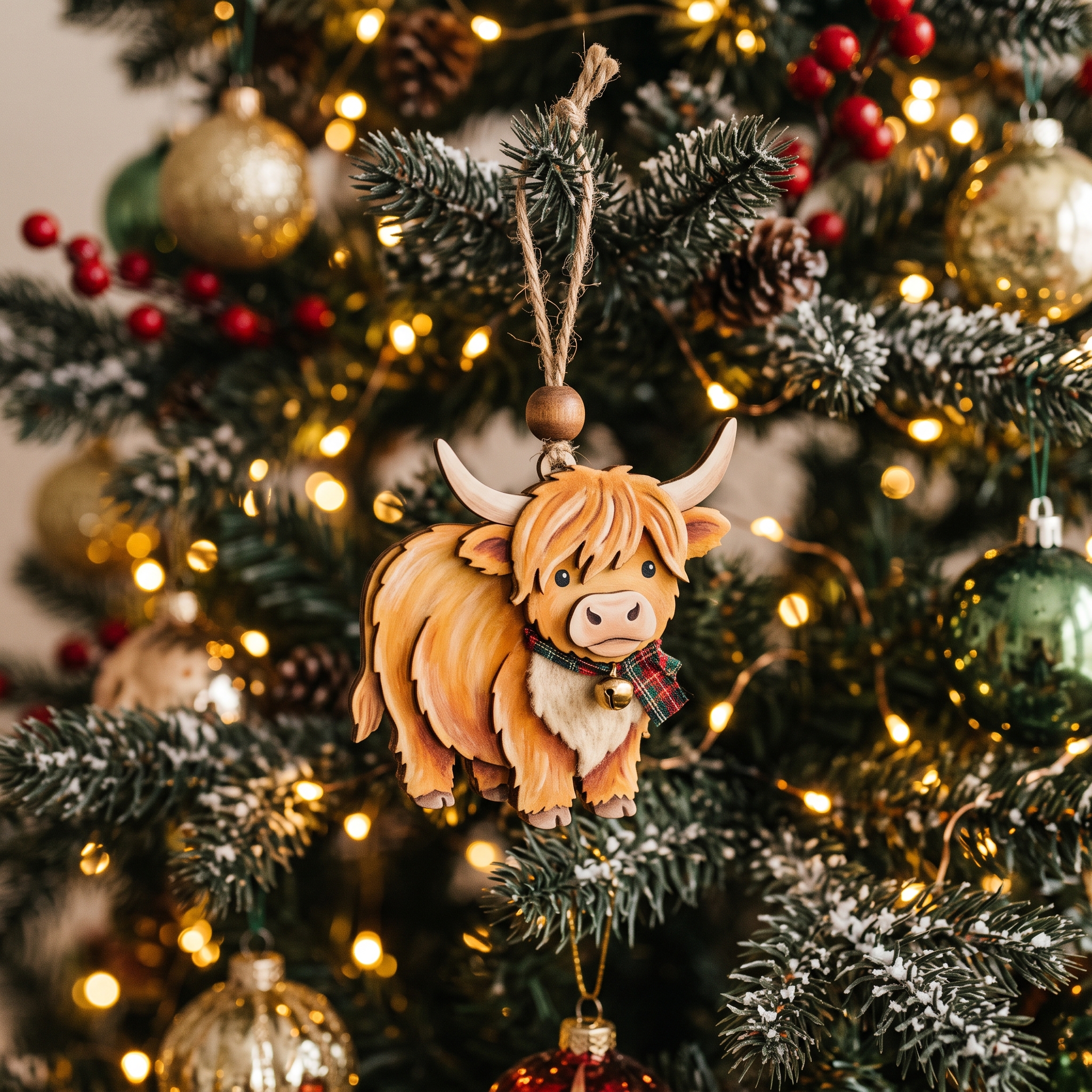
The most-supplied of the handmade lanes and still a strong puller — which means there is real, proven demand you can meet at scale. The trick is character and depth: a shaped subject with soft, rounded shading that reads as an object, not a sticker.
A cute dimensional character ornament design with a soft 3D, sculpted look. A ROUNDED CHARACTER (a plump highland cow, a chubby snowman, a curled-up sleeping cat) with gentle volumetric shading, soft rim light, and a die-cut shaped silhouette so it reads as a little object, warm cozy palette. High-resolution printable ornament artwork, isolated on a transparent background, no string, no hook, no mockup, no text, no real brand.
4. Illustrated animal & floral (the printable winner at 7.5%)
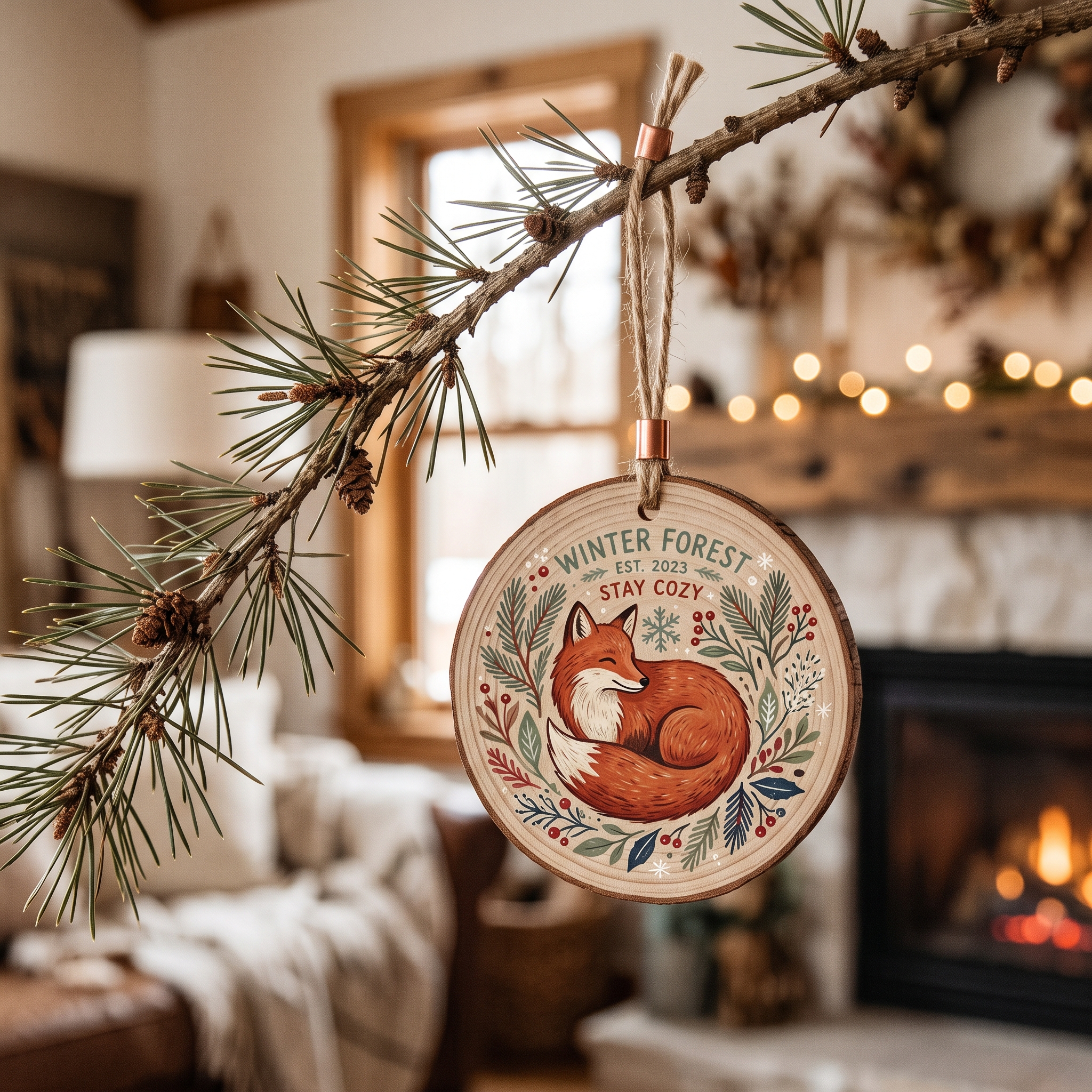
This is the one flat-printed lane that wins — because the art is genuinely drawn, not photographed. Illustrated animals and florals average 7.5% and sit way above the photo-disc floor. A characterful hand-drawn creature or a loose winter botanical prints beautifully on any blank and still reads as art someone made.
A hand-illustrated ornament design in a warm folk-art style. A SUBJECT (a winter fox among pine sprigs, a robin on a holly branch, a loose poinsettia wreath) drawn with visible linework and gouache-style texture, a cozy limited palette of sage, cranberry and cream, gentle personality. High-resolution printable ornament artwork, isolated on a transparent or off-white background, no ornament blank, no string, no mockup, no text, no real brand.
5. Engraved & carved wood look (5.5%, the accessible entry)
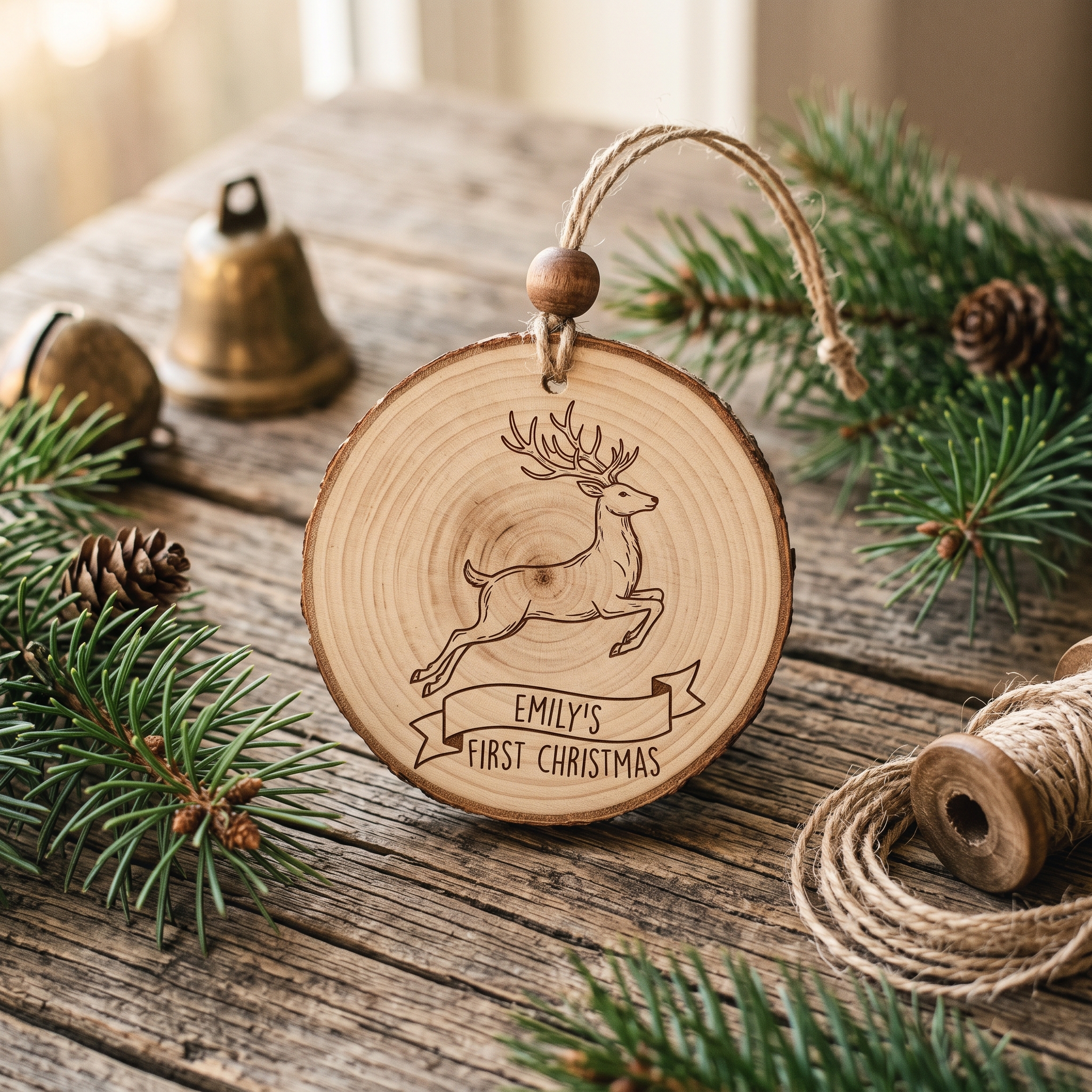
Not the top puller, but worth flagging because it out-indexes the entire printed lane and it is the easiest handmade look to actually produce — plenty of suppliers offer real wood ornament blanks. The signature is fine engraved linework on warm grain, often with a small personalized banner done tastefully.
An ornament design that looks laser-engraved into warm wood. A fine single-color LINE-ART SUBJECT (a leaping deer, a mountain-and-pine scene, a delicate snowflake) with clean engraved strokes and a small optional banner reading “YOUR WORD”, visible wood grain showing through, rustic and refined. High-resolution printable ornament artwork, isolated on a transparent background, no string, no mockup, no real brand.
After you generate any of these, shrink it to about 200 pixels wide and see if it still reads as something. Ornaments live or die at thumbnail size in the search grid, and they are small to begin with. If it turns to mush, simplify: bolder shapes, higher contrast, one clear subject. That thumbnail test is the difference between an ornament that pulls and one buyers scroll past.
💡 Pro tip — mimic the make, not the material. You can’t hand-stitch felt or press real clay through a print-on-demand supplier, but you can print artwork that looks stitched, pressed, or carved. The data rewards the handmade look, not the handmade method — so build faux-embroidery texture, a stamped-clay impression, or an engraved-wood line into the art itself and put it on whatever blank your supplier offers.
The two traps that look busy but rarely sell
Two kinds of ornament flood these searches. Because there are so many of them, they look like proof of demand. The favorite ratio says otherwise — and both are flat printed.
The photo disc. A picture printed onto a ceramic or aluminum round is the single weakest meaningful theme in the study at 3.9%, and there are endless of them. The problem is baked in: when the art is the buyer’s own photo on a stock blank, you are not competing on creativity, you are competing on turnaround time, review count, and ad spend. That is a fight a new shop rarely wins. This is the “upload your photo” red ocean, and it drags the whole flat-printed lane down.
The plain printed name. A first name in a script font on a glossy round pulls barely above the photo disc. It blurs together because every one looks the same, and the buyer is really shopping for the occasion — a first Christmas, a new home — not your design. Enormous supply, generic output, bottom-of-the-board pull. If you must serve the personalization demand, do it on a made-looking blank — engraved wood, stamped clay, a felt banner — not a flat printed circle.
None of this means these designs are worthless. They are crowded and undifferentiated. Supply is enormous and it is hard to stand out, so the next new listing gets ignored. Spend most of your energy in the under-supplied, high-pull handmade lanes instead.
💡 Pro tip — volume is not demand. A flooded search looks like proof people are buying, but the favorite ratio says the opposite: the two most-made ornaments — the photo disc and the printed name — pull the worst on the entire board. Before you commit to a crowded angle, check its demand against its competition so you aim at an open pocket, not a pile-up.
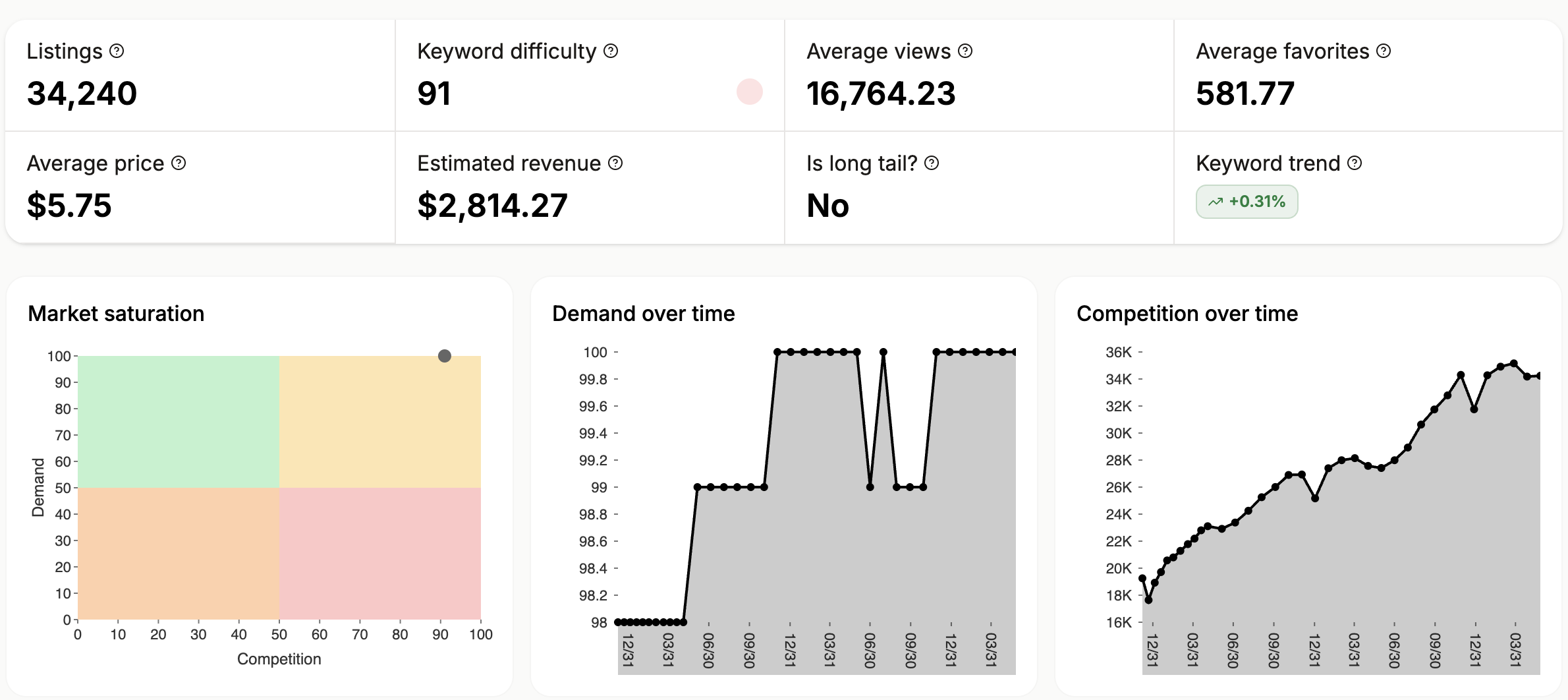
Want to see how crowded an ornament angle is before you commit to it? That is what the free Keyword Explorer shows you: demand against competition for any phrase, so you can aim at a pocket that is not already a red ocean.
Your yardstick: is your design a winner?
Numbers are only useful if you can hold your own work up against them. So here is the scale for an ornament that already ranks on Etsy.
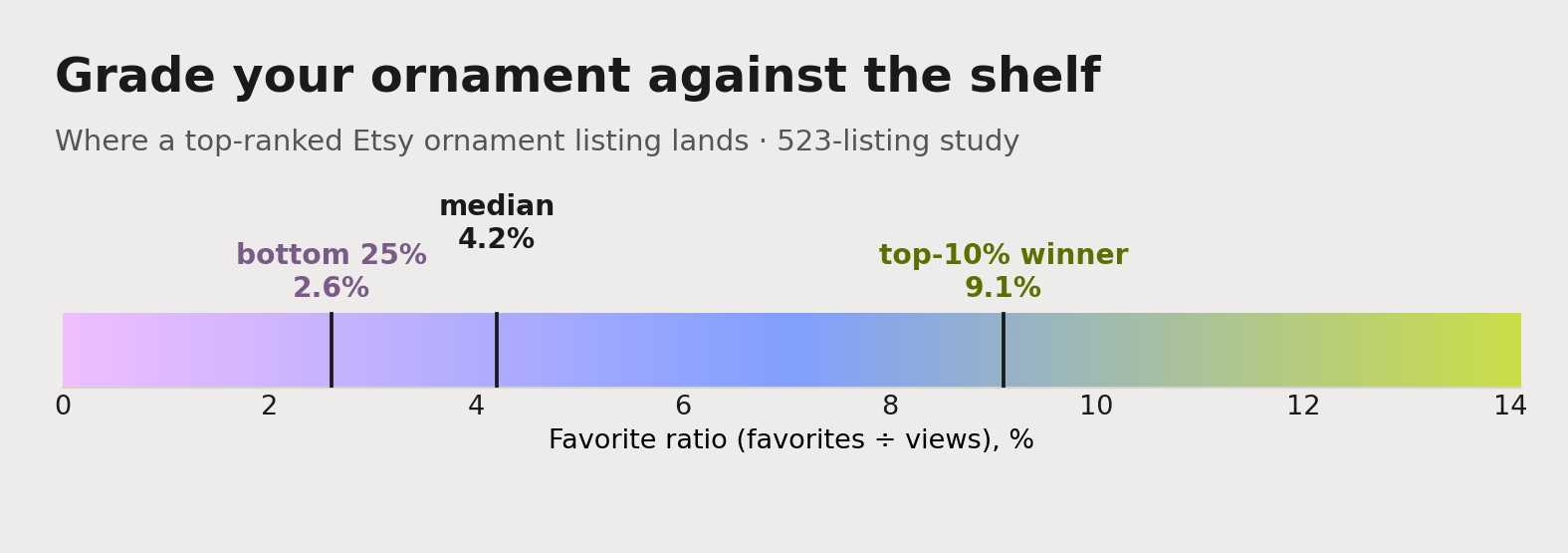
- Under 2.6%: the bottom quarter. People are seeing it and scrolling past. Rethink the design.
- Around 4.2%: dead average. Fine, not a winner.
- 6 to 9%: top third. A strong design.
- 9.1% and up: the top 10%. A genuine winner.
If you sell on Etsy, you can run this check on your own listings tonight. Open a listing’s stats, divide favorites by views, and see where it lands. An ornament sitting under 4.2% is telling you something, and it is usually the design, not the traffic.
💡 Pro tip — grade an ornament tonight. Pull up one of your live listings, divide its favorites by its views, and drop the number on the scale above. Anything under 4.2% is sitting in the bottom half of the shelf — and on ornaments that almost always means the design is reading as a template, not a traffic problem you can ad-spend your way out of.
Two rules a design has to survive first
Before a design can sell, it has to stay up. Two Etsy rules quietly end more print-on-demand shops than any trend miss.
It has to be your own. Etsy’s Creativity Standards require that items made with production tools — which is all print-on-demand — are based on your own original design. Buying a trending ornament file or a stock illustration pack and printing it unchanged fails that test, and it is a common reason listings get deactivated. Our guide to Etsy’s rules for print-on-demand sellers walks through what “original” actually means in practice.
It cannot borrow someone else’s work. Copying a hot ornament, using a famous character, or lifting a photographer’s image is the fastest route to a takedown and a shop at risk. This one bites ornament sellers especially hard, because holiday characters and licensed franchises are everywhere and it is so easy to feed one into an AI tool. The safe move is your own take on a theme, not someone else’s asset. If copycats are a worry the other direction too, there is a hidden setting that helps protect your shop from copycats.
Neither rule blocks you from selling a felt fox or a hand-drawn winter robin. Plenty of shops do. They block you from selling the exact one someone else already made. Original beats borrowed, and it is also the only version that lasts.
The presentation finding: the make matters more than the mockup
Now the part that will save you hours of second-guessing.
Sellers agonize over how to shoot an ornament. On a plain white background? Hung on a tree? Styled on linen with a candle? I checked across the whole set — and here the answer is refreshingly freeing.
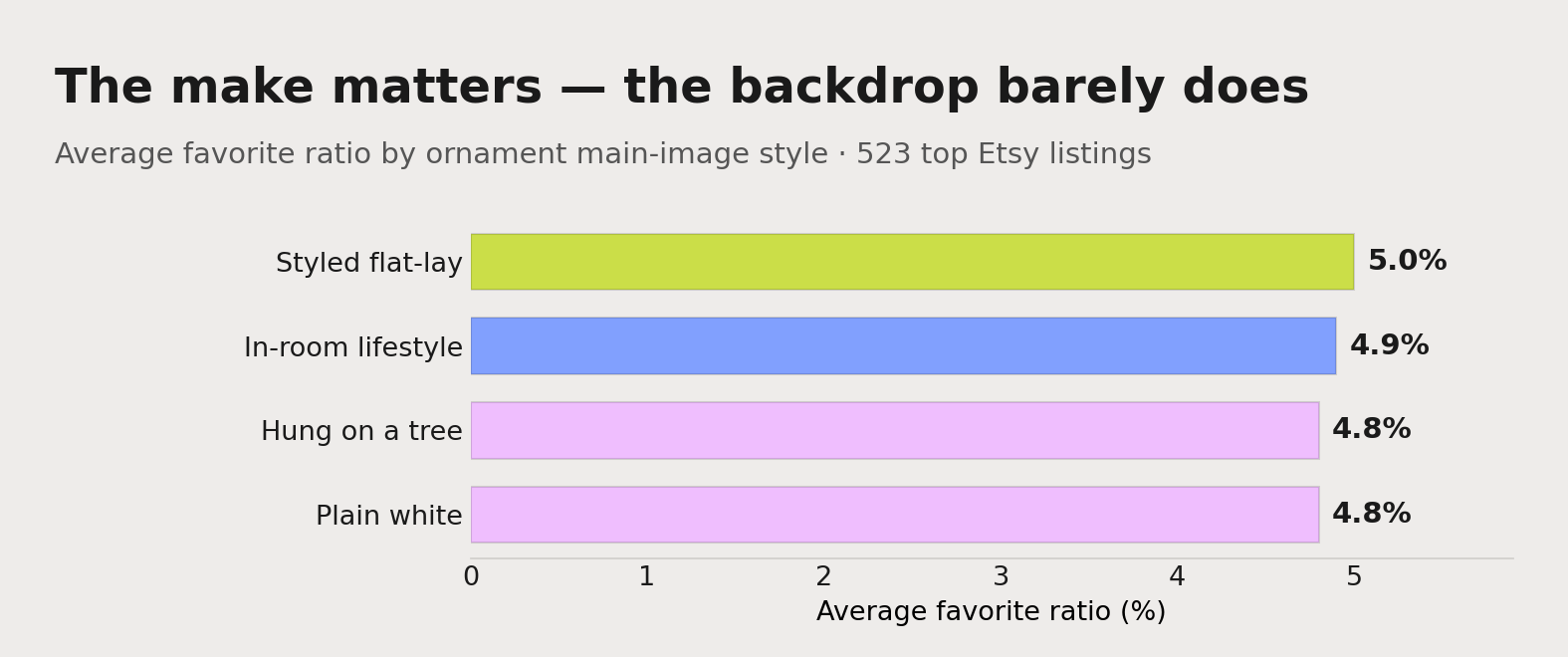
Unlike wall art, where a styled room scene pulled far ahead of a bare shot, ornament presentation barely moves the needle. A styled flat-lay (5.0%), an in-room lifestyle shot (4.9%), a plain white background (4.8%), and the classic hung-on-a-tree shot (4.8%) all land within a single point of each other. Translation: buyers are judging the ornament, not the backdrop. The design does the work here, not the staging.
💡 Pro tip — stop chasing the perfect tree shot. Styled flat-lay, in-room lifestyle, plain white, and hung-on-a-tree all pull within a single point of each other — the backdrop is a rounding error here. Put the hour you’d spend restaging into making the ornament itself look made, and you’ll move the one number that actually shifts demand.
So the guidance is: make the ornament itself look made, and stop fussing over the perfect tree shot. A few things that still move listings:
- Do not ship the default Printify or Printful stock mockup. Everyone uses them, so your listing blends into a wall of identical glossy circles. A realistic smart-object scene or a bulk-mockup tool is worth the small effort. Here is what we learned about better listing images with mockups.
- Show both sides and the material. Ornament returns come from surprise — thinner, smaller, or shinier than expected. Use most of your ten slots: a hero shot, a close-up of the texture, the back, a hand-for-scale shot, and a “what you get” graphic. The full sequence is in our guide to listing image types that drive sales.
- Match the real product. If you sell a printed ceramic round, do not lead with a lush felt mockup. Etsy requires the thumbnail to represent what ships, and mismatches drive returns and unhappy reviews.
- Add a simple video. A ten-second turn of the ornament catching the light gets impression priority without any on-camera work.
- Disclose it. When an image is a mockup or AI-assisted, say so, both for Etsy’s standards and for buyer trust. Here is how and why to disclose mockups and AI images.
Free download: the Etsy SEO Checklist
A winning ornament still has to be found. This one-page checklist walks the titles, tags, and attributes that get ornaments ranking, so the design you just made actually gets seen.
Grab the free Etsy SEO Checklist →
New shops break in — with a genuinely good ornament
If all of this feels like the top of Etsy is locked up by big shops with ad budgets, the data says: harder than some categories, but not closed.
I flagged a listing as “rising” when it was new, pulling a high favorite ratio, from a small or mid-size shop. Those rising listings were about 5% of the whole top set.
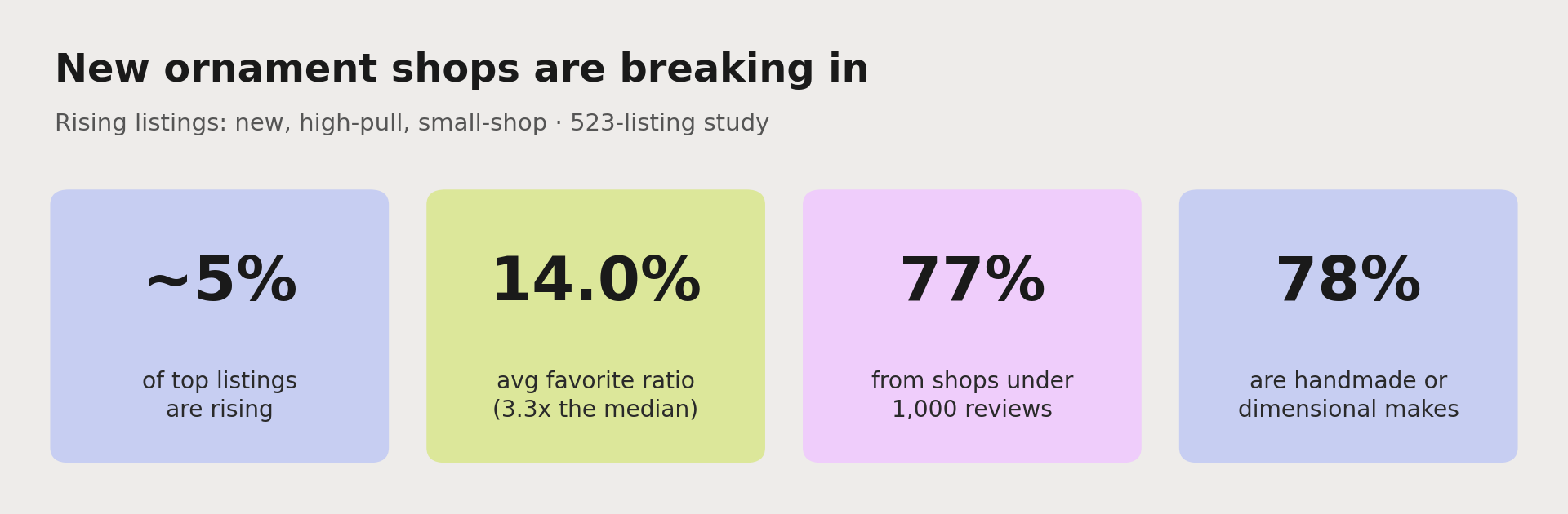
The rising listings averaged a 14.0% favorite ratio, about three and a half times the overall median and well past the winner line. 77% came from shops with fewer than 1,000 reviews. And 78% of them were handmade or dimensional makes — not flat printed discs.
The rising designs win with the exact playbook above: a felt animal, a stamped-clay star, a dimensional character, a hand-drawn winter creature. A fresh, specific, made-looking ornament from a small shop is breaking into these searches every season. That could be your shop. The design is the lever, and it is a lever you fully control.
Every ornament niche plays differently
“Ornament” is not one market. Each search term pulls a different buyer and a different mix of designs, and the personalization terms behave very differently from the general ones.
I pulled the full ranked results for the two most personalization-heavy searches — the crowded lanes most new sellers start with — and here is how they compare, ranked by median favorite ratio. Every number is OCR’d off the live search pages and matched back to the ranked study set.
| Search term | Listings (matched set) | Median favorite ratio | Winner line (top 10%) | What dominates | Flat printed | Rising | Ads |
|---|---|---|---|---|---|---|---|
| personalized ornament | 186 | 4.4% | 7.7% | Custom name 35%, photo 17%, home/address 17% | 65% | 4% | 74% |
| custom christmas ornament | 214 | 4.2% | 7.5% | Custom name 40%, home/address 18%, photo 17% | 59% | 4% | 70% |
Both terms sit right at or below the 4.2% overall median, both are majority flat printed, and both are 70%+ ads. The lesson is the same at the term level as at the make level: the searches where a name or a photo on a disc is the product are the crowded, ad-heavy, lower-pulling lanes on the board.
The open, higher-converting demand lives in the made-looking niches — felt, clay, 3D, engraved, illustrated animal and floral — not the “personalize a flat disc” ones. If you are starting out, aim your listings and your SEO at the handmade lanes, not the name-generator ones.
Where to start this week
If you came in thinking photo discs and printed name ornaments were the ornament business, I hope this traded that assumption for a map. You do not need to guess what is hot. You need to make an ornament that looks made — dimension, texture, a hand-drawn subject — then check whether people actually save it.
Here is the whole post as five steps:
- Pick an open lane: felt or embroidered, stamped clay, 3D and figural, engraved wood, or hand-illustrated animal and floral. Skip the flat photo-disc and printed-name red oceans that dominate the shelf.
- Make it look made, not printed. Even on a printed blank, use texture, dimension, and drawn art — not a photo on glass.
- Run the thumbnail test: if it does not read at 200 pixels wide, simplify to one clear subject.
- Present it honestly and match the real product. The design does the work, so do not over-invest in the perfect tree shot.
- List it, then read its favorite ratio. Under 4.2% and buyers are scrolling past. Above 9.1% and you have a winner.
Most sellers never get to that last step. They make an ornament, cross their fingers, and move on. But that number is the whole game. Make something, check its favorite ratio a couple of weeks later, keep the ones that pull, and let the rest go. Do that enough times and the guessing quietly stops. One day you might even be the shop someone else is pulling apart in a post like this one.
Keep reading on Listadum. New to print-on-demand? Start with selling on Etsy without inventory. Ready to run the print-on-demand niche properly? See our guide to Etsy’s rules for print-on-demand sellers.
The rest of the series
This is one spoke in Listadum’s print-on-demand teardown — every big POD product on Etsy, ranked by favorite ratio, so you can see what sells and what is not worth your time.
- The pillar: The Complete Guide to Niche Etsy Strategies — how to pick a niche and a product worth your time.
- The apparel siblings, already live: What T-Shirt Designs Actually Sell on Etsy and What Sweatshirt Designs Actually Sell on Etsy.
- More product teardowns in the series: wall art, tote bags, throw pillows, phone cases, and stickers.
Frequently asked questions
What kind of ornament sells best on Etsy?
Handmade, dimensional ones, not flat printed discs. In my study of 523 top listings, the handmade makes — embroidered and felt (7.6% average favorite ratio), stamped clay (7.5%), 3D and figural (6.6%), hand-painted (5.5%), and engraved wood (5.5%) — were 39% of the shelf but produced 77% of the winners. Flat printed discs, especially photo ornaments (3.9%), pulled the least despite being 60% of every listing studied.
Why don’t photo and printed-name ornaments sell as well on Etsy?
Because they are crowded and undifferentiated. Flat printed discs are 60% of the shelf, so buyers have endless near-identical options and shop on price, turnaround, reviews, and ad spend rather than your design. When the buyer’s own photo or name on a stock blank is the product, a new shop has almost no way to stand out.
What is a good favorite ratio for an ornament listing?
The median top-ranked ornament listing sits at a 4.2% favorite ratio (favorites divided by views). The bottom quarter is under 2.6%, and a genuine top-10% winner reaches 9.1% or higher. Check your own listing by dividing its favorites by its views.
Do I have to hand-make ornaments to sell handmade-looking ones through print-on-demand?
No. Most print-on-demand suppliers print art onto ceramic, wood, aluminum, or acrylic blanks. The winning move is to design printed artwork that looks made — faux-embroidery texture, a stamped-clay impression, a carved-wood line, an illustrated 3D character — so a printed ornament stops reading as a flat printed disc.
How should I photograph an ornament for Etsy?
It matters less than you think. In the study, styled flat-lay (5.0%), in-room lifestyle (4.9%), plain white (4.8%), and hung-on-a-tree (4.8%) all pulled within a point of each other. Buyers judge the ornament, not the backdrop. Show the texture, the back, and a scale reference, match the real product, and put your effort into the design.
Are print-on-demand ornaments still worth selling on Etsy in 2026?
Yes, but it is a crowded, seasonal, ad-heavy market: the median price is about $14.00 and 69% of ranked listings run ads. The design is the differentiator. A genuine, original, made-looking ornament in an under-supplied lane — felt, clay, 3D, engraved, or illustrated — is what separates a winner from the pile of photo discs.
Which ornament search terms should a new seller target?
Aim at the made-looking niches, not the personalization ones. The two personalization-heavy searches I studied — personalized ornament and custom christmas ornament — both pulled at or below the 4.2% median, were majority flat printed, and ran 70%+ ads. The open demand lives in handmade-style searches like felt, clay, wood, and illustrated animal ornaments.
Stop guessing which of your designs is pulling and which is dead weight.
Listadum reads every listing in your shop and flags the ones losing you sales: weak images, no video, thin titles, low engagement. You get a clear, prioritized list of what to fix first, in plain English.
Free plan · no credit card · connect your real Etsy shop in minutes
About the author
Neha Chandelier, Co-founder of Listadum, selling on Etsy since 2020. She writes about Etsy tips and tricks, how to sell on Etsy, and growing a handmade shop.
Last updated August 13, 2026.
Sources: Listadum Keyword Explorer (demand data, pulled July 2026); Listadum study of 523 top-ranked Etsy ornament listings ranked by favorite ratio; per-term OCR of the personalized-ornament and custom-christmas-ornament searches; Etsy Creativity Standards.