Deciding what to sell is the hardest part of starting on Etsy. Not the shop setup, not the photos, not the fees. It is that very first question: what do I actually make and list?
Maybe you are opening your first shop and staring at a blank page. Maybe you already have a shop, sales have gone quiet, and you are trying to figure out what to add. Either way, the advice out there sounds the same everywhere: “sell what you love,” or “sell whatever is trending.” So you pick something off a best-seller list, spend weeks making it, hit publish, and then nothing happens. No views, no sales, buried under a million shops selling the exact same thing.
I have been selling on Etsy since 2020, and I want to say this clearly: you are not doing anything wrong. The lists are answering the wrong question. They tell you what sells in general. They never tell you whether you can actually get seen selling it, and that is the part that decides whether you make a sale or shout into the void.
This guide is here to fix that. Here is what you will walk away with:
- A simple two-question test you can run on any product idea, so you never pick blind again.
- The real 2026 categories, scored with live Etsy data, sorted into what is worth your time and what is quietly a trap.
- The actual best-selling listings in each category, so you can see what winning looks like.
- A way to match a product to your own time, budget, and skills.
Work through it in order. By the end you will not just have a list. You will know how to size up any product for yourself, this year and next.
In this article
- The trap almost every new seller falls into
- The only two questions that decide what to sell
- How to read the map with real numbers
- The 2026 categories, scored on live Etsy data
- The saturation traps everyone recommends
- The real 2026 pockets
- Personalized and custom items: your biggest lever
- Repeatable digital products
- Physical vs POD vs digital: which fits your life
- A 10-minute way to validate any idea
- A quick word on trends
- Your what-to-sell checklist
- FAQ
The trap almost every new seller falls into
Before we get to the good stuff, let us name the mistake, because nearly everyone makes it at the start. It is picking a product because it is trending.
Trends feel like a shortcut. Everyone says mugs are hot, so you make mugs. The trouble is that everyone else read the same article you did. By the time a product is on every “best sellers” list, thousands of new shops are already making it.
Here is the part those lists leave out. The most-recommended categories are almost always the most crowded ones. High demand is only half the story. If ten thousand sellers are chasing that same demand, being found gets very hard, and you end up competing on price, which is a race nobody wins.
Trends are not useless. They are just the topping, not the base. You want to start from something more stable: real demand you can actually reach.
The only two questions that decide what to sell
So how do you find real demand you can actually reach? You stop scanning lists and start asking two questions. Every product on Etsy can be judged with them:
- Is there real demand? Are people actually searching for and buying this?
- Can you get seen? Or are there already so many listings that a new shop disappears?
Plot those two questions against each other and you get a simple map. It is the same map I use before I add anything to my own shop.
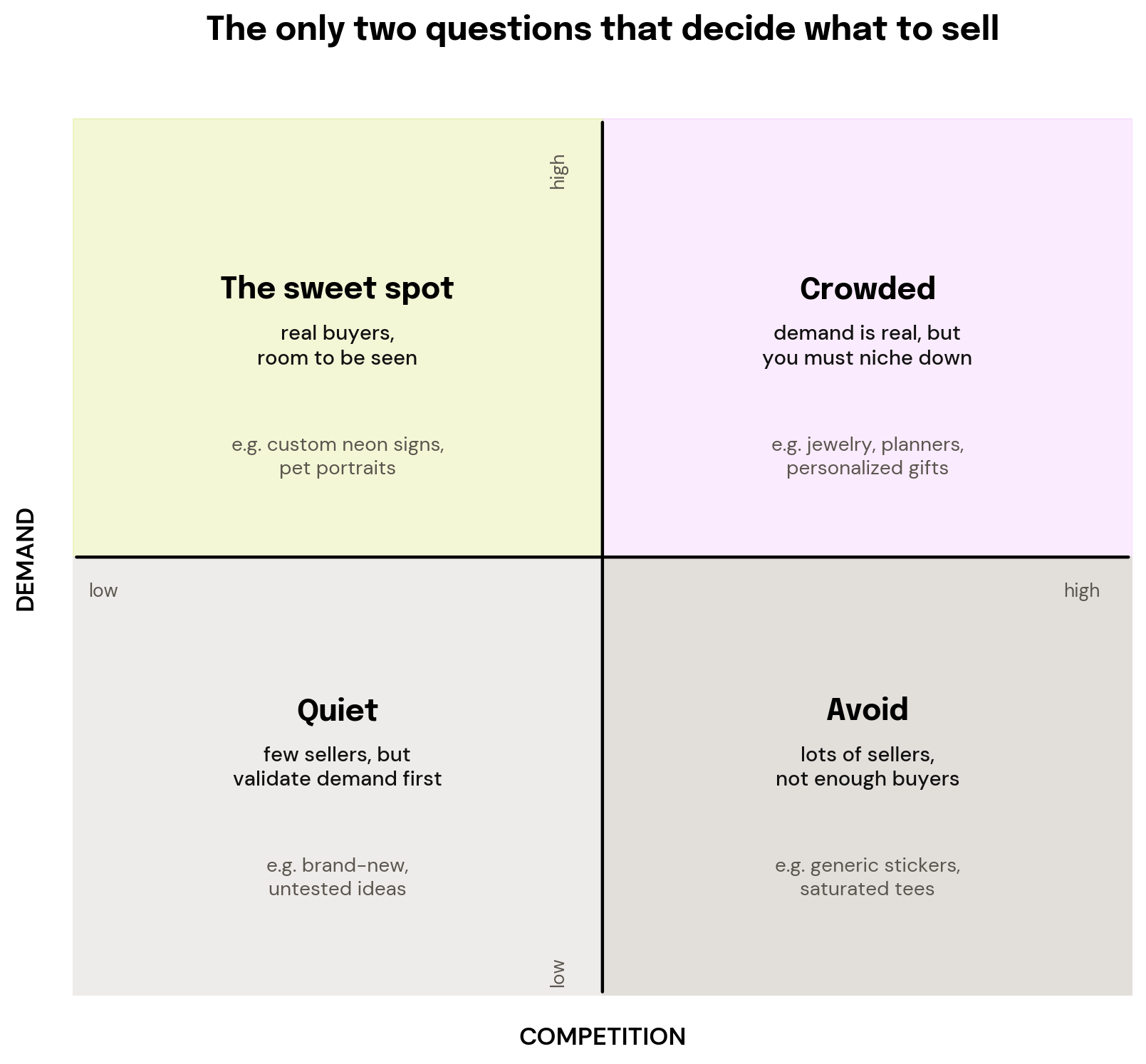
The two questions that decide what to sell, as a map.
The top-left corner is where you want to be: real buyers, and enough room that a new listing can still be found. The top-right corner (high demand, high competition) can still work, but only if you narrow down to a specific niche instead of selling the generic version. The bottom-right corner is the trap: lots of sellers fighting over not enough buyers. And the bottom-left is a quiet room. It might be a gem, or it might be empty because nobody wants it, so you validate before you commit.
Once you see products this way, the advice to “just sell wall art” falls apart. Wall art has huge demand. It also has the most competition on the entire platform. It sits in the top-right, and unless you have a sharp angle, a brand-new shop gets buried.
How to read the map with real numbers
The map is the idea. Here is how you put real numbers on it. Four signals tell you almost everything:
- Competing listings. How many other listings show up for that search. This is your “can I get seen” number. Lower is easier.
- Average price. What the item actually sells for. This sets the ceiling on your margin.
- Top-listing revenue. Roughly what a strong listing in that category earns per month. This tells you money is actually moving, not just browsing.
- Trend direction. Whether views are climbing or cooling over the last month.
You can pull all four for any keyword in a couple of minutes with a keyword tool. I will show you exactly how in the validation section below. For now, let us run the real 2026 categories through these four numbers.
The 2026 categories, scored on live Etsy data
I pulled live Etsy data for ten of the most-recommended categories. Here is what the map looks like when you plot competing listings against what a top listing actually earns.
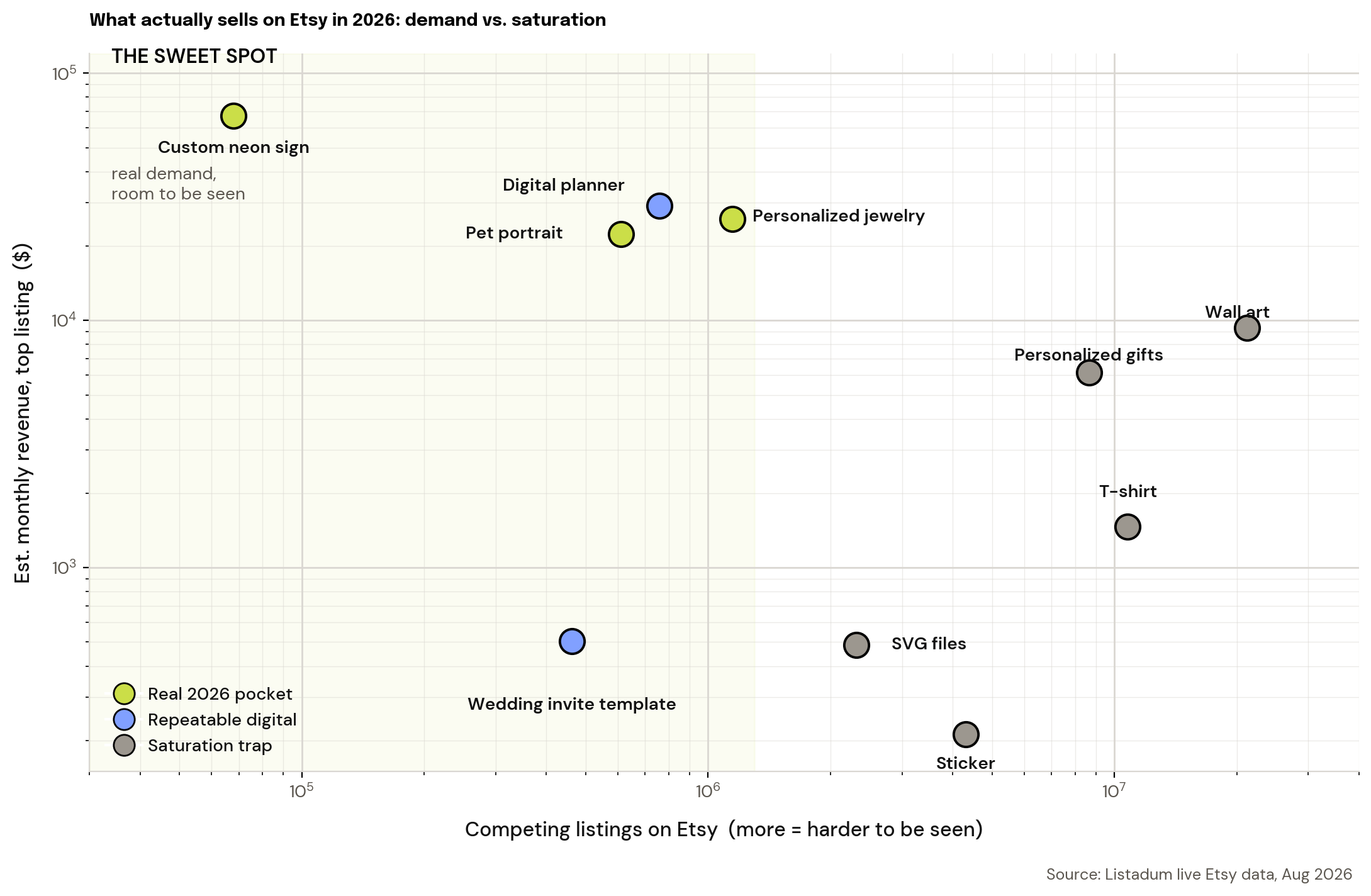
Ten popular categories, scored on live Etsy demand. Source: Listadum, August 2026.
Here is the same thing as a list, ranked by what a top listing actually earns per month. This is the table to screenshot.
| Category | Competing listings | Avg price | Top listing / month | The verdict |
|---|---|---|---|---|
| Custom neon signs | 68,000 | $61 | ~$67,000 | Best pocket. Real money and low competition, but a higher-cost item to produce. |
| Digital planners | 760,000 | $9 | ~$29,000 | Repeatable digital. Low price, but you make it once and sell it forever. |
| Personalized jewelry | 1,150,000 | $27 | ~$26,000 | Strong demand, but crowded. Win by owning one style or occasion. |
| Pet portraits | 610,000 | $39 | ~$22,000 | Beginner-friendly pocket. Emotional, giftable, works made-to-order or POD. |
| Wall art | 21,200,000 | $58 | ~$9,300 | Saturation trap. The most crowded category on Etsy. |
| Personalized gifts | 8,700,000 | $20 | ~$6,200 | Too broad to win generic. Only works once you niche down. |
| T-shirts | 10,800,000 | $25 | ~$1,500 | Saturated. Strong demand, brutal competition. |
| Wedding invite templates | 463,000 | $8 | ~$500 | Small but open digital niche. |
| SVG files | 2,300,000 | $3 | ~$490 | Volume play only, thin margins. |
| Stickers | 4,300,000 | $4 | ~$210 | Avoid as generic. Heavy competition, tiny margins. |
Notice what the ranking exposes: wall art earns a decent $9,300 for its top listing, but with 21 million competing listings, that top spot is almost impossible for a new shop to reach. High revenue does not help you if you cannot get seen. That is the whole point of scoring on both numbers at once.
Three groups jump out.
Saturation traps (bottom-right): wall art, personalized gifts, t-shirts, SVG files, stickers. Huge listing counts, weak revenue per listing.
Real pockets (top-left): custom neon signs and pet portraits. Strong revenue, and far less competition than you would expect. Personalized jewelry belongs here on revenue too, but only once you narrow it to a specific style or occasion.
Repeatable digital (top-middle): digital planners and templates. Lower price tags, but you make them once and sell them forever.
Let us walk through each group, because the “why” matters more than the ranking.
The saturation traps everyone recommends
These are the categories at the top of almost every list. The numbers show why that is a problem for a new shop.
- Wall art: about 21 million competing listings. That is the most crowded category on Etsy.
- T-shirts: roughly 10.8 million listings, and the top listing earns only around $1,500 a month.
- Personalized gifts: about 8.6 million listings. Huge, but so broad that you are competing with everyone.
- Stickers: over 4 million listings, at an average price near $4. Brutal margins and heavy competition.
I am not saying these can never work. I am saying they will not work as the generic version. “Wall art” loses. “Minimalist line-art prints for plant-filled apartments” has a fighting chance. The way through a saturation trap is always the same: niche down until you are the obvious choice for a specific buyer, or skip it. If you want the demand side of this idea in more depth, we wrote a whole piece on the one factor that decides if an item will sell.
Even the most crowded categories have winners, so let us look at who is actually selling in each one right now. Watch for the pattern: almost none of them are the generic version. They win with a personal twist, a tight niche, or a fresh design. That is the way through.
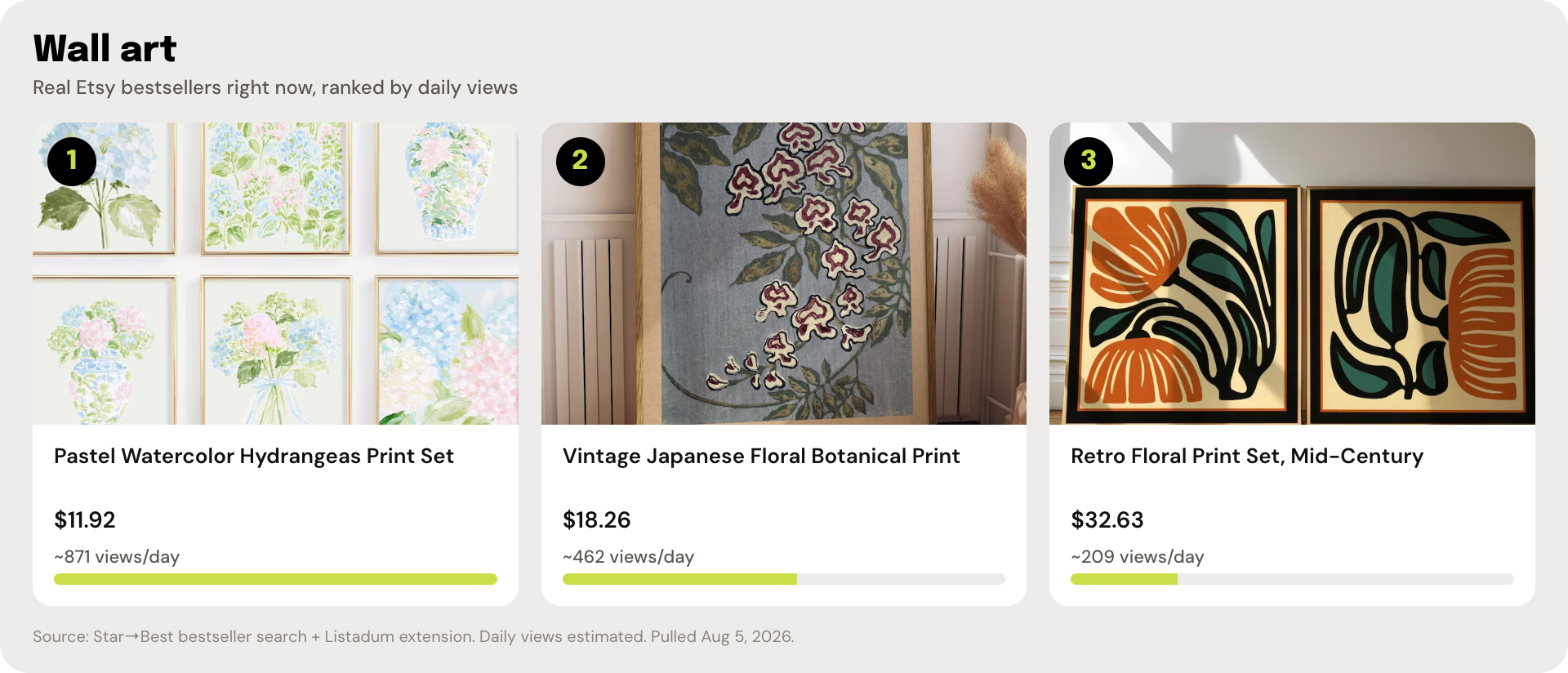
Wall art winners are specific aesthetics: florals, vintage botanicals, retro sets, never generic “wall art.”
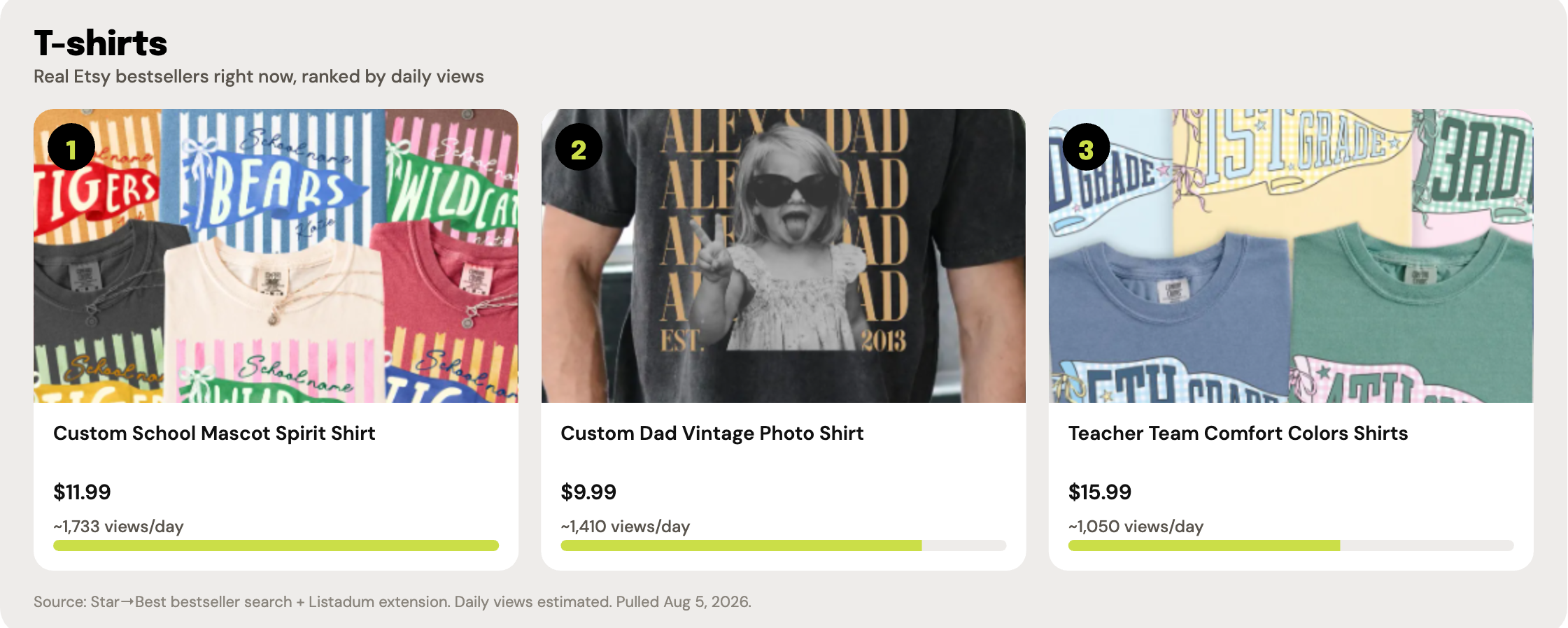
Every top t-shirt is custom or hyper-specific: school mascots, photo shirts, teacher teams.
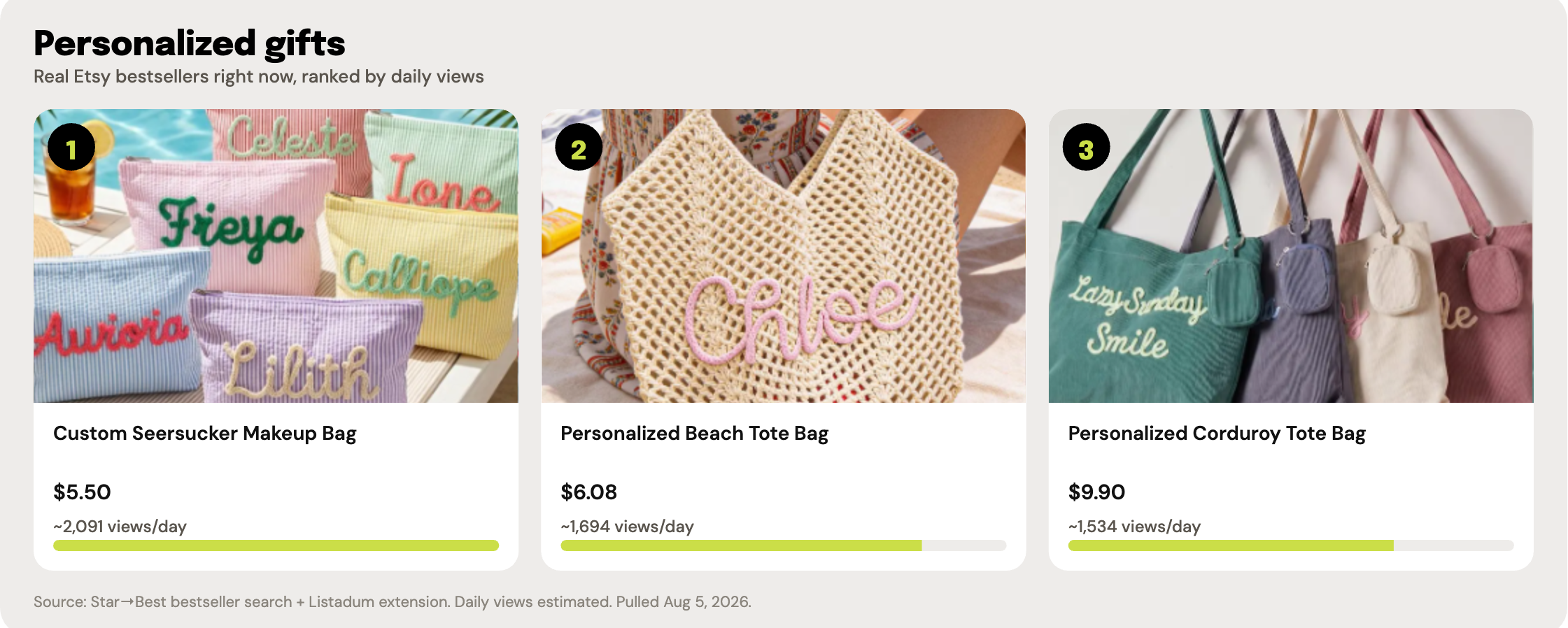
The winning “personalized gifts” are small, custom, giftable items, never the broad category.
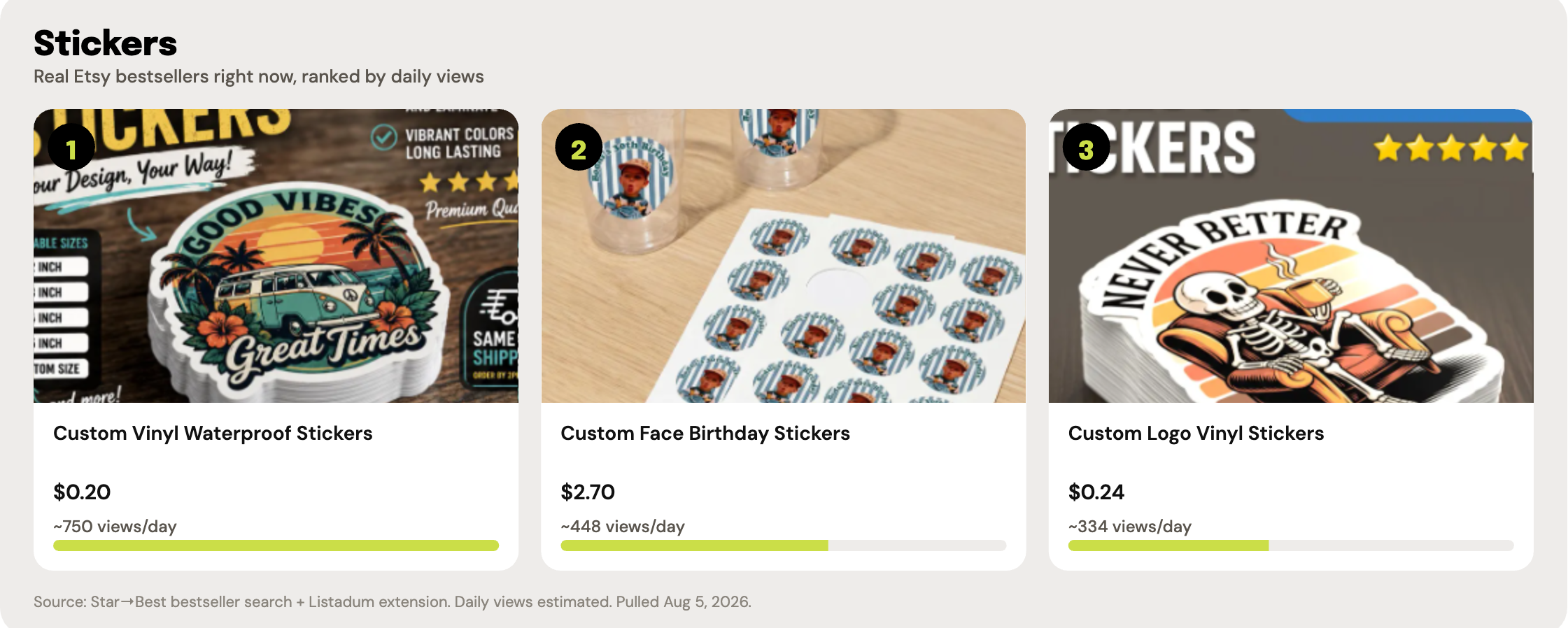
Even in stickers, the winners are custom and photo-based, not generic packs.
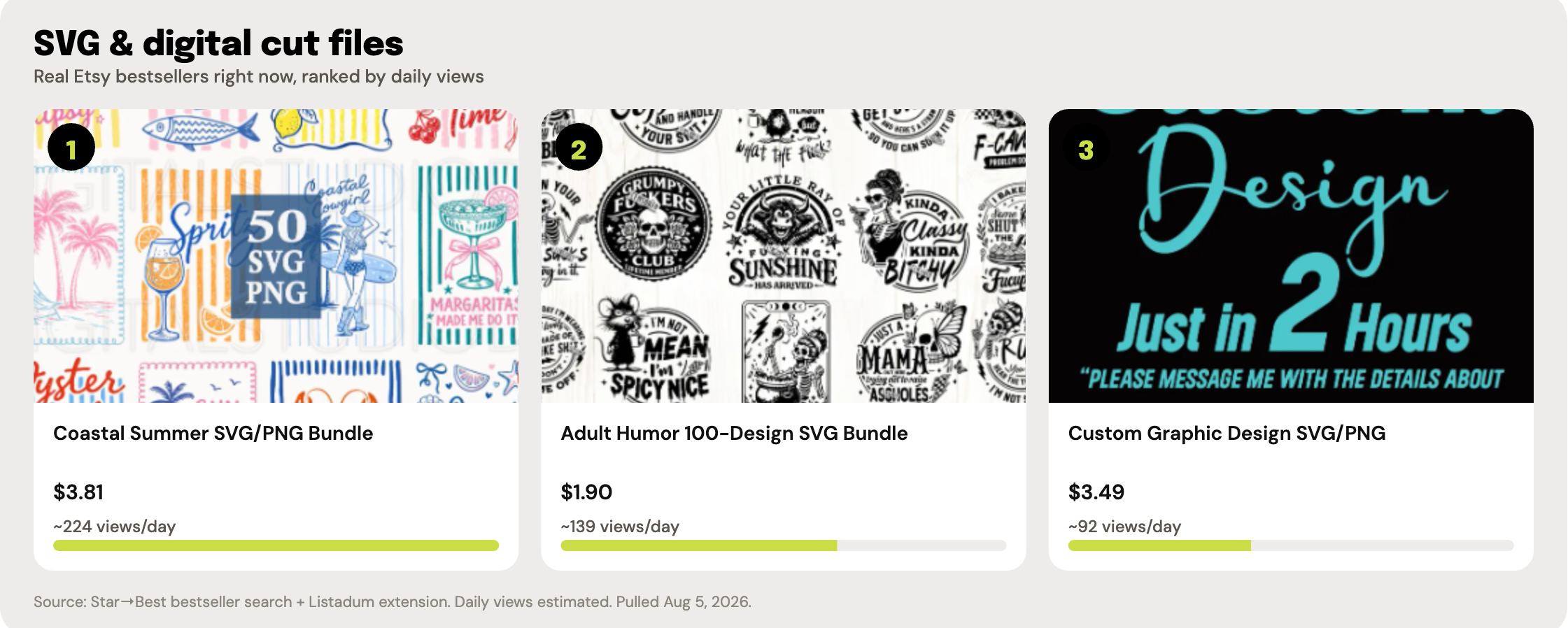
SVG winners are tight themed bundles and custom design services, not scattered clip art.
The real 2026 pockets
Now the interesting part. A few categories have strong buyer demand without the crushing competition.
- Custom neon signs: only about 68,000 competing listings, an average price around $61, and the strongest top-listing revenue in my whole sample. Real money, and a fraction of the competition of the “obvious” picks. The catch is production: you are sourcing or making a physical, higher-cost item, so this suits sellers who can handle that.
- Pet portraits: around 611,000 listings, average price near $39, and healthy top-listing revenue. This is a much friendlier place to start. It is an emotional, giftable purchase, buyers happily pay for it, and you can run it as made-to-order or even print-on-demand.
- Personalized jewelry: strong demand and a solid price point, though competition is real. This one lives in the “niche down” corner: win it by owning a specific style or occasion, not by listing generic name necklaces.
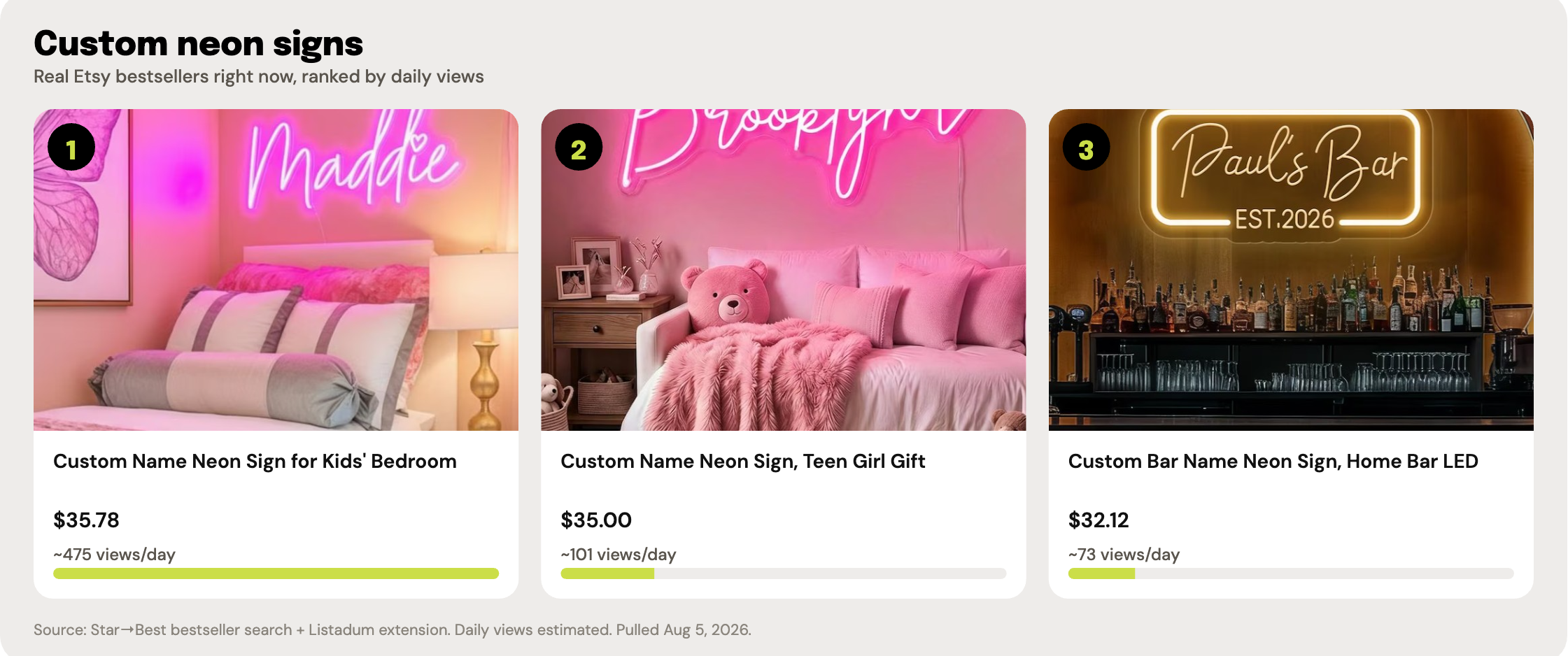
The custom neon signs winning right now. Real listings, pulled from Etsy bestsellers.
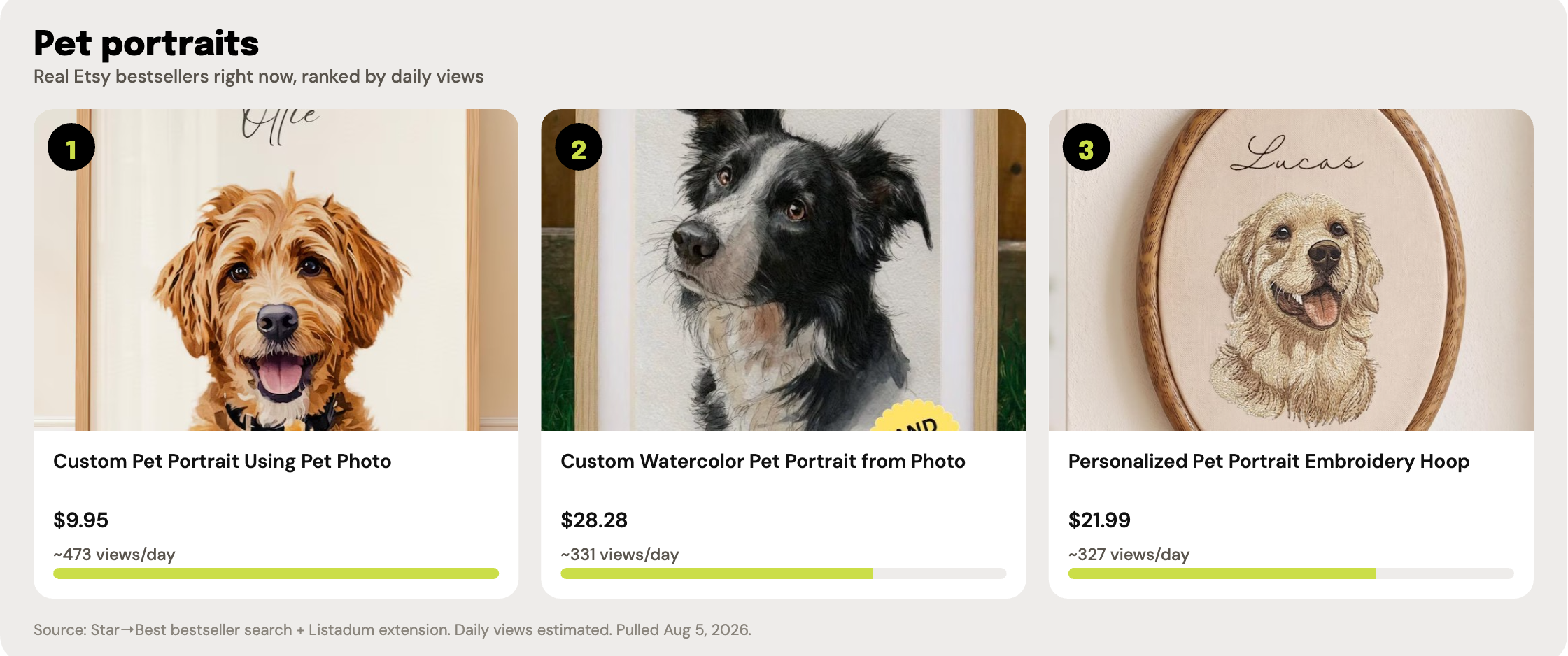
Pet portraits selling now, from a photo print to watercolor to embroidery.
The lesson is not “go sell neon signs.” It is that the best opportunities are rarely the ones on every list, because being on every list is exactly what creates the competition.
Personalized and custom items: your biggest lever
If there is one thing that reliably sells on Etsy, it is a personalized product. Buyers come to Etsy for exactly what they cannot get on Amazon: a name, a date, a pet, an inside joke, made just for them. Personalization is consistently the number one thing that moves a sale on Etsy, and it is the reason the same product can be a trap or a pocket depending on how you sell it.
Here is the shift. A plain coffee mug competes with 1.6 million other mugs, mostly on price. A mug with a specific couple’s names and wedding date competes with almost no one, because it was made for one buyer. You did not change the product. You changed how personal it is. That is how you climb out of a saturation trap without inventing a whole new category.
Personalization also protects your margin. A custom piece is worth more to the buyer, so you can charge more, and it is much harder for a copycat to undercut something made to order.
A few ways to add it:
- Names, dates, and initials. The simplest and most in-demand. Wedding, baby, and anniversary gifts live here.
- Pets and people. Pet portraits and family pieces sell on emotion and rarely get haggled down.
- Occasion-specific. The same product, retargeted for Mother’s Day, teacher gifts, or a housewarming.
- Made-to-order or print-on-demand. Personalize by hand, or use a POD partner that supports personalization fields so the order still ships without you touching it.
The trade-off is real. Personalized orders mean more buyer messages, proofs, and production time, so build that into your pricing and your processing times. Etsy gives you a built-in personalization field on the listing to collect the details cleanly. For the step by step, see how to list personalized items on Etsy.
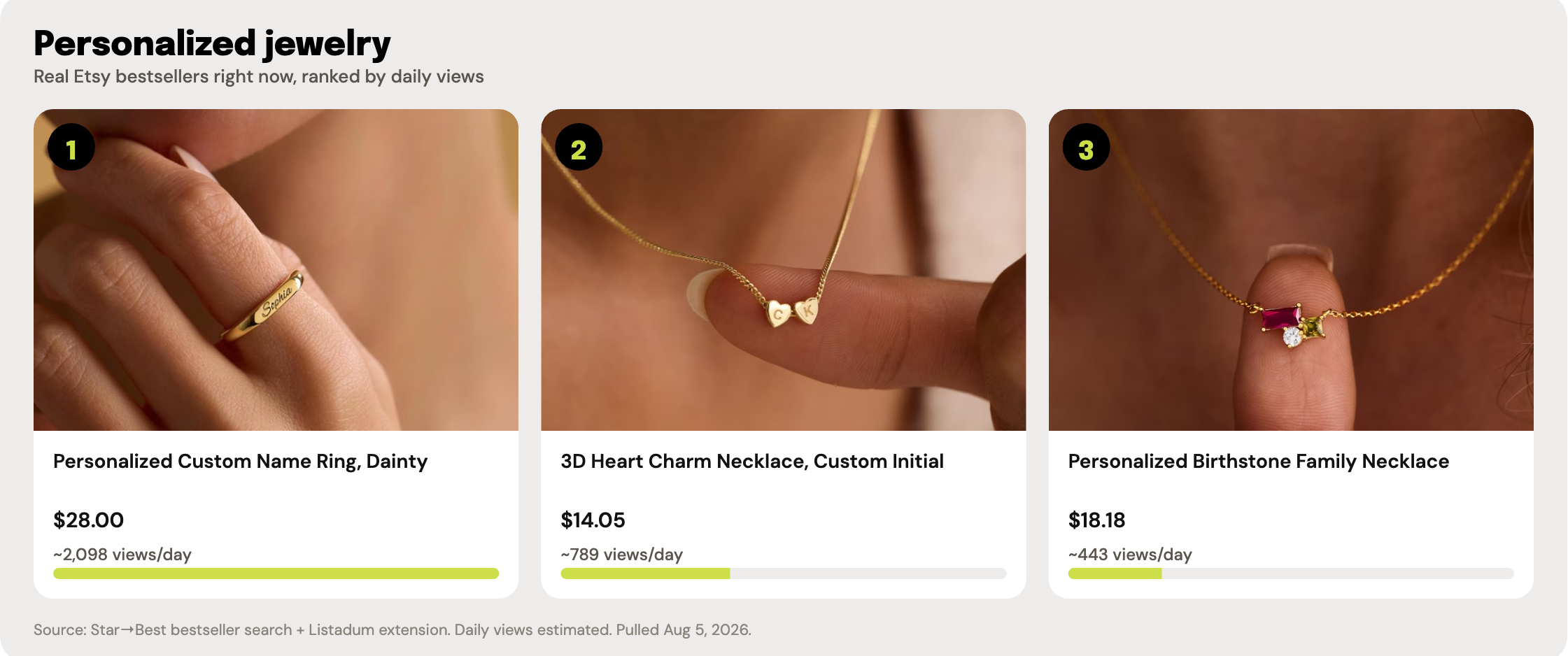
Personalized jewelry proves the point: the winners are all custom names, initials, and birthstones.
Repeatable digital products
Digital is its own kind of pocket, and it plays by different rules.
A digital planner sells for about $9, which sounds low. But you make it once and sell the same file thousands of times with zero reprint cost and no shipping. In my data, a top digital planner listing earns close to $29,000 a month. That is the power of a product with no marginal cost.
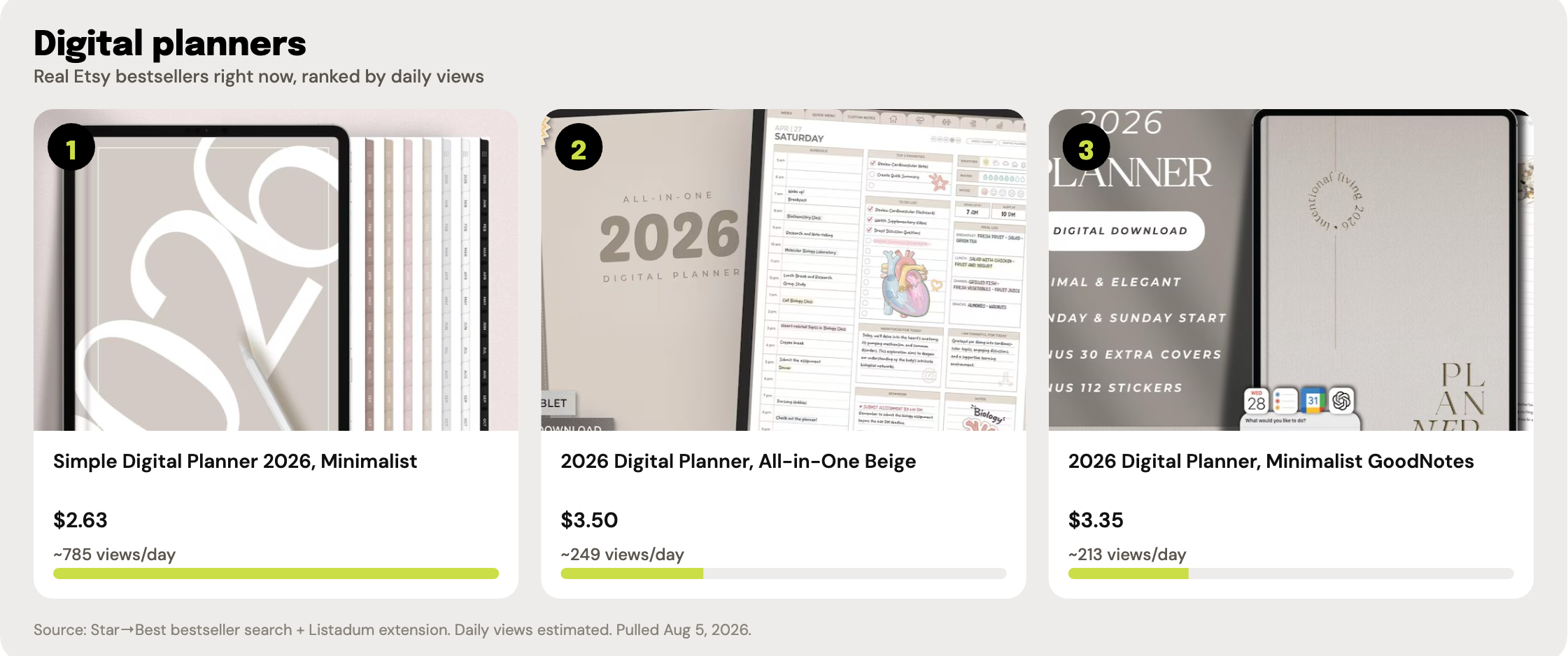
The digital planners selling now. Notice the prices: $2 to $4, and still the highest view counts on this whole page.
Templates work the same way: wedding invitation templates, résumé templates, social media kits. Lower price, near-infinite margin, and buyers who want an instant download. The trade-off is that digital is easy to copy, so your listings and your niche have to be sharp. If digital sounds like your lane, start with our guide to selling digital products on Etsy.
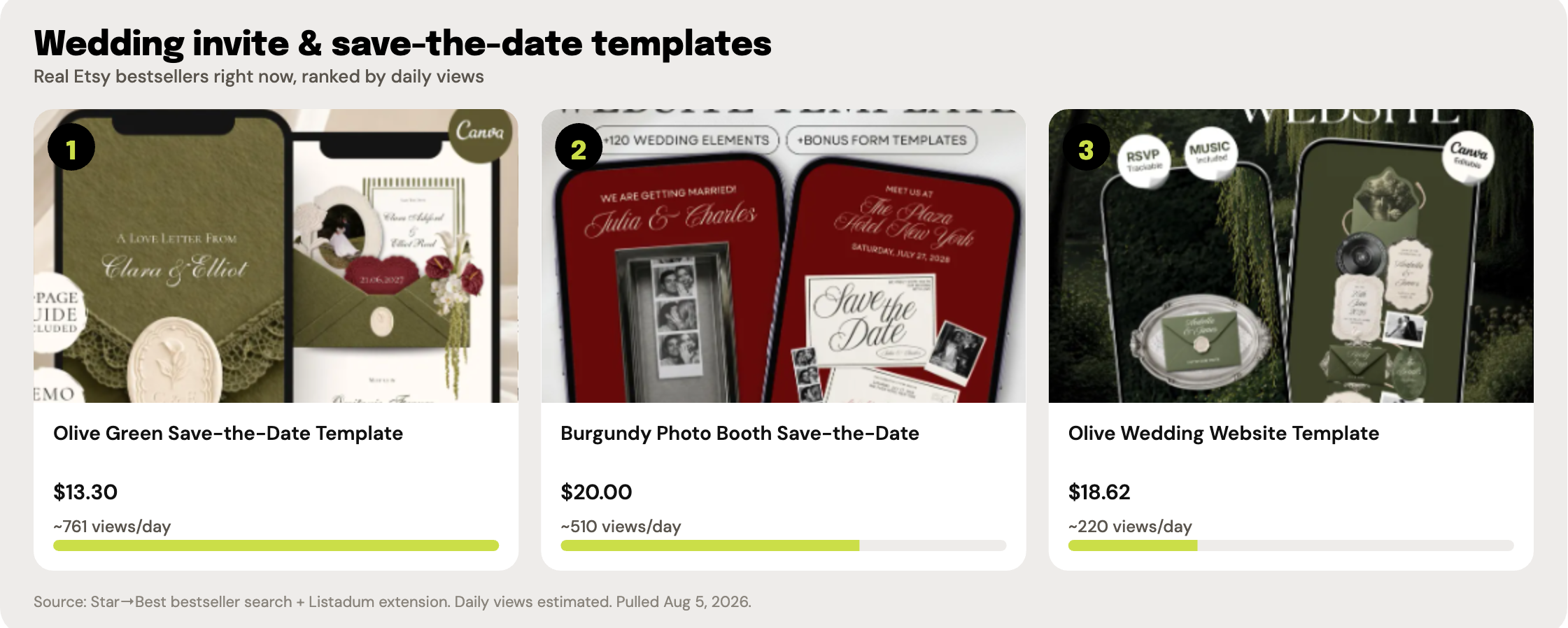
Wedding and save-the-date templates: editable Canva and website designs sold as instant downloads.
Leaning digital? Our free Trending Digital Products Report shows the digital niches gaining traction right now, with the demand data behind them. It is a useful next step before you decide which template or download to make.
Physical vs POD vs digital: which one fits your life
The “best” product is the one you can actually make and keep making. Here is the quick way to match the model to your situation.
- Handmade physical: best margins and the strongest handmade story, but it costs you time per order and you handle shipping. Great if you already make something.
- Print-on-demand (POD): a partner prints and ships for you, so there is no inventory. Lower margins and more competition, but low risk to start. Good if you can design but do not want to hold stock. Note that Etsy has specific rules for print-on-demand sellers, so read those first.
- Digital: the best margins and it scales while you sleep, with no shipping ever. But it is easy to copy and the prices are lower, so you win on volume and niche.
There is no universally right answer. Pick the model that fits your time, your budget, and the skills you already have. A product you can produce consistently beats a “hotter” product you burn out on in a month.
A 10-minute way to validate any product idea
This is the whole point of the guide: you can do this yourself, for any idea, before you spend a single hour making anything.
- Pull the real numbers, not a guess. Run the keyword through our free Keyword Explorer. It shows real search demand, how many listings actually compete for it, and whether interest is climbing or fading, all in one view. Do not rely on Etsy’s own results count: it pads the page with loosely related items, so it tells you almost nothing about real competition.
- Look at the top listings. Are they recent shops or all old, established ones? Recent bestsellers mean the door is still open. This is the one check worth doing by eye on Etsy itself.
- Check the price band. Would you make real money at that price after your costs and Etsy’s fees?
- Read it on the map. Real demand plus room to be seen is a keeper. Strong demand but heavy competition means niche down. Little demand means validate before you commit.
The Keyword Explorer puts demand and competition side by side with color cues, so you can spot a real pocket at a glance. It is the same tool I used to build the chart above.
Not sure if your idea is a pocket or a trap?
Run it through the free Keyword Explorer and see demand and competition side by side before you commit. No account needed to try it.
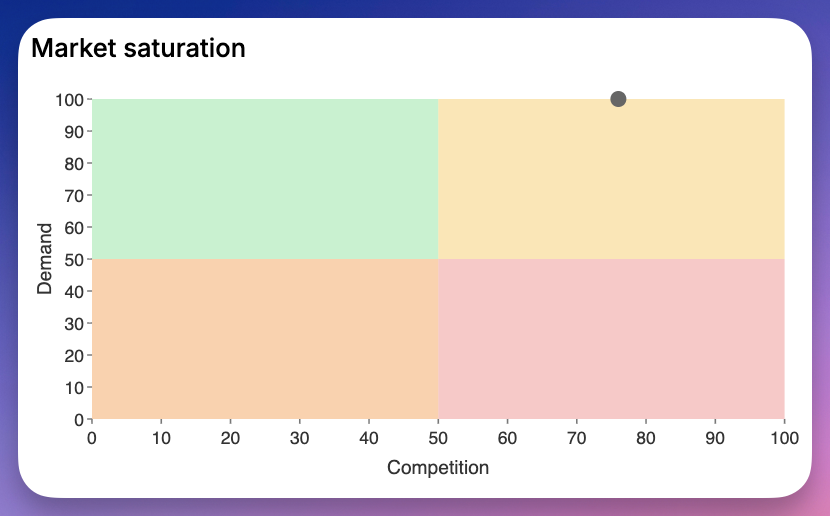
The free Keyword Explorer shows demand against competition, the same two axes as the map above.
A quick word on trends (and why not to build on them)
Every year brings a fresh wave of Etsy aesthetics, and 2026 is no different. There is genuine energy around cozy maximalism, nostalgic and “grandmillennial” styles, and holiday mash-ups. These can absolutely lift a listing.
Use them as a layer, not a foundation. Pick a solid category first, from the map, then dress it in whatever style is having a moment. That way, when the trend cools, your shop does not cool with it. For the current month-by-month picture of what is rising, we keep a running “what’s selling right now” spoke (coming soon in this hub), so you can refresh the trend layer without rebuilding your shop.
Your what-to-sell checklist
Ready to actually pick something? Run any idea through this list. If it clears the checks, you have a product worth listing. Screenshot it and keep it handy the next time you are deciding what to add.
- [ ] Write down 5 to 10 ideas you could realistically make or source.
- [ ] Check demand and competition together. Run each idea through the free Keyword Explorer to see real search demand and how many listings actually compete for it. Etsy’s own results count is padded with loosely related items, so it is not a reliable read on its own.
- [ ] Check the trend in the same tool. The Keyword Explorer also shows whether interest is climbing or fading, so you are not betting on something already sliding.
- [ ] Look at the top sellers. Are they recent shops or all years old? Recent bestsellers mean the door is still open. This is the one check worth doing by eye on Etsy.
- [ ] Run the price math. Would you make real money at the going price, after your costs and Etsy’s fees?
- [ ] Place it on the map. Real demand plus room to be seen is a keeper. High demand but crowded means niche down. Low demand means validate first.
- [ ] Add your twist. Personalize it, or narrow it to a specific buyer, so you are not selling the generic version.
- [ ] Match it to you. Can you make it consistently with the time, budget, and skills you have right now?
- [ ] Pick one or two, and list a few variations. Then watch views versus sales, and let the data guide what you make next.
Frequently asked questions
What sells best on Etsy in 2026?
By demand, the biggest categories are still personalized items, jewelry, home decor, digital downloads, and apparel. But “best selling” and “best for you to start” are different questions. The categories with the most sales also have the most competition. For a new shop, a lower-competition pocket like pet portraits or a sharp digital niche is often a smarter place to begin.
What is the most profitable thing to sell on Etsy?
Digital products have the highest margins because there is no cost to reproduce them and no shipping. Among physical items, higher-ticket made-to-order products like custom signage and personalized jewelry tend to leave the most profit per sale. Profit is price minus your true costs and Etsy’s fees, so always run those numbers before you commit.
Is Etsy too saturated to start in 2026?
No, but the generic categories are. Etsy still adds new buyers every year, and shops break through constantly. The trick is to enter through a specific niche rather than the crowded front door. “Candles” is saturated. “Soy candles scented like national parks” is a pocket.
What should I sell if I have no budget?
Digital products. You can design a planner, template, or printable with free tools and list it with zero inventory and no shipping. Your only real cost is time, which makes it the lowest-risk way to test whether you enjoy selling on Etsy at all.
Handmade, digital, or print-on-demand: which is easiest?
Digital is the easiest to start and scale, but the easiest to copy. POD is easy on logistics since a partner ships for you, but margins are thinner and competition is high. Handmade is the most work per order but has the best margins and the strongest story. Match the model to the time and skills you already have.
You are more ready than you think
Picking what to sell used to feel like a gamble. Now it is a decision you can actually make. You do not need a secret product that nobody else has found. You need a product with real buyers, a niche you can own, and a twist that is yours. That is within reach for any seller willing to check the numbers before they commit.
So start with one idea. Run it through the checklist. If it lands in the sweet spot, make it. If it does not, you just saved yourself weeks of work on the wrong thing. Either way, you are already ahead of every seller still picking blindly off a list. You have got this.
You have the map. Now check your idea against real numbers.
You just learned to judge any product by two things: real demand and room to be seen. Listadum puts both in front of you: search demand versus competition for any idea, and a completion score for every listing once you start selling, so you build on data instead of guesses.
Find your product pocket free →
Free plan · no credit card · connect your real Etsy shop in minutes
By Neha Chandelier, Co-founder of Listadum, selling on Etsy since 2020. She writes about Etsy tips and tricks, how to sell on Etsy, and growing a handmade shop.
Last updated: August 5, 2026