By Neha Chandelier, co-founder of Listadum · Last updated August 12, 2026
The whole puzzle shelf runs on one belief: that a puzzle sells because it’s personal.
Everyone says it. Upload the family photo, print it on 500 pieces, and you have a gift nobody else can copy. So that is what the whole shelf does. I looked at the top of Etsy’s puzzle results and it was a wall of the same idea: someone’s dog on a jigsaw, someone’s wedding on a jigsaw, a slab of wood with a family’s last name cut into it. It all looked like proof that personalization is the product.
Then I stopped assuming and looked at what buyers actually save. The wall of personalized puzzles was not winning. It was drowning.
If you have ever thought “I’ll just let customers upload their own photo and the puzzle sells itself,” you are not wrong that people buy those. You are missing the part the crowded shelf hides: those are the hardest, lowest-pulling puzzles to sell as a new shop, and they are almost the only thing anyone makes.
So I did the same thing I do for every product in this series. I pulled the data.
I captured the top listings across all four of the biggest puzzle searches on Etsy, deduped them down to 732 distinct designs, and ranked every one by a single number that shows whether people actually want it. Not Etsy’s default order. Real demand. Then I hand-tagged all 732 by theme, aesthetic, and mockup so I could see the pattern underneath the wall.
This is the long version: the full ranking, the design types that win with a prompt to make each one, the two traps that eat new shops alive, the benchmark to grade your own work, and how it all shifts from niche to niche. Grab a coffee.
The one number that tells you if a design sells
Etsy shows you a photo, a price, and a star rating on every listing card — but not the two numbers that reveal demand: views and favorites. The free Listadum browser extension adds both to every card as you scroll, and that unlocks a simple calculation.
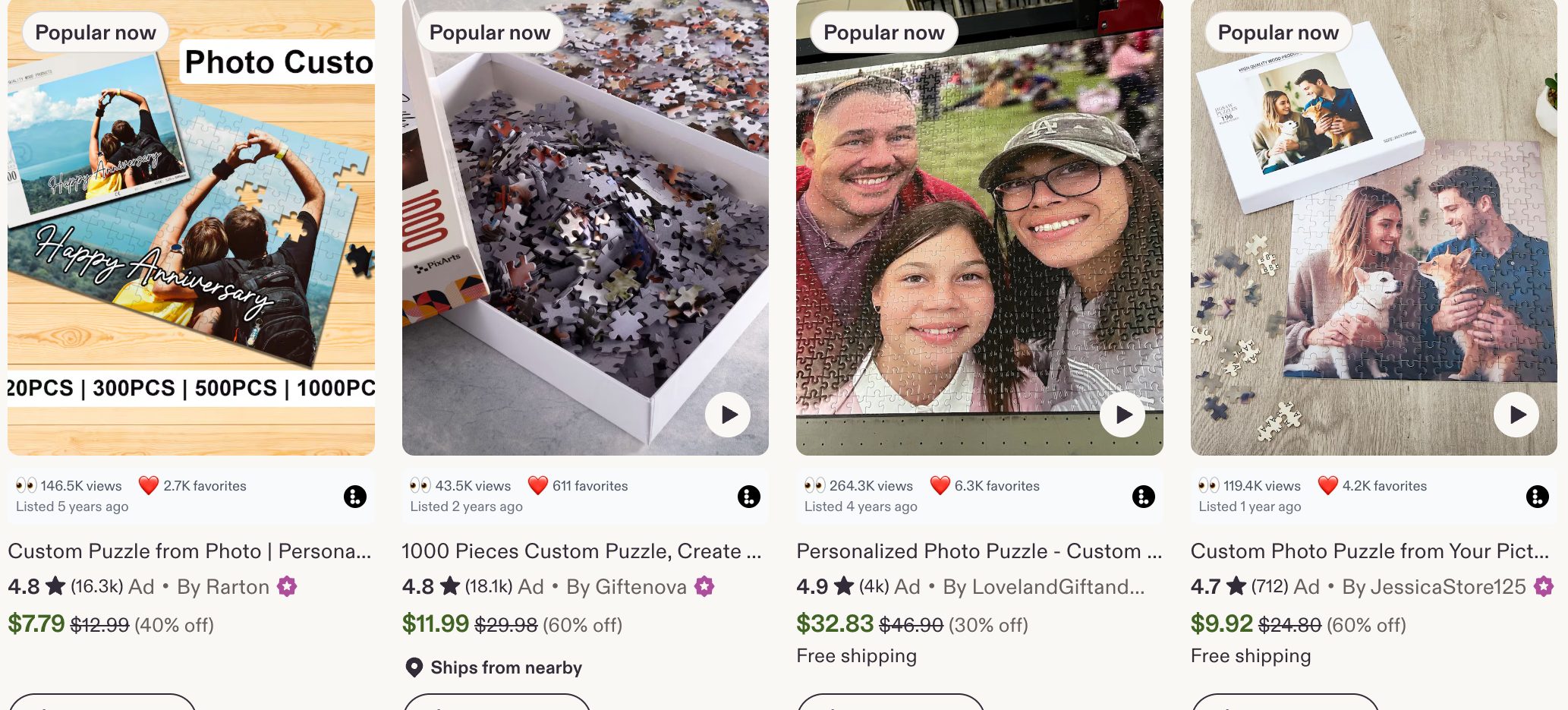
What the Listadum extension adds to a normal Etsy search — the views and favorites count on every card. Those two numbers are what this whole method runs on.
Divide one by the other and you get something useful:
Favorite ratio = favorites / views.
Inside Listadum, we call this your favorite ratio, and it is the number I trust most when I judge a design.
Of the people who saw this puzzle, what share liked it enough to keep it. That single ratio strips out the noise. A brand-new puzzle from a tiny shop and a three-year-old listing from a shop with 40,000 sales can finally be compared fairly, because the favorite ratio cancels out ad spend, age, and shop size.
It measures the design’s pulling power, and nothing else. And pulling power is the part you actually control when you sit down to make a new puzzle.
When I re-ranked all 732 listings by favorite ratio, the order scrambled hard. Designs Etsy had buried out-pulled designs sitting in the top row. Etsy’s default sort tells you what Etsy is promoting, plus who is paying for ads. The favorite ratio tells you what buyers love. Those are not the same list, and on puzzles they are barely even related, because two-thirds of the shelf is running ads.
The picture wins, not the personalization
Here is the headline finding, and it flips the whole shelf on its head.
Buyers save art. A beautiful illustrated picture, a whimsical scene, an animal, a botanical, a painting, pulls far more saves than a personalized photo or a name cut into wood, almost every time.
The two biggest blocks on the entire shelf are the two worst performers. Custom photo jigsaws are 41% of every listing I looked at and only about 13% of the top-10% winners. Wooden personalized-name puzzles are another fifth of the shelf and also pull below their weight.
Together, the personalized product is roughly 62% of the market and the bottom of the ranking. Meanwhile illustrated art puzzles are a small slice of supply and take home a quarter of the winners.
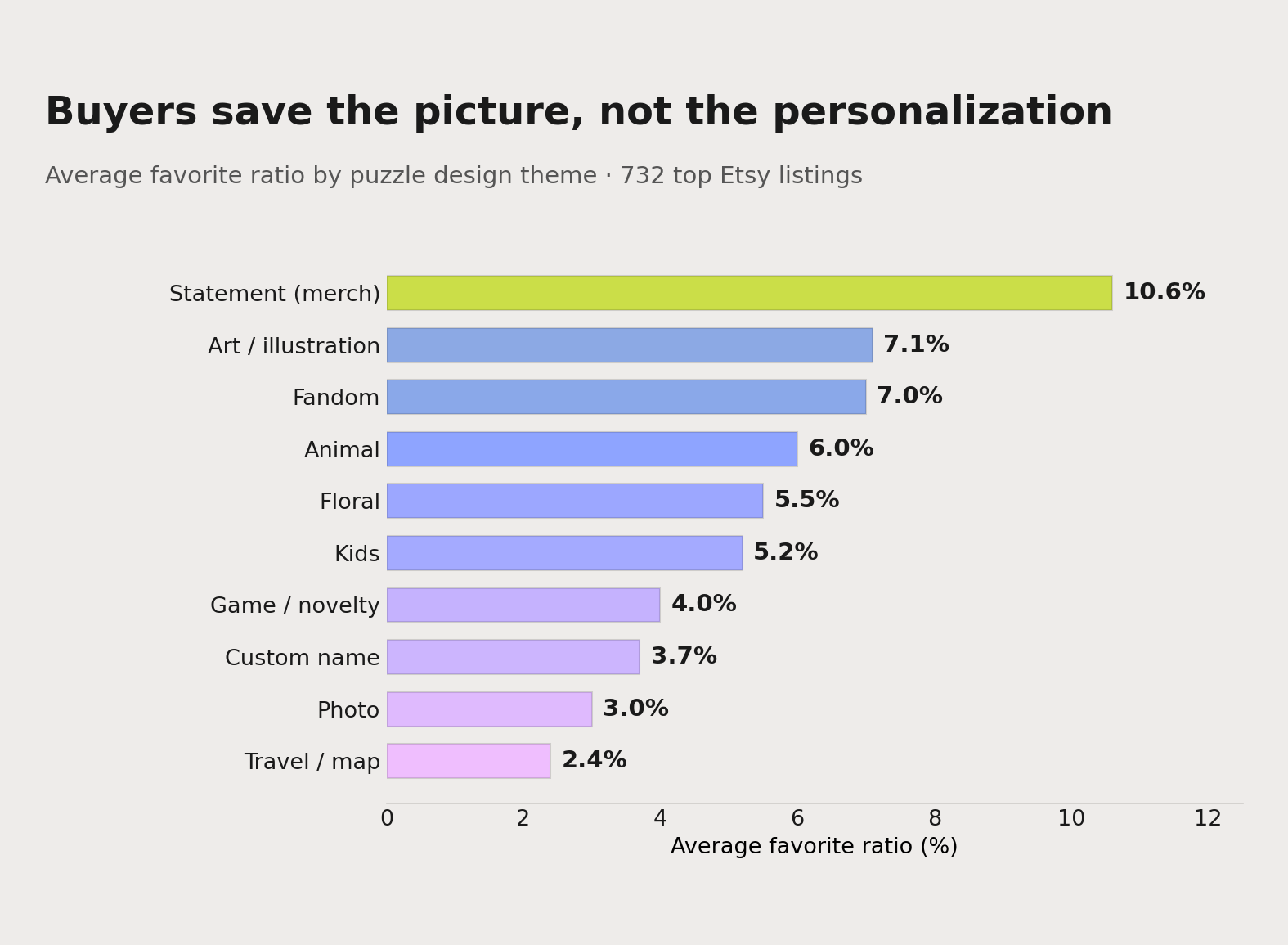
The plain-English version: on a puzzle, the printed picture is the product, and personal is not the same as good. A gorgeous original illustration that a stranger would want on their coffee table out-pulls a photo only its owner cares about. Say it with a picture worth staring at for two hours, not with someone’s name.
That is the big picture. Now let me show you the whole board, not just the top of it.
The full ranking: winners, runners-up, and what to skip
Every theme is not a simple win or lose. There are tiers, and the runners-up matter as much as the champions, because they are less crowded and still pull well. Here is where each design theme landed, by average favorite ratio across all 732 listings. The overall median is 2.9%.
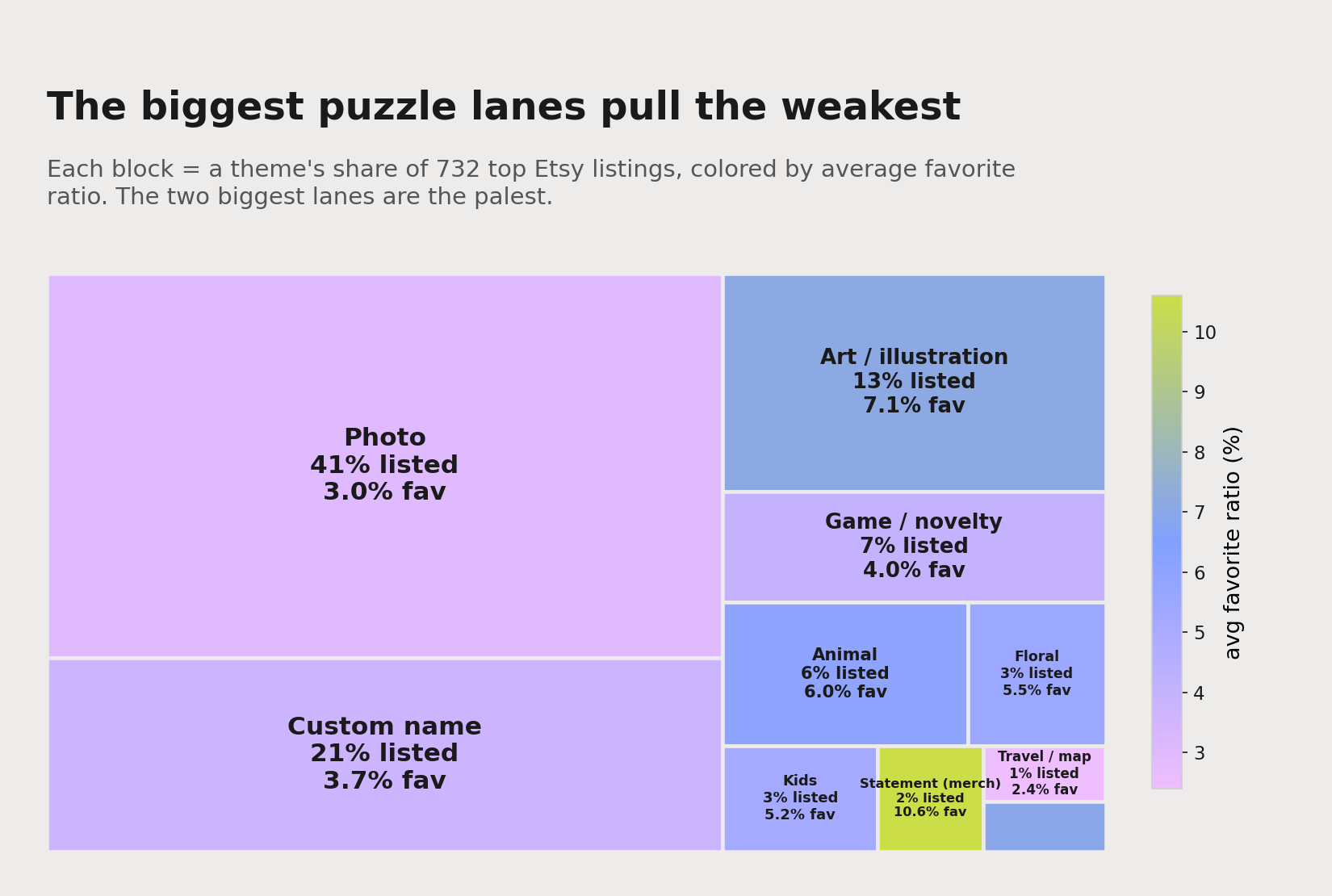
The treemap shows how the shelf is stocked; line each theme’s share of listings up against its share of the top-10% winners and the mismatch is stark: the two biggest blocks pull the fewest winners, while the small illustrated lanes punch far above their supply.
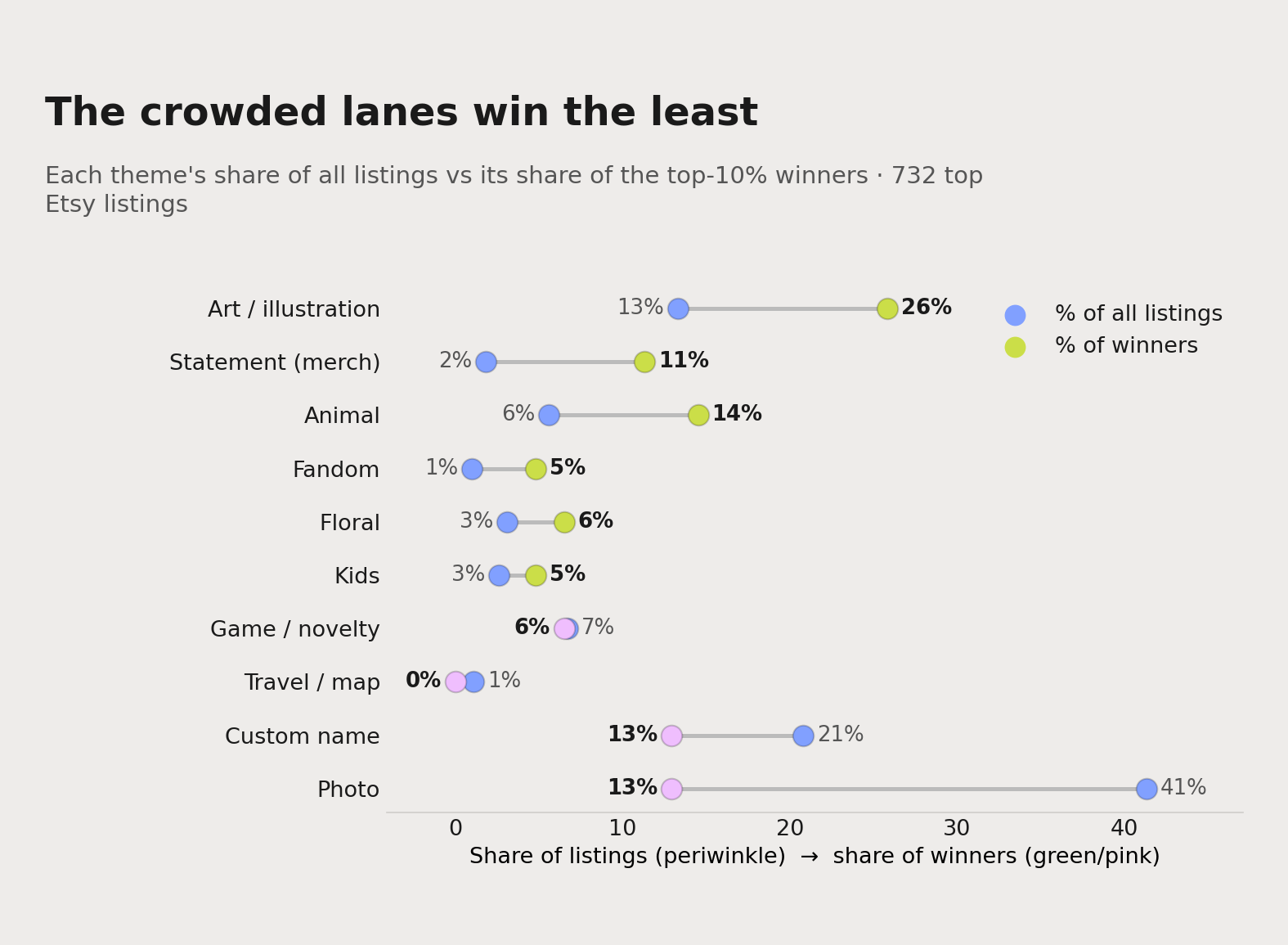
The top pullers (7% and up). Art and illustration (7.1%) is the highest-pulling real puzzle theme in the study, at more than double the median. Fandom-style enthusiast designs pull about 7.0% too, from a tiny base. (A “statement” group technically tops the chart at 10.6%, but a big chunk of those are puzzle-lover t-shirts and mugs the search dragged in, not puzzles, so I treat it as a bonus lane below, not a core type.)
The strong core (5 to 6%). Animals (6.0%), floral and botanical (5.5%), and kids’ designs (5.2%). This is the reliable middle of the winners’ circle: illustrated, giftable, and clearly under-supplied. Animals in particular over-index about 2.6x, the highest pull-per-listing of any legitimate puzzle theme.
The middle of the pack (around 4%). Game and novelty puzzles (4.0%) land just above the median. Not a winner, not a trap. A fun mechanic or a clever gimmick can carry one, but the design still has to be worth looking at.
The crowded laggards (below 4%, and enormous supply). Wooden custom-name puzzles (3.7%), custom photo jigsaws (3.0%), and travel/map designs (2.4%). These pull at or below the median, and the first two are also the two most crowded categories on the entire shelf. That is the worst possible combination. More on that trap below.
Two things jump out when you read it this way. First, the gap between the top puller and the flooded photo block is nearly 2.5x. Second, the winners are not personal. They are pictures: something a stranger would be happy to display.
Here is how much each theme over- or under-delivers relative to how much shelf space it takes up, its share of winners divided by its share of listings: animals punch about 2.6x their weight, floral 2.1x, art and illustration 2.0x, kids 1.9x. Custom photo delivers 0.3x and wooden name 0.6x. That ratio is the real map of where the open lanes are, and on puzzles the open lanes are wide.
The five puzzle design types that win (with a prompt to make each)
This is the part I wish someone had handed me before I wasted a month on photo templates. For each winning type: what the data says, why it works, and a Gemini prompt you can use to generate your own original artwork.
Two rules before you generate anything, because they decide whether your shop survives. Keep it original, since Etsy requires print-on-demand art to be your own. And never prompt for a real brand, painting still in copyright, character, logo, or place mark. Every prompt below is written to stay clear of that.
Swap the CAPS placeholder for your niche so the output is yours, not a generic AI design a hundred other sellers can also make. On a puzzle the artwork fills the whole board, so each prompt asks for the finished picture only, no puzzle, no box, no mockup.
1. Illustrated scene puzzles (7.1% average, and a quarter of the winners)
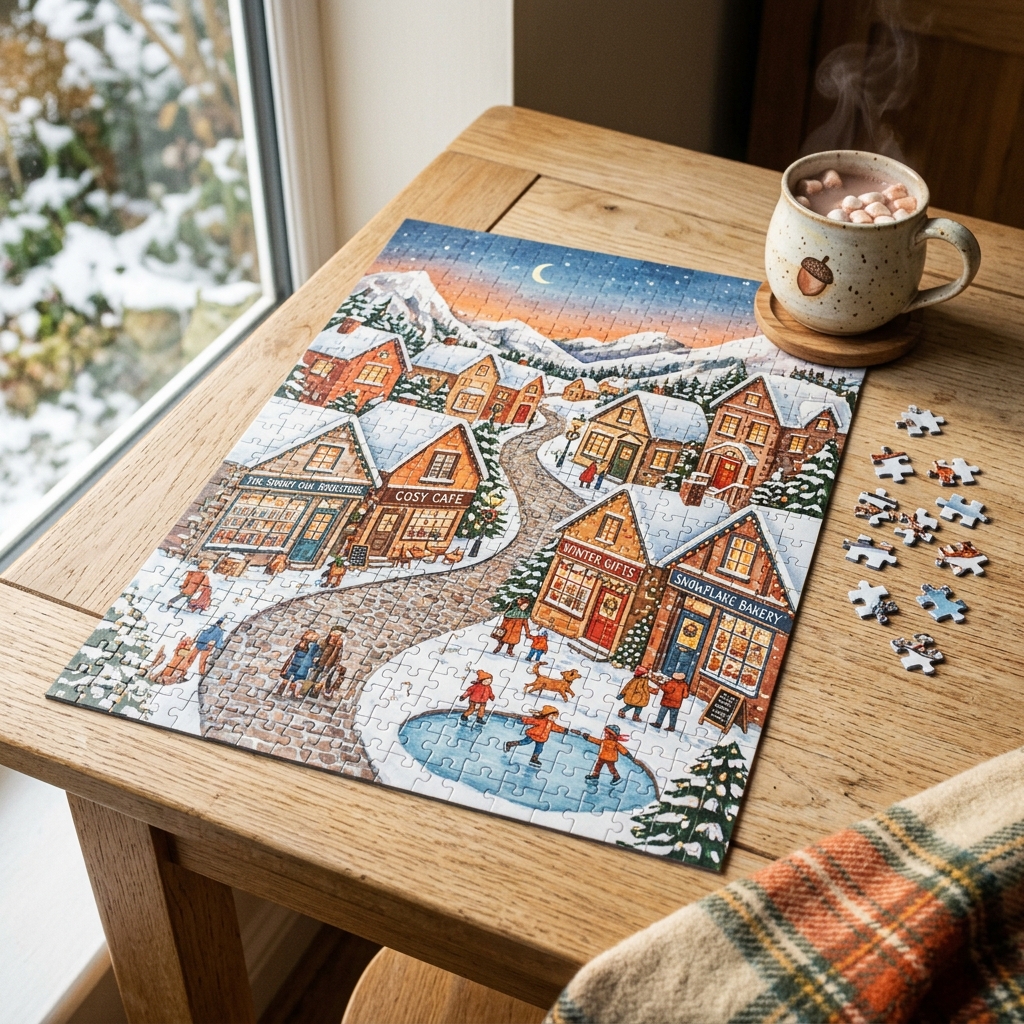
The engine of the whole category. A rich, detailed illustrated scene, a cozy village, a bookshop interior, a cottagecore garden, a busy little world, is what puzzle buyers actually want, because the fun is in staring at it for two hours. Detail and warmth do the work here: lots of small things to find, a limited harmonious palette, a mood you want to sit inside.
A detailed hand-illustrated scene designed to fill an entire rectangular jigsaw puzzle: a cozy, richly-detailed SETTING OF YOUR CHOICE (for example a snowy village high street, a crowded independent bookshop, a cottage garden in summer) packed with small charming details to discover. Warm storybook illustration style, harmonious limited palette, soft depth, gentle light. Full-bleed edge-to-edge composition, no border. Just the finished artwork, no puzzle pieces, no cut lines, no box, no mockup.
2. Animal puzzles (6.0% average, the highest pull per listing)
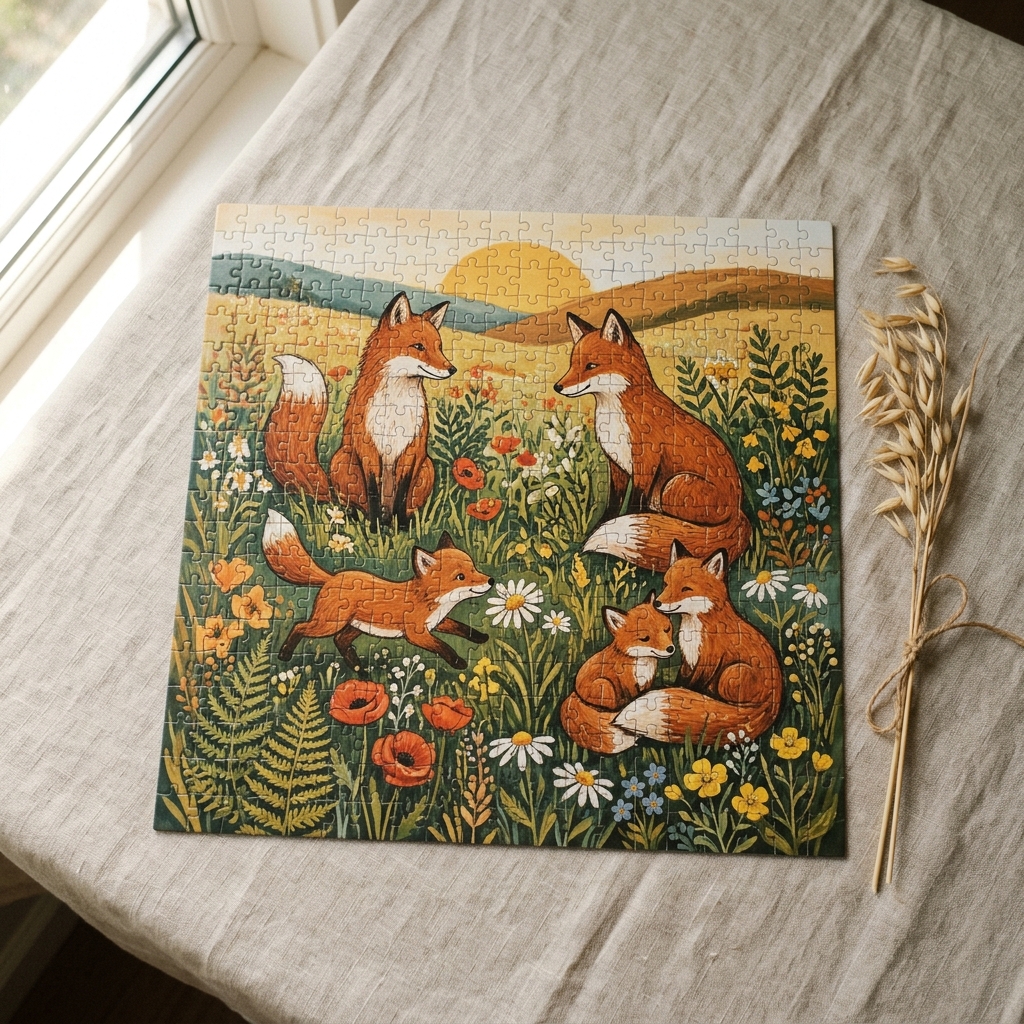
The best pull-per-listing of any real puzzle theme, and a wide, gift-friendly buyer base. A characterful illustrated animal, drawn with personality, beats a stock animal photo every time. Think a fox in a meadow, a shelf of cats, a garden full of birds: warm, a little whimsical, full of detail.
A charming illustrated animal design made to fill a rectangular jigsaw puzzle: AN ANIMAL OR GROUP OF ANIMALS OF YOUR CHOICE (for example a family of foxes in a meadow, a shelf of cozy cats, a pond of ducks) drawn in a warm, detailed storybook style with lots of small background details. Limited earthy palette, soft natural light, full-bleed edge-to-edge composition. Just the finished artwork, no puzzle pieces, no cut lines, no box, no mockup.
3. Botanical and floral puzzles (5.5% average, over-indexing 2x)
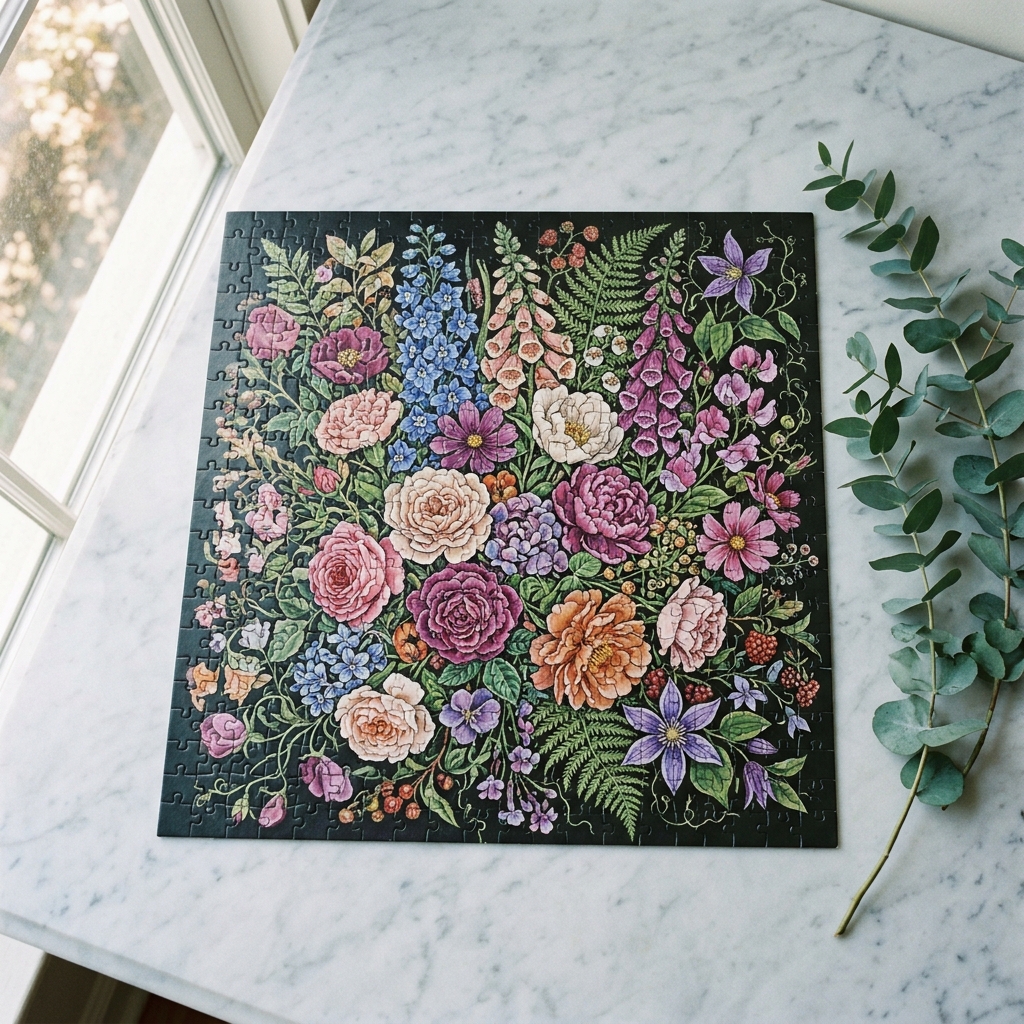
On t-shirts, florals are a crowded trap. On puzzles they are a winner, because a dense, beautiful botanical is exactly the kind of image people want to slowly assemble. The move is richness and structure: a full arrangement, pressed-flower layouts, a vintage botanical plate feel, not a few sparse stems.
A lush, densely-packed botanical illustration designed to fill a rectangular jigsaw puzzle: A FLORAL OR PLANT THEME OF YOUR CHOICE (for example a cottage-garden bouquet, a pressed-wildflower arrangement, a vintage botanical study of ferns and herbs) rendered in a detailed illustrated style with many overlapping blooms and leaves. Rich harmonious palette, elegant composition, full-bleed edge-to-edge, no border. Just the finished artwork, no puzzle pieces, no cut lines, no box, no mockup.
4. Fine-art and gallery puzzles (a top-pulling illustration lane)
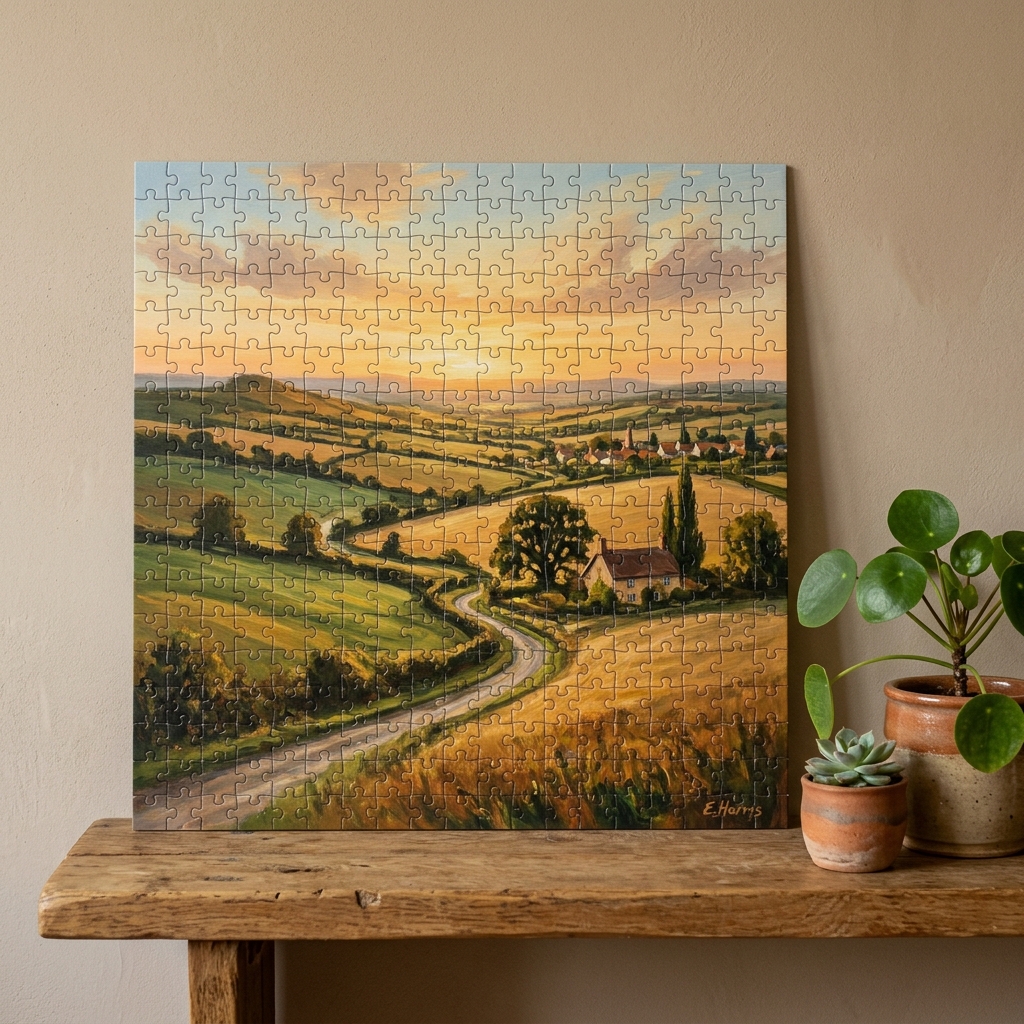
Puzzles are one of the few products where “looks like a painting” is a selling point, not a cliche. A painterly landscape, an abstract in confident color, a moody seascape gives the buyer a piece of art they assemble and sometimes frame. Just keep it your own work or a clearly original composition, never a copyrighted painting.
An original painterly artwork designed to fill a rectangular jigsaw puzzle: A PAINTING SUBJECT OF YOUR CHOICE (for example a rolling countryside at golden hour, an abstract composition in bold blocks of color, a moody coastal seascape) in a rich fine-art style with visible brushwork and depth. Gallery-worthy palette, balanced composition, full-bleed edge-to-edge, no border. Original artwork only, not based on any existing painting. Just the finished artwork, no puzzle pieces, no cut lines, no box, no mockup.
5. Kids’ illustrated puzzles (5.2% average, over-indexing 1.9x)
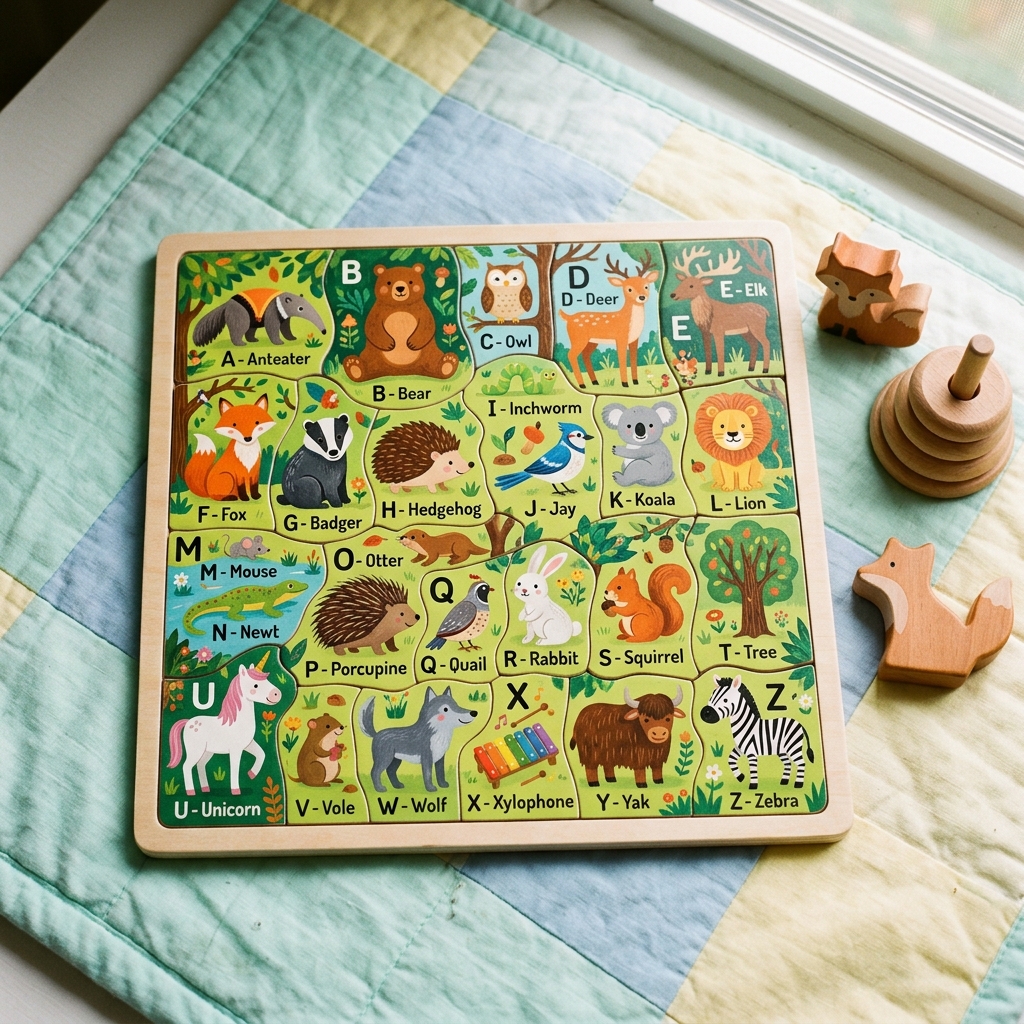
A dependable, gift-heavy lane that over-indexes on saves. Bright, friendly, and genuinely charming beats generic clip-art. A woodland-animals alphabet, a busy farm scene, an under-the-sea world: cheerful, chunky shapes and a clear focal point that reads for little eyes.
A bright, friendly children’s illustration designed to fill a rectangular jigsaw puzzle: A PLAYFUL KIDS’ THEME OF YOUR CHOICE (for example a woodland-animals alphabet, a busy farmyard, an under-the-sea scene) drawn in a cheerful modern style with bold rounded shapes and a clear focal point. Cheerful primary-friendly palette, simple joyful composition, full-bleed edge-to-edge. Just the finished artwork, no puzzle pieces, no cut lines, no box, no mockup.
One bonus lane: novelty and puzzle-lover designs
Not a core type, but worth flagging. Game and novelty puzzles (4.0% average) pull fine when the mechanic is genuinely fun, and there is a small, high-pulling pocket of “puzzle-lover” merch, in-group humor for people who love jigsaws. Be careful reading its numbers: a lot of those top hits are actually t-shirts and mugs the search pulled in, not puzzles. Treat it as a light-hearted side lane with the same two rules, not a main strategy.
After you generate any of these, shrink the image to about 300 pixels wide and see if it still reads as a clear, appealing picture. If it turns to mud, simplify: stronger focal point, cleaner palette, more breathing room. That thumbnail test is the difference between a puzzle that pulls in search and one buyers scroll past.
💡 Pro tip — give buyers something to hunt for. A puzzle rewards busy: the more small, charming details you pack into the scene, the longer the buyer gets to enjoy assembling it, and the more reason they have to save it. A sparse, minimalist image that would look great on a t-shirt often falls flat spread across 1,000 pieces.
The two traps that look busy but rarely sell
Two kinds of puzzle flood these searches. Because there are so many of them, they look like proof of demand. The favorite ratio says otherwise, louder here than on any other product I have studied.
Custom photo jigsaws. These are 41% of all listings I studied, the single biggest block on the shelf, and only about one in eight of the winners. Their average favorite ratio is 3.0%, at the very bottom of the ranking. The problem is baked in: when the design is the buyer’s own photo, you are not competing on creativity, you are competing on price, turnaround, and reviews. That is a fight a new shop rarely wins. It is the “upload your photo here” red ocean.
Wooden personalized-name puzzles. The chunky “NICK” and family-name wood pieces are another fifth of the shelf, and they under-index too, averaging 3.7%. Same trap in a different material: the value is the name, not the design, so buyers sort by cheapest and fastest, and a fresh listing just gets buried. Note the one exception: a wooden puzzle that is genuinely a beautiful illustrated design, not just a name, behaves like an art puzzle and does fine. The wood is the format, the art is the hook.
💡 Pro tip — sell the art, not the name. If you love the wooden-puzzle format, win with it the same way the art lane wins: a genuinely beautiful illustrated design cut into wood behaves like an art puzzle. The moment the name is the whole point, you are back in the price-and-turnaround fight a new shop rarely wins.
None of this means these puzzles are bad. They are crowded. Supply is enormous and it is hard to stand out, so the next new listing gets ignored. Enter these lanes only with a genuinely different angle, and spend most of your energy in the under-supplied, high-pull illustrated lanes instead.
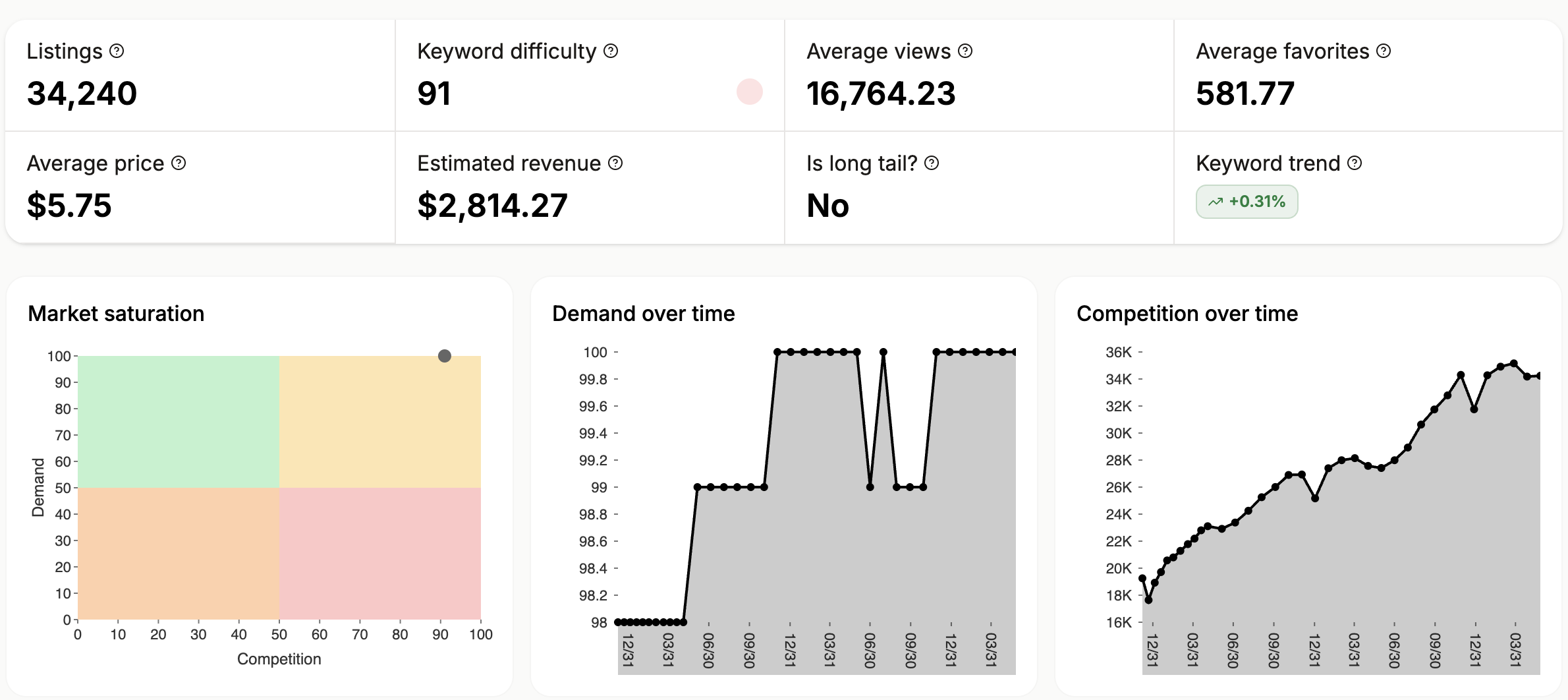
Want to see how crowded a design angle is before you commit to it? That is what the free Keyword Explorer shows you: demand against competition for any phrase, so you can aim at a pocket that is not already a red ocean.
Your yardstick: is your design a winner?
Numbers are only useful if you can hold your own work up against them. So here is the scale for a puzzle that already ranks on Etsy.
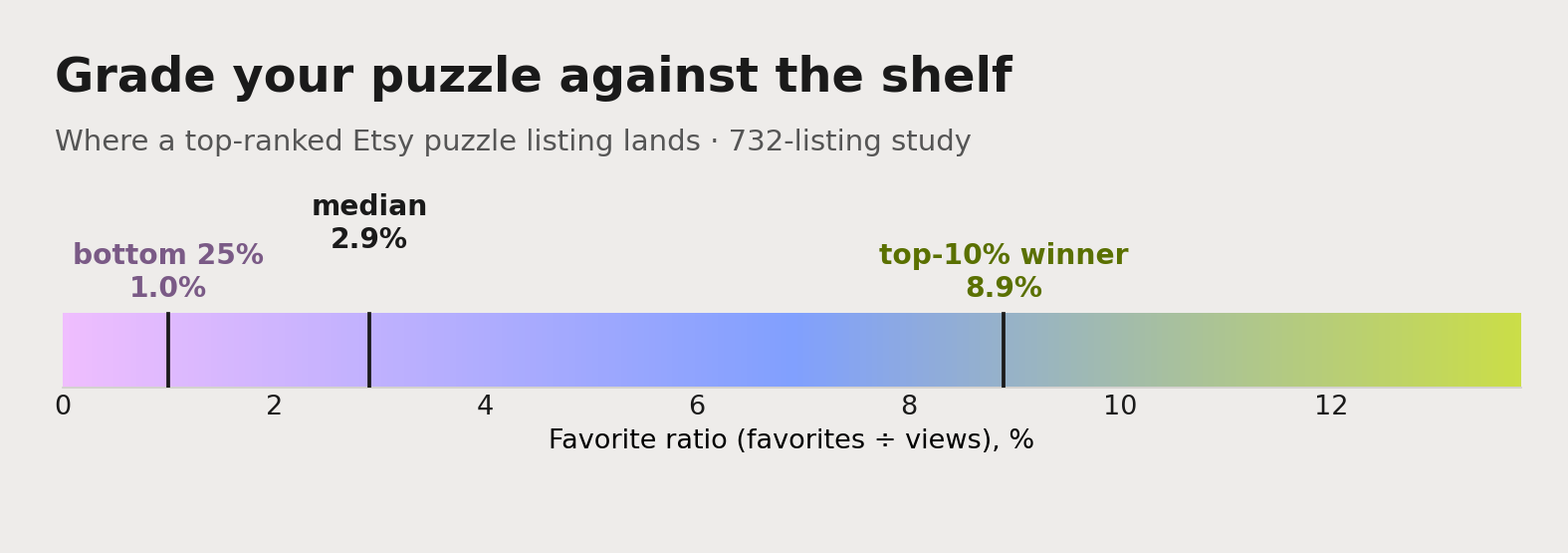
- Under 1%: the bottom quarter. People are seeing it and scrolling past. Rethink the design.
- Around 2.9%: dead average. Fine, not a winner.
- 5 to 8%: the strong tier. A design that genuinely pulls.
- 8.9% and up: the top 10%. A genuine winner.
If you sell on Etsy, you can run this check on your own listings tonight. Open a listing’s stats, divide favorites by views, and see where it lands. A puzzle sitting under 3% is telling you something, and it is usually the design, not the traffic. Note that the whole puzzle shelf runs lower than apparel: a 6% puzzle is a strong performer, where a 6% t-shirt is only average. Grade against the puzzle bar, not the t-shirt one.
💡 Pro tip — grade one listing tonight. Open a live puzzle listing, divide its favorites by its views, and drop the number on the scale above. Under 3% and the design is usually the problem, not the traffic, and remember to grade against the 2.9% puzzle median, never the higher apparel bar.
Two rules a design has to survive first
Before a design can sell, it has to stay up. Two Etsy rules quietly end more print-on-demand shops than any trend miss.
It has to be your own. Etsy’s Creativity Standards require that items made with production tools, which is all print-on-demand, are based on your own original design. Buying a trending illustration and dropping it on a puzzle unchanged fails that test, and it is a common reason listings get deactivated. Our guide to Etsy’s rules for print-on-demand sellers walks through what “original” actually means in practice.
It cannot borrow someone else’s art. Puzzles make this trap especially easy to fall into, because a famous painting or a beloved character looks perfect on 1,000 pieces. Reproducing a copyrighted painting, a logo, a character, or a map with protected marks is the fastest route to a takedown and a shop at risk. The safe move is your own original artwork, not someone else’s. If copycats are a worry the other direction too, there is a hidden setting that helps protect your shop from copycats.
Neither rule blocks you from selling a cottage-garden puzzle or a cozy-village scene. Plenty of shops do. They block you from selling the exact one someone else already made, or a painting you do not own the rights to. Original beats borrowed, and it is also the only version that lasts.
The mockup myth: it matters less than you think
Now the part that will save you hours of second-guessing.
Sellers agonize over the listing photo. Should the puzzle be fully assembled, half-done, still in the box? I checked, across all 732 listings. The mockup does move the needle a little on puzzles, but not in the direction people fret about, and never as much as the design.
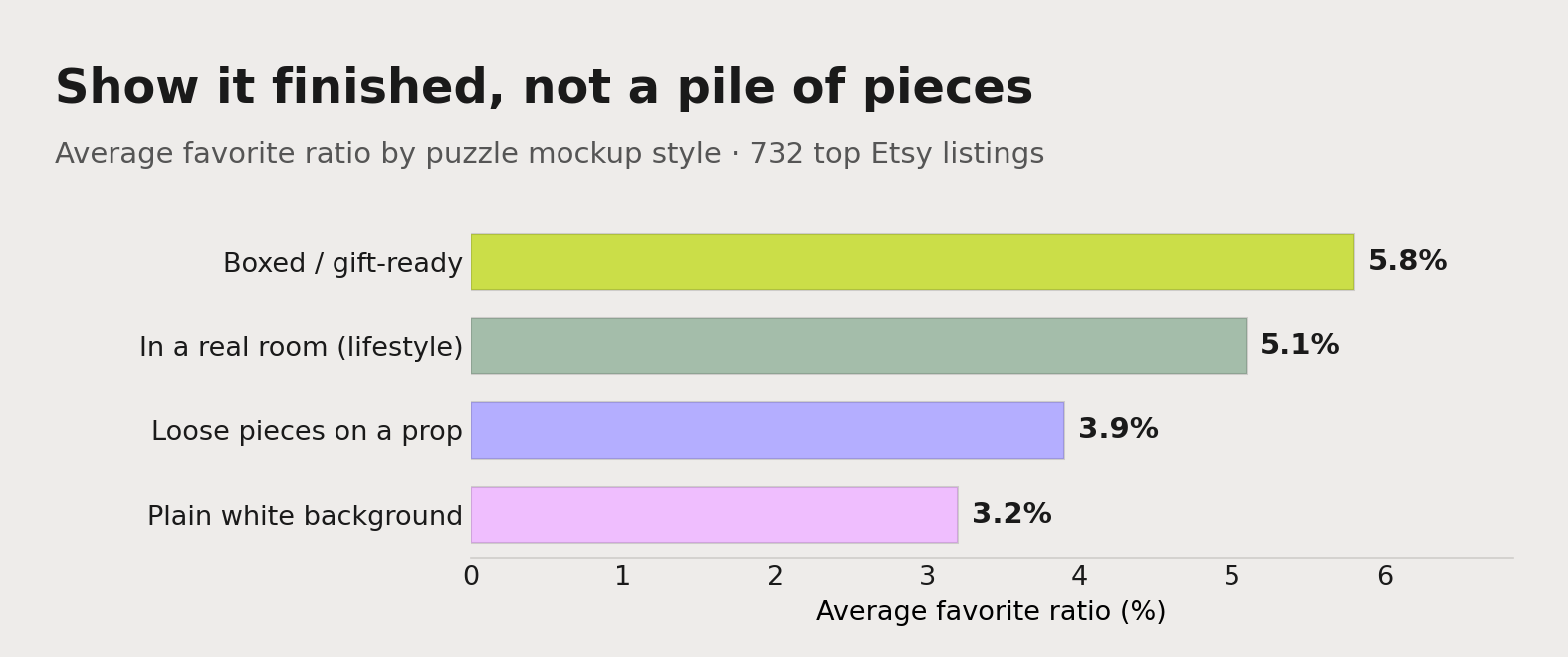
The crowded default, a pile of loose pieces styled with a few props, is 56% of the shelf and pulls the lowest at 3.9%. A plain white background is worse (3.2%). What pulls best is showing the puzzle as a finished thing someone would want: a boxed, gift-ready shot (5.8%) or a lifestyle photo of the completed puzzle in a real room (5.1%).
Read that carefully, though, because most of the gap is really the design talking. Illustrated art puzzles are the ones that get the beautiful boxed and lifestyle treatment; photo and name puzzles get the loose-pieces shot.
So the honest guidance is not “the boxed photo makes a bad puzzle sell.” It is: lead with a shot that shows the finished picture as something desirable, not a heap of pieces on white, and then let a genuinely good design carry the rest.
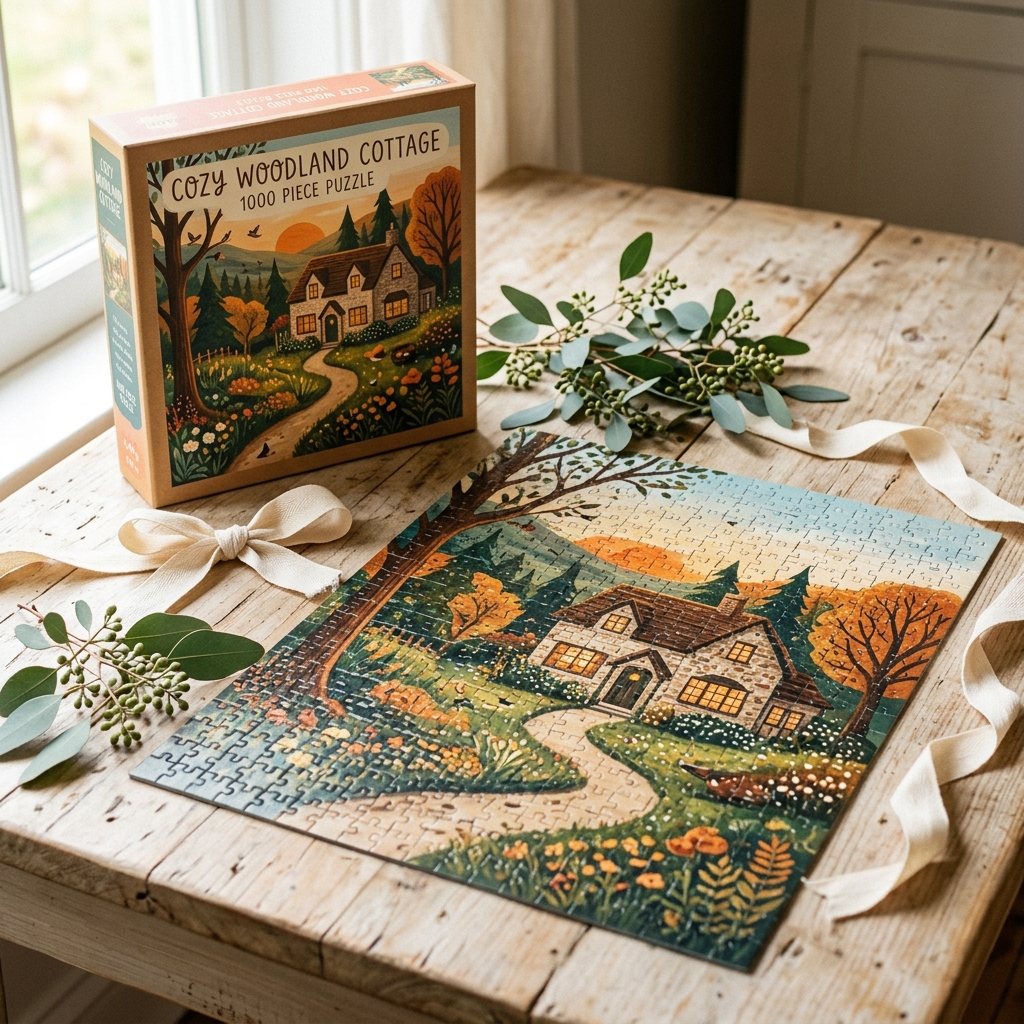
💡 Pro tip — lead with the finished picture. Make your thumbnail the assembled puzzle shown as something desirable, boxed and gift-ready, or styled in a real room, not a heap of loose pieces on white. It is the cheapest lever in this whole post, and almost nobody bothers.
A few things that still do move puzzle listings, none of which is worth agonizing over:
- Do not ship the bare printer stock mockup. Everyone uses them, so your listing blends into a wall of identical grids of pieces. A realistic finished-puzzle or boxed mockup is worth the small effort. Here is what we learned about better listing images with mockups.
- Use most of your ten image slots, in an order. A finished-puzzle hero for the thumbnail, then a close-up of the artwork detail, a size and piece-count reference, the box, an in-a-room lifestyle shot, then a “what you get” graphic. The full sequence is in our guide to listing image types that drive sales.
- Show the real piece count and finished size. Puzzle buyers care a lot about whether it is 500 or 1,000 pieces and how big it ends up. Say it clearly in an image, or you get returns and unhappy reviews.
- Add a simple video. A ten-second pan across the finished artwork gets impression priority without any on-camera work.
- Disclose it. When an image is a mockup or AI-assisted, say so, both for Etsy’s standards and for buyer trust. Here is how and why to disclose mockups and AI images.
Free download: the Etsy SEO Checklist
A winning design still has to be found. This one-page checklist walks the titles, tags, and attributes that get a puzzle ranking, so the design you just made actually gets seen.
Grab the free Etsy SEO Checklist →
New shops break in every week
If all of this feels like the top of Etsy’s puzzle results is locked up by big, ad-heavy shops, the data says there is still a door, it is just narrower here than on apparel.
I flagged a listing as “rising” when it was young, pulling a high favorite ratio, from a small or mid-size shop. Those rising listings were about 5% of the whole top set, and they averaged roughly a 14% favorite ratio, nearly five times the overall median. New designs that genuinely pull do get surfaced.
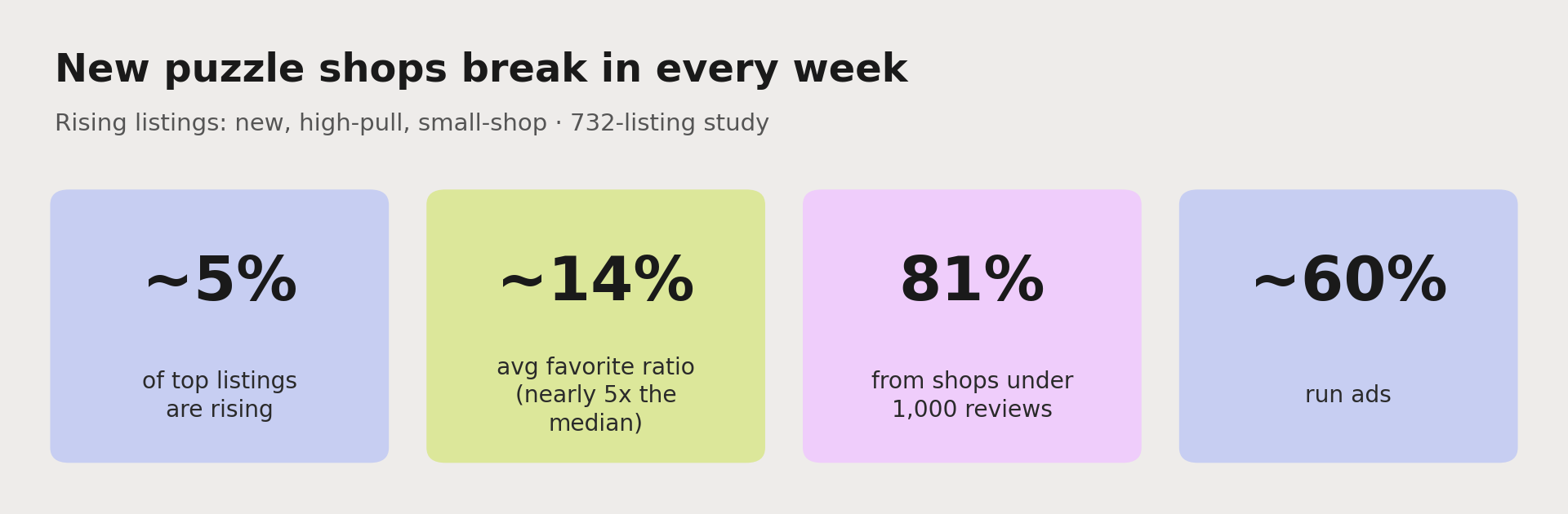
Be honest with yourself about the two catches. Rising is rarer on puzzles than on t-shirts, and about 60% of those rising listings are running ads, against 66% of the shelf overall. This is a more pay-to-play market. But the upside is real: 81% of the rising winners come from shops with under 1,000 reviews. A small shop with a genuinely beautiful design can still break in.
And the rising designs win with the exact same playbook: an illustrated scene, an animal, a botanical, a painting. Not another photo upload, not another name in wood. A fresh, beautiful picture from a small shop is breaking into these searches every single week.
That could be your shop. The design is the lever, and it is a lever you fully control.
Every puzzle niche plays differently
Here is where the deeper research pays off. “Puzzles” is not one market. Each search term is its own little world, with its own winning mix, its own competition, and its own opening for a new shop. I broke all four down, re-ranking each term’s top listings on its own.
| Search term | Listings | Median favorite ratio | Winner line (top 10%) | What dominates | Rising | Ads |
|---|---|---|---|---|---|---|
| puzzle | 292 | 4.1% | 10.5% | Illustrated art and fine-art scenes (plus puzzle-lover apparel and novelty noise) | 5% | 71% |
| custom puzzle | 280 | 2.4% | 5.4% | Custom photos and wooden name boards | 1% | 63% |
| photo puzzle | 280 | 2.3% | 6.5% | Custom photo uploads | 1% | 79% |
| personalized puzzle | 273 | 2.3% | 5.0% | Wooden name boards and photos | 0% | 62% |
A few reads that change how you would approach each:
- The generic “puzzle” search is the one you want. It has by far the highest median (4.1%) and the highest winner line (10.5%), and its top results are dominated by illustrated art and fine-art scenes, exactly the lane the whole study points to. This is where a beautiful original design competes on design, not on price. Almost all of the room in the puzzle market lives here.
- The three personalization searches are the red ocean, made visible. “Custom,” “photo,” and “personalized” puzzles all sit at a 2.3 to 2.4% median with a winner line around 5%, roughly half the ceiling of the generic search. A buyer typing these words wants their own photo or name, so you are competing on price, turnaround, and reviews, and a new shop almost never wins that. Rising new shops are near zero in all three (0 to 1%).
- “Photo puzzle” is the most pay-to-play of all. 79% of its listings run ads, the highest of any term. If you were tempted to chase the photo-jigsaw keyword, that number is the tell: it is bought, not earned.
- The cross-niche rule. The one search that rewards design is the plain one, and the three that promise personalization are the trap. Bring an original illustrated design to the “puzzle” search, and you are playing the one hand with real upside.
Where to start this week
If you came in believing personalization was the whole puzzle game, I hope this traded that belief for a map. You do not need a customer’s photo to compete. You need one picture strangers would be happy to spend two hours assembling, then a check of whether people actually save it.
Here is the whole post as five steps:
- Pick an open lane: an illustrated scene, an animal, a botanical, a painting, a kids’ design. Skip the photo-upload and name-in-wood red oceans.
- Make it a picture worth staring at: rich detail, a clear focal point, a harmonious palette.
- Keep it readable as a thumbnail: it should still look like an appealing picture at 300 pixels wide.
- Show it finished and in context. Lead with a boxed or in-a-room shot, never a pile of loose pieces on white.
- List it, then read its favorite ratio. Under 3% and buyers are scrolling past. Above 8.9% and you have a winner.
Most sellers never get to that last step. They upload a photo, cross their fingers, and move on. But that number is the whole game. Make something, check its favorite ratio a couple of weeks later, keep the ones that pull, and let the rest go. Do that enough times and the guessing quietly stops. One day you might even be the shop someone else is pulling apart in a post like this one.
Keep reading on Listadum. New to print-on-demand? Start with selling on Etsy without inventory. Want the design-first playbook for another product? See what t-shirt designs actually sell on Etsy.
Frequently asked questions
What kind of puzzle designs sell best on Etsy?
Illustrated art. In my study of 732 top listings, art and illustration puzzles pulled a 7.1% average favorite ratio and took about a quarter of the winners despite being a small share of supply. Animals (6.0%), florals and botanicals (5.5%), and kids’ designs (5.2%) also pulled well above the 2.9% median. Custom photo jigsaws (3.0%) and wooden personalized-name puzzles (3.7%) pulled the least, despite being the two biggest blocks on the shelf.
Why don’t personalized photo puzzles sell as well?
They are the most crowded thing on the shelf, at 41% of all listings, and they compete on price, turnaround, and reviews rather than on design. That is a fight a new shop rarely wins. A stranger has no reason to save a puzzle of someone else’s photo, so the favorite ratio stays low even though people do buy them.
Are print-on-demand puzzles still worth selling on Etsy in 2026?
Yes, but the design is the differentiator, not the personalization, and it is a heavily advertised market, so budget for that. A beautiful original illustration for a clearly defined buyer is what separates a winner from the pile. The median puzzle sells around $19.95, a solid gift price point.
Does it matter whether I show the puzzle assembled, in the box, or in pieces?
A little. Boxed, gift-ready shots (5.8% average favorite ratio) and in-a-room lifestyle shots (5.1%) pull better than the default pile of loose pieces on a prop (3.9%) or a plain white background (3.2%). But most of that gap is really the design: lead with a shot that shows the finished picture as something desirable, and let a strong design do the rest.
How do I know if my puzzle design is any good before I go all in?
Once it is live, check its favorite ratio: favorites divided by views. Under about 3% means buyers are scrolling past. Above 8.9% puts you in the top 10% of puzzle listings that already rank. The puzzle bar sits lower than apparel, so grade against other puzzles, not t-shirts.
Can I put a famous painting or character on a puzzle?
No. Reproducing a copyrighted painting, a character, a logo, or a protected map is a takedown and trademark risk. Etsy’s Creativity Standards require print-on-demand items to be based on your own original work. Make your own original artwork in that style instead.
Stop guessing which of your designs is pulling and which is dead weight.
Listadum reads every listing in your shop and flags the ones losing you sales: weak images, no video, thin titles, low engagement. You get a clear, prioritized list of what to fix first, in plain English.
Free plan · no credit card · connect your real Etsy shop in minutes
About the author
Neha Chandelier, Co-founder of Listadum, selling on Etsy since 2020. She writes about Etsy tips and tricks, how to sell on Etsy, and growing a handmade shop.
Last updated August 12, 2026.
Sources: Listadum Keyword Explorer (demand data, pulled July 2026); Listadum study of 732 top-ranked Etsy puzzle listings ranked by favorite ratio; Etsy Creativity Standards.